Instruction to Jury that Intent is not an Essential Element of Conversion
What is this form?
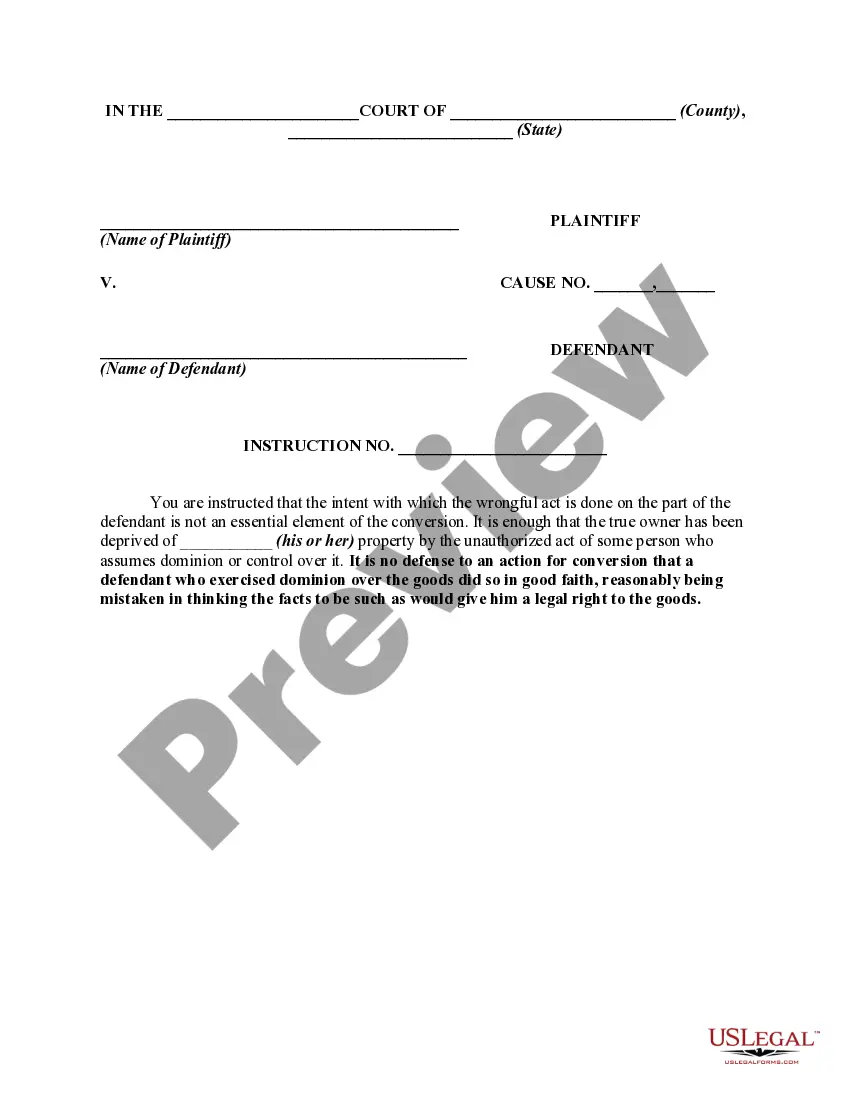
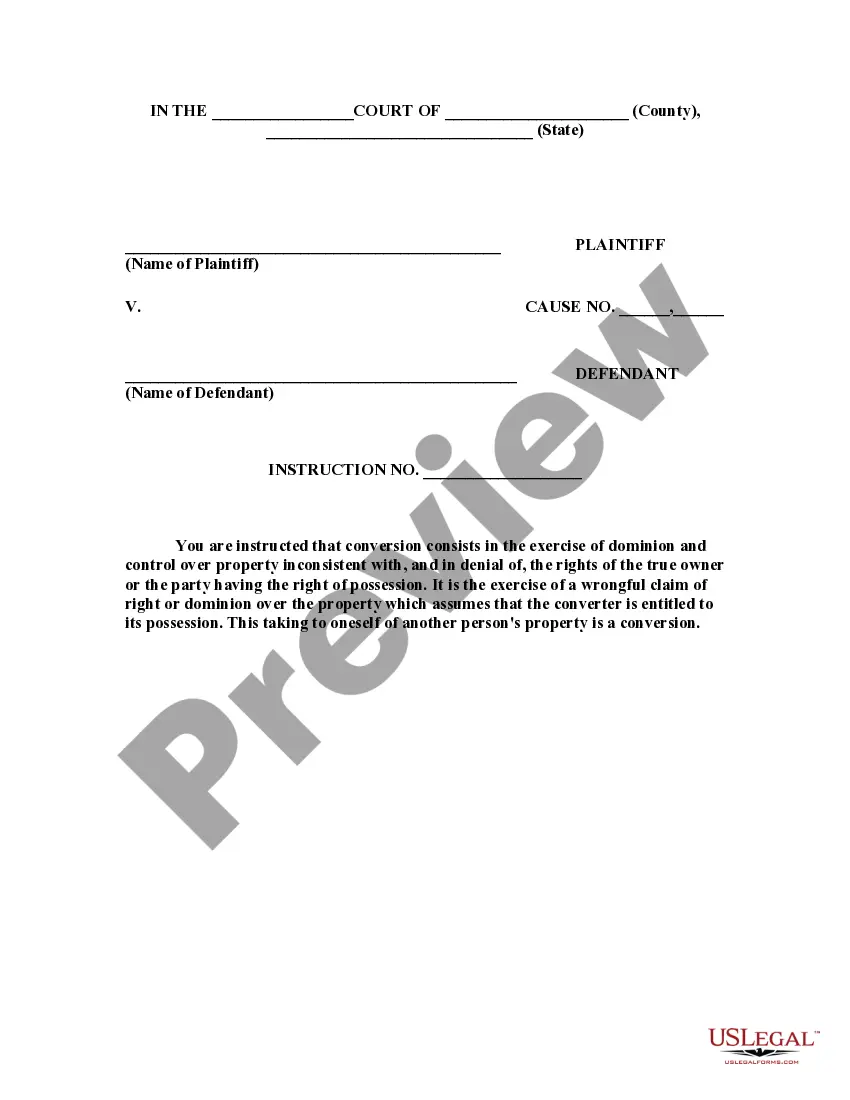
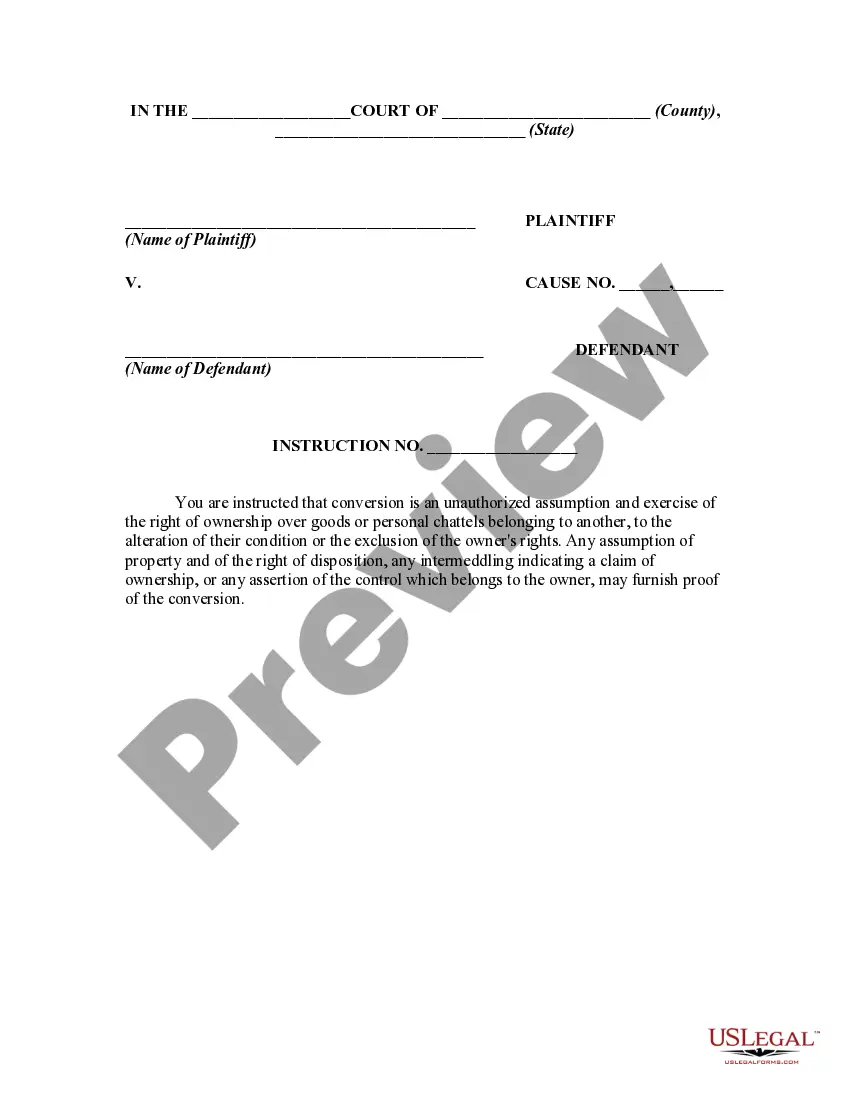
This form is known as the Instruction to Jury that Intent is not an Essential Element of Conversion. It serves as a clear guideline for jurors regarding the legal interpretation of conversion, specifically indicating that the intent of the defendant is not necessary for the plaintiff to prove their case. This form helps clarify critical legal concepts in a conversion case, aiding in preventing misunderstandings that might arise during jury deliberations.
Form components explained
- Case title and parties involved: Identifies the plaintiff and defendant in the case.
- Instruction number: A reference for specific jury instructions pertinent to the case.
- Clarification on the intent: States that the defendant's intent is not essential for proving conversion.
- Deprivation of property: Specifies that the focus is on the unauthorized act and the deprivation of property from the true owner.
- Good faith defense rejection: Clarifies that good faith or a reasonable mistake does not excuse the act of conversion.
When to use this form
This form is used in legal proceedings when a jury is tasked with determining a case of conversion. It helps jurors understand that they do not need to consider the intent behind the defendant's actions, which can be crucial in cases where the defendant may have acted under a mistaken belief about their rights to the property. This instruction is typically provided after all evidence has been presented and prior to jury deliberations.
Who this form is for
This form is intended for use by:
- Judges in jury trials involving cases of conversion.
- Legal professionals preparing jury instructions for conversion claims.
- Parties involved in litigation related to property disputes where conversion is at issue.
Completing this form step by step
- Identify the parties involved by entering the names of the plaintiff and defendant.
- Assign an instruction number for reference in the judicial documents.
- Clearly state the property at issue, indicating what the true owner has been deprived of.
- Ensure the language reflects that intent is not an essential element in the instruction provided to the jury.
- Review for clarity and legal compliance before including it in the jury instructions.
Does this document require notarization?
Notarization is not commonly needed for this form. However, certain documents or local rules may make it necessary. Our notarization service, powered by Notarize, allows you to finalize it securely online anytime, day or night.
Get your form ready online
Our built-in tools help you complete, sign, share, and store your documents in one place.
Make edits, fill in missing information, and update formatting in US Legal Forms—just like you would in MS Word.
Download a copy, print it, send it by email, or mail it via USPS—whatever works best for your next step.
Sign and collect signatures with our SignNow integration. Send to multiple recipients, set reminders, and more. Go Premium to unlock E-Sign.
If this form requires notarization, complete it online through a secure video call—no need to meet a notary in person or wait for an appointment.
We protect your documents and personal data by following strict security and privacy standards.

Make edits, fill in missing information, and update formatting in US Legal Forms—just like you would in MS Word.

Download a copy, print it, send it by email, or mail it via USPS—whatever works best for your next step.

Sign and collect signatures with our SignNow integration. Send to multiple recipients, set reminders, and more. Go Premium to unlock E-Sign.

If this form requires notarization, complete it online through a secure video call—no need to meet a notary in person or wait for an appointment.

We protect your documents and personal data by following strict security and privacy standards.
Avoid these common issues
- Failing to specify the property involved in the conversion case.
- Not clarifying the rejection of intent as an element in jury deliberations.
- Using complex legal language instead of plain language that jurors can easily understand.
Benefits of completing this form online
- Convenient access to professionally drafted legal forms anytime, anywhere.
- Editable templates allow for customization to fit specific case needs.
- Ensures compliance with legal standards set by licensed attorneys.
Looking for another form?
Form popularity
FAQ
A jury instruction is given by the judge to the jury to explain what is happening in the court, to explain the points of law relevant to the case, to explain certain aspects of the evidence presented and to assist the jurors in understanding their duties in reaching a verdict.
Wrongful conversion is to protect you against loss following the purchase of a vehicle from someone who is not the true owner. Personal Accident and Assault. Personal Accident and Assault covers bodily injury to you or your employees as a result of an accident caused by theft or attempted theft.
By tortuous taking; by any use or appropriation of the use of the person in possession, indicating a claim of right in opposition to rights of the owner; or. refusal to give up possession to the owner on demand.
Conversion in California is a civil cause of action that applies when a person unlawfully and without permission, took or interfered with someone else's possession of their property. The victim can bring a claim for recovery of the property, or compensation for the value of the lost property.
Conversion is a tort that exposes you to liability for damages in a civil lawsuit. It applies when someone intentionally interferes with personal property belonging to another person.
Jury Instructions. instructions that are given by the trial judge that specifically state what the defendant can be found guilty of and what the prosecution or plaintiff has to prove in order for a guilty verdict.
Jury instructions, directions to the jury, or judge's charge are legal rules that jurors should follow when deciding a case.
Jury Instructions For your research purposes, using either one is fine. Remember that jury instructions are designed to accurately reflect the law but are not the law itself.
Jury instructions are important for several reasons. The primary reason is they lay out the applicable law for jurors to follow. Without jury instructions, the jury would not know the elements of a DUI or Robbery charge.That is why jury instructions are typed and printed and placed in the court file.