Individual Personal Care Service Agreement - Caregiver for Elderly or Disabled - Consent
Overview of this form
The Individual Personal Care Service Agreement - Caregiver for Elderly or Disabled - Consent is a legal document that establishes the relationship between a client and an independent caregiver. This form outlines the terms of the caregiver's services, ensuring that the client can maintain control over their home environment while receiving assistance with daily tasks. Unlike other caregiving agreements, this form includes specific provisions regarding the caregiver's independence and limitations on liability for certain types of negligence.
Key components of this form
- Identification of the client and caregiver, including their addresses.
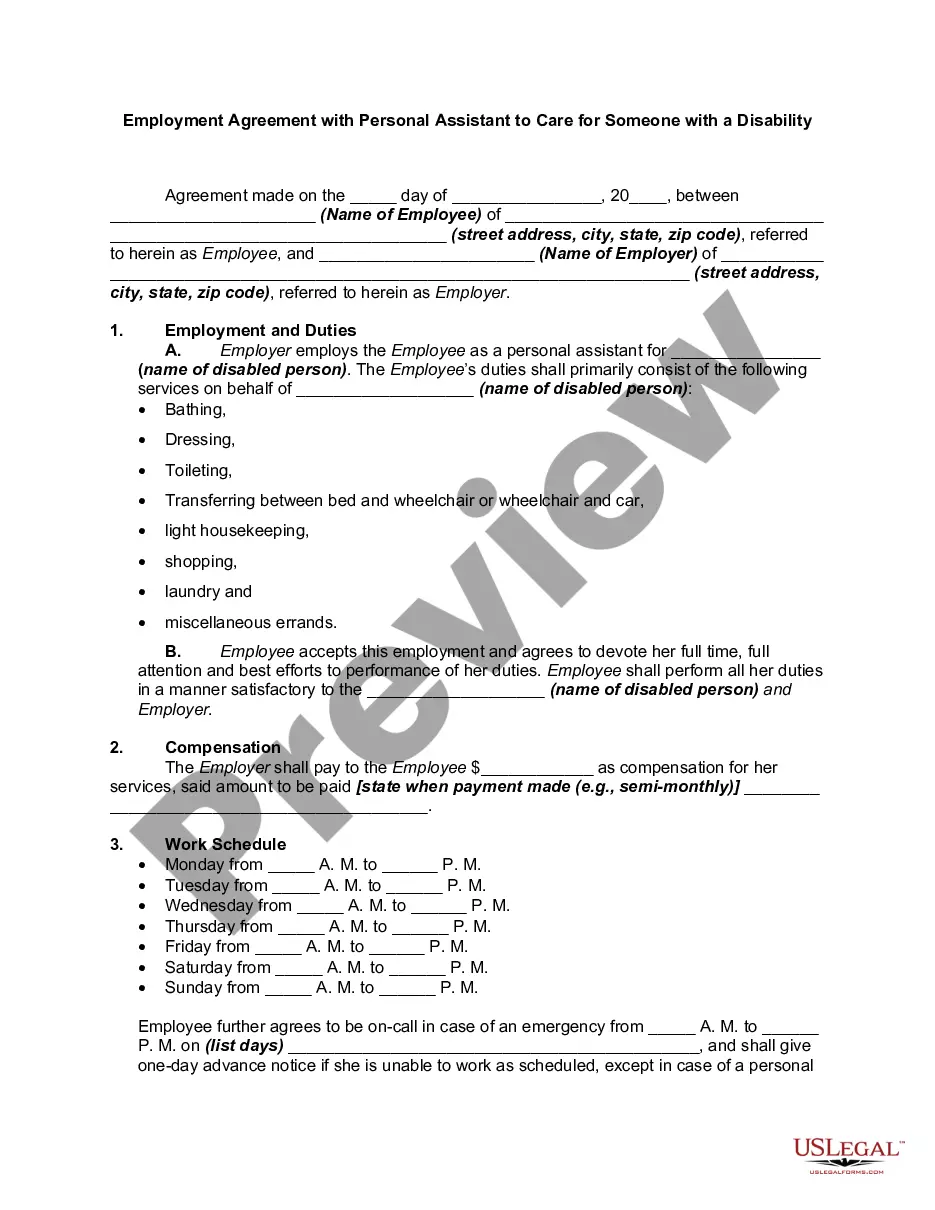
- Details on the caregiver's duties, such as assistance with daily living activities and medication scheduling.
- Terms of employment, including scheduling and compensation arrangements.
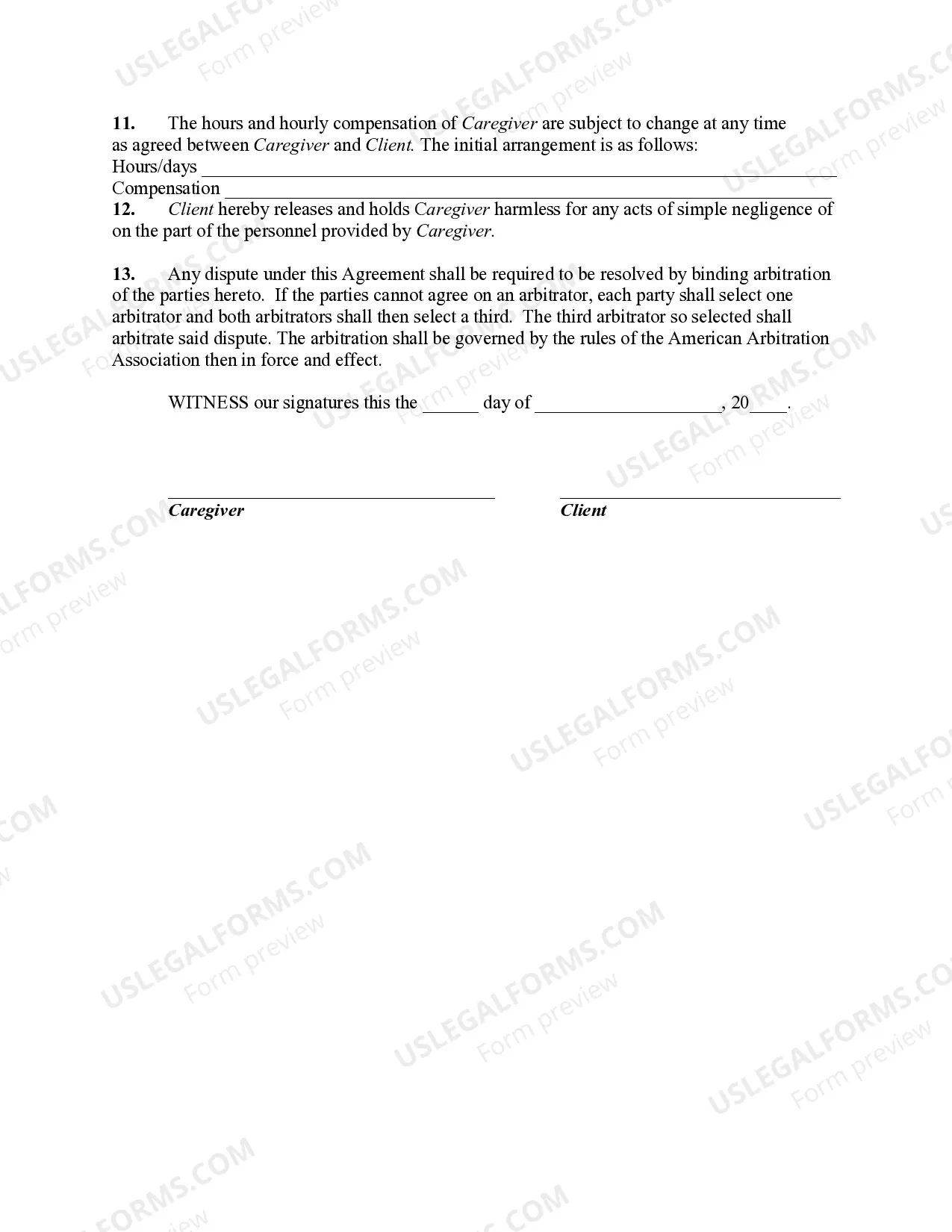
- Provisions for termination and dispute resolution through arbitration.
- A waiver of damages for simple negligence by the caregiver.





When this form is needed
This form should be used when an elderly or disabled individual requires personal care services from an independent caregiver. It is particularly useful when establishing clear expectations and responsibilities regarding care, ensuring both parties are protected and understand their rights and obligations.
Who needs this form
- Elderly individuals or disabled persons seeking assistance to live at home.
- Caregivers or personal care providers operating as independent contractors.
- Family members or guardians coordinating care for a loved one.
How to prepare this document
- Identify and enter the names and addresses of the client and caregiver.
- Specify the services the caregiver will provide, including daily living assistance and scheduling.
- Agree on a work schedule and compensation, recording it in the designated fields.
- Review the terms of waiver and liability, ensuring both parties understand the implications.
- Sign and date the agreement, ensuring both parties retain copies.
Notarization requirements for this form
This form does not typically require notarization unless specified by local law. However, consulting a legal professional is recommended to ensure compliance with state regulations.
Get your form ready online
Our built-in tools help you complete, sign, share, and store your documents in one place.
Make edits, fill in missing information, and update formatting in US Legal Forms—just like you would in MS Word.
Download a copy, print it, send it by email, or mail it via USPS—whatever works best for your next step.
Sign and collect signatures with our SignNow integration. Send to multiple recipients, set reminders, and more. Go Premium to unlock E-Sign.
If this form requires notarization, complete it online through a secure video call—no need to meet a notary in person or wait for an appointment.
We protect your documents and personal data by following strict security and privacy standards.

Make edits, fill in missing information, and update formatting in US Legal Forms—just like you would in MS Word.

Download a copy, print it, send it by email, or mail it via USPS—whatever works best for your next step.

Sign and collect signatures with our SignNow integration. Send to multiple recipients, set reminders, and more. Go Premium to unlock E-Sign.

If this form requires notarization, complete it online through a secure video call—no need to meet a notary in person or wait for an appointment.

We protect your documents and personal data by following strict security and privacy standards.
Avoid these common issues
- Failing to specify the services to be provided, leading to misunderstandings later.
- Not including the agreed-upon schedule and compensation terms.
- Overlooking the importance of the waiver clauses and their implications.
Benefits of completing this form online
- Quick access to a professionally drafted template.
- Editability allows for customization to fit specific needs.
- Secure and reliable storage of documents for easy retrieval.
Legal use & context
- This agreement establishes a formal contract between the caregiver and client, outlining duties and protections.
- Waivers for negligence may limit recoverable damages, thus understanding the liabilities is essential.
- Arbitration for disputes emphasizes the importance of resolving conflicts outside of court.
Looking for another form?
Form popularity
FAQ
Under JACC, family members can be paid to provide caregiving services for their loved ones. JACC offers program participants the option to choose their own service providers for several approved services.
The agreement is a contract typically between a family member who agrees to provide caregiver services for a disabled or aging relative and the person receiving care.Drawing up an agreement clarifies for a family what tasks are expected in return for a stated compensation.
The Aid and Attendance Pension benefit is another program available in Texas that can be used to pay family members to provide care. At the forefront, it should be mentioned that this program is only relevant for war-time veterans or their surviving spouses who require assistance with their activities of daily living.
Commonly, it is an adult child who is paid via Medicaid to provide care, but some states, such as Alabama, Arizona, California, Colorado, Delaware, Florida, Hawaii, Kentucky, Minnesota, Montana, New Hampshire, New Jersey, North Dakota, Oklahoma, Oregon, and Wisconsin, even provide funds for spouses to be paid
The first and most common Medicaid option is Medicaid Waivers.With this option, the care recipient can choose to receive care from a family member, such as an adult child, and Medicaid will compensate the adult child for providing care for the elderly parent.
Does Medicare Pay for Caregivers? Your Guide to At-Home Healthcare. Medicare typically doesn't pay for in-home caregivers for personal care or housekeeping if that's the only care you need. Medicare may pay for short-term caregivers if you also need medical care to recover from surgery, an illness, or an injury.
Retirement social security will not pay a caregiver directly. However, depending on your earnings amount through your working lifetime, and when you decide to take your social security income, you may make enough to pay for a caregiver.
The most common program that pays loved ones for caregiving is a Medicaid option program known as Medicaid Waivers. These Waivers are also referred to Home and Community Based Services (HCBS) Waivers, 1915(c) Waivers, or even Section 1115 Waivers.