Complaint to Contest Will
Overview of this form
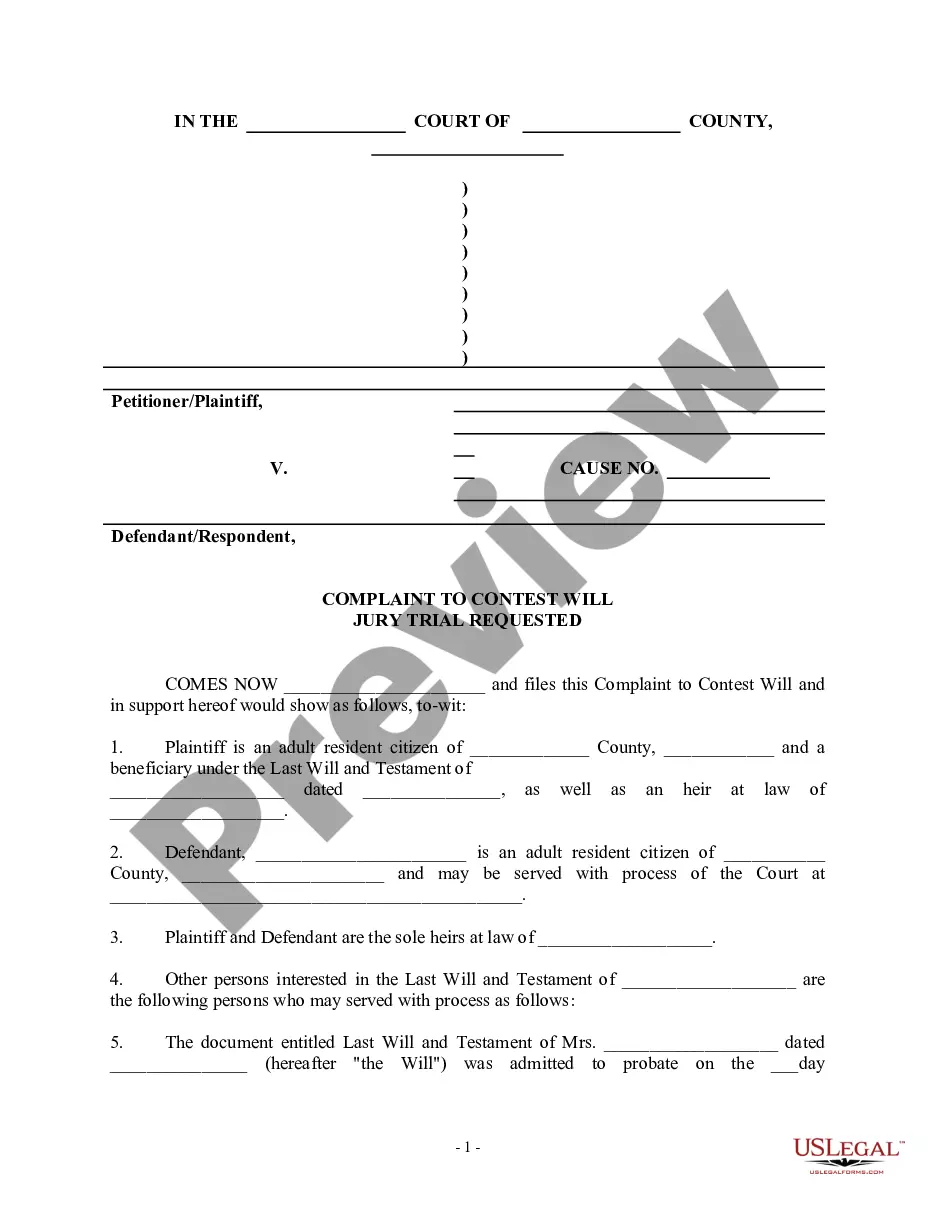
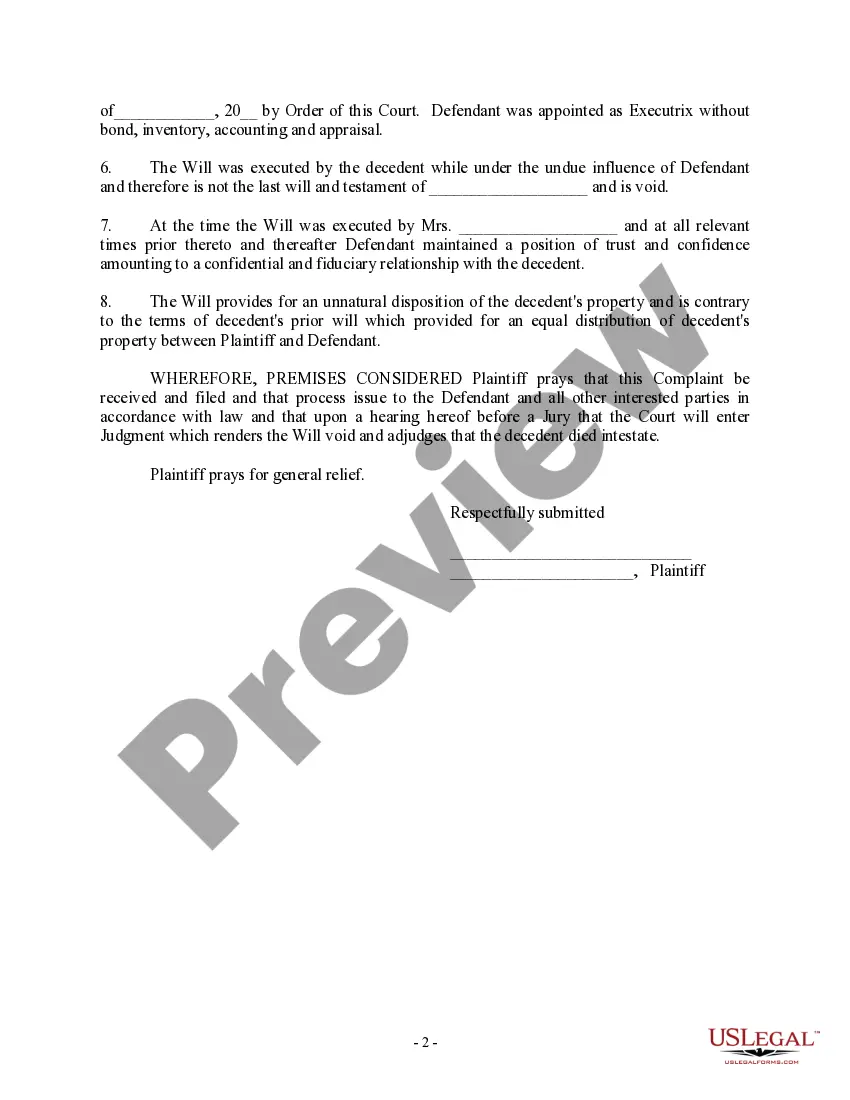
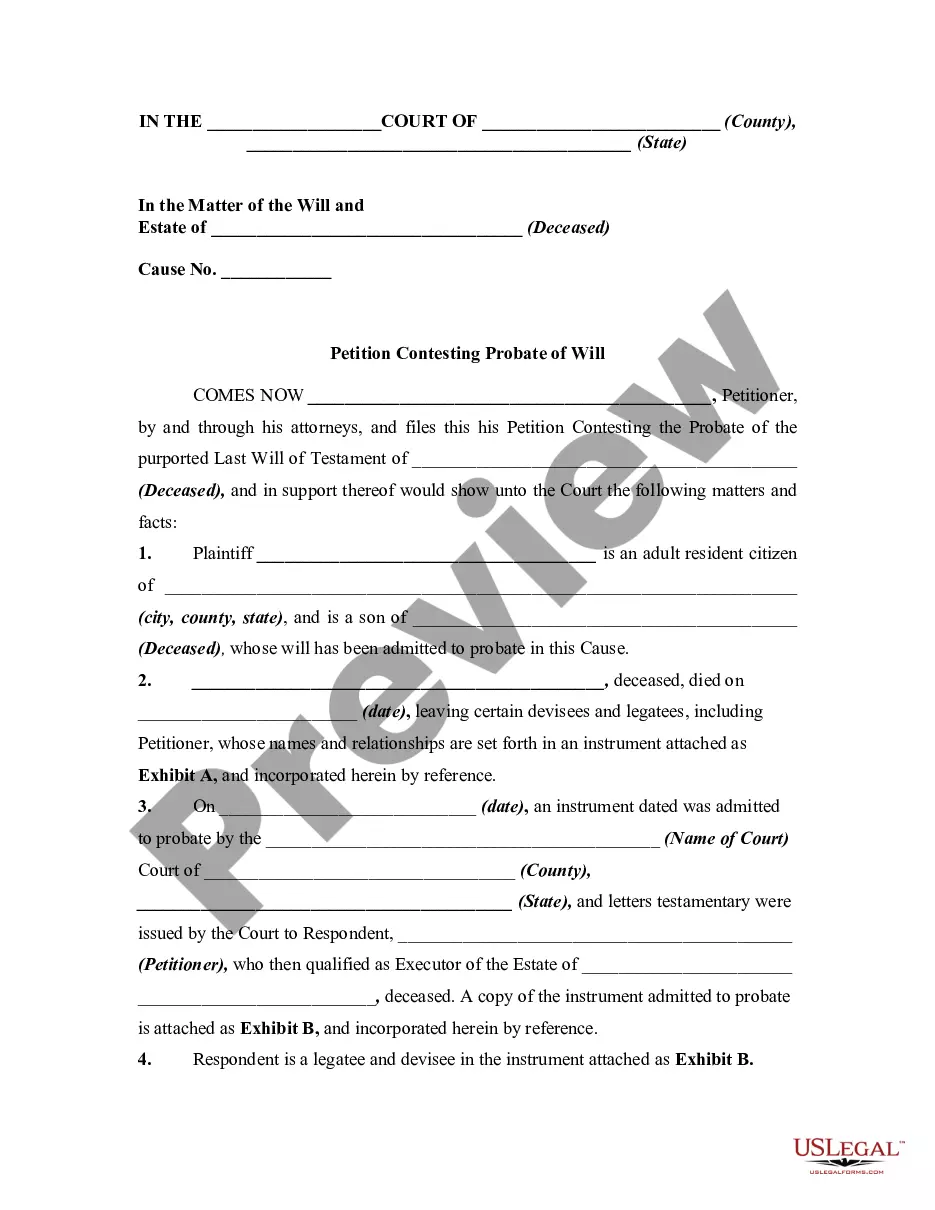
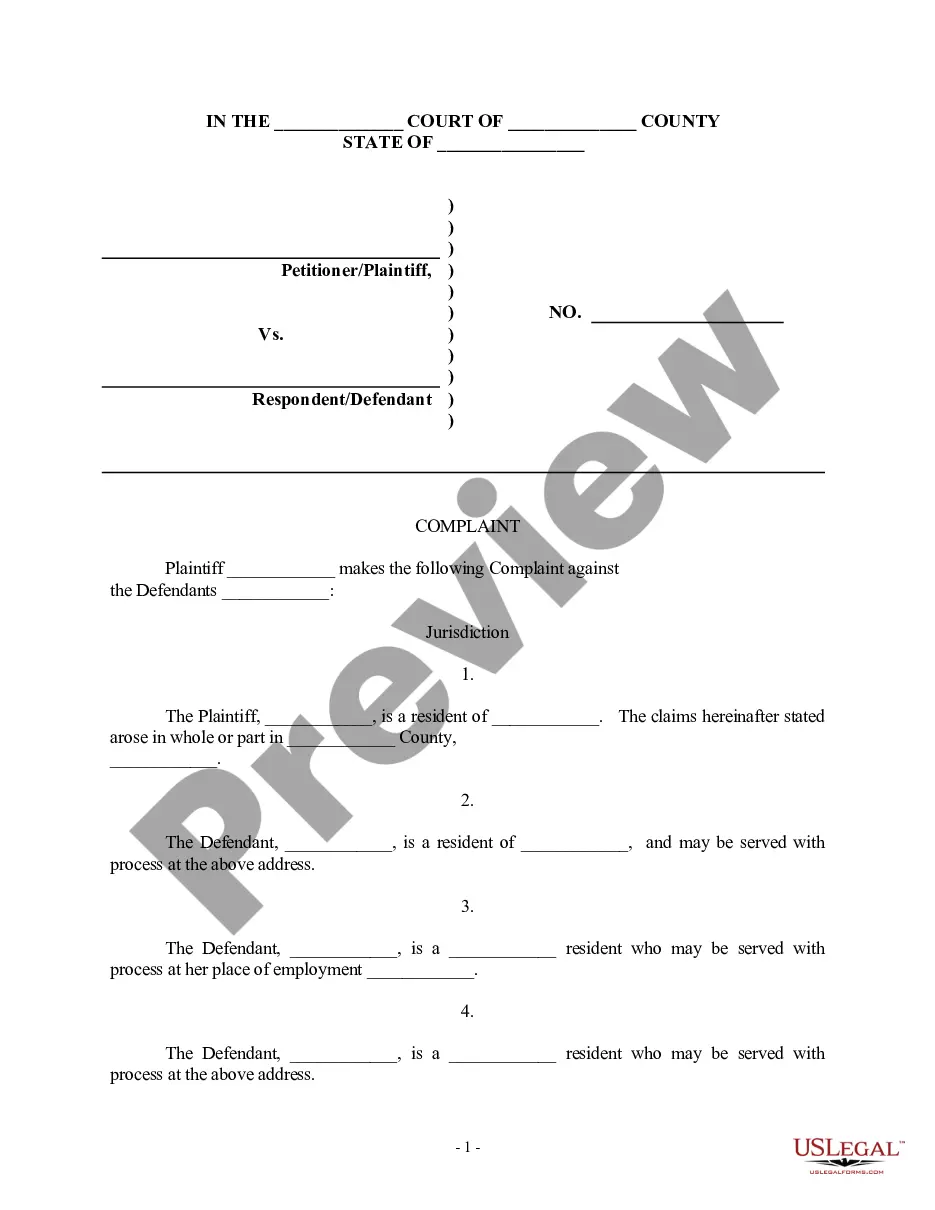
The Complaint to Contest Will is a legal document used by individuals who wish to challenge the validity of a will. This form allows an interested party, such as a beneficiary or heir, to argue that the will should be declared void, typically due to issues like undue influence or lack of capacity of the deceased. It differs from other probate forms by specifically addressing objections regarding the will itself, making it essential for those who believe that a will does not reflect the true intentions of the deceased individual.
Main sections of this form
- Identification of the Plaintiff and Defendant including their addresses.
- Statement of the Plaintiff's relationship to the deceased and status as a beneficiary or heir.
- Details about the will being contested, including the date and its admission to probate.
- Claims stating the grounds for contesting the will, such as undue influence or a violation of prior wills.
- Request for a jury trial and legal relief for the Plaintiff.
When to use this form
This form should be used when an individual believes the will of a deceased person is invalid due to reasons such as coercion, misrepresentation, or the deceased lacking the mental capacity to create a will. It is appropriate to file this complaint if you are a direct beneficiary who has been prejudiced by the provisions of the new will compared to previous ones or if you suspect fraudulent activity regarding the will's creation.
Who should use this form
- Individuals who are beneficiaries of a prior will.
- Heirs at law seeking to contest a recently admitted will.
- Persons who suspect undue influence was exerted on the deceased at the time of will execution.
- Anyone wishing to legally assert their claim regarding the distribution of the deceased's estate.
Completing this form step by step
- Identify and enter the names and addresses of the Plaintiff and Defendant.
- Provide details regarding your relationship to the deceased and your status as a beneficiary or heir.
- Fill in information about the will being contested, including its date and the circumstances of its admission to probate.
- Articulate the legal grounds for contesting the will, including evidence of undue influence or prior wills.
- Sign and date the complaint, ensuring compliance with local court requirements.
Does this document require notarization?
This form does not typically require notarization unless specified by local law. However, it is always a good practice to check your local jurisdictionâs requirements for any relevant notarial acts related to the filing process.
Get your form ready online
Our built-in tools help you complete, sign, share, and store your documents in one place.
Make edits, fill in missing information, and update formatting in US Legal Forms—just like you would in MS Word.
Download a copy, print it, send it by email, or mail it via USPS—whatever works best for your next step.
Sign and collect signatures with our SignNow integration. Send to multiple recipients, set reminders, and more. Go Premium to unlock E-Sign.
If this form requires notarization, complete it online through a secure video call—no need to meet a notary in person or wait for an appointment.
We protect your documents and personal data by following strict security and privacy standards.

Make edits, fill in missing information, and update formatting in US Legal Forms—just like you would in MS Word.

Download a copy, print it, send it by email, or mail it via USPS—whatever works best for your next step.

Sign and collect signatures with our SignNow integration. Send to multiple recipients, set reminders, and more. Go Premium to unlock E-Sign.

If this form requires notarization, complete it online through a secure video call—no need to meet a notary in person or wait for an appointment.

We protect your documents and personal data by following strict security and privacy standards.
Typical mistakes to avoid
- Failing to properly identify all interested parties, which can delay the process.
- Not stating clear grounds for contesting the will, leaving the complaint weak.
- Omitting necessary signatures or filing the form within the deadline.
Benefits of using this form online
- Convenience of completing the form at your own pace from anywhere.
- Immediate access to downloadable and editable templates tailored by legal professionals.
- Secure online storage and the option for online notarization to streamline the legal process.
Legal use & context
- This form is used within the legal proceedings to contest a will, making it a formal assertion of rights under probate law.
- Filing this complaint is a crucial step in establishing your legal position regarding the estate of the deceased.
Key takeaways
- The Complaint to Contest Will is a specialized legal form crucial for challenging the validity of a will.
- Ensure all relevant parties are identified and properly described in the form.
- Understand the grounds for contesting a will to strengthen your case.
Looking for another form?


Form popularity
FAQ
The simple answer is that you can't ever stop someone contesting your will. This is because state and territory legislation across Australia allows 'eligible' people to make a claim against an estate if they can establish that they have not been adequately provided for in the deceased's will.
A will may have been attested by two witnesses and duly signed by the testator but if it's not dated, it becomes void. The law also says that a new will with a later date would make the previous one null and void. If a will is termed invalid, the court distributes the property as if no will ever existed.
Clearly the best way to avoid a contested will, or at least a successfully contested will, is to ensure the will is drafted and executed properly in the first place. We would also encourage our clients to discuss their plans for inheritance with family members, so there are no nasty surprises at a later stage.
Undue influence The expression of a testator's last wishes must be the result of the exercise of his or her own volition. Any impairment to the free expression of the testator's wishes at the time the will is made may result in a will being declared invalid.
When you challenge a will you are challenging the validity of the Will itself. A challenge to a Will is often for these main reasons: undue influence, fraud, forgery, or lack of mental capacity (referred to as testamentary capacity).
There is no need for embarrassment about that. Sometimes it is simply not worth the risk and expense of contesting a will, however hurt you may be by its terms. DO know your funding options whether Pay As You Go or some form of No Win No Fee or No Win Reduced Fee arrangement.
It must be in writing. Generally, of course, wills are composed on a computer and printed out. The person who made it must have signed and dated it. A will must be signed and dated by the person who made it. Two adult witnesses must have signed it. Witnesses are crucial.
A will can also be declared invalid if someone proves in court that it was procured by undue influence. This usually involves some evil-doer who occupies a position of trust -- for example, a caregiver or adult child -- manipulating a vulnerable person to leave all, or most, of his property to the manipulator instead
A will can also be declared invalid if someone proves in court that it was procured by undue influence. This usually involves some evil-doer who occupies a position of trust -- for example, a caregiver or adult child -- manipulating a vulnerable person to leave all, or most, of his property to the manipulator instead