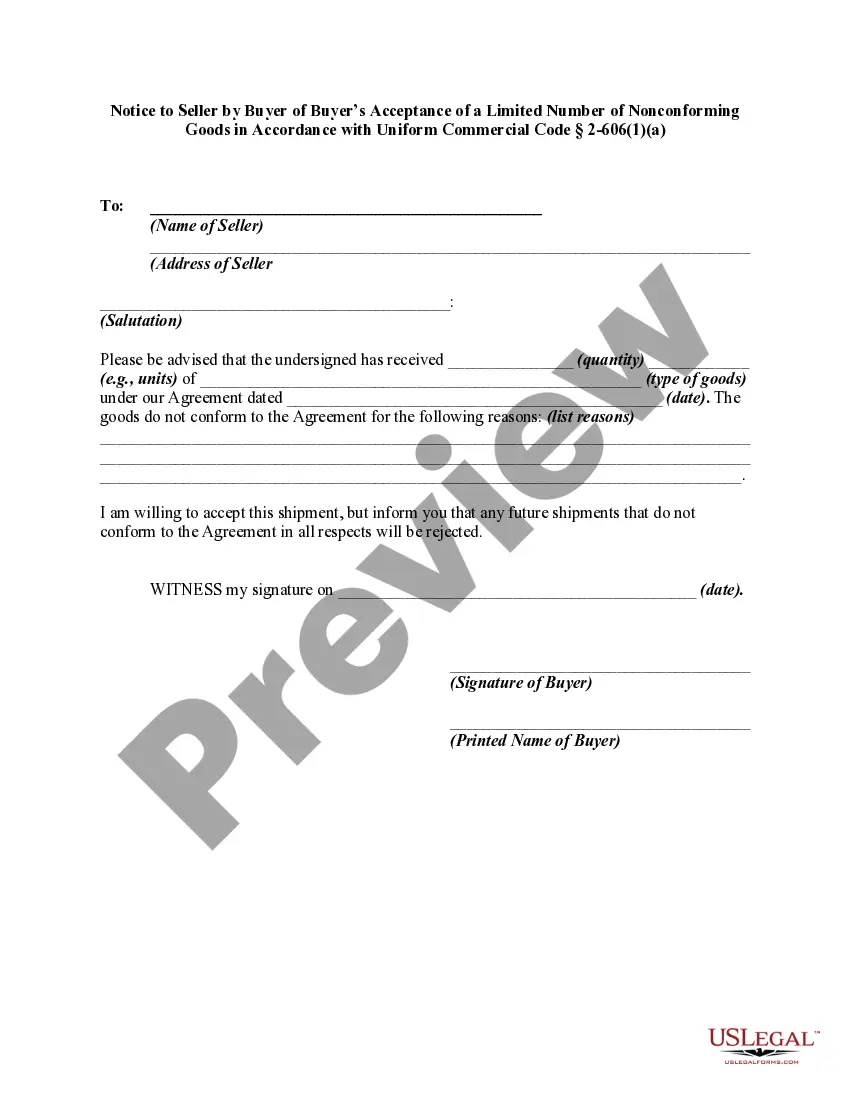
Notice to Seller by Buyer of Buyer's Acceptance of a Limited Number of Nonconforming Goods in Accordance with Uniform Commercial Code ' 2-606(1)(a)
Understanding this form
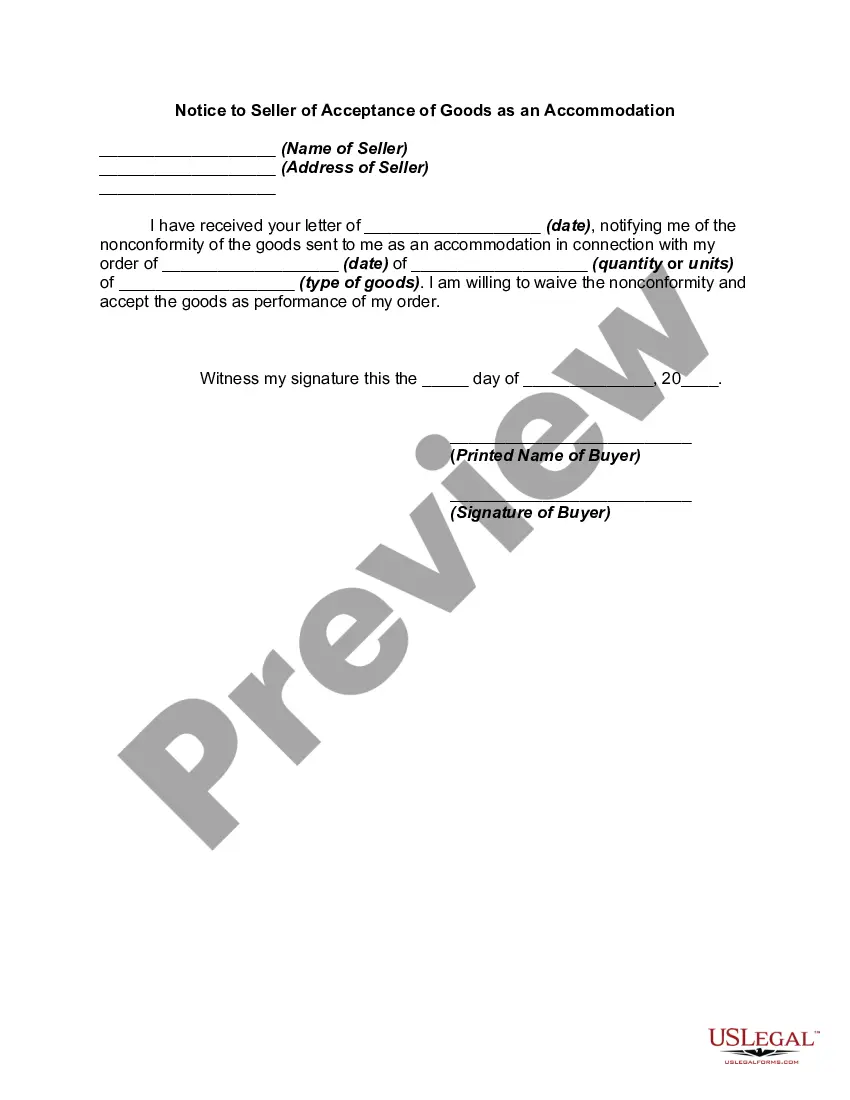
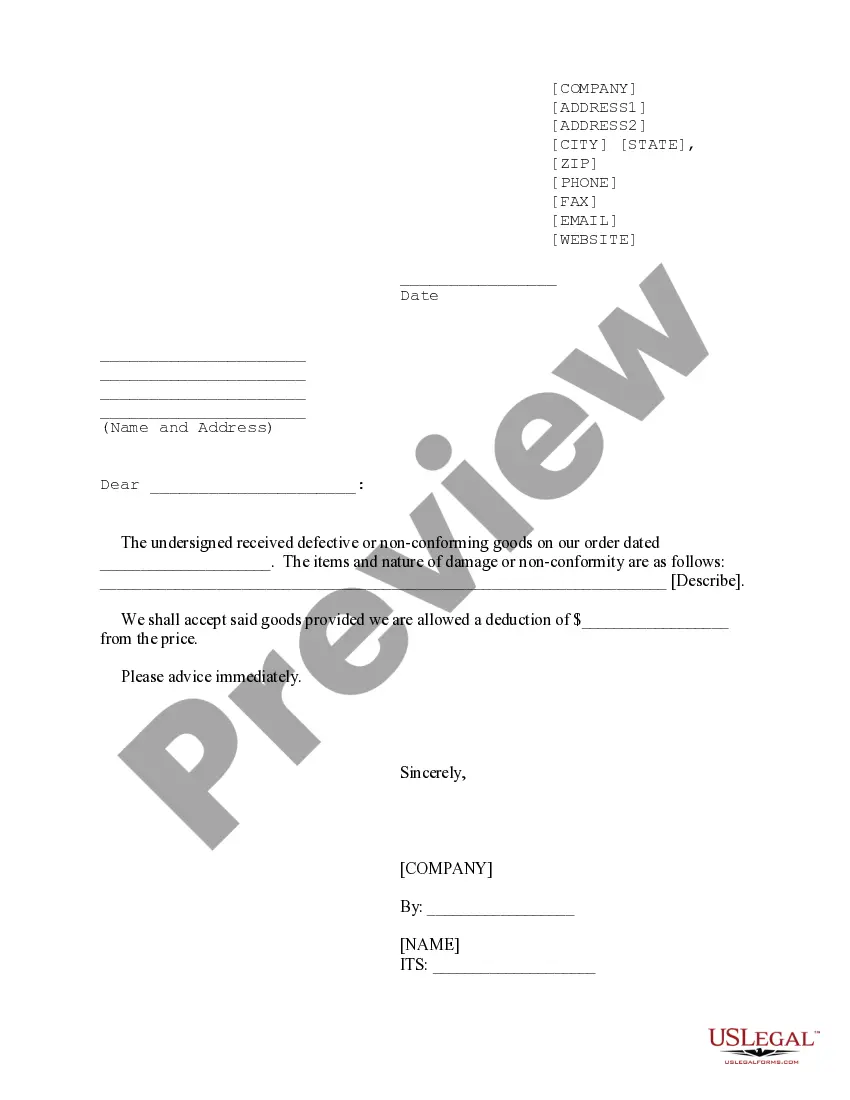
This form is a Notice to Seller by Buyer of Buyer's Acceptance of a Limited Number of Nonconforming Goods, as per the Uniform Commercial Code § 2-606(1)(a). It allows a buyer to formally notify the seller that while the received goods do not meet contract specifications, the buyer chooses to accept them. This notice does not waive the buyer's rights under the contract, allowing for future rejections of nonconforming goods.
Key components of this form
- Name and address of the seller.
- Quantity and type of goods received.
- Date of the agreement between buyer and seller.
- Reasons for nonconformity of the goods.
- A statement of acceptance and conditions for future shipments.
- Date and signature of the buyer.
Situations where this form applies
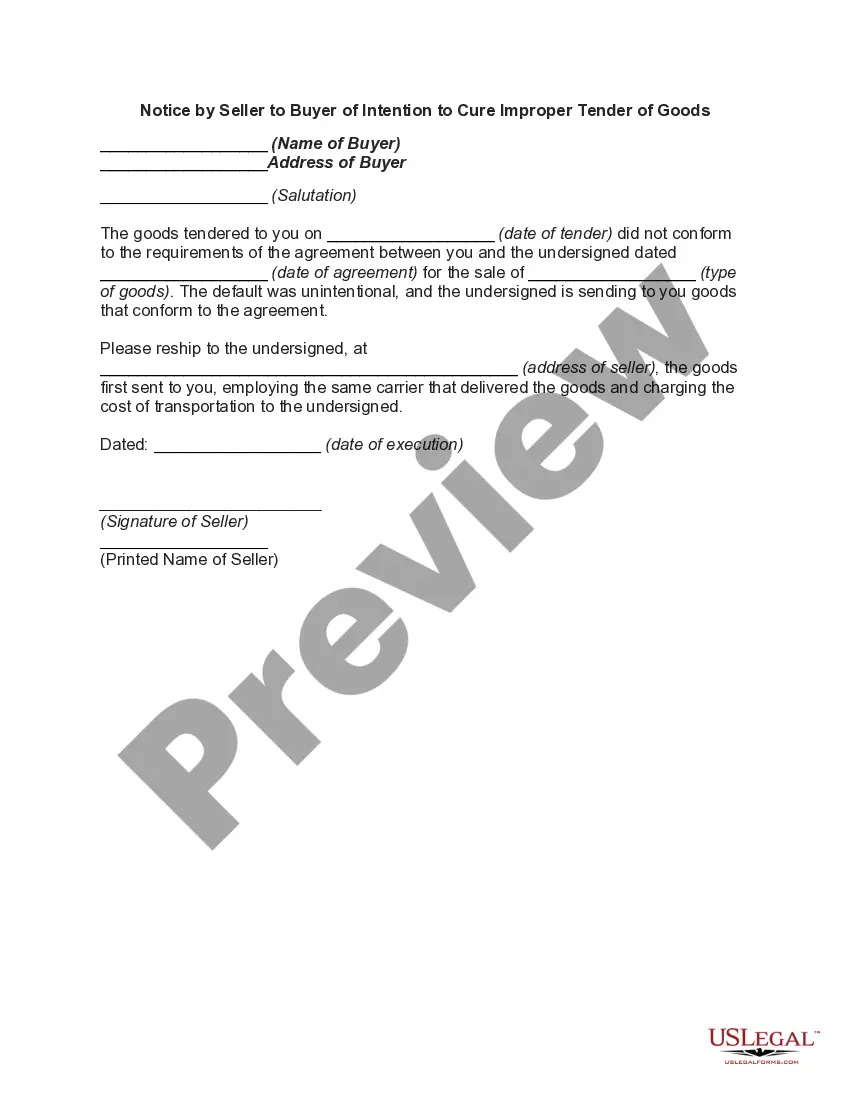
You should use this form when you receive goods from a seller that do not conform to the terms of your agreement, but you still wish to accept those goods. This situation often arises in commercial transactions where the buyer wants to maintain a working relationship while signaling that future deviations from the contract will not be tolerated.
Who this form is for
- Buyers in commercial transactions who receive nonconforming goods.
- Businesses seeking to protect their rights while maintaining supplier relationships.
- Individuals who have entered into purchasing agreements and wish to provide formal notification to the seller.
Steps to complete this form
- Identify the seller by entering their name and address at the beginning of the form.
- Specify the quantity and type of goods received in the appropriate fields.
- Provide the date of the agreement where indicated.
- Clearly state the reasons for the nonconformity of the goods.
- Sign and date the form to finalize your acceptance.
Notarization guidance
This form does not typically require notarization unless specified by local law. It is advisable to check the requirements for your jurisdiction to ensure compliance.
Get your form ready online
Our built-in tools help you complete, sign, share, and store your documents in one place.
Make edits, fill in missing information, and update formatting in US Legal Forms—just like you would in MS Word.
Download a copy, print it, send it by email, or mail it via USPS—whatever works best for your next step.
Sign and collect signatures with our SignNow integration. Send to multiple recipients, set reminders, and more. Go Premium to unlock E-Sign.
If this form requires notarization, complete it online through a secure video call—no need to meet a notary in person or wait for an appointment.
We protect your documents and personal data by following strict security and privacy standards.

Make edits, fill in missing information, and update formatting in US Legal Forms—just like you would in MS Word.

Download a copy, print it, send it by email, or mail it via USPS—whatever works best for your next step.

Sign and collect signatures with our SignNow integration. Send to multiple recipients, set reminders, and more. Go Premium to unlock E-Sign.

If this form requires notarization, complete it online through a secure video call—no need to meet a notary in person or wait for an appointment.

We protect your documents and personal data by following strict security and privacy standards.
Common mistakes
- Failing to specify reasons for nonconformity clearly.
- Not signing or dating the form, which may render it ineffective.
- Using ambiguous language that could lead to misunderstandings of acceptance terms.
Why use this form online
- Convenience of immediate download and completion from any location.
- Editability to tailor the form to your specific situation.
- Access to professionally drafted content, ensuring legal reliability.
Key takeaways
- This notice is essential for buyers accepting nonconforming goods to protect their rights.
- Clearly stating reasons for nonconformity is crucial for effective communication.
- Completing the form accurately avoids potential legal complications in future transactions.
Looking for another form?







Form popularity
FAQ
Under the law, acceptance occurs when: 1) after a reasonable opportunity to inspect the goods the Buyer signifies to the Seller that the goods are conforming or that the goods will be retained in spite of any non-conformity; or 2) after a reasonable opportunity to inspect the goods the Buyer fails to make an
(2) Revocation of acceptance must occur within a reasonable time after the buyer discovers or should have discovered the ground for it and before any substantial change in condition of the goods which is not caused by their own defects. It is not effective until the buyer notifies the sellerof it.
The basic obligation of the buyer or lessee is to accept and pay for conforming goods in accordance with the contract. When the contract is unclear and disputes arise, the courts look to the UCC and impose standards of good faith and commercial reasonableness.
A buyer's basic obligations are to accept the goods and pay the sale price. If the goods are nonconforming, the buyer may reject the goods.
It is the duty of the buyer to demand delivery of the goods within a reasonable time.If the buyer refuses to accept the goods, it is his duty to inform the seller about it. 7. If the seller delivers the goods as per the contract, it becomes the duty of the buyer to take delivery of the same within a reasonable time.
37 The buyer is deemed to have accepted the goods when the buyer intimates to the seller that he has accepted them, or when the goods have been delivered to him, and the buyer does any act in relation to them, which is inconsistent with the ownership of the seller, or when, after the lapse of a reasonable time, the
The Uniform Commercial Code, or UCC, is a uniform act that covers sales and other commercial transactions.Article 2 is a vast segment of the UCC that specifically addresses contracts for the sale of goods. A good is any movable property identified at the time of the contract.
(1) Unless otherwise agreed and subject to subsection (3), where goods are tendered or delivered or identified to the contract for sale, the buyer has a right before payment or acceptance to inspect them at any reasonable place and time and in any reasonable manner.