Release by Trustor of Right to Revoke Trust
About this form
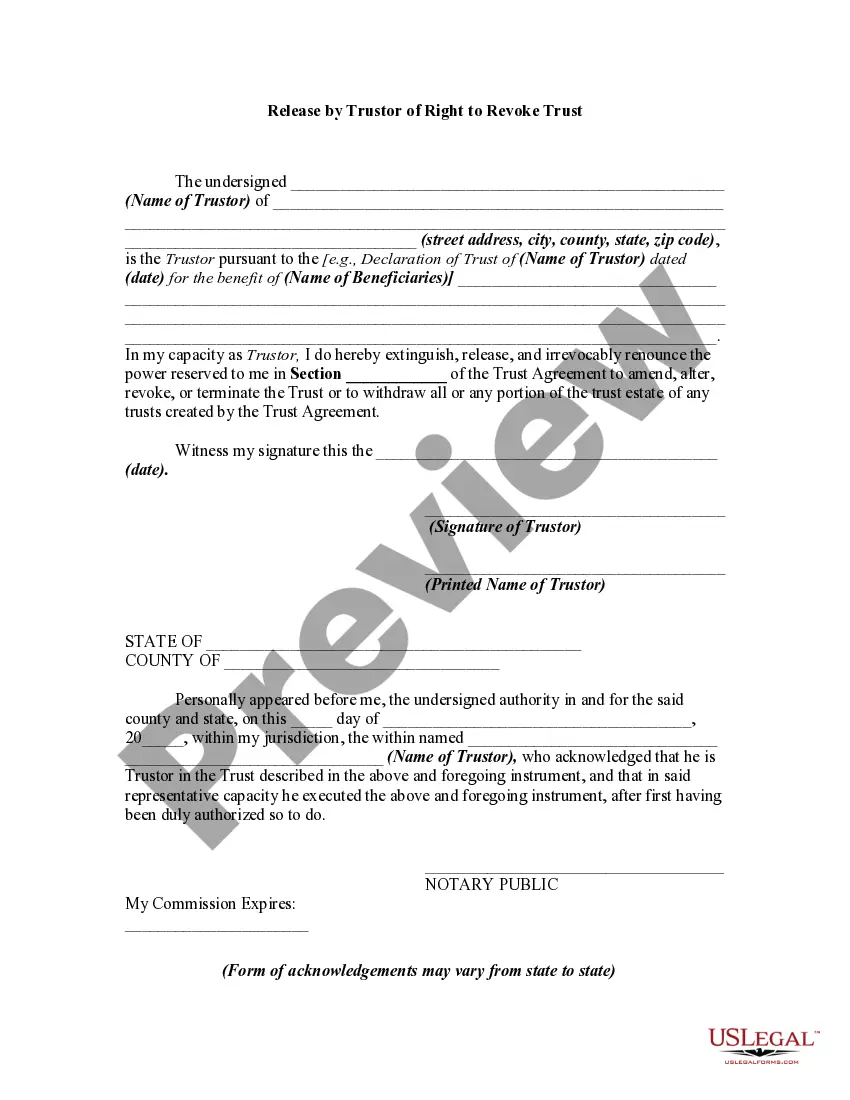
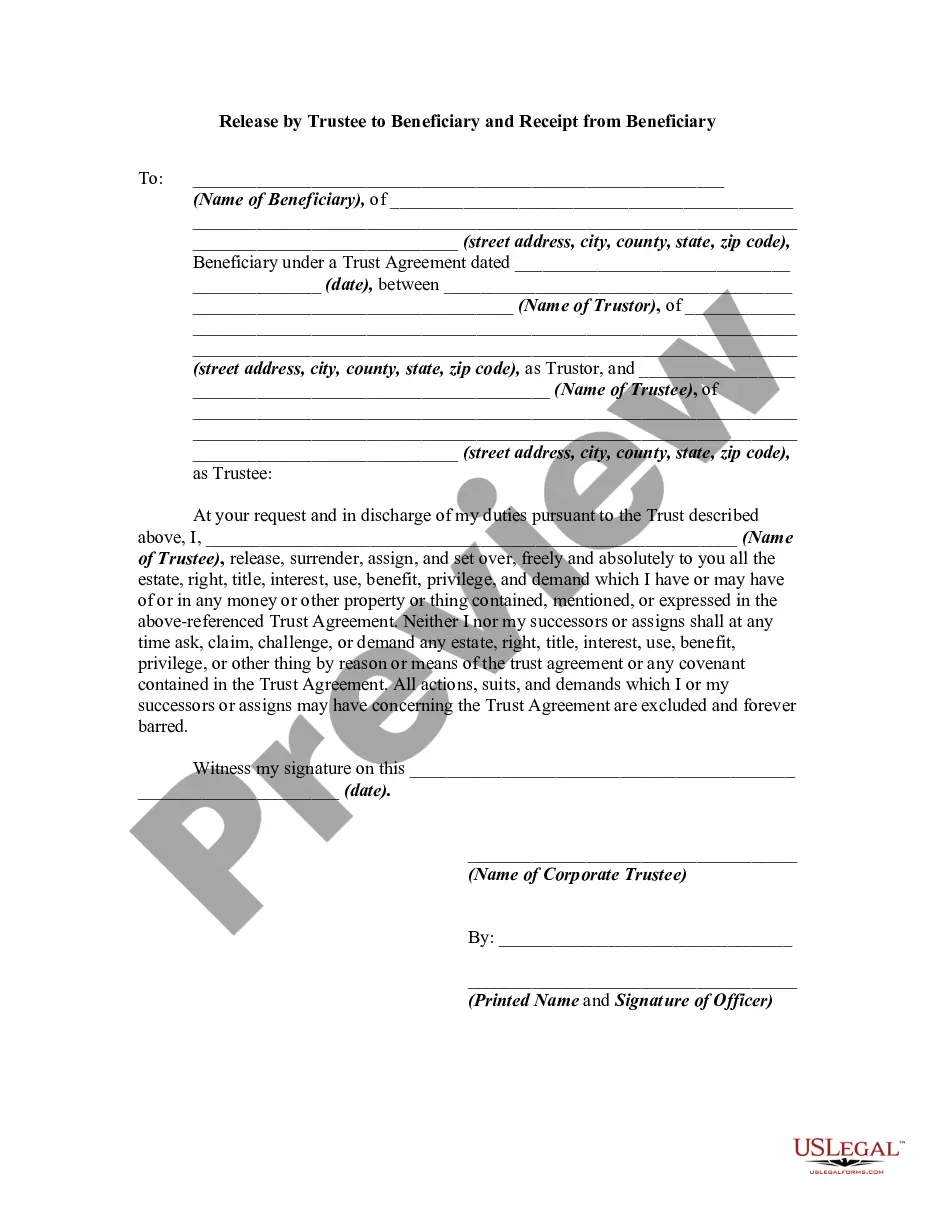
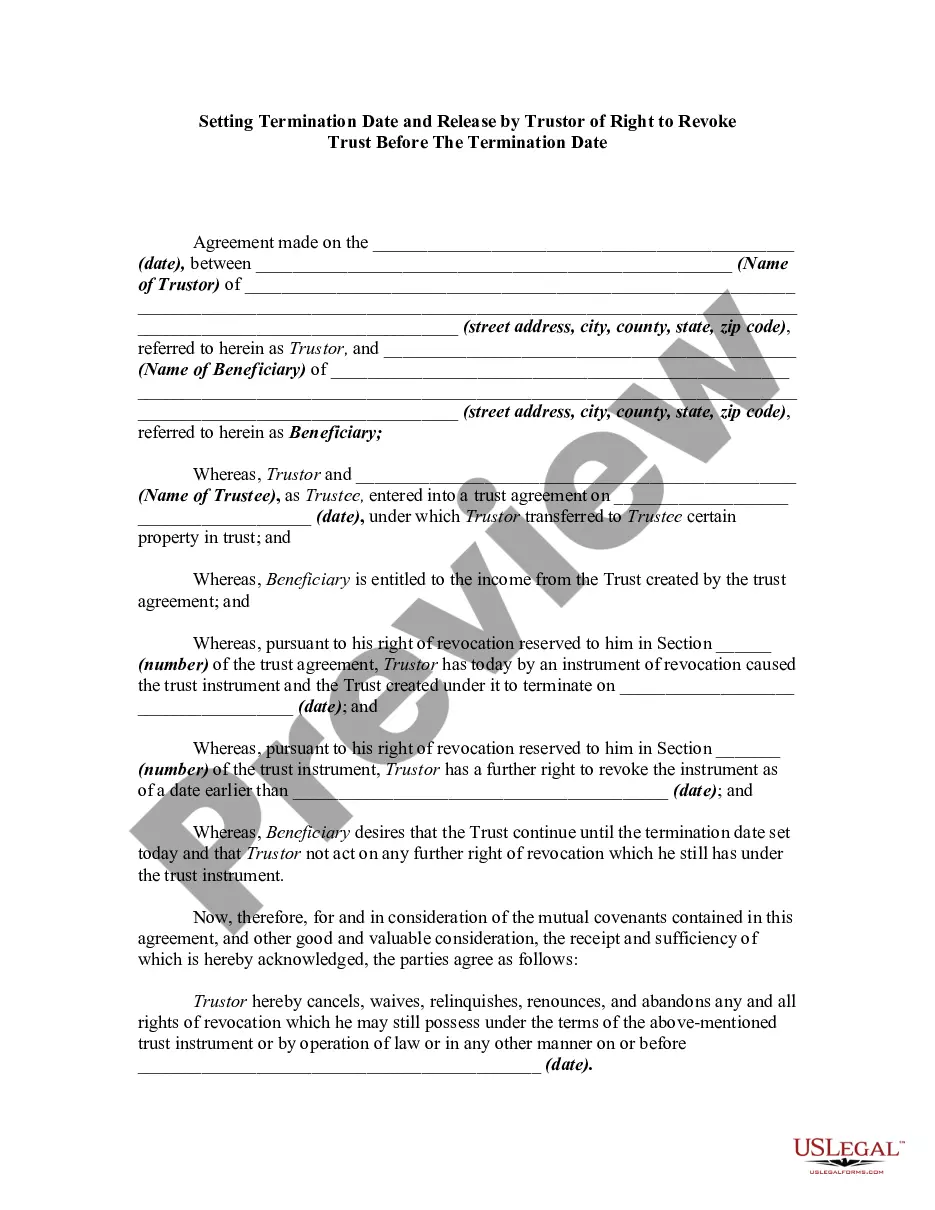
The Release by Trustor of Right to Revoke Trust is a legal document used by a trustor to formally relinquish their right to amend, revoke, or terminate a trust. This form serves as an important tool for definitive estate planning and ensures that the trustorâs intentions are legally enshrined. Unlike other estate documents, this release specifically addresses the relinquishment of rights concerning a trust, making it distinct and essential for ensuring the integrity of the trust.
Main sections of this form
- Name and address of the trustor.
- Details of the original trust agreement including its date and beneficiaries.
- Explicit statement of the trustor's intent to release their rights to revoke the trust.
- Signature field for the trustor.
- Notary acknowledgment section to validate the execution of the document.

Situations where this form applies
This form should be used when a trustor decides to permanently give up their authority to modify or cancel a trust they previously established. It is commonly necessary in situations where a trustor wants to ensure that the trust remains intact for benefactors, such as family members or charities, without the risk of later alteration. Using this form helps clarify the trustor's intentions and avoids potential disputes over the authority to revoke or amend the trust.
Who this form is for
This form is intended for:
- Individuals who have established a trust and wish to formally relinquish their rights to revoke or alter it.
- Trustors seeking to protect the trust's integrity for the benefit of specified beneficiaries.
- People looking to make clear legal declarations regarding their rights in estate planning scenarios.
Instructions for completing this form
- Identify and enter the trustor's full name and address at the beginning of the form.
- Provide details of the original declaration of trust, including the name of the trustor, date, and name of beneficiaries.
- Clearly state the specific section being released and ensure precise wording to avoid ambiguity.
- Sign and date the form in the designated section to confirm your intent.
- Have the document notarized to ensure its validity and legal enforceability.
Does this form need to be notarized?
Yes, this form must be notarized to be legally valid. Notarization ensures that the trustor's signature is genuine and that they are executing the document willingly and without coercion. US Legal Forms offers integrated online notarization services, allowing you to complete the process securely via video call, anytime and anywhere, without the need to travel.
Get your form ready online
Our built-in tools help you complete, sign, share, and store your documents in one place.
Make edits, fill in missing information, and update formatting in US Legal Forms—just like you would in MS Word.
Download a copy, print it, send it by email, or mail it via USPS—whatever works best for your next step.
Sign and collect signatures with our SignNow integration. Send to multiple recipients, set reminders, and more. Go Premium to unlock E-Sign.
If this form requires notarization, complete it online through a secure video call—no need to meet a notary in person or wait for an appointment.
We protect your documents and personal data by following strict security and privacy standards.

Make edits, fill in missing information, and update formatting in US Legal Forms—just like you would in MS Word.

Download a copy, print it, send it by email, or mail it via USPS—whatever works best for your next step.

Sign and collect signatures with our SignNow integration. Send to multiple recipients, set reminders, and more. Go Premium to unlock E-Sign.

If this form requires notarization, complete it online through a secure video call—no need to meet a notary in person or wait for an appointment.

We protect your documents and personal data by following strict security and privacy standards.
Common mistakes to avoid
- Failing to complete all required fields, particularly the specific section number of the trust agreement.
- Not having the form notarized if state law requires notarization.
- Omitting the date of signing, which can create confusion regarding the timing of the release.
- Using unclear language which could lead to misinterpretation of the trustor's intent.
Benefits of using this form online
- Convenience of downloading the form immediately and filling it out at your own pace.
- Editability allows users to customize the form to fit their specific trust circumstances.
- Access to legally drafted templates ensures that the form complies with relevant legal standards.
Summary of main points
- The form allows a trustor to formally relinquish their right to revoke a trust.
- Completing the form correctly is essential to ensure enforceability.
- Consult local laws to confirm specific requirements and necessary modifications.
Looking for another form?





Form popularity
FAQ
If you created an individual living trust, you can revoke it at any time. Either grantor can revoke a shared trust, wiping out all terms of the trust. The trust property is returned to each person according to how they owned it before transferring it to the trust. EXAMPLE: Yvonne and Andre make a living trust together.
In some states, your trustee must submit a formal accounting of the trust's operation to all beneficiaries.Trustees can sometimes waive this requirement if all beneficiaries agree in writing. In either case, after the report is made, the trust's assets can be distributed and the trust can be dissolved.
The terms of an irrevocable trust may give the trustee and beneficiaries the authority to break the trust. If the trust's agreement does not include provisions for revoking it, a court may order an end to the trust. Or the trustee and beneficiaries may choose to remove all assets, effectively ending the trust.
The first step in dissolving a revocable trust is to remove all the assets that have been transferred into it. The second step is to fill out a formal revocation form, stating the grantor's desire to dissolve the trust.
This can take as long as 18 months or so if real estate or other assets must be sold, but it can go on much longer. How long it takes to settle a revocable living trust can depend on numerous factors.
EXAMPLE: Yvonne and Andre make a living trust together. Step 1: Transfer ownership of trust property from yourself as trustee back to yourself. Step 2: A revocation prints out with your trust document. Step 3: Complete the Revocation of Trust by filling in the date, and then sign it in front of a notary public.
It depends on the type of trust. If your mother is currently living and has the right to remove and replace the Trustee, then you ask her to remove you as Trustee.If it is not spelled out in the trust, you can petition the court to appoint a successor Trustee.
If you want to revoke your trust, you must formally take all of the trust assets out of the living trust and transfer title back to you. Basically, you must reverse the process you followed when you transferred ownership of the property to yourself as trustee.
Power of trustee to modify or revoke The trustee's power also comes from the trust agreement. As such, the agreement must expressly confer on the trustee the power to revoke or modify the trust, otherwise the trustee has no power to alter the terms of the trust.