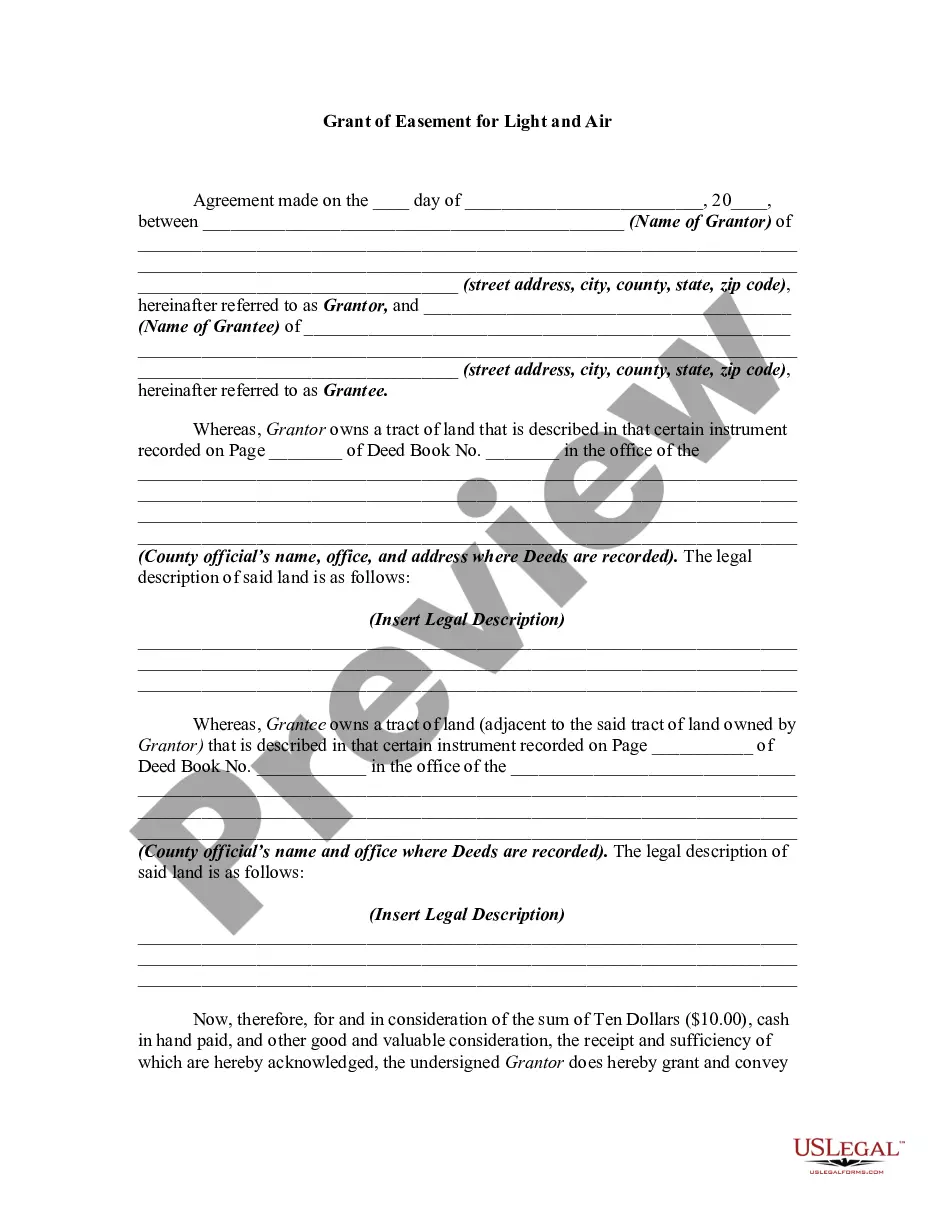
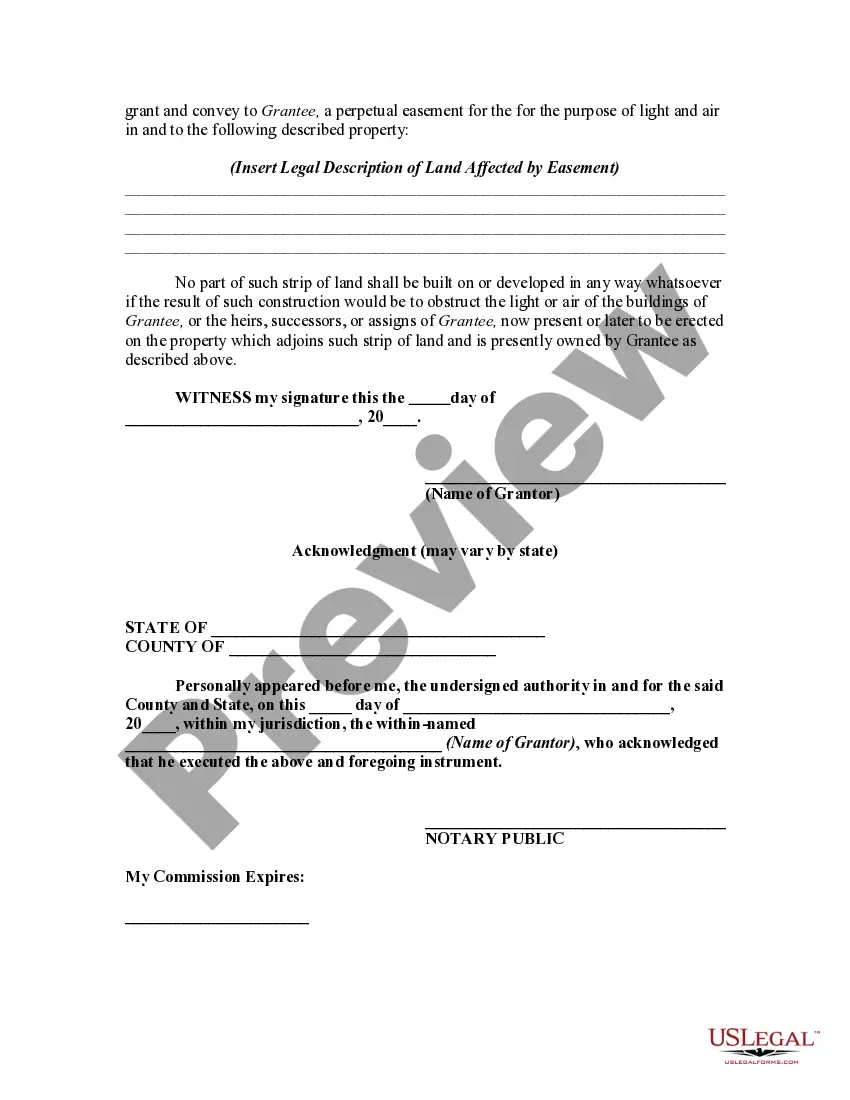
Grant of Easement for Light and Air
What this document covers
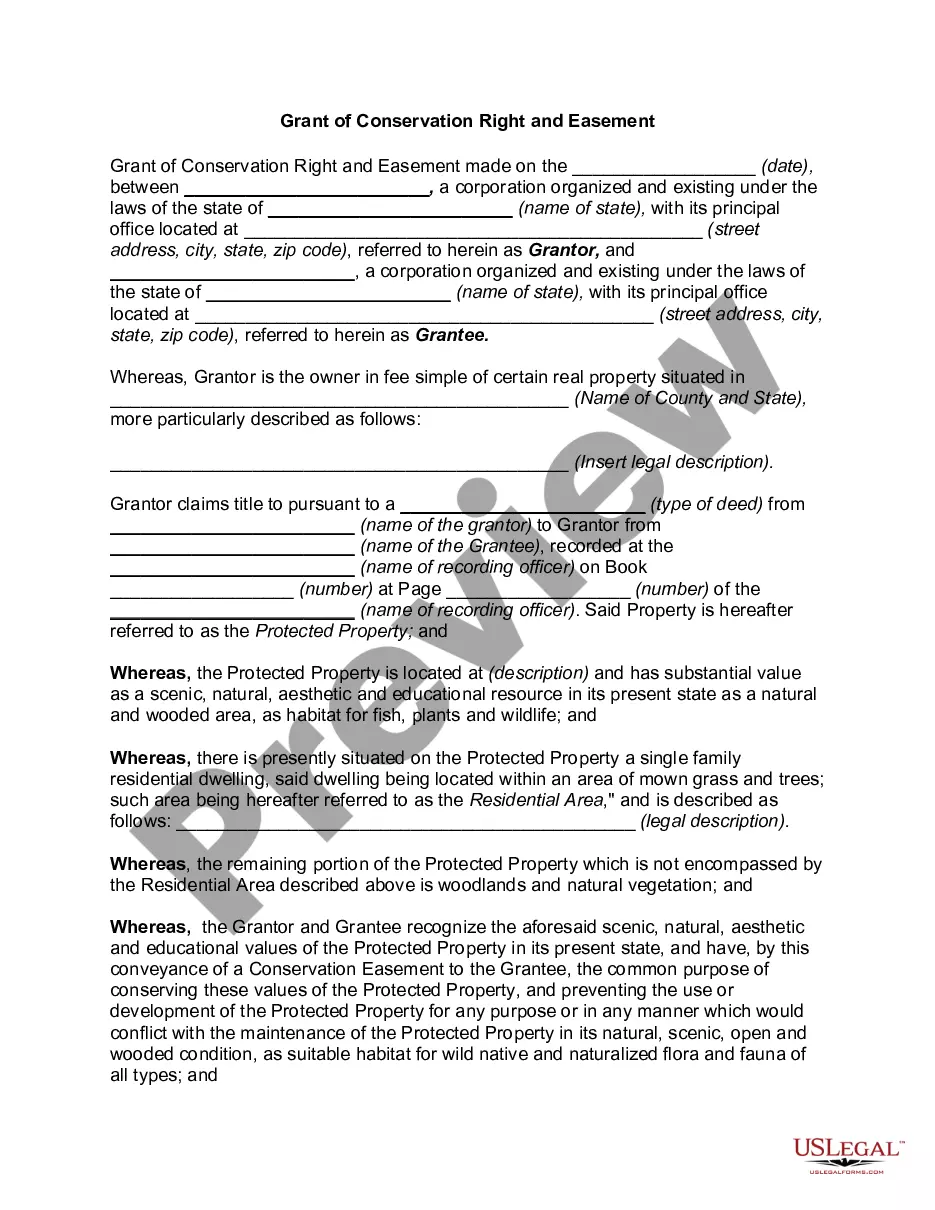
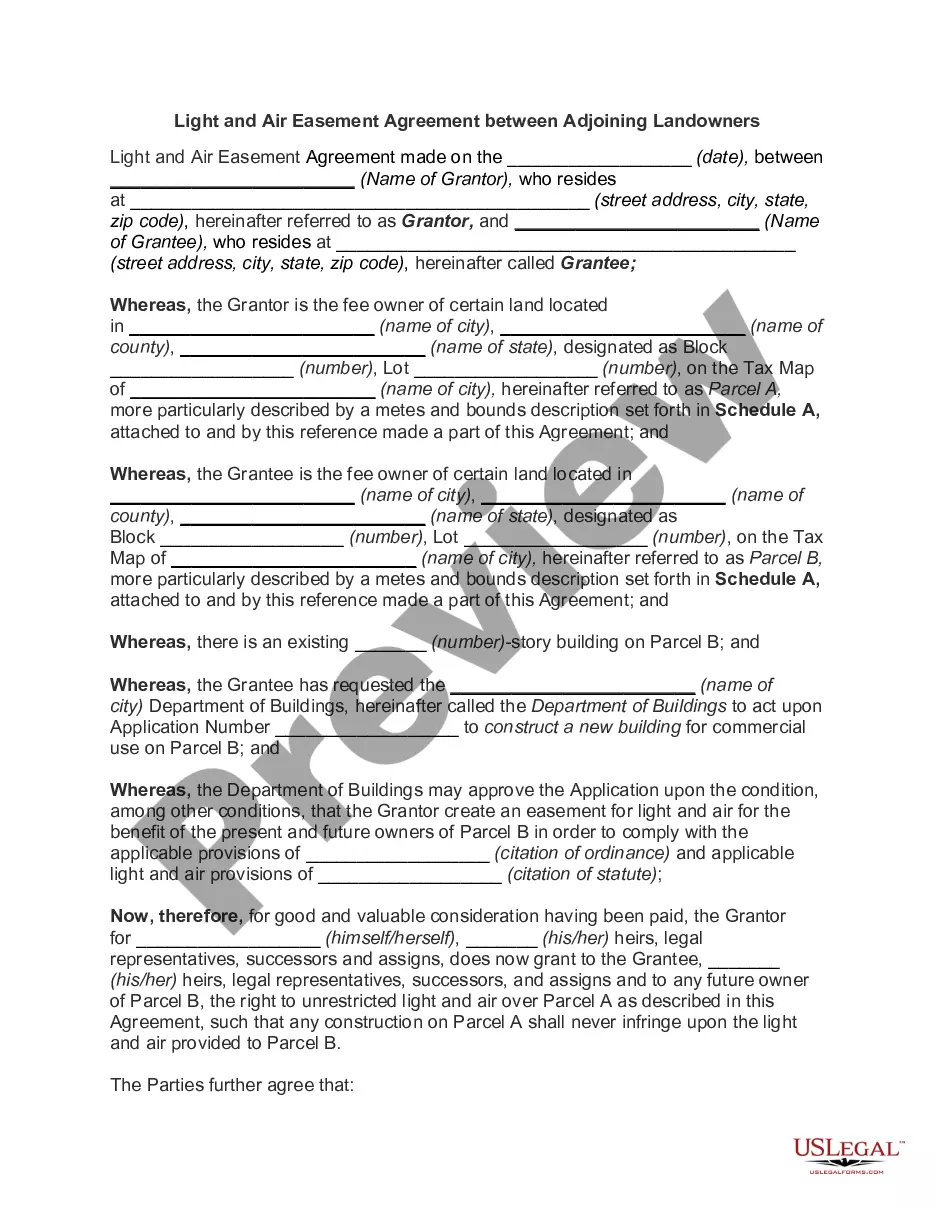
The Grant of Easement for Light and Air is a legal document that allows the owner of a property to ensure unobstructed access to light and air over their land. This form differs from other easements in that it specifically protects against structures that may block natural light and airflow from neighboring properties. It is important for property owners who want to safeguard their rights to light and air, particularly in urban areas where buildings are closely situated.
Key parts of this document
- Details of the Grantor (property owner) and Grantee (recipient of the easement)
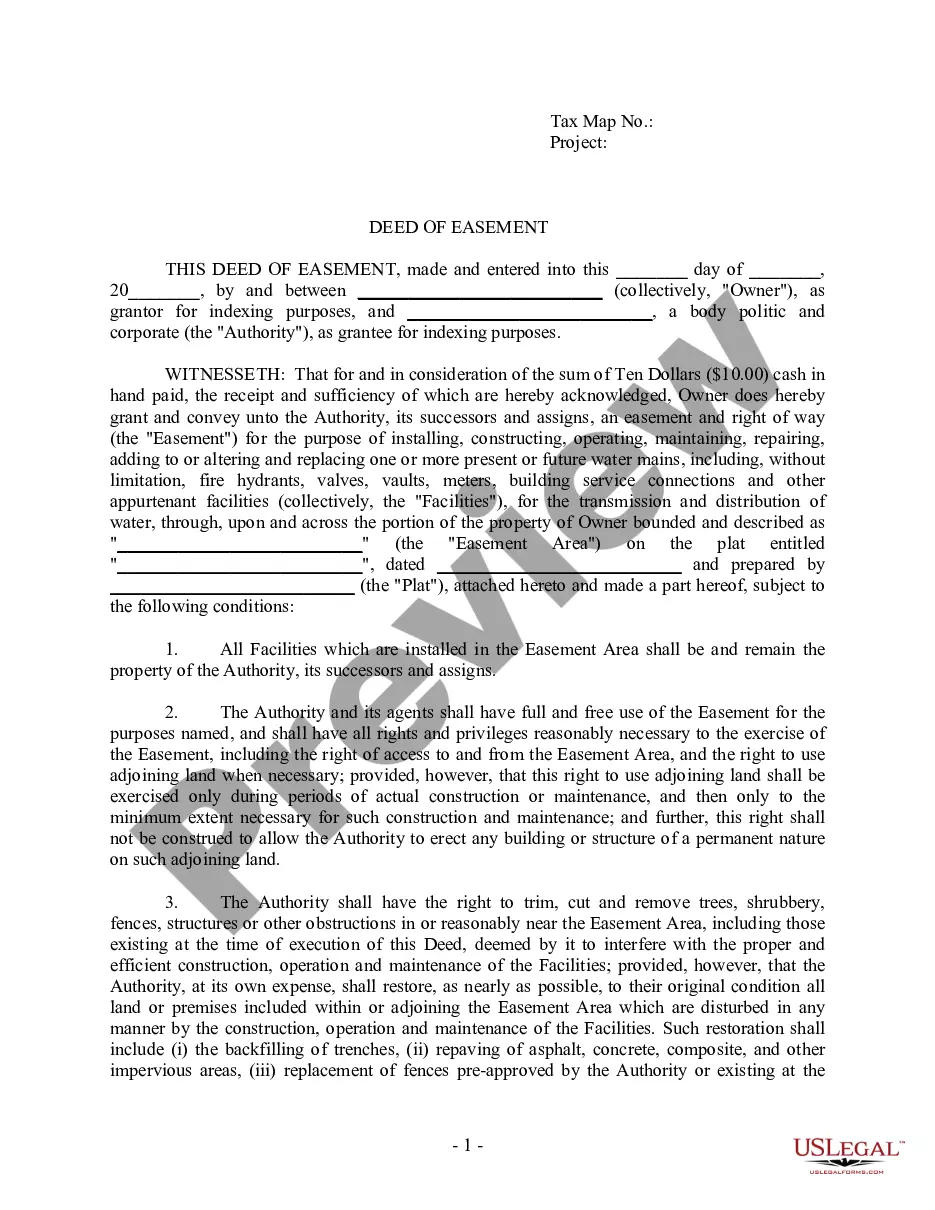
- Legal descriptions of the properties involved
- Specification of the easement for light and air
- Terms stating that construction is prohibited if it obstructs light or air
- Signature of the Grantor, along with a notary acknowledgment
When this form is needed
This form is used when a property owner wishes to grant an easement for light and air to a neighboring property owner. It is particularly useful in residential or commercial settings where new construction may threaten light and airflow to existing structures. This easement can prevent disputes between neighbors regarding the impact of future development on access to light and air.
Who needs this form
- Property owners who want to protect their access to light and air from neighboring developments
- Real estate developers seeking to formalize easements in property transactions
- Anyone involved in land use planning or property disputes related to building restrictions
Completing this form step by step
- Identify the parties involved: the Grantor and the Grantee.
- Provide the legal descriptions of the properties that are affected by the easement.
- Specify the terms of the easement, ensuring clarity on what is prohibited regarding construction.
- Include the date of agreement and ensure that both parties sign the document.
- Complete the notary acknowledgment section, if required by state law.
Notarization guidance
This form must be notarized to be legally valid. US Legal Forms provides secure online notarization powered by Notarize, allowing you to complete the process through a verified video call.
Get your form ready online
Our built-in tools help you complete, sign, share, and store your documents in one place.
Make edits, fill in missing information, and update formatting in US Legal Forms—just like you would in MS Word.
Download a copy, print it, send it by email, or mail it via USPS—whatever works best for your next step.
Sign and collect signatures with our SignNow integration. Send to multiple recipients, set reminders, and more. Go Premium to unlock E-Sign.
If this form requires notarization, complete it online through a secure video call—no need to meet a notary in person or wait for an appointment.
We protect your documents and personal data by following strict security and privacy standards.

Make edits, fill in missing information, and update formatting in US Legal Forms—just like you would in MS Word.

Download a copy, print it, send it by email, or mail it via USPS—whatever works best for your next step.

Sign and collect signatures with our SignNow integration. Send to multiple recipients, set reminders, and more. Go Premium to unlock E-Sign.

If this form requires notarization, complete it online through a secure video call—no need to meet a notary in person or wait for an appointment.

We protect your documents and personal data by following strict security and privacy standards.
Common mistakes to avoid
- Failing to include accurate legal descriptions of the properties involved.
- Omitting signatures from both the Grantor and Grantee.
- Not properly completing the notary acknowledgment if required.
- Using vague terms that may cause confusion about the easement's purpose.
Benefits of completing this form online
- Convenience of completing the form from home without the need for in-person visits to legal offices.
- Editable format allows for adjustments to ensure all information is accurately captured.
- Access to templates drafted by licensed attorneys, ensuring legal validity.
Main things to remember
- The Grant of Easement for Light and Air protects the access to light and air between neighboring properties.
- Clear legal descriptions and proper signatures are essential for the document's validity.
- Consulting local laws is important for compliance with specific state requirements.
- A notarized document strengthens the legal standing of the easement.
Looking for another form?

Form popularity
FAQ
An easement is a limited right to use another person's land for a stated purpose. Examples of easements include the use of private roads and paths, or the use of a landowner's property to lay railroad tracks or electrical wires.
Recording: The Easement must be recorded in the Office of the County Recorder of the county in which the Land is located. Copies: Copies of the fully executed recorded Easement should be provided to the campus real estate office and to RESS.
For example, you might want an easement because someone's property provides easy access to water. In order to obtain an easement, you need to negotiate with the landowner whose property you want to use. Then, you will need to draft an acceptable legal document and file it with your Recorder of Deeds.
An easement is a right which the owner or occupier of certain land possesses, as such, for the beneficial enjoyment of that land, to do and continue to do something, or to prevent and continue to prevent something being done, in or upon, or in respect of certain other land not his own. Kinds/ Types of Easement -
A "right to light" is an easement that gives a landowner the right to receive light through defined apertures in buildings on his or her land.
A permissive easement is simply permission to use the land of another. It is essentially a license, which is fully revocable at any time by the property owner.Use of this road is permissive and may be revoked at any time by the owner."
Types of Easements An easement may be classified as either an easement appurtenant or an easement in gross. Easement Appurtenant. An easement appurtenant is an easement that benefits one parcel of land, known as the dominant tenement, to the detriment of another parcel of land, known as the servient tenement.
In law there is no right to a view. However, a recent case Dennis v Davies shows that if you have the benefit of a restrictive covenant against neighbouring land not to cause nuisance or annoyance then the annoyance factor can be used to protect a view.
A negative easement is a promise not to do something with a certain piece of property, such as not building a structure more than one story high or not blocking a mountain view by constructing a fence.