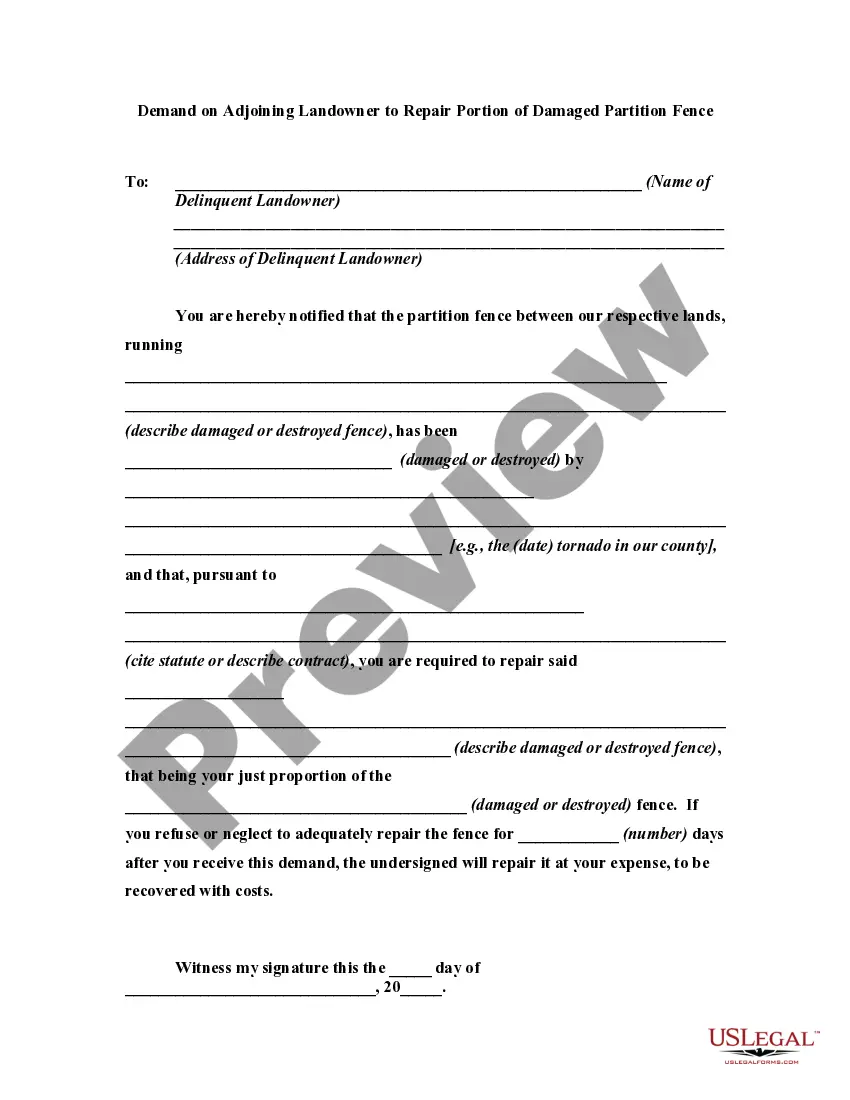
Demand on Adjoining Landowner to Repair Portion of Damaged Partition Fence
What is this form?
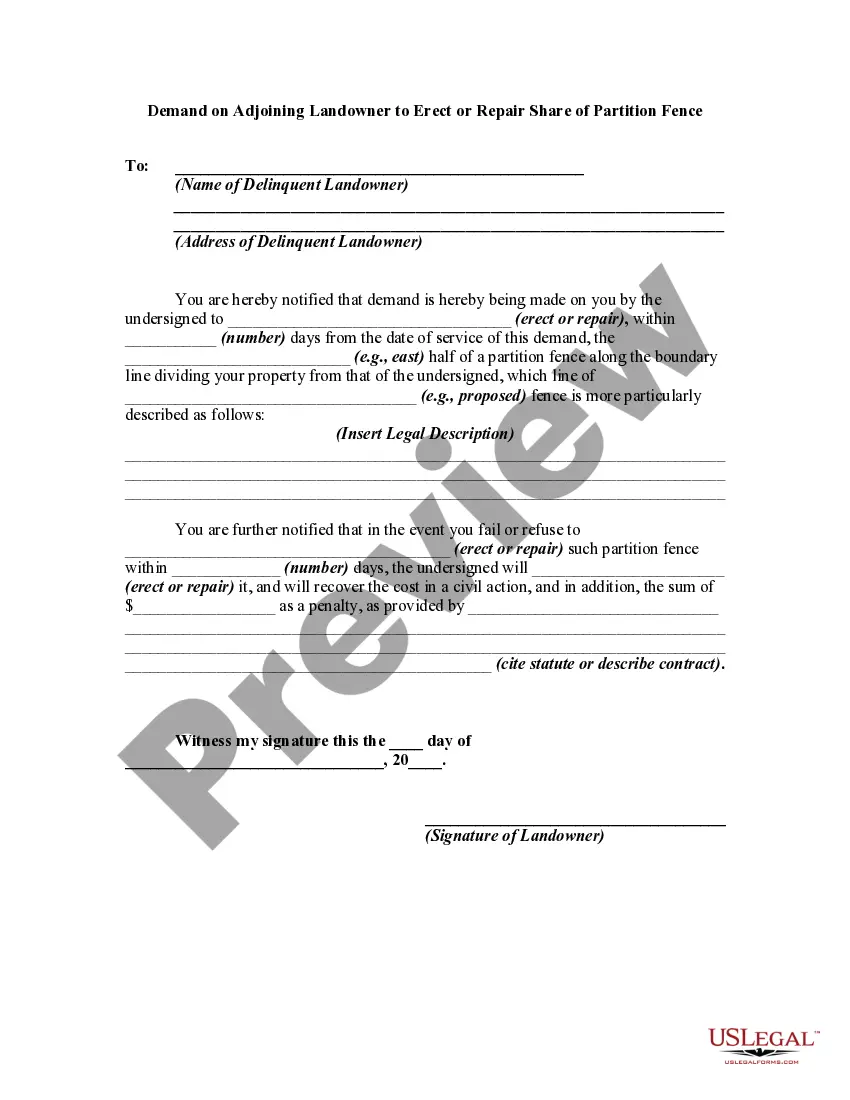
The Demand on Adjoining Landowner to Repair Portion of Damaged Partition Fence is a legal document used by landowners to request repairs on a shared boundary fence that has been damaged. This form clarifies the responsibilities of adjoining landowners concerning the maintenance and repair of a partition fence, highlighting that the fence is typically owned jointly. Understanding this form can help facilitate communication between landowners and ensure compliance with local laws regarding fence maintenance.
Main sections of this form
- Name and address of the delinquent landowner
- Description of the damaged or destroyed fence
- Details of the incident causing the damage
- Citation of relevant statute or contract requiring repairs
- Timeframe for repairs before further action is taken
- Signature of the initiating landowner

Common use cases
This form should be used when a partition fence between two properties has been damaged due to an event such as a storm, and the landowner needs to officially request repairs from the neighboring landowner. It is particularly useful in clarifying each party's responsibilities for maintaining common boundaries and serves as a formal record of communication should disputes arise later.
Who this form is for
- Property owners with adjoining lands where a partition fence exists
- Landowners seeking to clarify maintenance responsibilities
- Individuals needing to establish formal communication with neighboring landowners about fence repairs
Completing this form step by step
- Identify and write the name and address of the delinquent landowner.
- Describe the partition fence that has been damaged.
- Detail the event that caused the damage, including the date if applicable.
- Cite the relevant statute, contract, or agreement that mandates repair responsibilities.
- Specify a timeframe for the repairs to be completed.
- Sign and date the form to validate the request.
Does this document require notarization?
Notarization is generally not required for this form. However, certain states or situations might demand it. You can complete notarization online through US Legal Forms, powered by Notarize, using a verified video call available anytime.
Get your form ready online
Our built-in tools help you complete, sign, share, and store your documents in one place.
Make edits, fill in missing information, and update formatting in US Legal Forms—just like you would in MS Word.
Download a copy, print it, send it by email, or mail it via USPS—whatever works best for your next step.
Sign and collect signatures with our SignNow integration. Send to multiple recipients, set reminders, and more. Go Premium to unlock E-Sign.
If this form requires notarization, complete it online through a secure video call—no need to meet a notary in person or wait for an appointment.
We protect your documents and personal data by following strict security and privacy standards.

Make edits, fill in missing information, and update formatting in US Legal Forms—just like you would in MS Word.

Download a copy, print it, send it by email, or mail it via USPS—whatever works best for your next step.

Sign and collect signatures with our SignNow integration. Send to multiple recipients, set reminders, and more. Go Premium to unlock E-Sign.

If this form requires notarization, complete it online through a secure video call—no need to meet a notary in person or wait for an appointment.

We protect your documents and personal data by following strict security and privacy standards.
Mistakes to watch out for
- Failing to accurately describe the damaged fence.
- Not providing specific details about the incident causing the damage.
- Omitting the citation of relevant laws or agreements.
- Neglecting to set a reasonable timeframe for repairs.
- Not signing and dating the form before delivery.
Benefits of using this form online
- Immediate access to a professional draft tailored for your needs.
- Easy to edit and personalize with specific details related to your situation.
- Convenient download options for easy printing and delivery.
- Reliability backed by licensed attorneys who create and review the forms.
Legal use & context
- The demand establishes a formal record of communication regarding the fence repair responsibilities.
- Failure to comply with the demand can lead to further legal action to recover repair costs.
- This form may aid in resolving disputes amicably before pursuing legal remedies.
Looking for another form?

Form popularity
FAQ
California law presumes that a fence located directly on the property line benefits both homeowners equally. As such, the law states that both homeowners are equally responsible for costs associated with repair and maintenance.
A boundary fence, also called a division fence or partition fence, is a fence that is located on the line between two properties and is used by both owners. Boundary fences are owned by both owners when both use the fence.
The back of the fence the side where the posts are visible faces the owner. The owner of the fence is usually responsible for maintaining the fence.
The average cost to replace a fence is the same as installing a new one at an average price of $12 to $25 per linear foot, not including removing your existing fence for an extra $3 to $5 per linear foot.
If you and your neighbor are on good terms and you both decide that you would like a fence to separate your properties, the cost should be split equally.Even if the fence benefits the neighbor in some way, they have no obligation to help pay for it.
If the fence is your neighbour's responsibility2026 You should be aware that they are not legally obliged to put up a garden fence on their boundary at all. As long as there is a visible demarcation along the boundary, your neighbour could string a length of wire between some posts and call it a day.
The cheapest fence you can install is a wire fencing at $2 per foot on average, while a 6-foot high wood privacy fence costs $13 to $25 per linear foot, and vinyl fencing for $15 to $30 per foot. Check out our fence cost estimator below for more types of fences priced per foot and per acre.
There is no general rule about whether you are responsible for the boundary fence on the left or right or rear of the property. If your property is registered at the Land Registry you can obtain what is called an 'office copy' comprising a title plan and register details.
The finished side should face toward your neighbor. Not only is this more polite, but it's the standard. Your property will look a lot nicer with the good side facing the outside world. Otherwise, your fence will look like it was installed backward.