Motion to Correct a Clerical Omission Nunc Pro Tunc in a Previous Order
Understanding this form
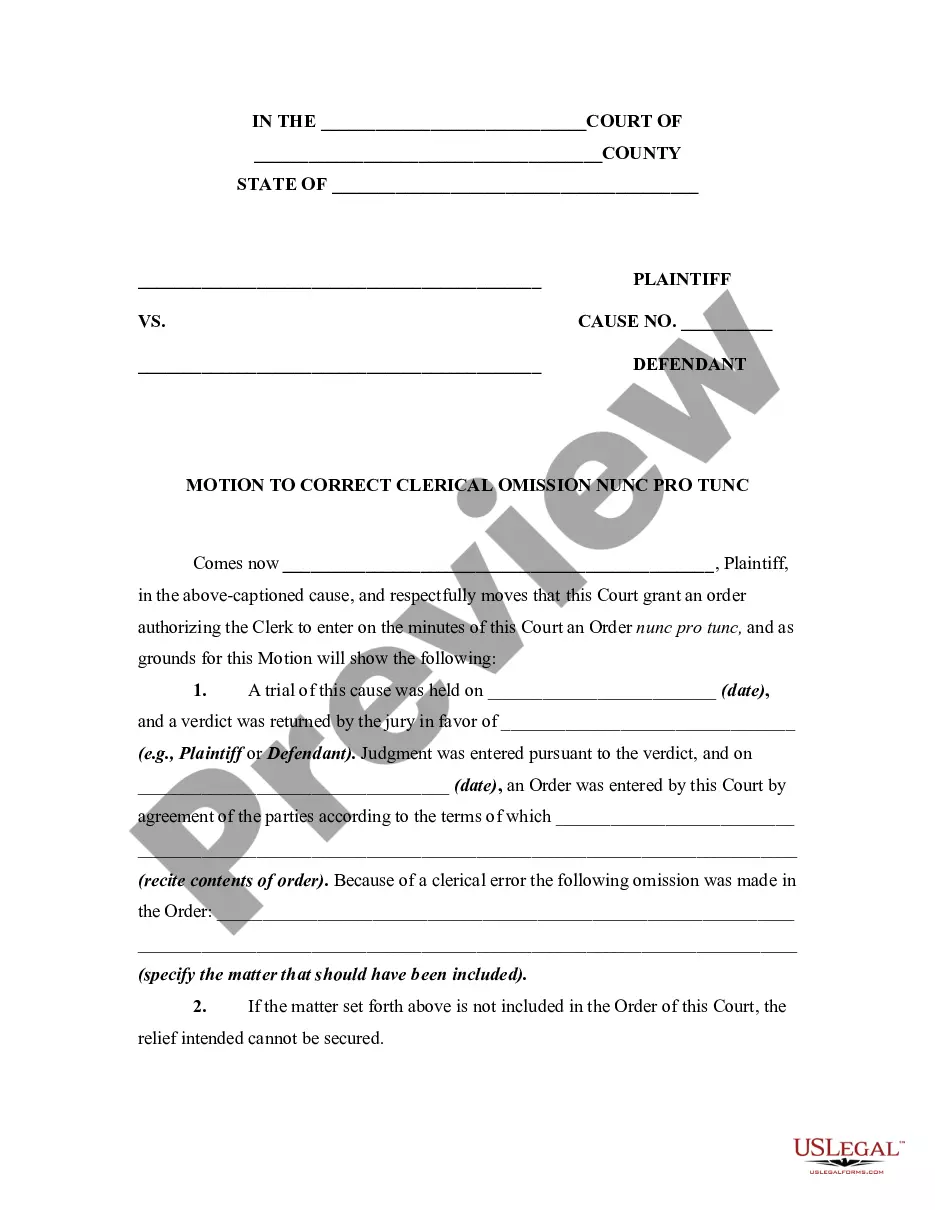
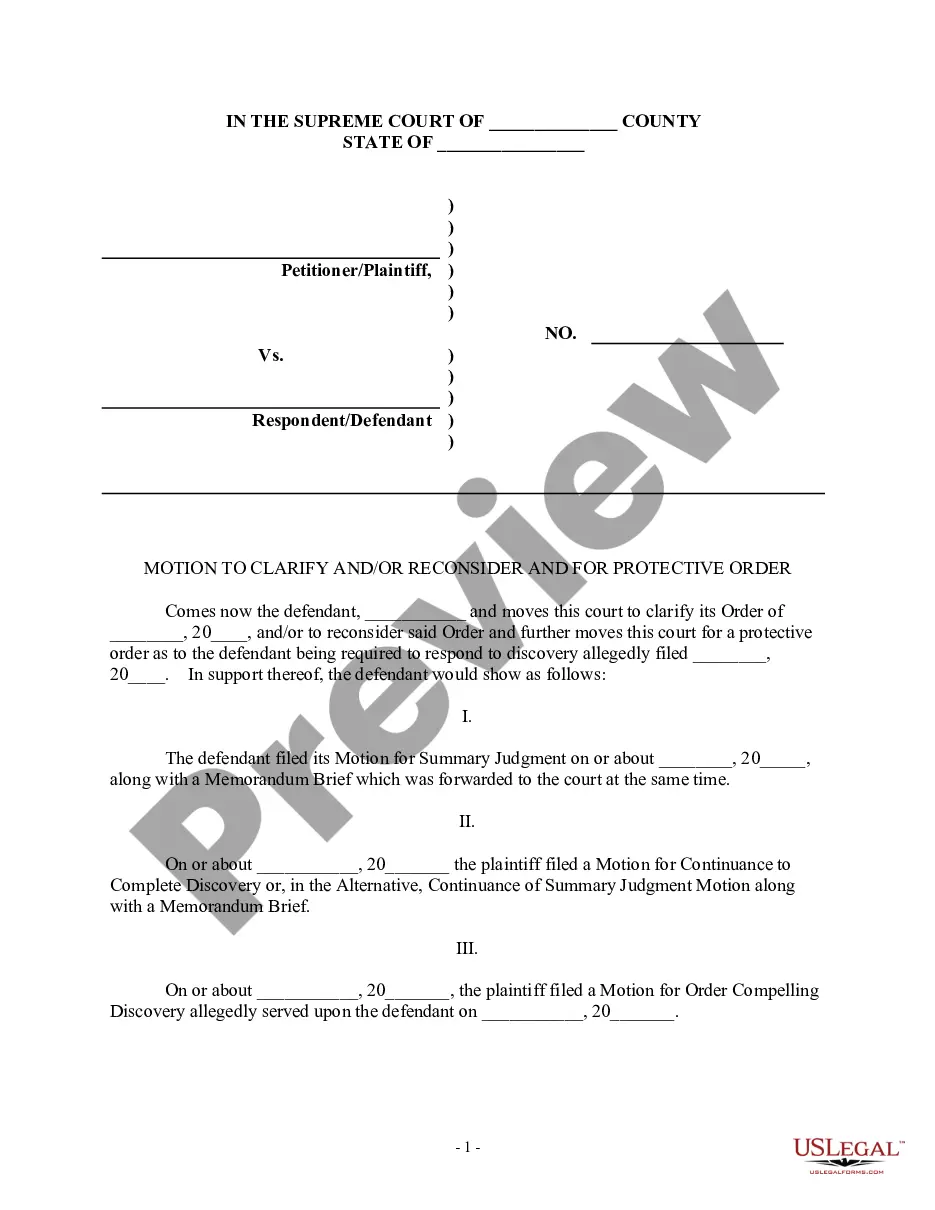
The Motion to Correct a Clerical Omission Nunc Pro Tunc in a Previous Order is a legal document used to request a court to amend an earlier judgment or order due to clerical errors. The term "nunc pro tunc," meaning "now for then," is applied when something that should have occurred at an earlier date is rectified now. Unlike standard motions, this form is specifically aimed at correcting mistakes that affect the accuracy of court records, ensuring that the intended legal outcomes reflect the true intentions of the court and parties involved.
Key parts of this document
- Identification of the parties involved (Plaintiff and Defendant).
- Details of the original trial date and the verdict.
- Specification of the clerical omission that occurred in the previous order.
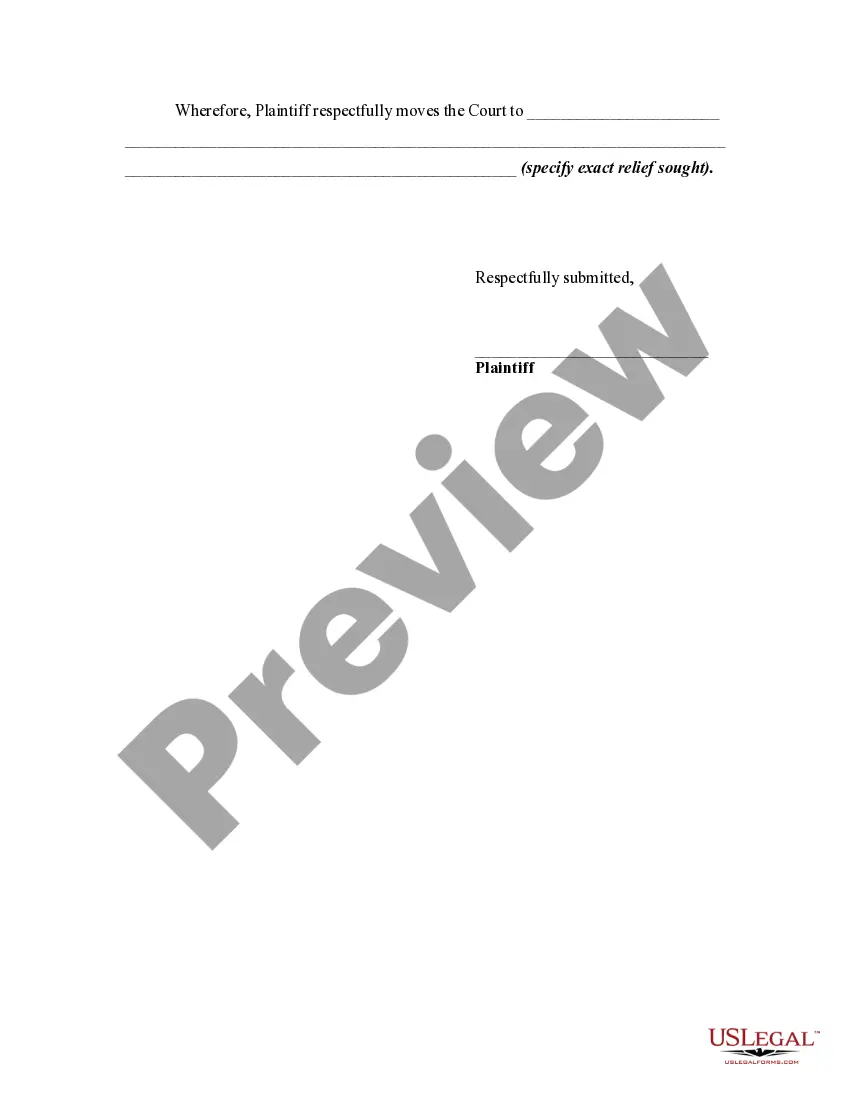
- Request for specific relief or correction intended by this motion.
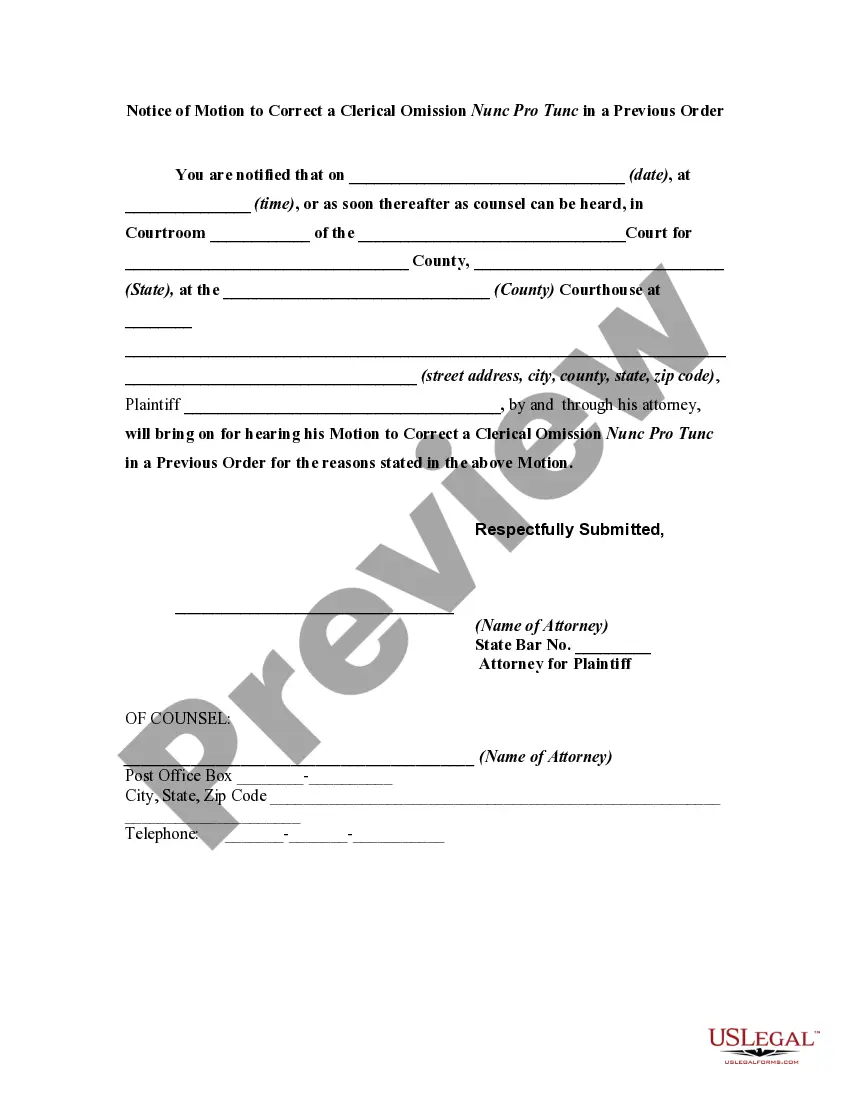
- Notice of the hearing date and the court location.
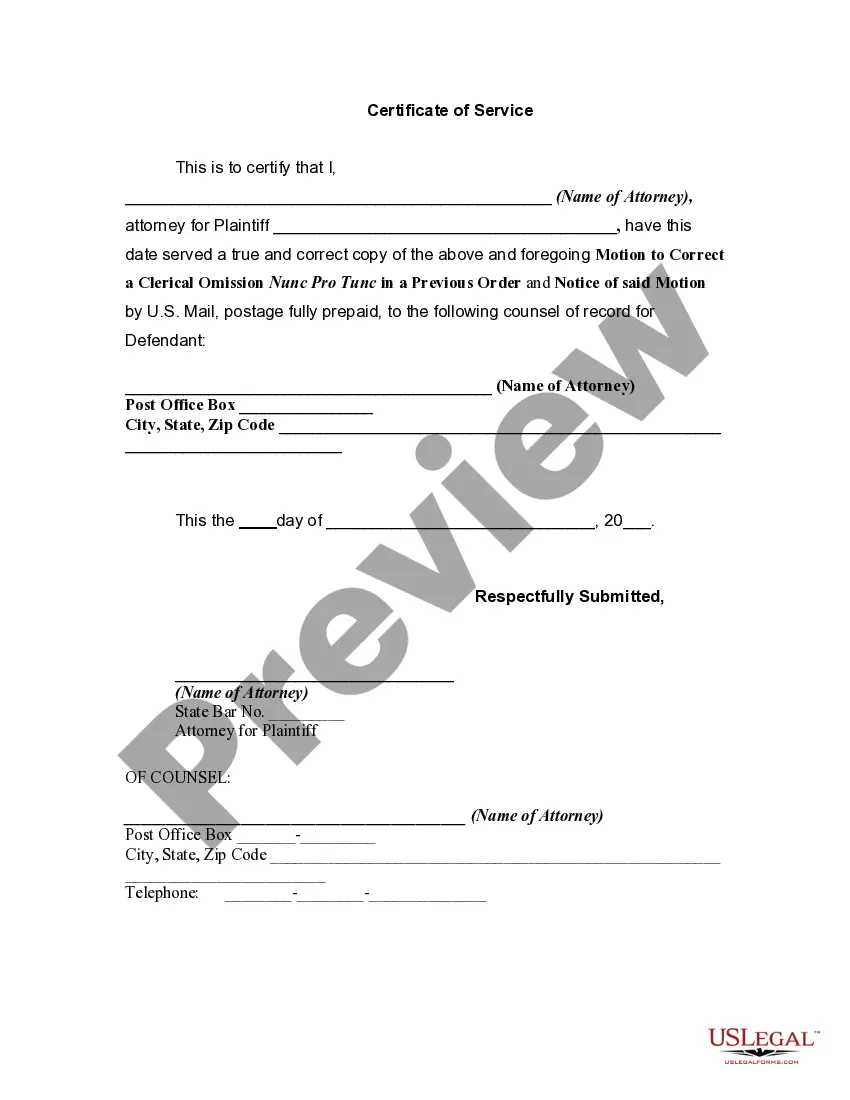
- Certificate of service confirming distribution of the motion to the opposing party.

When this form is needed
This form is necessary when a clerical error in a prior court order needs to be corrected for the legal intent and effect of that order to be fulfilled. For example, if a court's written order did not reflect the decision made during a trial or hearing, and this omission could hinder the relief intended, a motion needs to be filed. It is particularly vital in scenarios where accurate documentation affects the enforcement of judgments or rights.
Intended users of this form
- Individuals acting as plaintiffs in a civil case.
- Legal representatives or attorneys preparing motions for their clients.
- Anyone needing to amend a court order due to clerical errors affecting legal rights.
Instructions for completing this form
- Fill in the names of the Plaintiff and Defendant, along with the case number at the top of the form.
- Provide the date of the trial and the name of the party favored by the jury verdict.
- Clearly specify the content of the previous order that contained the clerical omission.
- State the specific relief or correction you seek from the court.
- Complete the notice of the motion, detailing the time and place for the hearing.
- Sign the certificate of service, confirming you have delivered copies of the motion to the opposing party.
Does this document require notarization?
This form usually doesn’t need to be notarized. However, local laws or specific transactions may require it. Our online notarization service, powered by Notarize, lets you complete it remotely through a secure video session, available 24/7.
Get your form ready online
Our built-in tools help you complete, sign, share, and store your documents in one place.
Make edits, fill in missing information, and update formatting in US Legal Forms—just like you would in MS Word.
Download a copy, print it, send it by email, or mail it via USPS—whatever works best for your next step.
Sign and collect signatures with our SignNow integration. Send to multiple recipients, set reminders, and more. Go Premium to unlock E-Sign.
If this form requires notarization, complete it online through a secure video call—no need to meet a notary in person or wait for an appointment.
We protect your documents and personal data by following strict security and privacy standards.

Make edits, fill in missing information, and update formatting in US Legal Forms—just like you would in MS Word.

Download a copy, print it, send it by email, or mail it via USPS—whatever works best for your next step.

Sign and collect signatures with our SignNow integration. Send to multiple recipients, set reminders, and more. Go Premium to unlock E-Sign.

If this form requires notarization, complete it online through a secure video call—no need to meet a notary in person or wait for an appointment.

We protect your documents and personal data by following strict security and privacy standards.
Common mistakes
- Failing to specify the exact clerical omission present in the previous order.
- Not including the correct date and time for the motion hearing.
- Missing signatures or contact information in the certificate of service.
- Neglecting to check local court rules for additional requirements.
Why complete this form online
- Convenient access to legal forms anytime, from any device.
- Editable templates allow for customization according to individual case details.
- Reliability of forms drafted by licensed attorneys ensures legal compliance.
Key takeaways
- The Motion to Correct a Clerical Omission Nunc Pro Tunc addresses clerical errors in court orders.
- It is crucial for ensuring that legal documents accurately reflect court intentions.
- Correct filing and proper notice to all parties are essential for the motion's success.
Looking for another form?
Form popularity
FAQ
Nunc Pro Tunc. Latin, Now for then. nunc pro tunc. (nuhnk proh tuhnk): adj. NUNC PRO TUNC, practice. This phrase, which signifies now for then, is used to express that a thing is done at one time which ought to have been performed at another.
Errors other than errors of principle are called clerical errors. The following are the types of clerical errors. 1. Errors of Omission: These errors arise as a result of some act of omission on the part of the person responsible for the maintenance of books of account.
When your court order contains a specific kind of mistakea clerical errorone way to correct it is by filing a document with the court called a motion for judgment nunc pro tunc. This is the method for asking the judge to issue a new judgment or order that contains the correct information.
Nunc pro tunc is a phrase used in an order or judgment when the court wants the order or judgment to be effective as of a date in the past rather than on the date the judgment or order is entered into the court record.
A clerical error is an error on the part of an office worker, often a secretary or personal assistant. It is a phrase which can also be used as an excuse to deflect blame away from specific individuals, such as high-powered executives, and instead redirect it to the more anonymous clerical staff.
A mistake made in a letter, paper, or document that changes its meaning, such as a typographical error or the unintentional addition or omission of a word, phrase, or figure. A mistake of this kind is a result of an oversight.
Error of omission is when a transaction is being missed out from being recorded by the person maintaining accounts. errors of commission is recording wrong account, wrong amount, wrong totalling etc,.