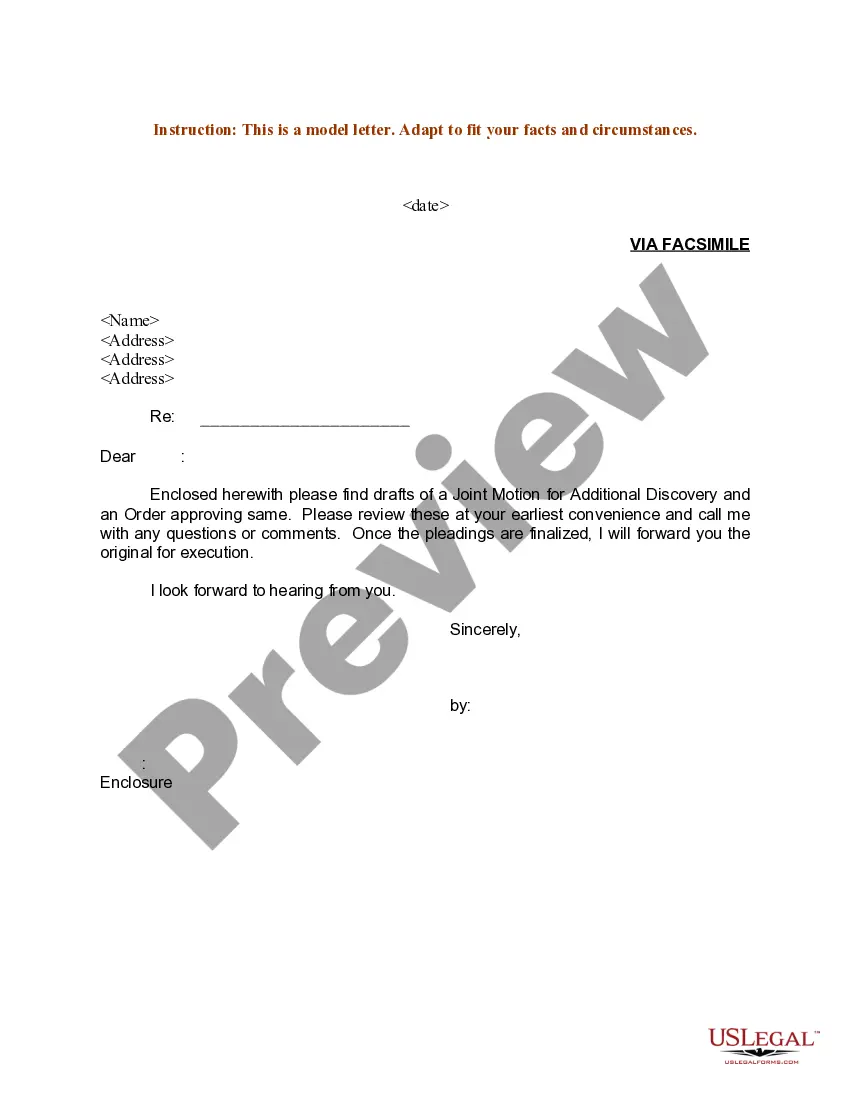
Sample Letter for Drafts of a Joint Motion for Additional Discovery and an Order Approving Same
Understanding this form
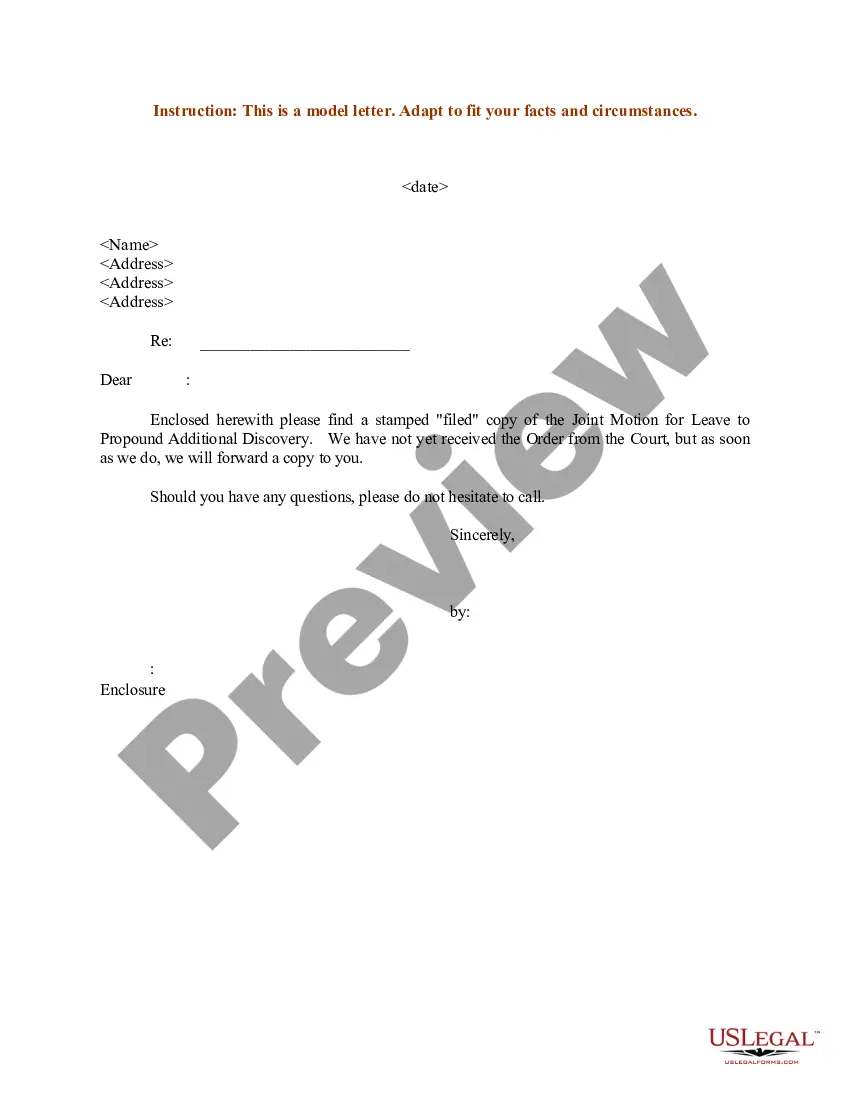
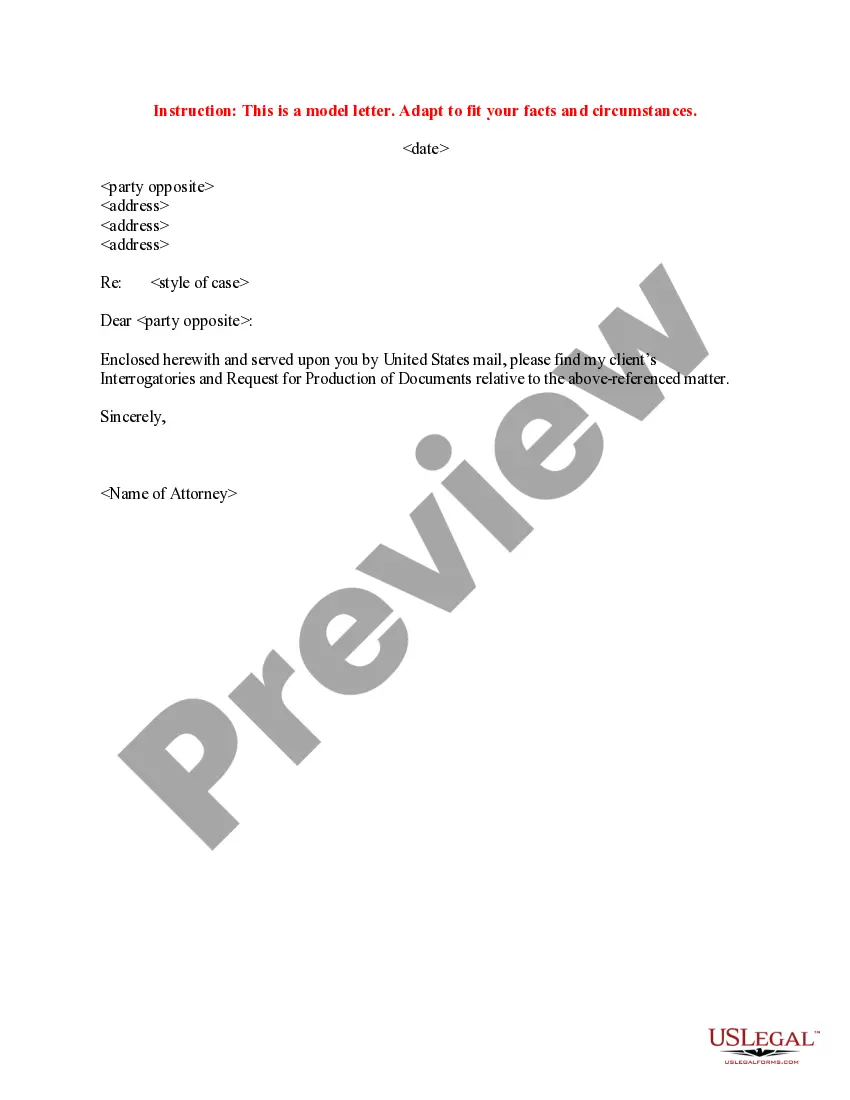
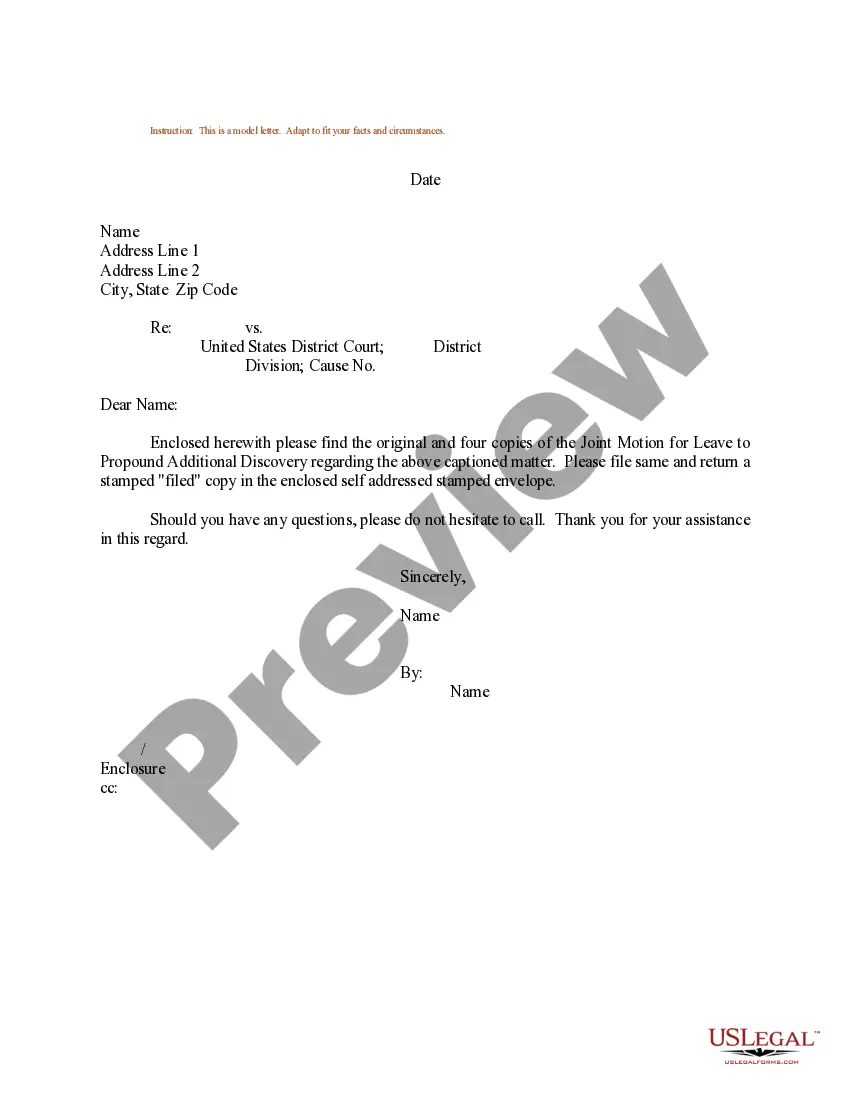
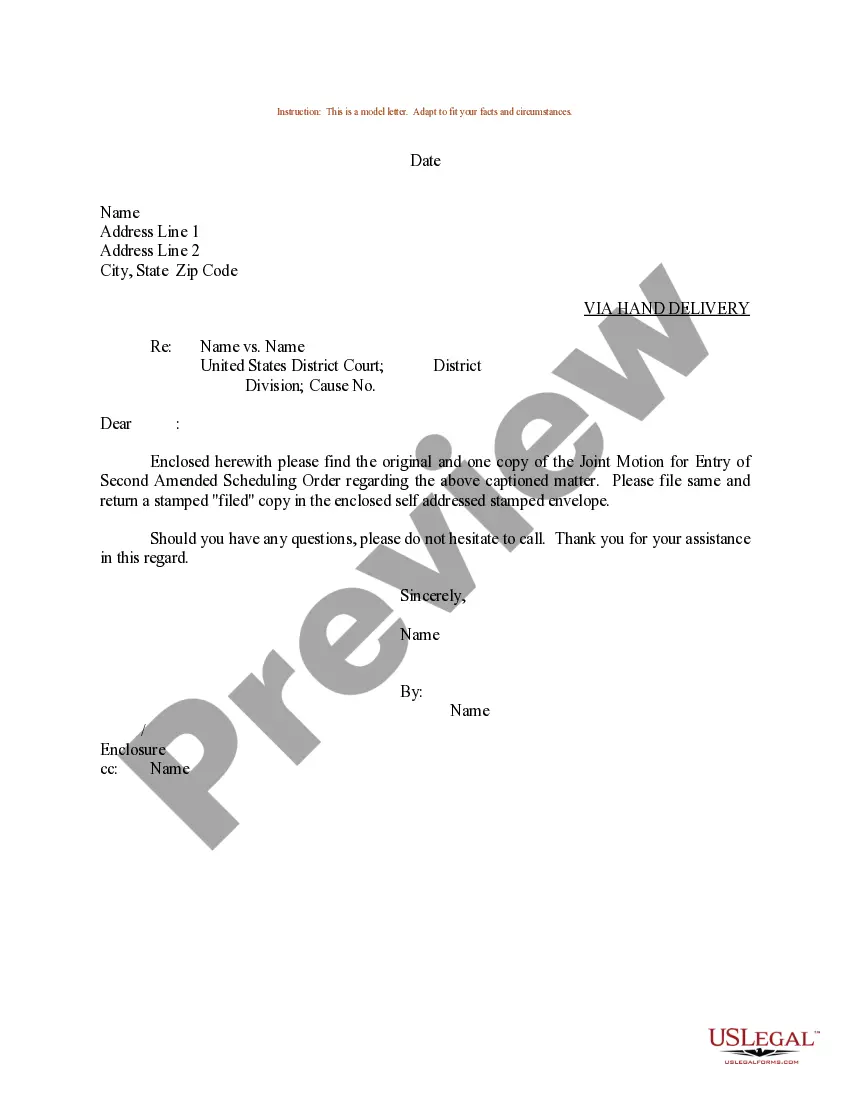
This form is a sample letter for drafts of a Joint Motion for Additional Discovery and an Order Approving Same. It provides a structured template to facilitate communication with the opposing party or court regarding the need for further discovery in a legal case. Unlike general motion templates, this specific letter is tailored to request additional discovery while seeking formal approval from the court.
Key components of this form
- Date section for when the letter is sent
- Recipient information, including name and address
- Subject line specifying the purpose of the letter
- Salutation and body text, which outlines the request for additional discovery
- Signature block for the sender's details and any necessary legal credentials

When to use this form
This letter is typically used in civil litigation where a party believes that additional discovery is necessary to support their case. It can be used when previous discovery efforts were insufficient or when new information has come to light that may impact the case. This form ensures that the request is formally documented and can be presented to the court.
Who can use this document
- Attorneys representing clients in civil litigation
- Individuals acting as their own legal representatives
- Parties in a legal dispute who need to request more evidence or information
Completing this form step by step
- Enter the date of the letter at the top of the form.
- Fill in the recipient's name, address, and any other required contact details.
- Specify the subject of the letter clearly to convey the purpose.
- Draft the body of the letter to articulate the reasons for requesting additional discovery.
- Sign the letter and include your contact information.
Does this form need to be notarized?
This form does not typically require notarization unless specified by local law. It focuses on formal communication without the need for additional verification.
Get your form ready online
Our built-in tools help you complete, sign, share, and store your documents in one place.
Make edits, fill in missing information, and update formatting in US Legal Forms—just like you would in MS Word.
Download a copy, print it, send it by email, or mail it via USPS—whatever works best for your next step.
Sign and collect signatures with our SignNow integration. Send to multiple recipients, set reminders, and more. Go Premium to unlock E-Sign.
If this form requires notarization, complete it online through a secure video call—no need to meet a notary in person or wait for an appointment.
We protect your documents and personal data by following strict security and privacy standards.

Make edits, fill in missing information, and update formatting in US Legal Forms—just like you would in MS Word.

Download a copy, print it, send it by email, or mail it via USPS—whatever works best for your next step.

Sign and collect signatures with our SignNow integration. Send to multiple recipients, set reminders, and more. Go Premium to unlock E-Sign.

If this form requires notarization, complete it online through a secure video call—no need to meet a notary in person or wait for an appointment.

We protect your documents and personal data by following strict security and privacy standards.
Common mistakes to avoid
- Failing to include a clear subject line.
- Not personalizing the letter for the specific case or recipient.
- Leaving out critical details about the discovery requests.
- Neglecting to proofread for typos or grammatical errors.
Advantages of online completion
- Convenience of downloading and editing the template as needed.
- Access to a legally accurate form drafted by licensed attorneys.
- Time-saving as you wonât need to create a letter from scratch.
Looking for another form?










Form popularity
FAQ
In the world of mechanics, there are four basic types of motion. These four are rotary, oscillating, linear and reciprocating. Each one moves in a slightly different way and each type of achieved using different mechanical means that help us understand linear motion and motion control.
Motion is a phenomenon that is very common in our daily life. For example, the car in which you travel moves, the air we breathe is in motion, the blood in our veins is in motion, the earth is in motion, the universe is moving and many more.
Motion to Dismiss an attempt to get the judge to dismiss a charge or the case. Motion to Suppress an attempt to keep certain statements or evidence from being introduced as evidence. Motion for Change of Venue may be made for various reasons including pre-trial publicity.
The Notice of Motion usually begins with the caption that includes the court of jurisdiction, the docket number, and below the docket number, "Notice of Motion." It is usual to then write, "Please take Notice that the undersigned will bring a motion for (what you are asking the court for or to do)." Read the Local
Motion to dismiss. Discovery motions. Motion to compel. Motion to strike. Motion for summary judgment. Motion for a directed verdict. Motion for nolle prosequi. Motion in Limine.
Motion means displacement or change in the position of an object over time. It can be described in terms of displacement, distance, velocity etc. eg pushing a block is an example of linear motion, opening a door is an example of rotation, rotating stone with attached thread is an example of a circular motion.
Examples Of Motion Our daily activities, like walking, running, closing the door, etc. involve motion.The flow of air in and out of our lungs is also an example of motion. The automobiles that carry passengers from the place of pick up to the destination possess motion.
Wind. A ball being thrown. Someone running. A fish swimming.