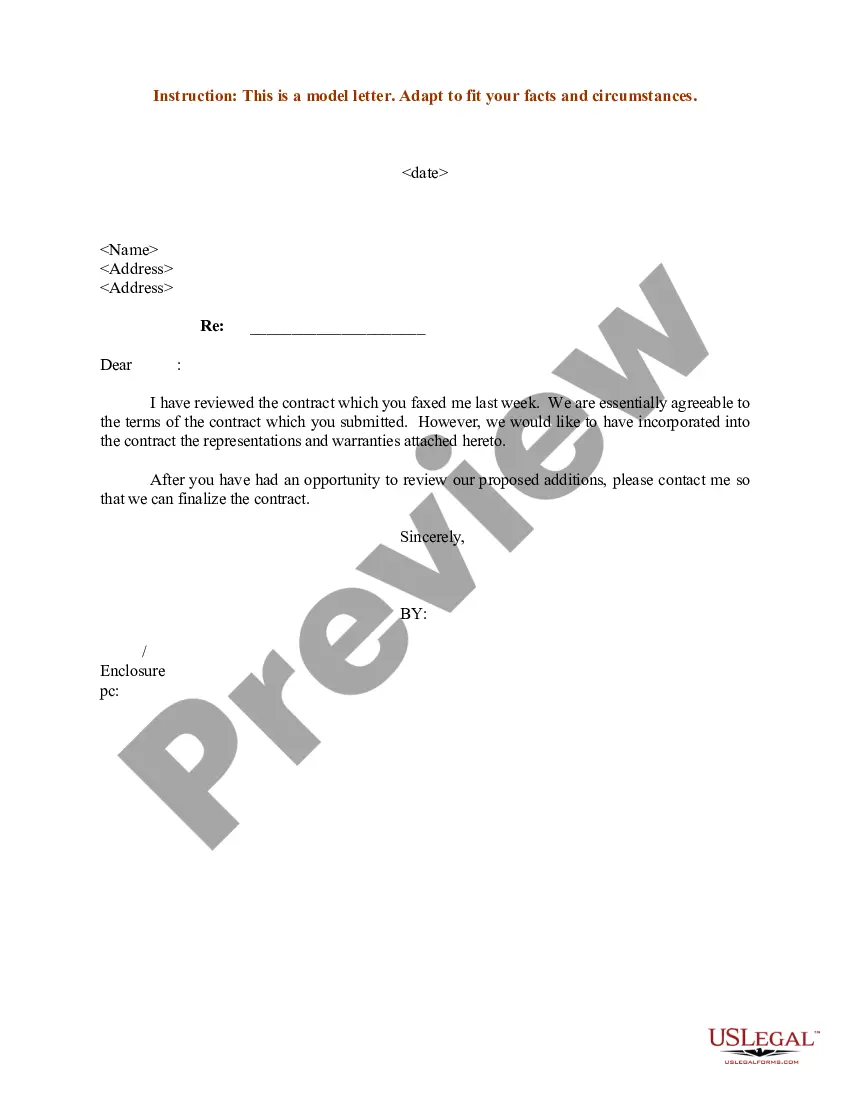
Sample Letter concerning Terms of a Contract
About this form
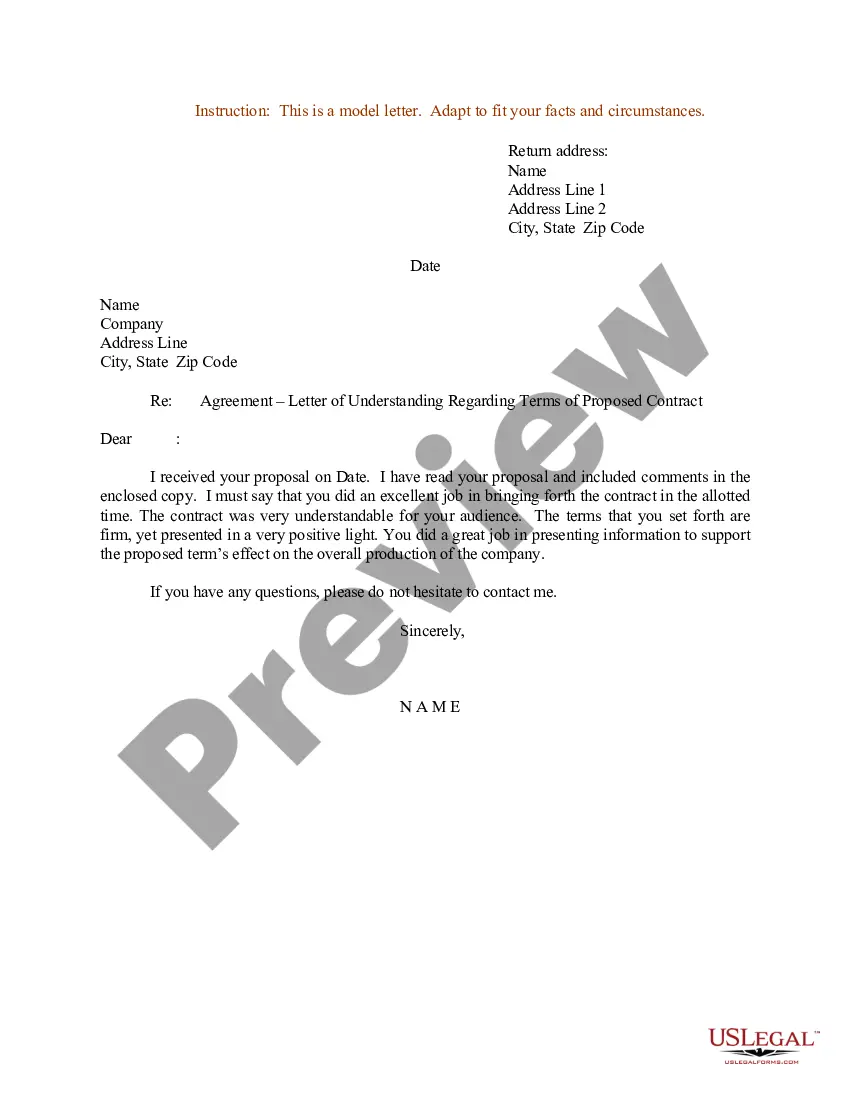
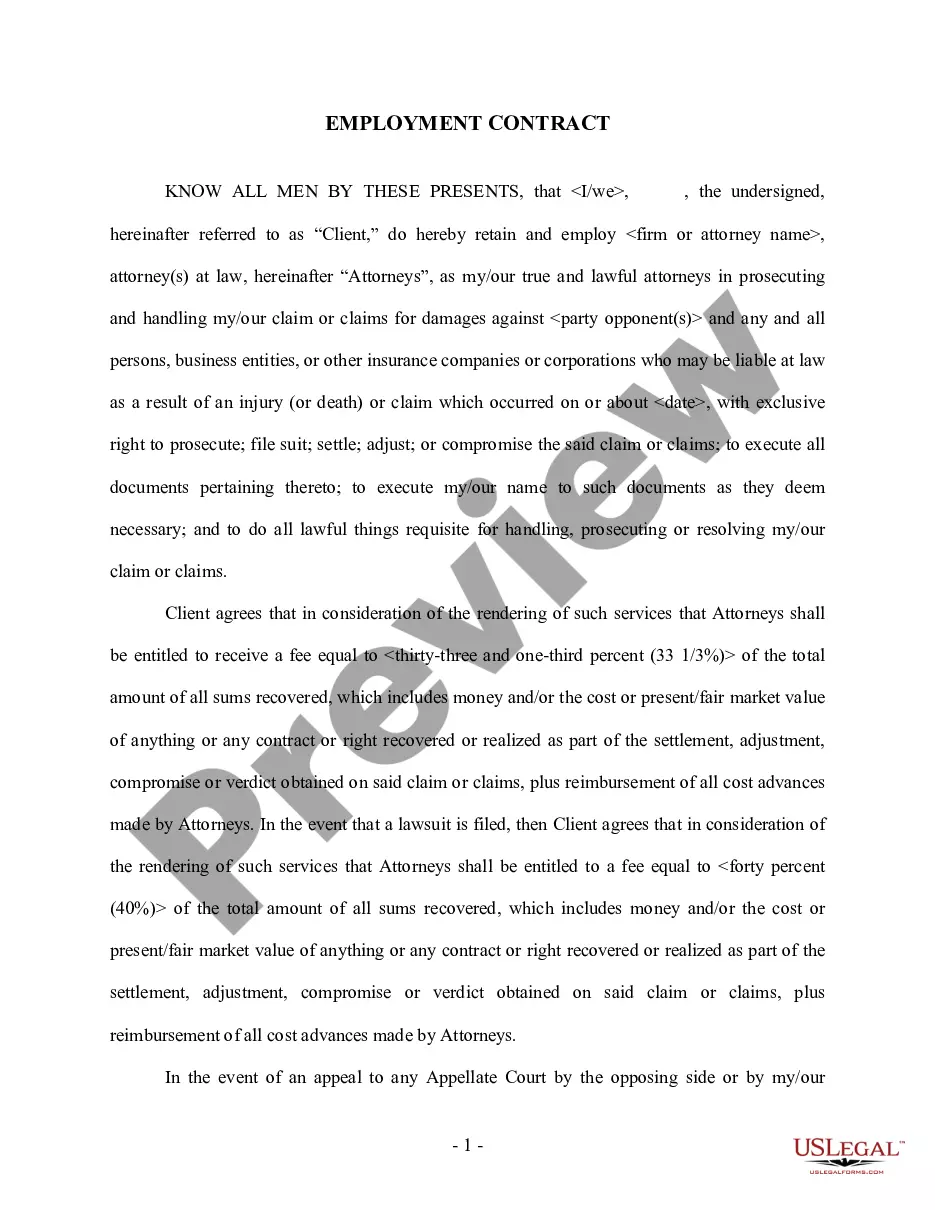
The Sample Letter concerning Terms of a Contract is a formal communication used to address and negotiate specific terms of a contract that has been received. Unlike basic contract templates, this letter allows the sender to seek amendments or clarifications by outlining their conditions for agreement. It ensures both parties are aligned before finalizing the contract.
Main sections of this form
- Introduction stating the review of the contract received.
- Agreement to the majority of the contract terms.
- Proposal for additional representations and warranties.
- Request for further communication to finalize the contract.
Situations where this form applies
This form is useful when you have reviewed a contract with another party and are ready to express your agreement with certain conditions while proposing changes. Use this letter when you want to clearly communicate your acceptance of most terms but require additional clauses to be included before proceeding with the agreement.
Who this form is for
- Business owners engaging in contracts with other parties.
- Individuals negotiating terms of agreements, such as leases or service contracts.
- Lawyers seeking to formalize amendments in a contractual agreement.
- Companies looking to assert their interests before concluding a contract.
Steps to complete this form
- Identify the parties involved in the contract.
- Clearly state that you have reviewed the received contract.
- Express agreement with the majority of the terms.
- List any additional representations and warranties you wish to include.
- Close with a request to discuss the proposed changes to finalize the contract.
Does this document require notarization?
This form usually doesn’t need to be notarized. However, local laws or specific transactions may require it. Our online notarization service, powered by Notarize, lets you complete it remotely through a secure video session, available 24/7.
Get your form ready online
Our built-in tools help you complete, sign, share, and store your documents in one place.
Make edits, fill in missing information, and update formatting in US Legal Forms—just like you would in MS Word.
Download a copy, print it, send it by email, or mail it via USPS—whatever works best for your next step.
Sign and collect signatures with our SignNow integration. Send to multiple recipients, set reminders, and more. Go Premium to unlock E-Sign.
If this form requires notarization, complete it online through a secure video call—no need to meet a notary in person or wait for an appointment.
We protect your documents and personal data by following strict security and privacy standards.

Make edits, fill in missing information, and update formatting in US Legal Forms—just like you would in MS Word.

Download a copy, print it, send it by email, or mail it via USPS—whatever works best for your next step.

Sign and collect signatures with our SignNow integration. Send to multiple recipients, set reminders, and more. Go Premium to unlock E-Sign.

If this form requires notarization, complete it online through a secure video call—no need to meet a notary in person or wait for an appointment.

We protect your documents and personal data by following strict security and privacy standards.
Typical mistakes to avoid
- Not specifying the additional terms clearly, which can lead to misunderstandings.
- Failing to document communication about changes, creating a lack of clarity.
- Rushing to finalize the contract without ensuring all terms are agreeable.
Advantages of online completion
- Convenience of downloading the template anytime and anywhere.
- Editability to tailor the letter to specific contract needs.
- Reliability from using a professionally drafted template by licensed attorneys.
Looking for another form?

Form popularity
FAQ
Writing Your Terms and Conditions. Start with a statement regarding the acceptance of your terms and conditions. Your very first paragraph should always be an acceptance of terms clause. This clause ensures that your users understand that by using your service they are accepting the terms and conditions.
A letter of agreement form is a document used to explain the terms and conditions of a relationship.The parties can then finish negotiating the details before it is put together as a legal document. A letter of agreement can, in some states, be legally binding if it is signed by all participating parties.
Terms and conditions are aimed at protecting the business (you). They give business owners the opportunity to set their rules (within applicable law) of how their service or product may be used including, but not limited to, things like copyright conditions, age limits, and the governing law of the contract.
Complete necessary heading. Write introduction. Define services to be rendered. Identify benchmarks and timeline. Agree on revisions. Include payment information. Clarify the period of enforcement. State the governing law.
When you hire a lawyer in the Priori network, drafting terms and conditions typically costs anywhere from $300 to $5,000. Drafting a privacy policy may cost anywhere from $275 for simple policies to $5,000 for more complex documents.
Begin your letter by clearly indicating the parties involved in the agreement. Remember to include the date the agreement takes effect and title of the venture. Clearly state the reason for your agreement in your first paragraph giving description of all details such as stake holder ratio, payment period etc.
Begin your letter by clearly indicating the parties involved in the agreement. Clearly state the reason for your agreement in your first paragraph giving description of all details such as stake holder ratio, payment period etc.
Introduction. Right to make changes to the agreement. User guidelines (rules, restrictions, requirements) Copyright and intellectual property. Governing law. Warranty disclaimer. Limitation of liability.
Use clear and concise language. Try and use language that is friendly and positive and explain the rational for provisions that might otherwise appear too strong. Make sure the information is set out in a well-structured and logical way.