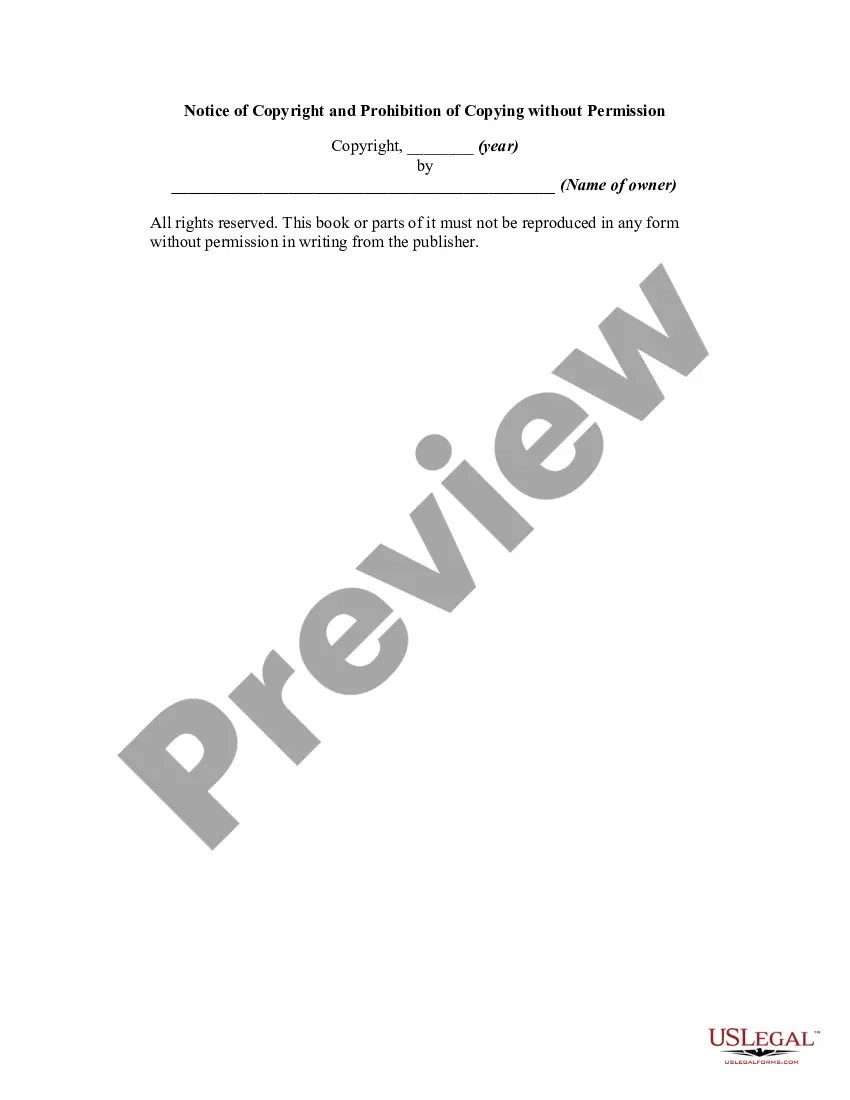
Notice of Copyright and Prohibition of Copying without Permission
What this document covers
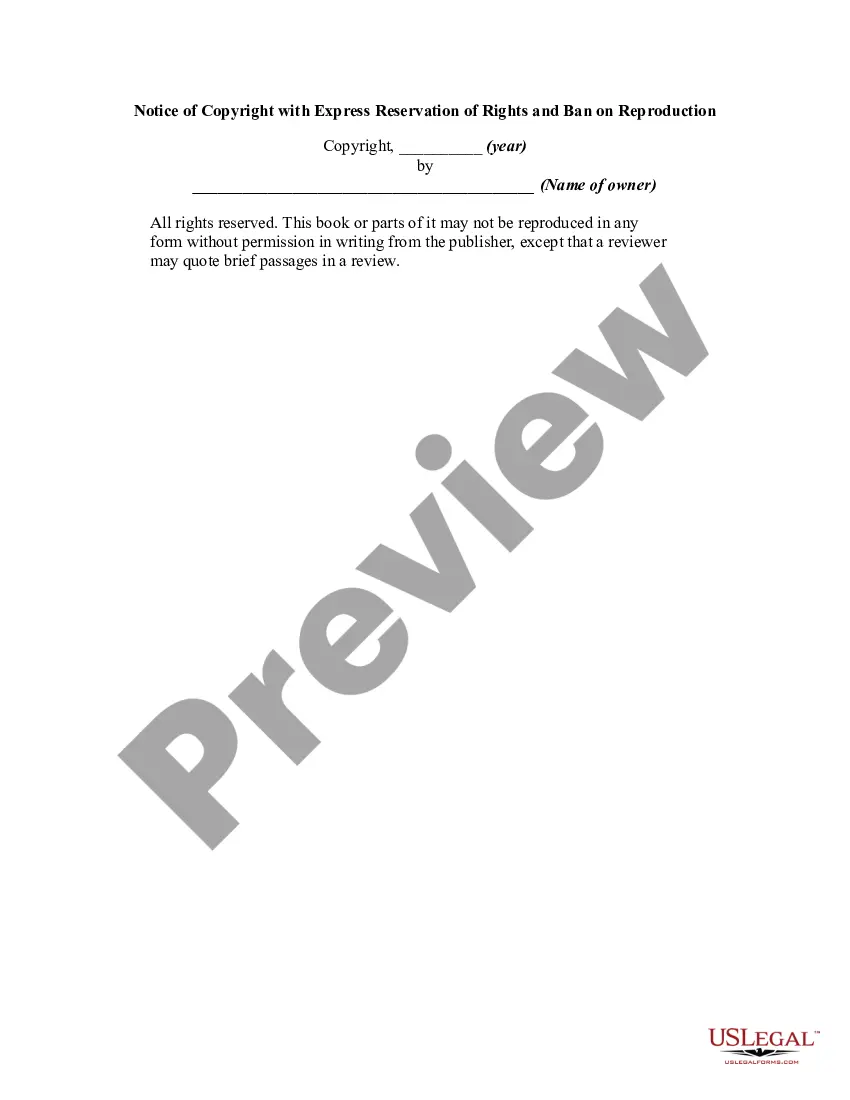
The Notice of Copyright and Prohibition of Copying without Permission is a legal document used to declare copyright ownership and protect creative works. This form provides a clear notice to the public that the work is under copyright, identifies the owner, and specifies the year of first publication. It differs from other legal forms by focusing specifically on copyright protection and the prohibition of unauthorized copying.
Key components of this form
- Copyright statement indicating ownership.
- Year of copyright registration.
- Name of the copyright owner.
- Statement prohibiting reproduction without permission.
When to use this document
This form should be used whenever a creator wants to formally announce that their work is protected by copyright. Whether you are publishing a book, a piece of art, or any other creative work, using this notice helps to inform the public of your rights and discourages unauthorized copies.
Who needs this form
This form is suitable for:
- Authors of books and articles.
- Artists and illustrators of original works.
- Musicians and composers.
- Software developers and creators of digital content.
How to prepare this document
- Locate the year of first publication and enter it in the designated field.
- Fill in the name of the copyright owner.
- Include the copyright statement that specifies all rights are reserved.
- Specify that reproduction in any form requires written permission.
Is notarization required?
This form usually doesn’t need to be notarized. However, local laws or specific transactions may require it. Our online notarization service, powered by Notarize, lets you complete it remotely through a secure video session, available 24/7.
Get your form ready online
Our built-in tools help you complete, sign, share, and store your documents in one place.
Make edits, fill in missing information, and update formatting in US Legal Forms—just like you would in MS Word.
Download a copy, print it, send it by email, or mail it via USPS—whatever works best for your next step.
Sign and collect signatures with our SignNow integration. Send to multiple recipients, set reminders, and more. Go Premium to unlock E-Sign.
If this form requires notarization, complete it online through a secure video call—no need to meet a notary in person or wait for an appointment.
We protect your documents and personal data by following strict security and privacy standards.

Make edits, fill in missing information, and update formatting in US Legal Forms—just like you would in MS Word.

Download a copy, print it, send it by email, or mail it via USPS—whatever works best for your next step.

Sign and collect signatures with our SignNow integration. Send to multiple recipients, set reminders, and more. Go Premium to unlock E-Sign.

If this form requires notarization, complete it online through a secure video call—no need to meet a notary in person or wait for an appointment.

We protect your documents and personal data by following strict security and privacy standards.
Common mistakes to avoid
- Forgetting to include the year of first publication.
- Not clearly identifying the copyright owner.
- Omitting the prohibition statement on reproduction.
Benefits of completing this form online
- Convenient access to a legally vetted form.
- Editable format that allows for customization according to your needs.
- Reliable content drafted by licensed attorneys.
Key takeaways
- The Notice of Copyright is essential for protecting creative works from unauthorized use.
- Accurate completion of the form is critical to enforce legal rights.
- This form can be utilized across multiple states, making it a versatile tool for copyright protection.
Looking for another form?




Form popularity
FAQ
Can I print a copyrighted picture for personal use? You can't legally use someone else's intellectual property without getting permission. Any reproduction of copyrighted material is considered a violation.
Fair use allows limited use of copyrighted material without permission from the copyright holder for purposes such as criticism, parody, news reporting, research and scholarship, and teaching. There are four factors to consider when determining whether your use is a fair one.
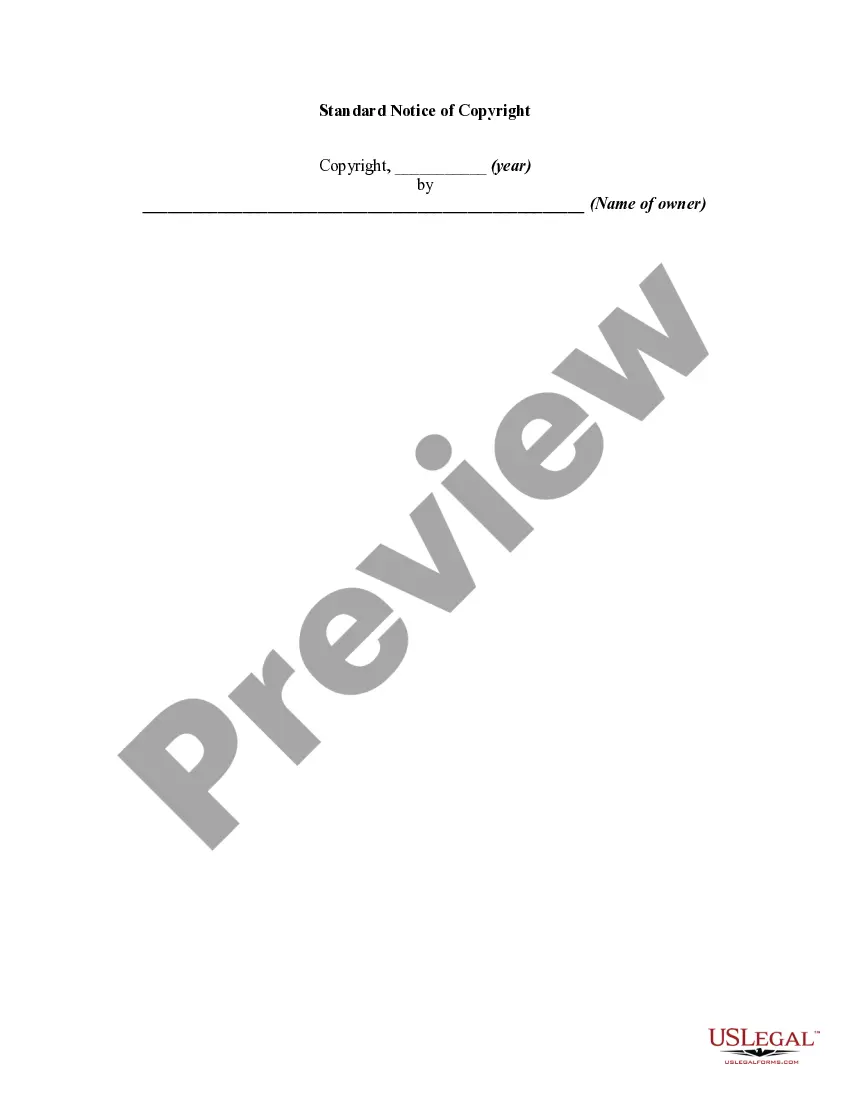
The symbol © (letter C in a circle), the word Copyright, or the abbreviation Copr. The year of first publication. The name of the copyright owner, an abbreviation by which the name can be recognized, or a generally known alternative designation of owner.
If an exception applies, you do not need to ask the copyright owner for permission to undertake acts within its scope. For example, the fair dealing exceptions can apply when you copy material for the purpose of research, study, criticism, review, parody, satire, reporting the news, or giving legal advice.
Using creative works such as a logo, photo, image or text without permission can infringe copyright law. All businesses need to understand how to legally use copyrighted material. If you break copyright law even by accident you can face large fines and even imprisonment.
Copyright is a legal means of protecting an author's work. It is a type of intellectual property that provides exclusive publication, distribution, and usage rights for the author.Many different types of content can be protected by copyright. Examples include books, poems, plays, songs, films, and artwork.
One way to make sure your intended use of a copyrighted work is lawful is to obtain permission or a license from the copyright owner. Contact a copyright owner or author as far as pos- sible in advance of when you want to use the material specified in your permissions request.
It is illegal to copy large sections of someone else's copyrighted work without permission, even if you give the original author credit.Fortunately, a fair use exemption allows you to legally copy small amounts of someone else's work. Just make sure to give the author credit so you won't be guilty of plagiarism!