Order Denying Review of Certification
Understanding this form
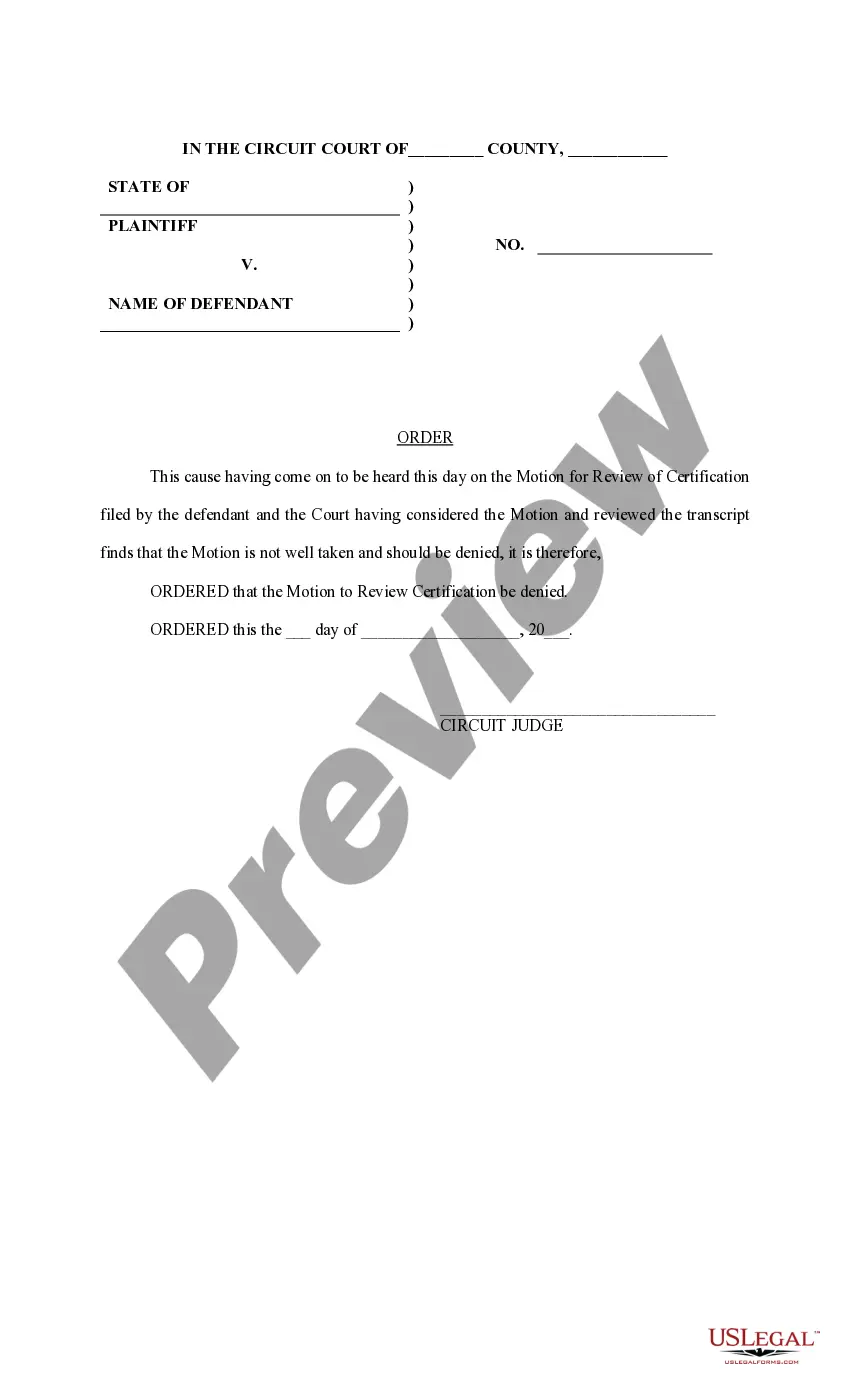
This is an Order Denying Review of Certification, which serves to formally reject a motion filed by a defendant seeking certification for a particular legal matter. Unlike other motions that may approve certification, this form signifies that the court finds the motion unfounded and thus denies the request. It is crucial for maintaining clarity within legal proceedings when jurisdiction or claims are challenged.
Key components of this form
- Field for the date of the order.
- Signature line for the Circuit Judge.
- Clear statement that the motion to review certification is denied.
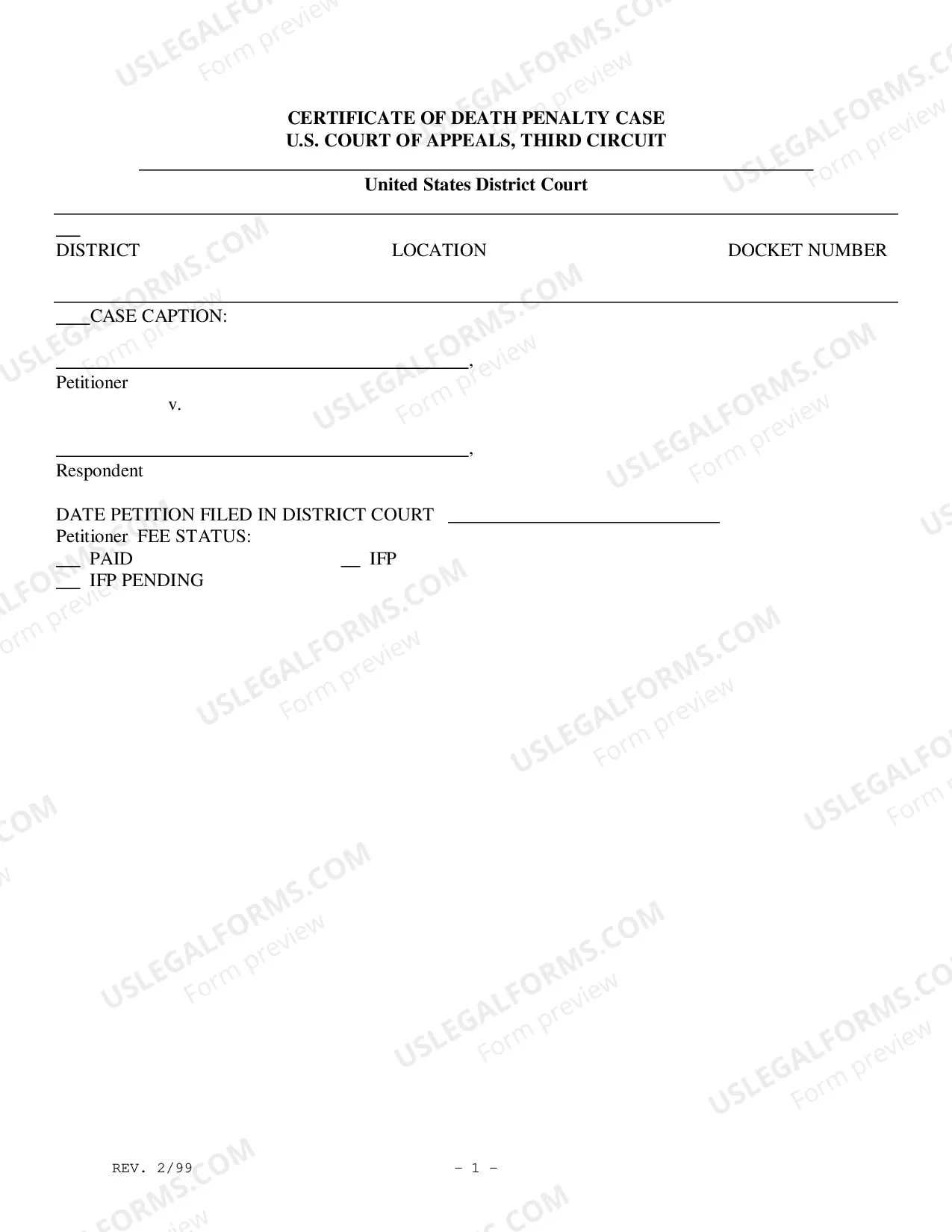
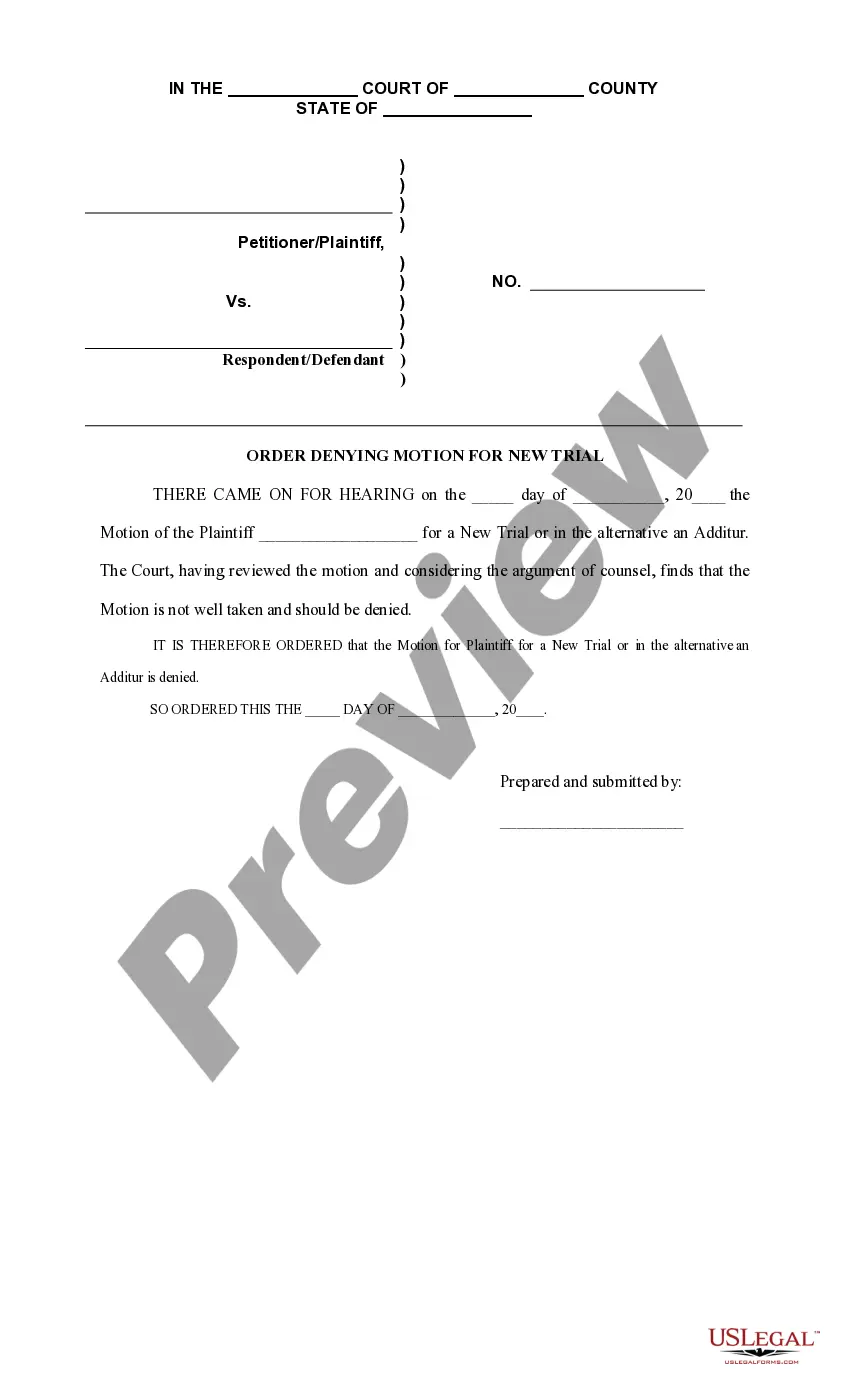
When to use this form
This form should be used when a defendant has submitted a motion for certification that the court has decided to deny. It serves to document the court's decision and is essential in cases where legal reviews or certifications are contested, ensuring that the legal proceedings can continue without ambiguity regarding the denial.
Who should use this form
This form is intended for:
- Judges presiding over cases involving certification motions.
- Legal representatives acting on behalf of defendants.
- Court clerks responsible for filing legal orders.
How to complete this form
- Enter the date of the order in the designated space.
- Indicate the name of the Circuit Judge in the appropriate section.
- Clearly state that the motion for review of certification is denied.
Does this form need to be notarized?
In most cases, this form does not require notarization. However, some jurisdictions or signing circumstances might. US Legal Forms offers online notarization powered by Notarize, accessible 24/7 for a quick, remote process.
Get your form ready online
Our built-in tools help you complete, sign, share, and store your documents in one place.
Make edits, fill in missing information, and update formatting in US Legal Forms—just like you would in MS Word.
Download a copy, print it, send it by email, or mail it via USPS—whatever works best for your next step.
Sign and collect signatures with our SignNow integration. Send to multiple recipients, set reminders, and more. Go Premium to unlock E-Sign.
If this form requires notarization, complete it online through a secure video call—no need to meet a notary in person or wait for an appointment.
We protect your documents and personal data by following strict security and privacy standards.

Make edits, fill in missing information, and update formatting in US Legal Forms—just like you would in MS Word.

Download a copy, print it, send it by email, or mail it via USPS—whatever works best for your next step.

Sign and collect signatures with our SignNow integration. Send to multiple recipients, set reminders, and more. Go Premium to unlock E-Sign.

If this form requires notarization, complete it online through a secure video call—no need to meet a notary in person or wait for an appointment.

We protect your documents and personal data by following strict security and privacy standards.
Avoid these common issues
- Failing to date the order correctly.
- Not having the judge sign the order.
- Using unclear language that does not clearly deny the motion.
Why complete this form online
- Convenience of downloading and using the form at any time.
- Editability allows for customization to meet specific needs.
- Access to forms drafted by licensed attorneys ensures reliability and compliance.
Legal use & context
- This form legally signifies the court's decision to deny a motion for certification.
- It is vital for maintaining accurate records in legal proceedings.
- Proper use of this form helps prevent potential appeals based on procedural issues.
Looking for another form?




Form popularity
FAQ
What does an order denying a motion to suppress mean in California? Generally, it means that the court will not block evidence in a criminal case. A Los Angeles DUI lawyer can step in if you are interested in blocking evidence. Find out more by calling us at (310) 862-0199.
A legal issue is considered as moot if its merely academic in nature. A moot motion is thus a motion that has no subtantive bearing on the overall case. The definition might however change based on jurisdiction.
Moot court is a co-curricular activity at many law schools. Participants take part in simulated court or arbitration proceedings, usually involving drafting memorials or memoranda and participating in oral argument. In most countries, the phrase "moot court" may be shortened to simply "moot" or "mooting".
In effect, in both kinds of cases, the lawyer asks the judge to direct a verdict for the defendant. The judge will either grant or deny the motion. If it is granted, the case is over and the defendant wins. If the motion is denied, as it usually is, the defense is given the opportunity to present its evidence.
What does an order denying a motion to suppress mean in California? Generally, it means that the court will not block evidence in a criminal case. A Los Angeles DUI lawyer can step in if you are interested in blocking evidence.
When a Court Denies a Motion as Moot, it Does not Grant the Motion because the Motion is now Irrelevant.But sometimes a motion is no longer relevant because circumstances change. If the motion no longer matters it is considered moot or irrelevant.
In the legal system of the United States, a matter is moot if further legal proceedings with regard to it can have no effect, or events have placed it beyond the reach of the law. Thereby the matter has been deprived of practical significance or rendered purely academic.
If the hearing was to argue a motion made by the other side, and that party did not appear for argument, then the court denying the motion means that the moving party was not granted the relief being sought or requested. In other words, you win.
To deny someone of a legal right is to deprive him or her of that right. A denial is a part of a legal Pleading that refutes the facts set forth by the opposing side.