Contract with Consultant as Self-Employed Independent Contractor with Limitation of Liability Clause
What is this form?
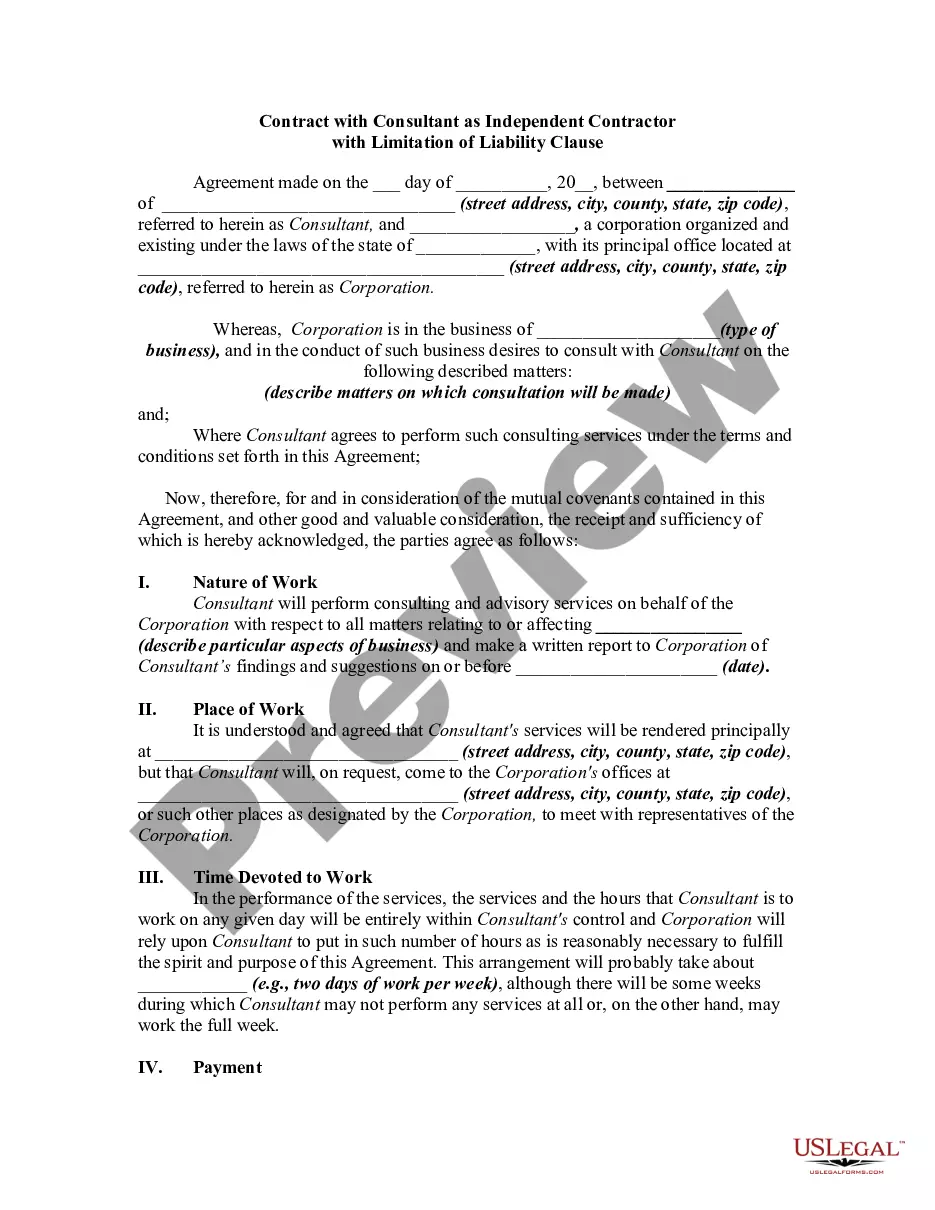
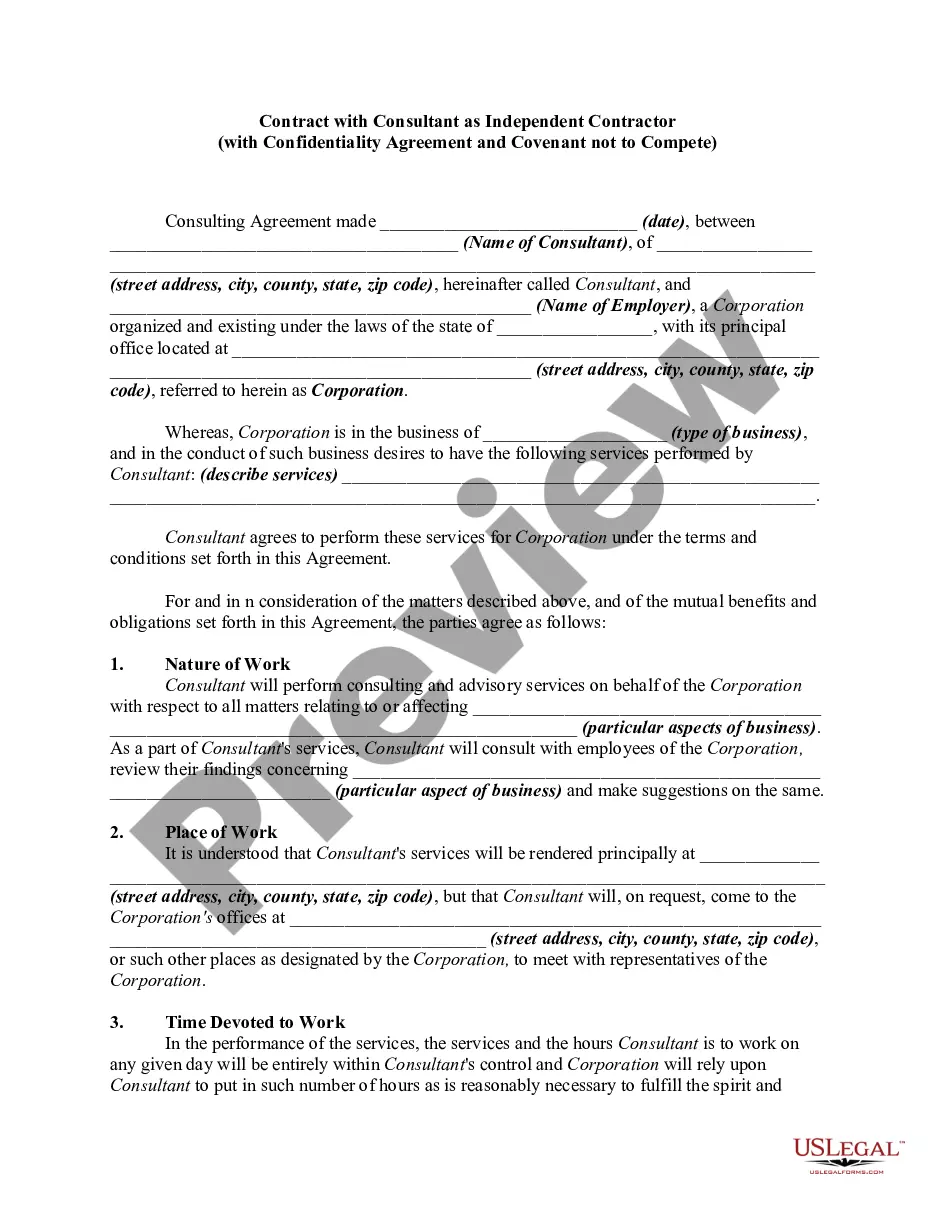
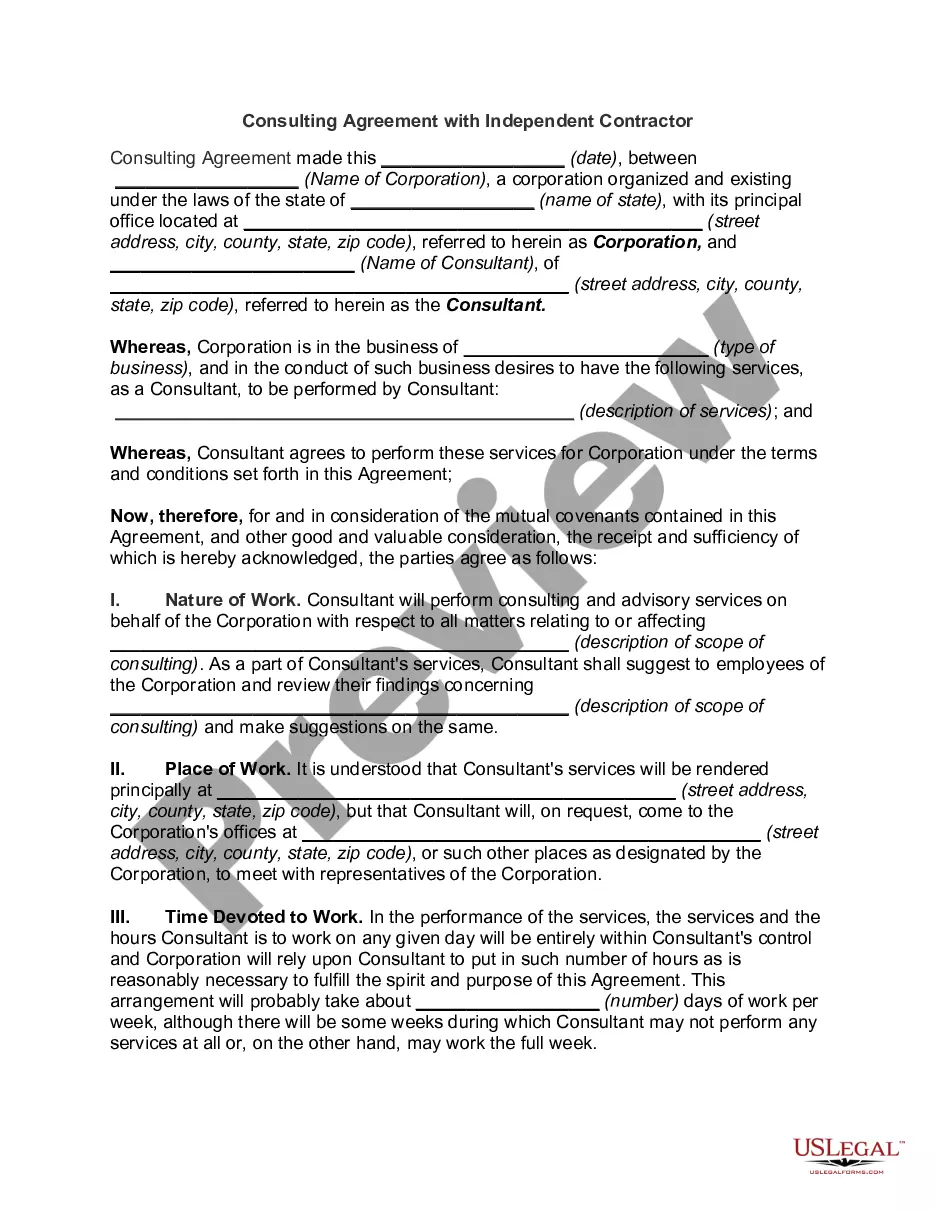
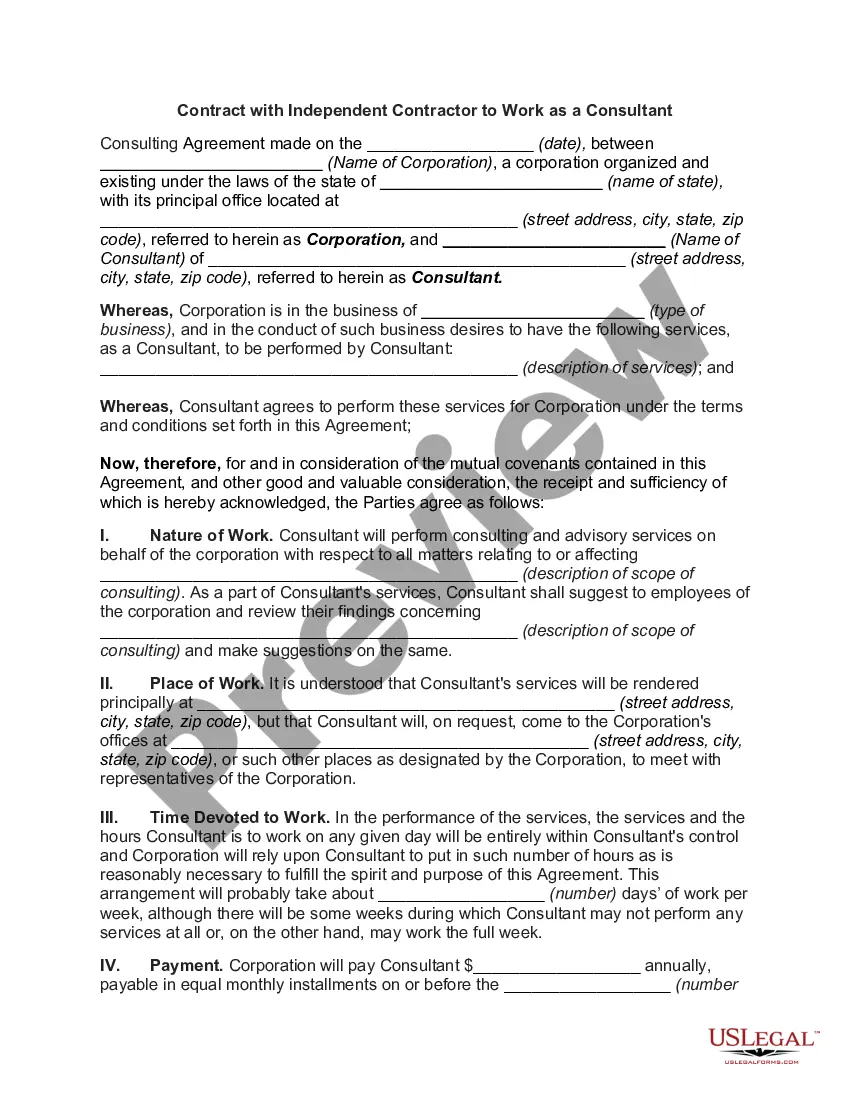
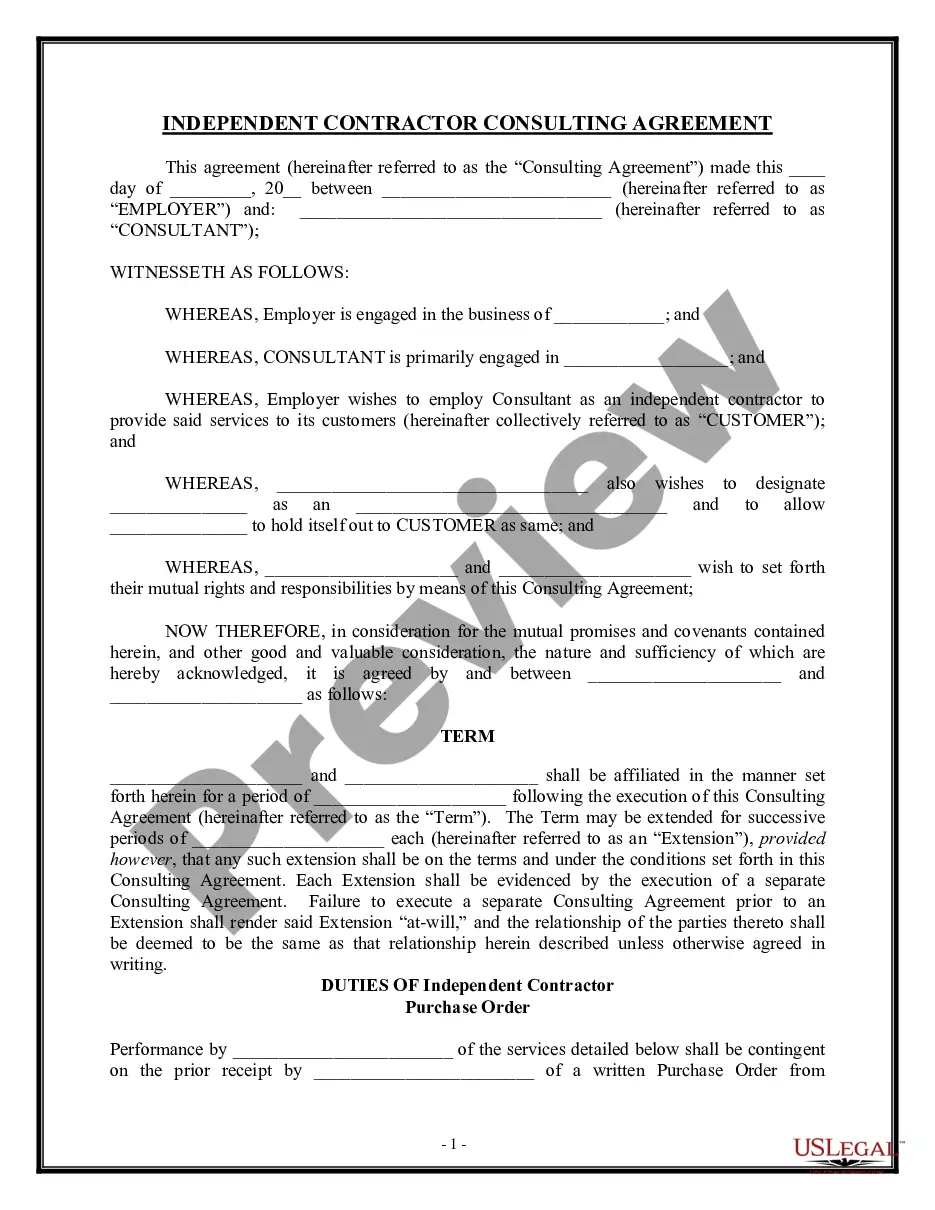
The Contract with Consultant as Self-Employed Independent Contractor with Limitation of Liability Clause is a legal document that outlines the terms of the consulting relationship between a consultant and a corporation. This agreement specifically includes a limitation of liability clause, clarifying the extent to which the consultant can be held liable for damages resulting from their services. This form is distinct from general consulting agreements because it includes this crucial provision to protect the consultant from significant financial risks.
Key parts of this document
- Identification of the parties involved, including the consultant and the corporation.
- Description of consulting services to be performed and the timeline for completion.
- Independent contractor status to clarify the relationship between the consultant and corporation.
- Compensation structure, including payment terms and reimbursement for expenses.
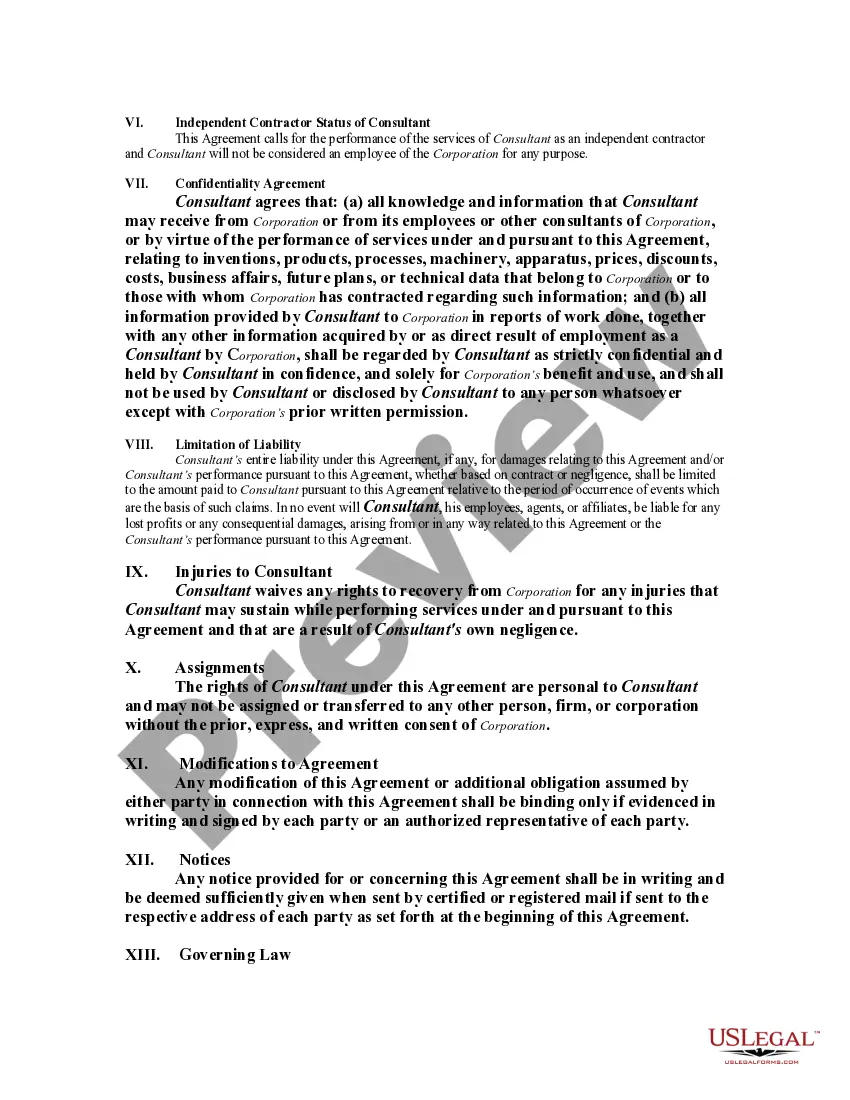
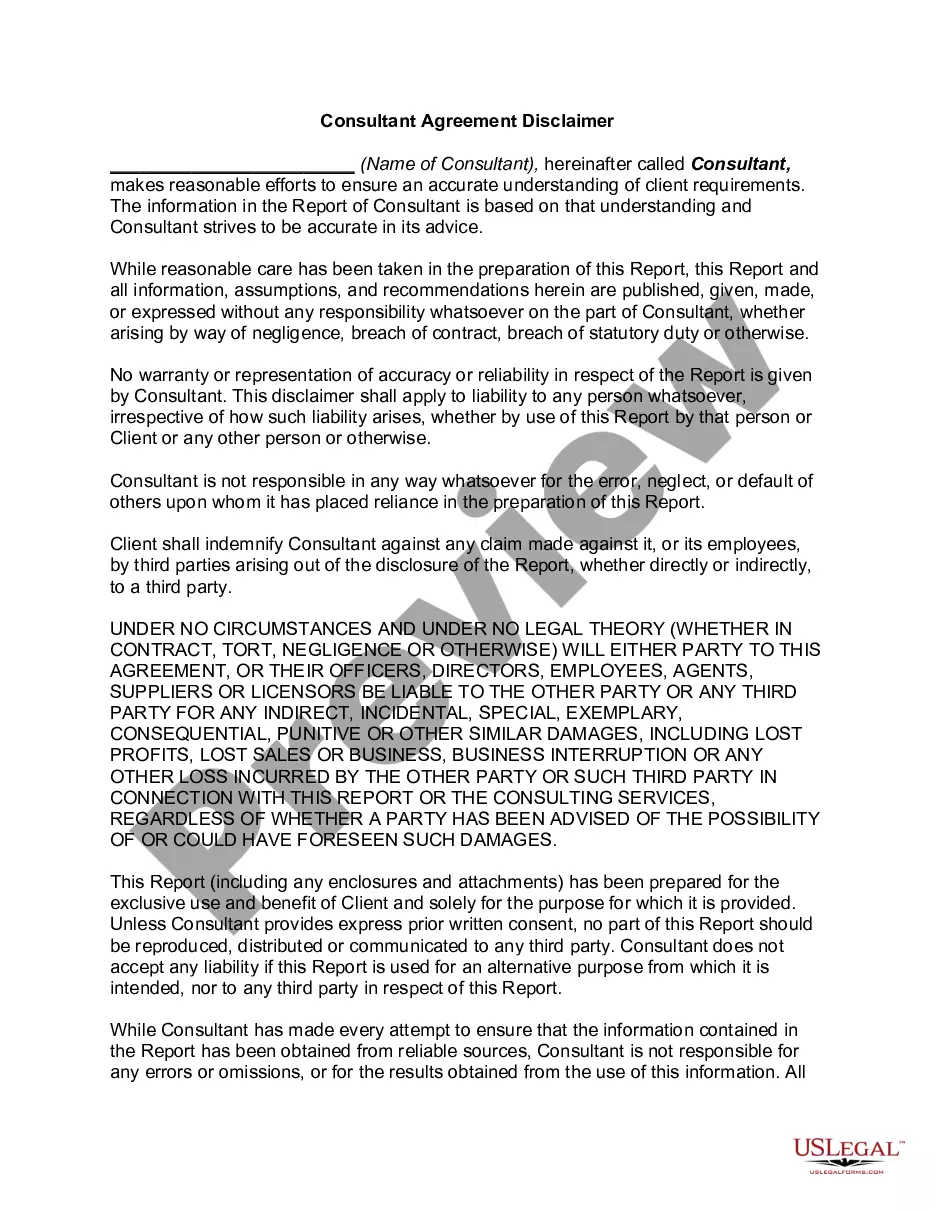
- A limitation of liability clause that restricts the consultant's liability.
- Confidentiality agreement protecting the corporation's sensitive information.
When to use this document
This form is useful when a corporation needs to hire a consultant for specific expertise without establishing an employer-employee relationship. Situations include project-based work, specialized consulting services, and expert advisory roles. It is particularly beneficial when the corporation wants to limit potential legal risks associated with the consultant's performance of duties.
Who should use this form
- Corporations or businesses seeking to employ the services of a consultant on a temporary or project basis.
- Consultants operating as independent contractors looking for a clear contractual agreement with their clients.
- Firms in need of legal protection through limitation of liability clauses in their agreements.
How to prepare this document
- Identify and enter the names and addresses of both the consultant and the corporation at the beginning of the agreement.
- Clearly describe the consulting services to be provided, including specific tasks or areas of expertise.
- Specify the payment terms, including the amount and schedule for compensation, as well as any reimbursable expenses.
- Outline the duration of the agreement, including any renewal terms or conditions for termination.
- Include the limitation of liability clause to limit potential claims against the consultant.
- Ensure all parties sign and date the contract to validate the agreement.
Notarization guidance
This form does not typically require notarization unless specified by local law. However, having it notarized can lend additional credibility and enforceability to the agreement.
Get your form ready online
Our built-in tools help you complete, sign, share, and store your documents in one place.
Make edits, fill in missing information, and update formatting in US Legal Forms—just like you would in MS Word.
Download a copy, print it, send it by email, or mail it via USPS—whatever works best for your next step.
Sign and collect signatures with our SignNow integration. Send to multiple recipients, set reminders, and more. Go Premium to unlock E-Sign.
If this form requires notarization, complete it online through a secure video call—no need to meet a notary in person or wait for an appointment.
We protect your documents and personal data by following strict security and privacy standards.

Make edits, fill in missing information, and update formatting in US Legal Forms—just like you would in MS Word.

Download a copy, print it, send it by email, or mail it via USPS—whatever works best for your next step.

Sign and collect signatures with our SignNow integration. Send to multiple recipients, set reminders, and more. Go Premium to unlock E-Sign.

If this form requires notarization, complete it online through a secure video call—no need to meet a notary in person or wait for an appointment.

We protect your documents and personal data by following strict security and privacy standards.
Avoid these common issues
- Failing to clearly define the scope of work, which can lead to misunderstandings.
- Not specifying payment terms or reimbursement procedures, which can cause payment disputes.
- Omitting signatures or dates on the agreement, which can invalidate the contract.
- Overlooking the inclusion of a limitation of liability clause, increasing potential risk for the consultant.
Why complete this form online
- Easy to download and fill out, saving time compared to drafting an agreement from scratch.
- Customizable fields allow you to tailor the agreement to meet specific business needs.
- Access to professionally drafted clauses ensures legal compliance and protects both parties.
- No need for physical paperwork; the form can be completed and stored digitally.
Legal use & context
- The limitation of liability clause is valid and enforceable as long as both parties have equal bargaining power.
- Consultants must ensure that they meet all local business regulations applicable to their services.
- Confidentiality agreements protect proprietary information and trade secrets shared during the consulting engagement.
Quick recap
- A consultant agreement defines the working relationship between an independent contractor and a corporation.
- Including a limitation of liability clause helps protect the consultant from extensive claims.
- It is crucial to specify the scope of work, payment terms, and signatures to ensure enforcement.
Looking for another form?

Form popularity
FAQ
Name of contractor and contact information. Name of homeowner and contact information. Describe property in legal terms. List attachments to the contract. The cost. Failure of homeowner to obtain financing. Description of the work and the completion date. Right to stop the project.
Writing Your Construction Contract. Write the title and a little preamble. Your title should describe the purpose of the contract. The preamble should simply state basics like: the date the agreement was entered into, the parties' names, the project, the work site location, and work commencement and end dates.
Form W-9. The IRS requires contractors to fill out a Form W-9, request for Taxpayer Identification Number and Certification, which you should keep on file for at least four years after the hiring. This form is used to request the correct name and Taxpayer Identification Number, or TIN, of the worker or their entity.
Independent Contractor Agreement for Consultant (IC) It contains a number of provisions favorable to you that a hiring firm wouldn't ordinarily put in an agreement -- for example, it requires the hiring firm to pay a late fee if you aren't paid on time.
What is an independent contractor? Also known as a consultant or freelancer, an independent contractor is a business or individual that is typically self-employed and provides a product or service for a customer in exchange for monetary compensation.
Terms. This is the first section of any agreement or contract and states the names and locations of the parties involved. Responsibilities & Deliverables. Payment-Related Details. Confidentiality Clause. Contract Termination. Choice of Law.
Get it in writing. Keep it simple. Deal with the right person. Identify each party correctly. Spell out all of the details. Specify payment obligations. Agree on circumstances that terminate the contract. Agree on a way to resolve disputes.