Waiver and Release for Moving and Delivery Service
Overview of this form
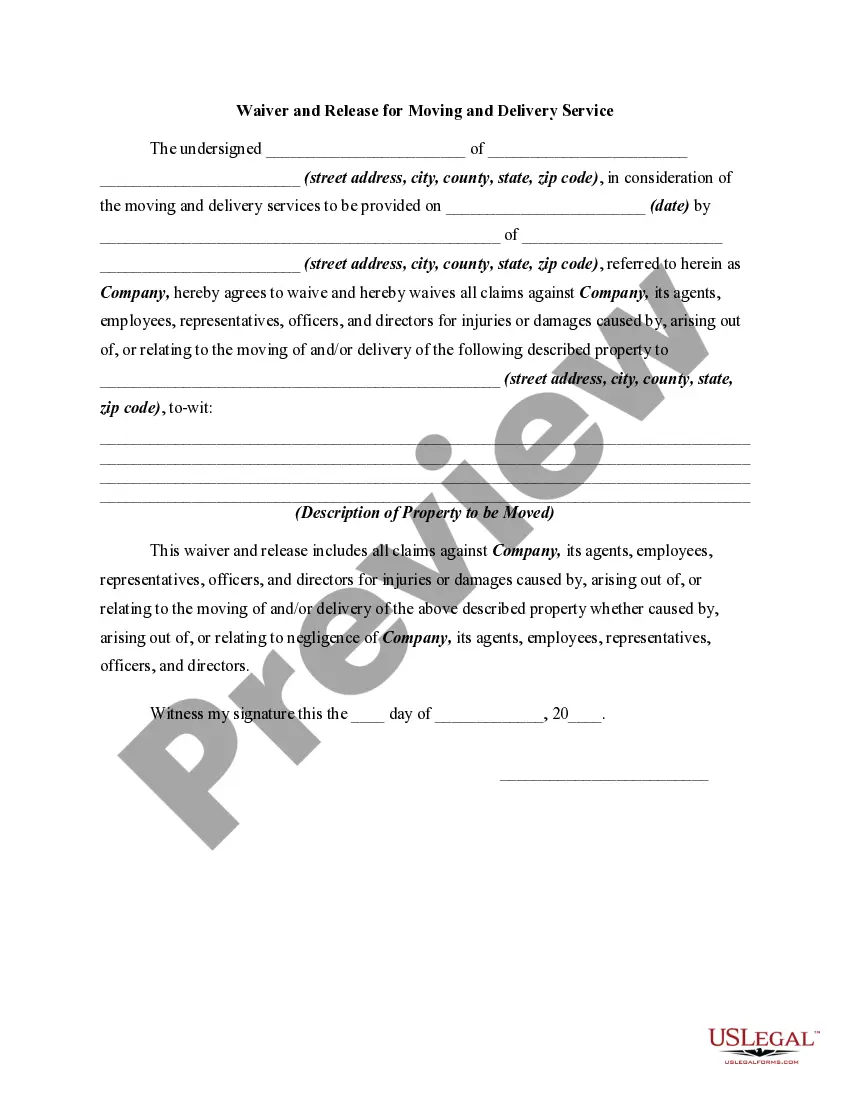
The Waiver and Release for Moving and Delivery Service is a legal document designed to protect a moving company from liability for injuries or damages that may occur during the moving or delivery process. By signing this form, individuals voluntarily relinquish their right to sue the moving company for any claims related to the service provided, even if negligence is involved. This form is distinct from other legal waivers as it specifically pertains to moving and delivery services, ensuring clarity regarding liabilities in that context.
Form components explained
- Undersigned information: Includes the name and address of the person receiving services.
- Service provider details: Captures the name and address of the moving company.
- Service date: Specifies the date when the moving service will be provided.
- Property description: Describes the items to be moved or delivered.
- Waiver clause: Clearly states the waiver of claims against the company and its representatives.
- Signature line: Required for the undersigned to validate the document.
When this form is needed
This form is essential when hiring a moving company for the transportation of belongings. It is particularly useful when the individual wishes to limit their ability to make claims against the movers in the event of unforeseen accidents or damage during the moving process. Instances include residential moves, commercial deliveries, or any situation where items are being transferred by a third-party service.
Who this form is for
This form is intended for:
- Individuals or businesses hiring a moving company.
- Property owners or renters responsible for the items being moved.
- Anyone looking to limit their legal liabilities related to moving and delivery services.
Completing this form step by step
- Identify the undersigned by entering their full name and address.
- Enter the name and address of the moving company providing the service.
- Specify the date the moving or delivery service will occur.
- Provide a detailed description of the property to be moved.
- Read the waiver clause carefully before signing to ensure understanding of liabilities being waived.
- Sign and date the form to validate the agreement.
Is notarization required?
Notarization is not commonly needed for this form. However, certain documents or local rules may make it necessary. Our notarization service, powered by Notarize, allows you to finalize it securely online anytime, day or night.
Get your form ready online
Our built-in tools help you complete, sign, share, and store your documents in one place.
Make edits, fill in missing information, and update formatting in US Legal Forms—just like you would in MS Word.
Download a copy, print it, send it by email, or mail it via USPS—whatever works best for your next step.
Sign and collect signatures with our SignNow integration. Send to multiple recipients, set reminders, and more. Go Premium to unlock E-Sign.
If this form requires notarization, complete it online through a secure video call—no need to meet a notary in person or wait for an appointment.
We protect your documents and personal data by following strict security and privacy standards.

Make edits, fill in missing information, and update formatting in US Legal Forms—just like you would in MS Word.

Download a copy, print it, send it by email, or mail it via USPS—whatever works best for your next step.

Sign and collect signatures with our SignNow integration. Send to multiple recipients, set reminders, and more. Go Premium to unlock E-Sign.

If this form requires notarization, complete it online through a secure video call—no need to meet a notary in person or wait for an appointment.

We protect your documents and personal data by following strict security and privacy standards.
Common mistakes
- Failing to provide a complete description of the property to be moved.
- Not entering the correct date of service.
- Neglecting to sign the document, making it legally invalid.
- Overlooking the need to read and understand the waiver clause before signing.
Benefits of using this form online
- Convenient access to the form anytime and anywhere.
- Editable format allows for quick customization to specific needs.
- Reliable framework drafted by licensed attorneys to ensure legality and compliance.
Legal use & context
- This waiver may be enforceable in most states, but its validity can depend on specific circumstances.
- Courts generally do not allow waivers that absolve parties from gross negligence or willful misconduct.
- Understanding the implications of signing a waiver is crucial, as it limits your rights to seek damages.
Key takeaways
- The Waiver and Release for Moving and Delivery Service protects moving companies from liability.
- This document should be used whenever hiring a moving service to understand potential risks.
- Complete all sections accurately and sign to validate the document.
Looking for another form?
Form popularity
FAQ
File a claim with the FMCSA You can file a claim against any interstate movers with the agency easily on their website or by calling their toll-free number: 1-888-DOT-SAFT (1-888-368-7238).
Get help. Writing a waiver should not be complicated. Use the correct structure. Proper formatting. Include a subject line. Include a caution! Talk about the activity risks. Do not forget an assumption of risk. Hold harmless.
A liability waiver, or release waiver, is a legal document that a company or organization requires members of the public to sign in order to protect their organization from being sued if you sustain an injury.Depending on the facts of your case, you may still be able to file a lawsuit and recover damages.
A liability waiver, or release of liability, is a legal document that a company or organization has you sign in order to protect them from being sued in the event that you are injured.
A release form or a waiver is simply a legal document containing an agreement between two parties.A waiver is an essential document that informs participants of the risks involved in certain activities and also protects you from liability.
All parties involved in the incident. A statement saying you were involved in the accident that caused the injury. The total amount of the property damage. A statement that releases the defendant from any future claims or damages that are related to the incident.
In California, a liability waiver must be clear, unambiguous, and explicit. In other words, waivers cannot be printed in faded ink, in small font, on the back of a paper, or in an otherwise ambiguous form. If the waiver that you sign is not represented clearly, it may not hold up in the event of a lawsuit.
A waiver is not complete until it includes the signatures of both the event host and business owner and that of the participant. The date should also be included alongside the signatures. You may also include a signature line for a witness if necessary.