Moving Services Contract - Self-Employed
Understanding this form
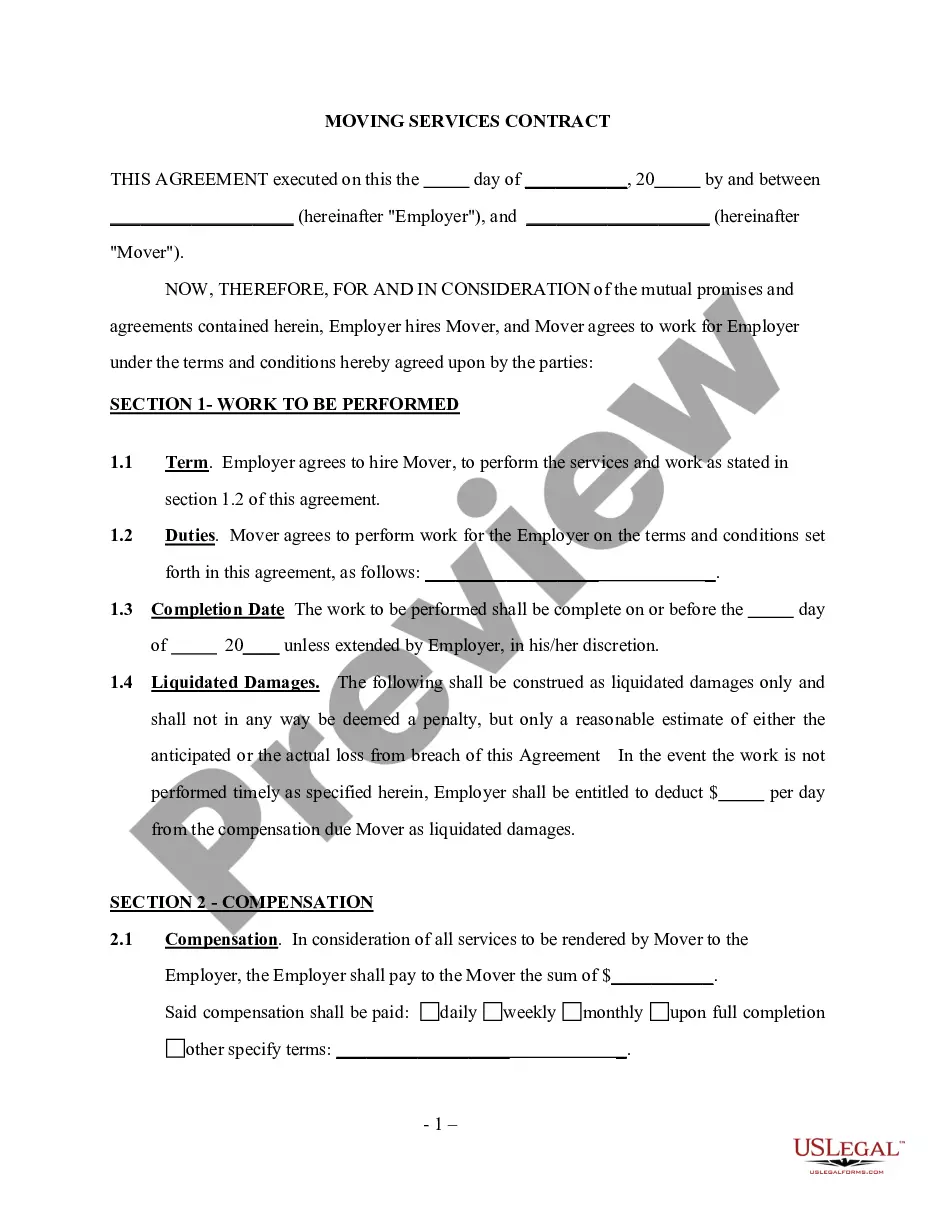
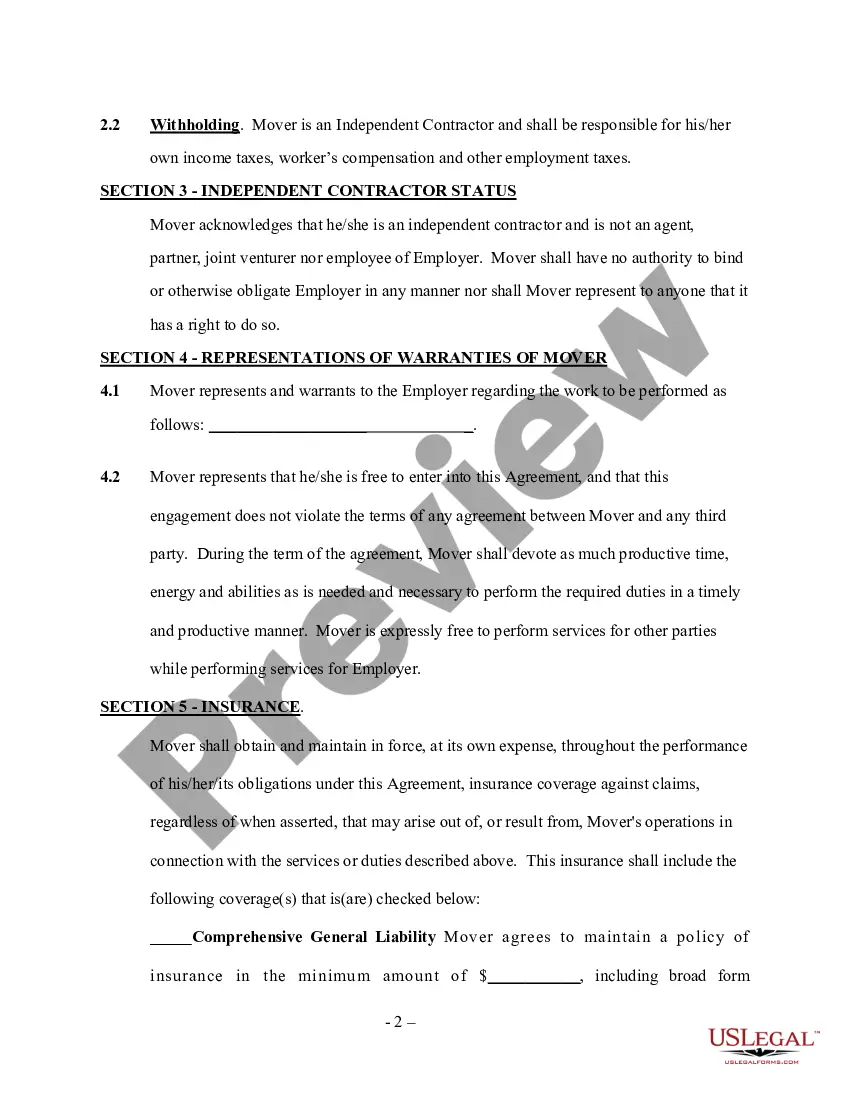
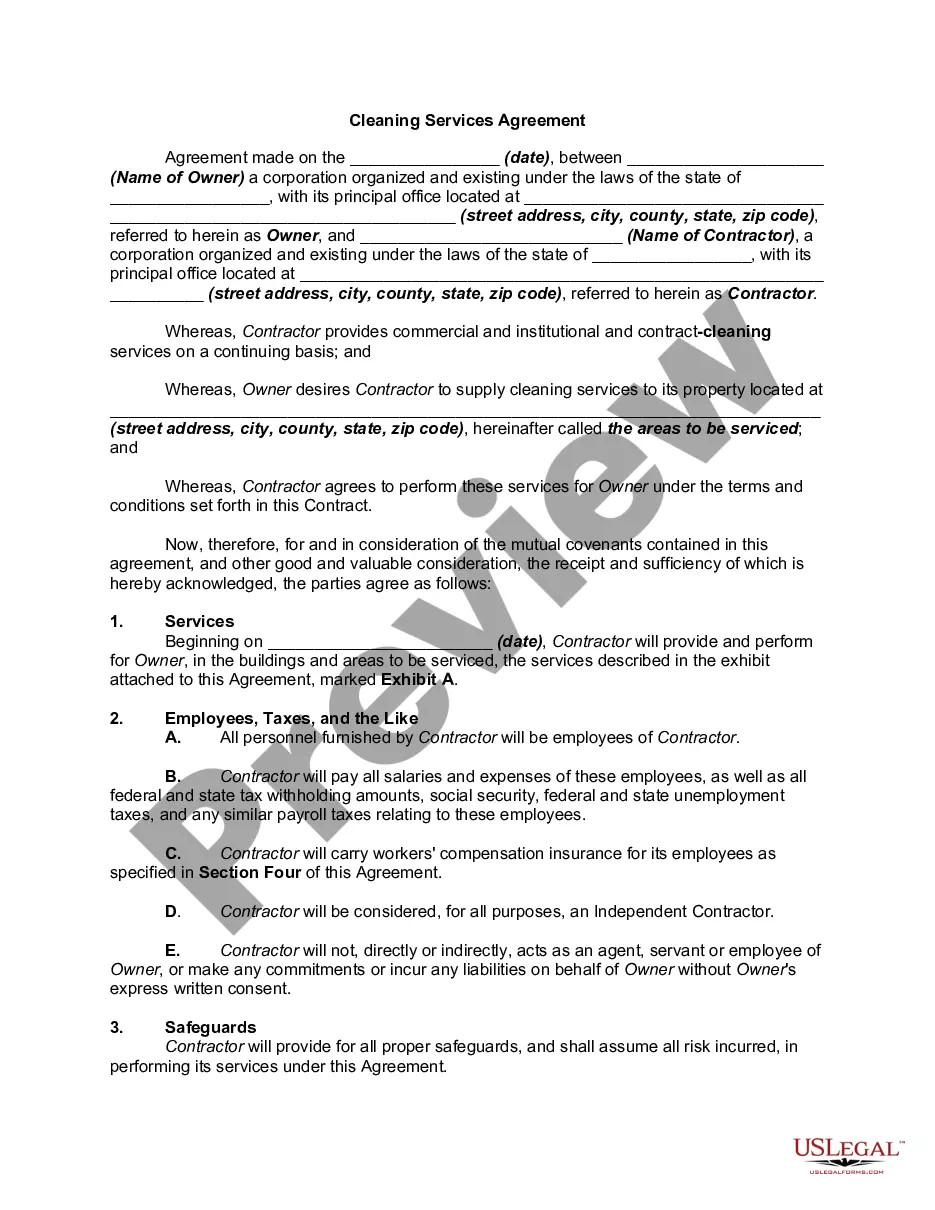
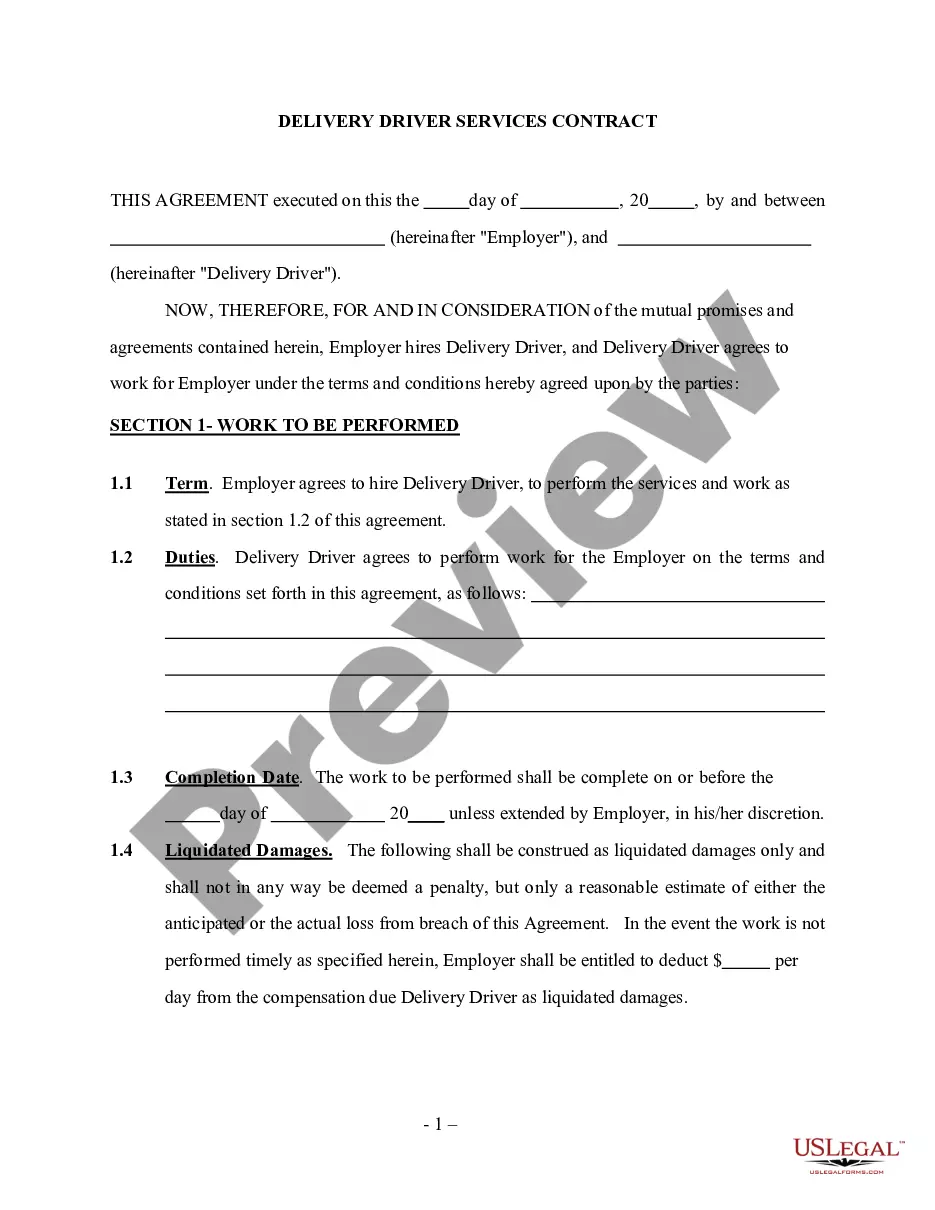
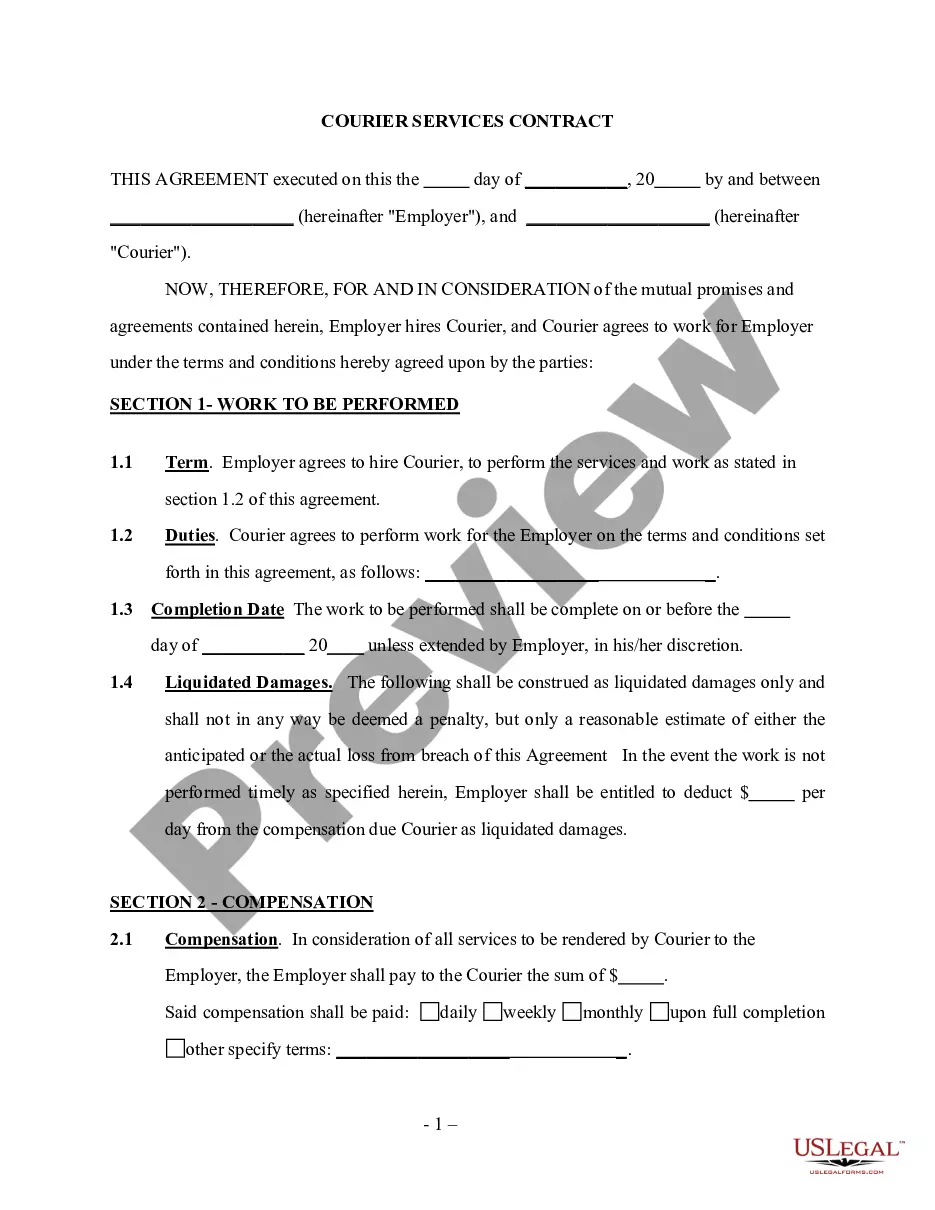
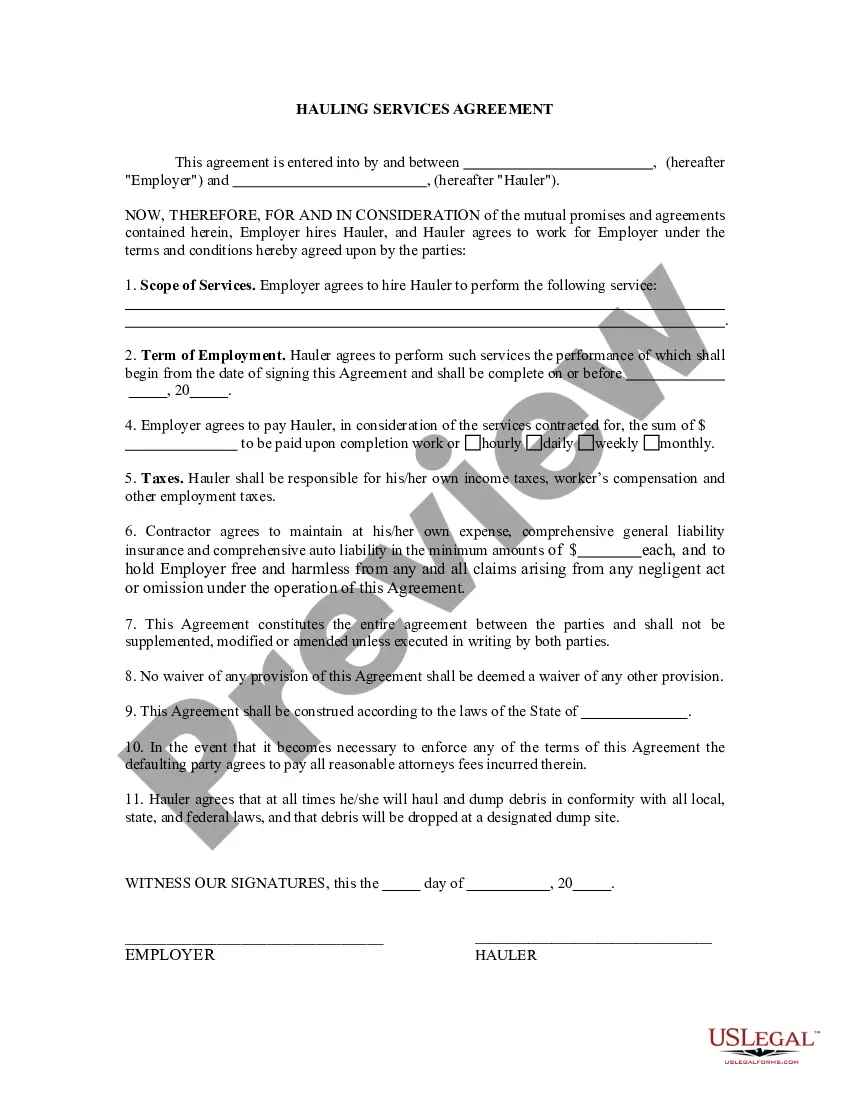
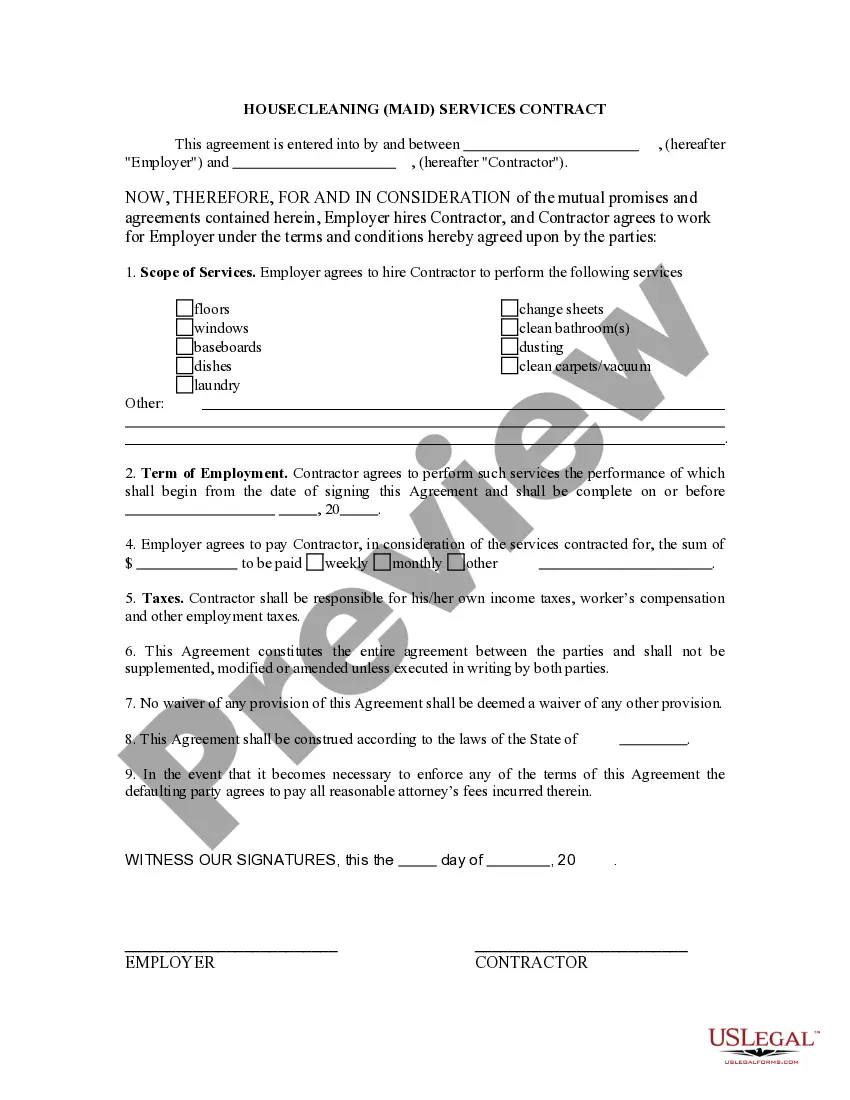
The Moving Services Contract - Self-Employed is a legal agreement that outlines the terms and conditions under which a self-employed mover agrees to provide moving services to an employer. This form differs from traditional employment contracts as it establishes the mover as an independent contractor, detailing their responsibilities without the typical employer-employee relationship. This ensures that both parties understand their rights and obligations, while also protecting the mover from unwanted liabilities or restrictions associated with being an employee.
Form components explained
- Work to be performed: Specifies the services the mover will provide and the compensation details.
- Independent contractor status: Clearly states that the mover is not an employee and does not have authority to bind the employer.
- Warranties and representations: The mover assures that they can legally enter the contract and will devote the necessary time to fulfill obligations.
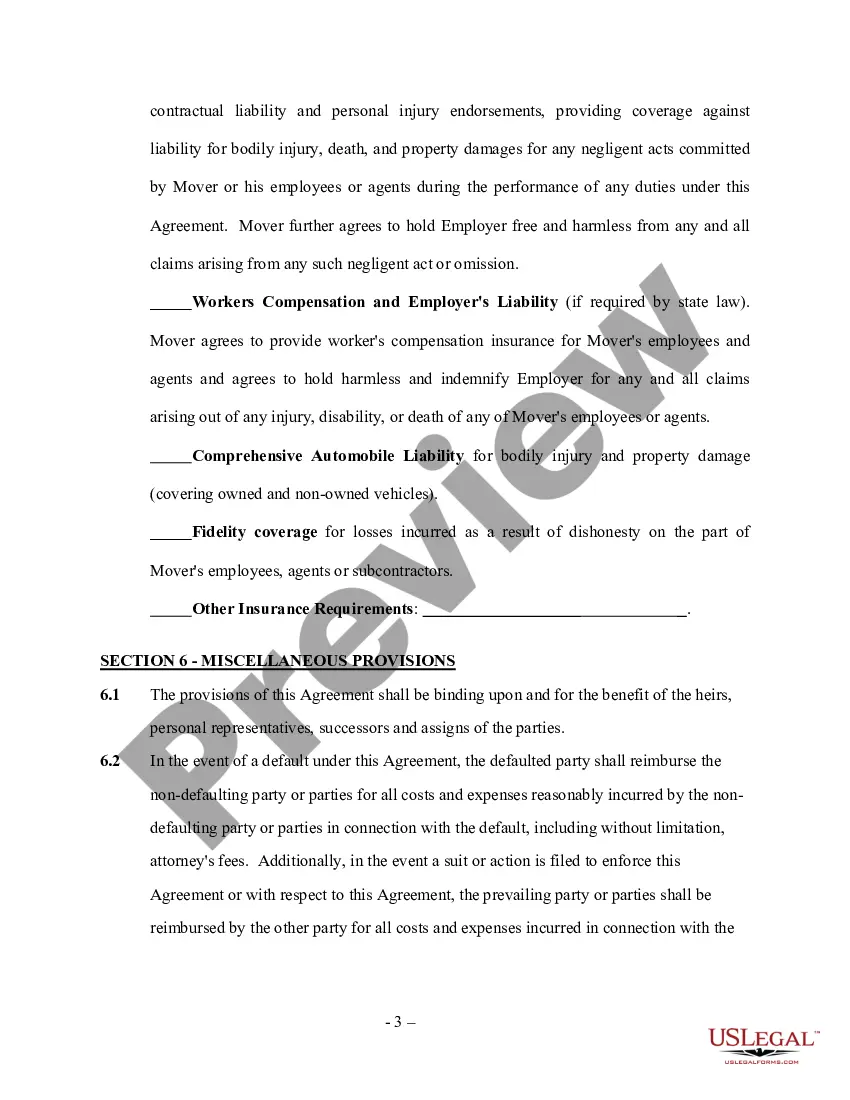
- Insurance requirements: Outlines the insurance coverage the mover must maintain during the contract period.
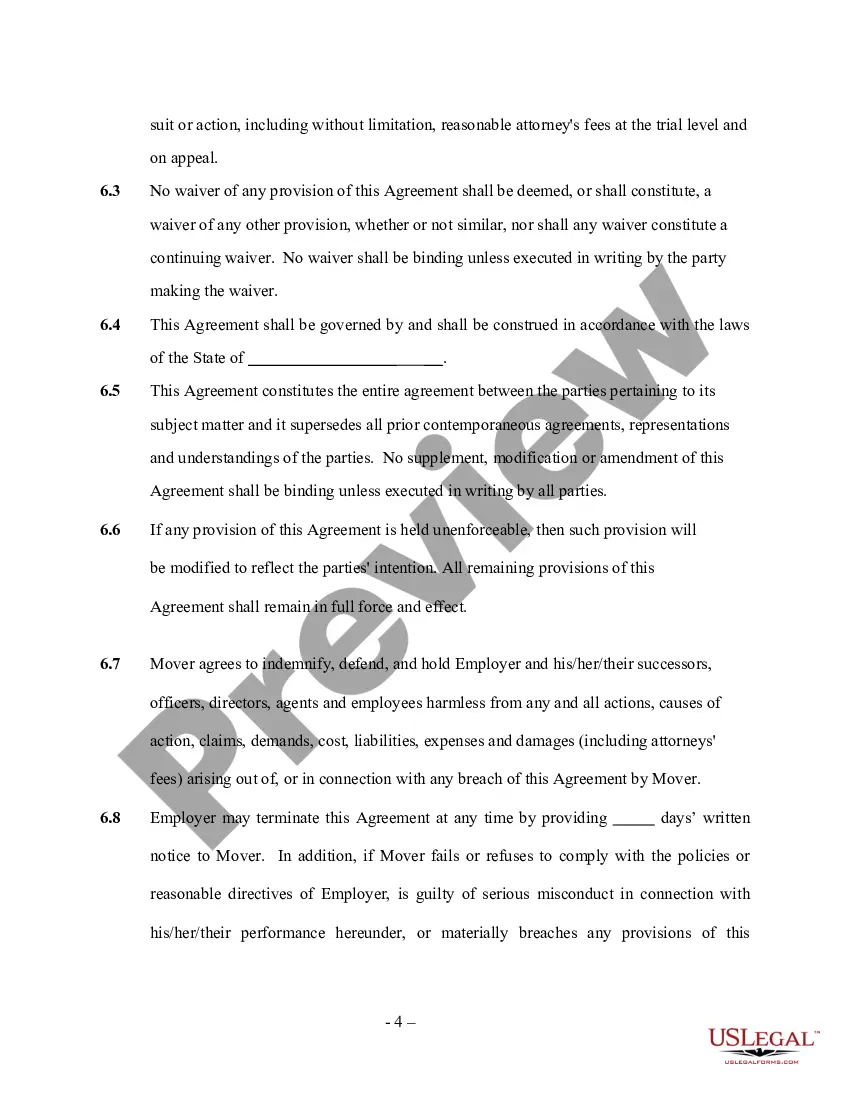
- Default and indemnification: Details the procedures if a party defaults on the agreement, including potential reimbursement for costs.
When to use this document
This form is ideal for situations where an employer needs to hire a self-employed mover to transport items. It is particularly useful when arranging moving services for personal goods, office relocations, or when hiring someone to assist with specific packing and unpacking tasks. Whenever both parties desire clarity on payment methods and responsibilities, this contract becomes essential.
Who should use this form
This form is intended for:
- Employers looking to hire self-employed movers for various relocation tasks.
- Self-employed movers offering their services to individuals or businesses.
- Parties who want a clear and enforceable agreement to outline the work and payment terms.
Completing this form step by step
- Identify the parties: Clearly state the names and addresses of both the employer and the mover.
- Specify the work: Detail the moving services that the mover will perform, including any specific items to be moved.
- Determine the compensation: Outline how and when the mover will be paid (e.g., daily, weekly, or upon completion).
- Review insurance requirements: Ensure the mover confirms they will maintain appropriate insurance coverage during the contract.
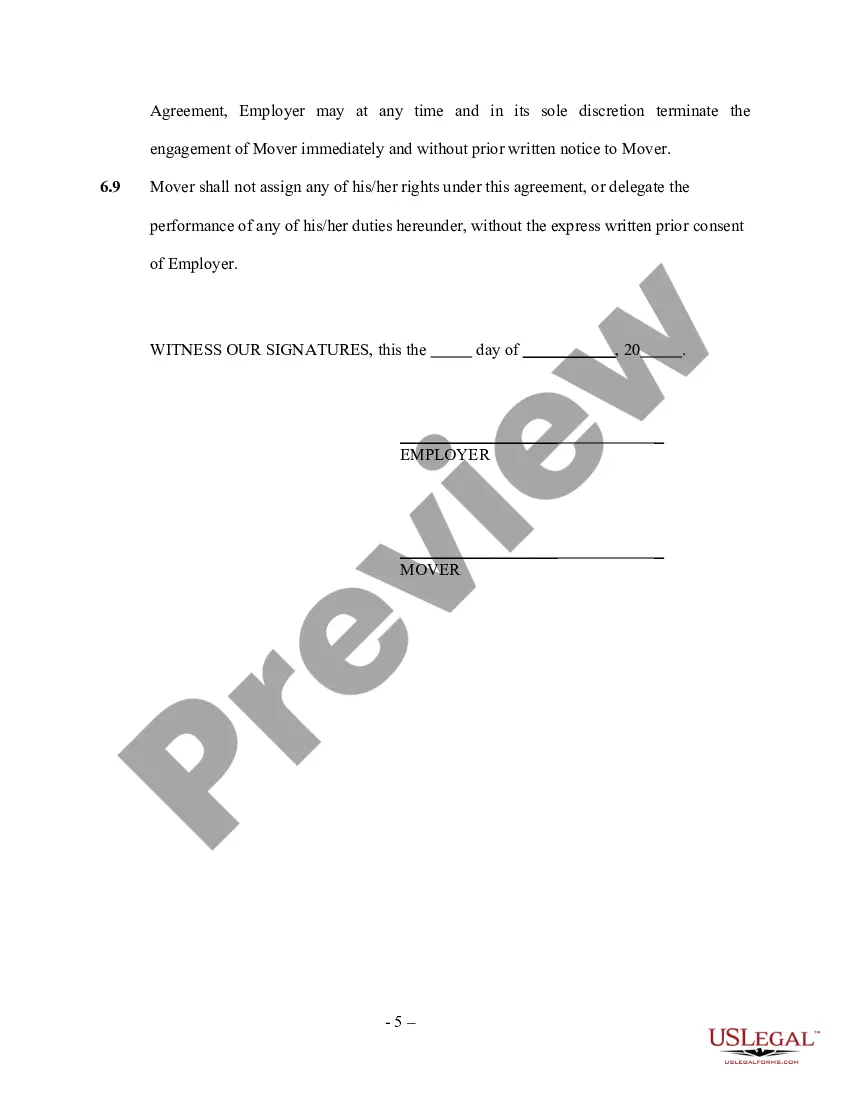
- Include signatures: Have both parties sign and date the contract to make it legally binding.
Notarization requirements for this form
This form does not typically require notarization unless specified by local law. Always verify any state-specific requirements before finalizing the agreement.
Get your form ready online
Our built-in tools help you complete, sign, share, and store your documents in one place.
Make edits, fill in missing information, and update formatting in US Legal Forms—just like you would in MS Word.
Download a copy, print it, send it by email, or mail it via USPS—whatever works best for your next step.
Sign and collect signatures with our SignNow integration. Send to multiple recipients, set reminders, and more. Go Premium to unlock E-Sign.
If this form requires notarization, complete it online through a secure video call—no need to meet a notary in person or wait for an appointment.
We protect your documents and personal data by following strict security and privacy standards.

Make edits, fill in missing information, and update formatting in US Legal Forms—just like you would in MS Word.

Download a copy, print it, send it by email, or mail it via USPS—whatever works best for your next step.

Sign and collect signatures with our SignNow integration. Send to multiple recipients, set reminders, and more. Go Premium to unlock E-Sign.

If this form requires notarization, complete it online through a secure video call—no need to meet a notary in person or wait for an appointment.

We protect your documents and personal data by following strict security and privacy standards.
Common mistakes
- Failing to specify exact services or items to be moved, leading to misunderstandings later.
- Not clarifying payment terms or methods, which can cause disputes over compensation.
- Overlooking to obtain necessary insurance coverage, putting both parties at risk.
Benefits of using this form online
- Convenient access to the form that can be downloaded and filled out quickly, saving time.
- Editability allows for easy customization to fit specific moving needs.
- Reliability ensures you are using a form drafted by licensed attorneys, increasing its validity.
Looking for another form?




Form popularity
FAQ
To set yourself up as a self-employed taxpayer with the IRS, you simply start paying estimated taxes (on Form 1040-ES, Estimated Tax for Individuals) and file Schedule C, Profit or Loss From Business, and Schedule SE, Self-Employment Tax, with your Form 1040 tax return each April.
An attorney or accountant who has his or her own office, advertises in the yellow pages of the phone book under Attorneys or Accountants, bills clients by the hour, is engaged by the job or paid an annual retainer, and can hire a substitute to do the work is an example of an independent contractor.
By the hour. For local moves within 50 miles, you can expect to pay movers by the hour. If you have two people handling the move, average moving costs should be between $80 and $100 per hour. You can expect to pay more per hour for a larger crew, but you'll likely finish faster, so costs tend to even out.
Simply put, being an independent contractor is one way to be self-employed. Being self-employed means that you earn money but don't work as an employee for someone else.An independent contractor is someone who provides a service on a contractual basis.
Unlike contractors and subcontractors who are brought in by a client to work on a specific project, self-employed people work for their own clients and are their own bosses. In general, the self-employed have a little more freedom than contractors when it comes to setting their schedules.
The general rule is that an individual is an independent contractor if the payer has the right to control or direct only the result of the work and not what will be done and how it will be done. The earnings of a person who is working as an independent contractor are subject to Self-Employment Tax.
The earnings of a person who is working as an independent contractor are subject to Self-Employment Tax. If you are an independent contractor, you are self-employed.However, your earnings as an employee may be subject to FICA (Social Security tax and Medicare) and income tax withholding.
As an independent contractor that is paying their own expenses and being paid a percentage of the move, they may make more money on some jobs and less on others (profit/loss). An employee does not have this risk, they are paid the same amount no matter what.
In the last year alone, the following well-recognized companies have been involved in independent contractor misclassification lawsuits: FedEx, Macy's, the NFL, Sleepy's, Penthouse, Lowe's, Jani-King, DirecTV, BMW and SuperShuttle.