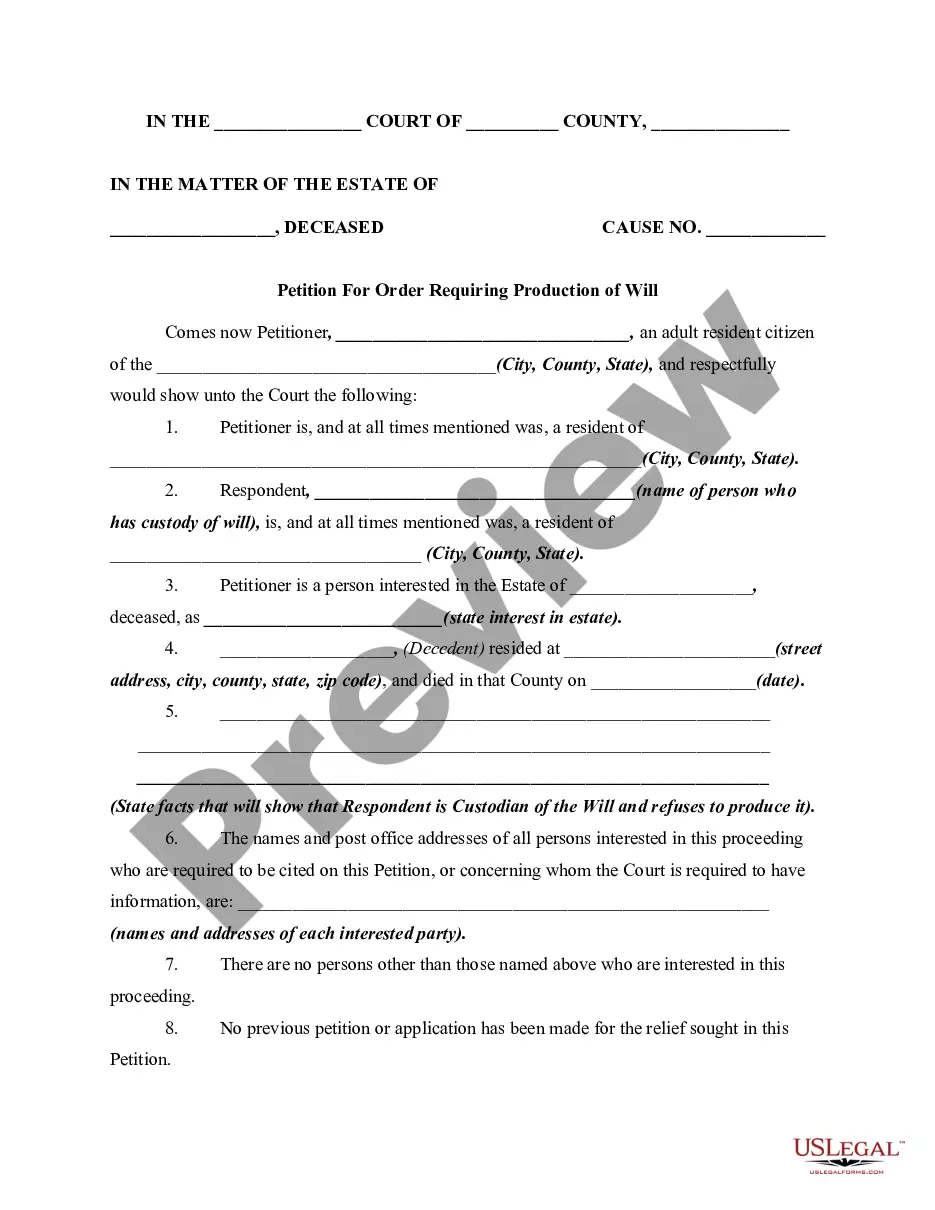
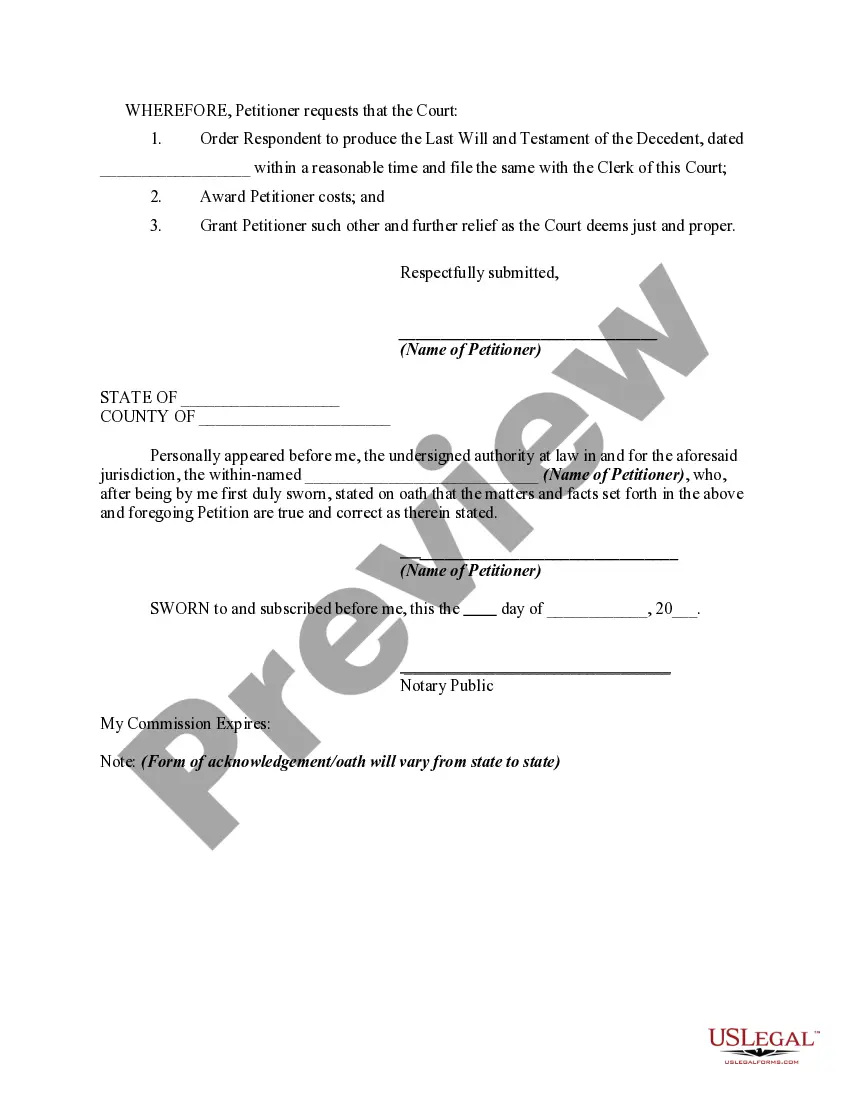
Petition For Order Requiring Production of Will
Overview of this form
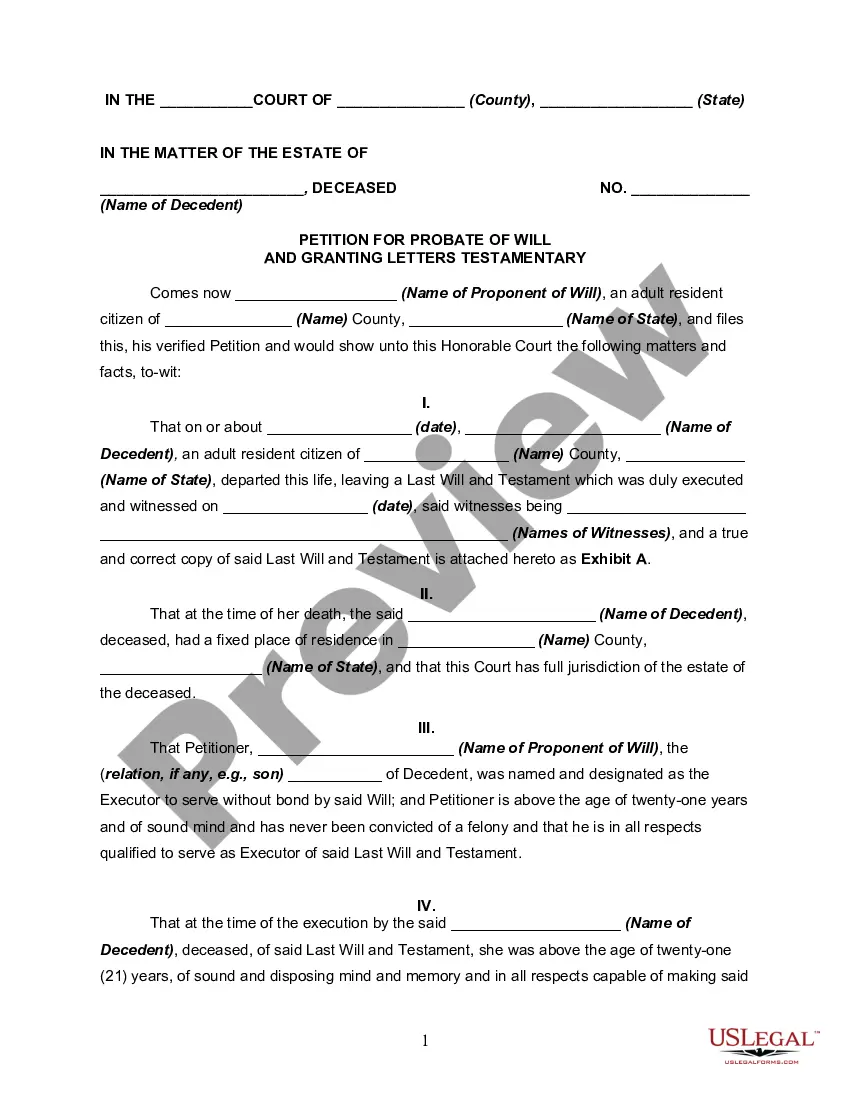
The Petition for Order Requiring Production of Will is a legal document used to compel the custodian of a deceased person's Last Will and Testament to produce the will. This form serves a specific purpose in estate proceedings, ensuring that interested parties can access the will when its production is being withheld. Unlike other probate forms, this petition focuses specifically on the retrieval of the will itself.
Main sections of this form
- Petitioner's information, including name and residency.
- Respondent's details, including the name of the individual holding the will.
- Designation of the petitioner's interest in the estate.
- Facts demonstrating the respondent's custody of the will and refusal to produce it.
- List of all interested parties who must be notified of the proceeding.
- Request for the court to order the production of the will and any associated costs.

When this form is needed
This form is necessary when a person believes that the individual who has the Last Will and Testament of a deceased person is not willing to present it to the court. Common scenarios include disputes among family members about the will's existence or provisions and situations where the will is believed to be in the possession of someone outside the family who refuses to share it.
Who can use this document
- Individuals who have a legal interest in the estate of a deceased person.
- Heirs or beneficiaries who suspect that the Last Will is being withheld.
- Executors or administrators of the estate seeking to fulfill their duties.
Steps to complete this form
- Identify the correct parties involved: the petitioner and the respondent.
- Specify your interest in the estate clearly to establish your standing.
- Document the facts that justify your request for the production of the will.
- Include the names and addresses of all relevant parties who need to be notified.
- Review and sign the document in the presence of a notary, if required.
Does this form need to be notarized?
This form must be notarized to be legally valid. Notarization provides an extra layer of authentication, ensuring that the petition is executed correctly. US Legal Forms offers integrated online notarization services, allowing you to complete this process securely and conveniently through a video call.
Get your form ready online
Our built-in tools help you complete, sign, share, and store your documents in one place.
Make edits, fill in missing information, and update formatting in US Legal Forms—just like you would in MS Word.
Download a copy, print it, send it by email, or mail it via USPS—whatever works best for your next step.
Sign and collect signatures with our SignNow integration. Send to multiple recipients, set reminders, and more. Go Premium to unlock E-Sign.
If this form requires notarization, complete it online through a secure video call—no need to meet a notary in person or wait for an appointment.
We protect your documents and personal data by following strict security and privacy standards.

Make edits, fill in missing information, and update formatting in US Legal Forms—just like you would in MS Word.

Download a copy, print it, send it by email, or mail it via USPS—whatever works best for your next step.

Sign and collect signatures with our SignNow integration. Send to multiple recipients, set reminders, and more. Go Premium to unlock E-Sign.

If this form requires notarization, complete it online through a secure video call—no need to meet a notary in person or wait for an appointment.

We protect your documents and personal data by following strict security and privacy standards.
Mistakes to watch out for
- Failing to list all interested parties, which could delay proceedings.
- Not properly documenting the facts surrounding the refusal to produce the will.
- Omitting signatures or required notarizations, if applicable.
Why complete this form online
- Convenience of accessing and completing the form from home.
- Editable format allows for quick adjustments to details.
- Access to legal templates drafted by licensed attorneys, ensuring compliance with legal standards.
What to keep in mind
- The Petition for Order Requiring Production of Will is essential for accessing a will held by another party.
- Clearly documenting your interest in the estate can help streamline the process.
- Notarization of the completed form may be necessary to ensure legal validity.
Looking for another form?








Form popularity
FAQ
Do you always need probate or letters of administrationYou usually need probate or letters of administration to deal with an estate if it includes property such as a flat or a house.you discover that the estate is insolvent, that is, there is not enough money in the estate to pay all the debts, taxes and expenses.
There is no requirement to file your will with a court during your lifetime. In fact, many people simply keep the document in a safe place and do not file it while they are still alive.The executor can then simply notify the court of the testator's death to begin the probate process.
To do this, you must file a Petition for Probate (form DE-111. NOTE: If there is no will and a court case is needed, the court will appoint an administrator to manage the estate during the probate process.
Letters of administration (also known as a grant of letters of administration) is a document issued by the probate registry. This allows someone to act as the administrator of an estate after someone has died.
Subject to the provisions of this article, a person in the following relation to the decedent is entitled to appointment as administrator in the following order of priority: (a) Surviving spouse or domestic partner as defined in Section 37. (b) Children. (c) Grandchildren.
How long does probate take? California law says the personal representative must complete probate within one year from the date of appointment, unless s/he files a federal estate tax. In this case, the personal representative can have 18 months to complete probate.
The court only allows someone to get letters of administration in probate in cases of a full probate procedure. Many estates are settled through trust administration or through small estate procedures for California.Smaller estates often don't need letters of administration at all.
These guidelines can vary state by state. However, generally, the first step is to file the decedent's will in the probate court in the county of his or her domicile. You will also need to file your appointment as executor with the probate court. The final step of the petition process is to have the will proved.
Letters of Administration are granted by a Surrogate Court or probate registry to appoint appropriate people to deal with a deceased person's estate where property will pass under Intestacy Rules or where there are no executors living (and willing and able to act) having been validly appointed under the deceased's will