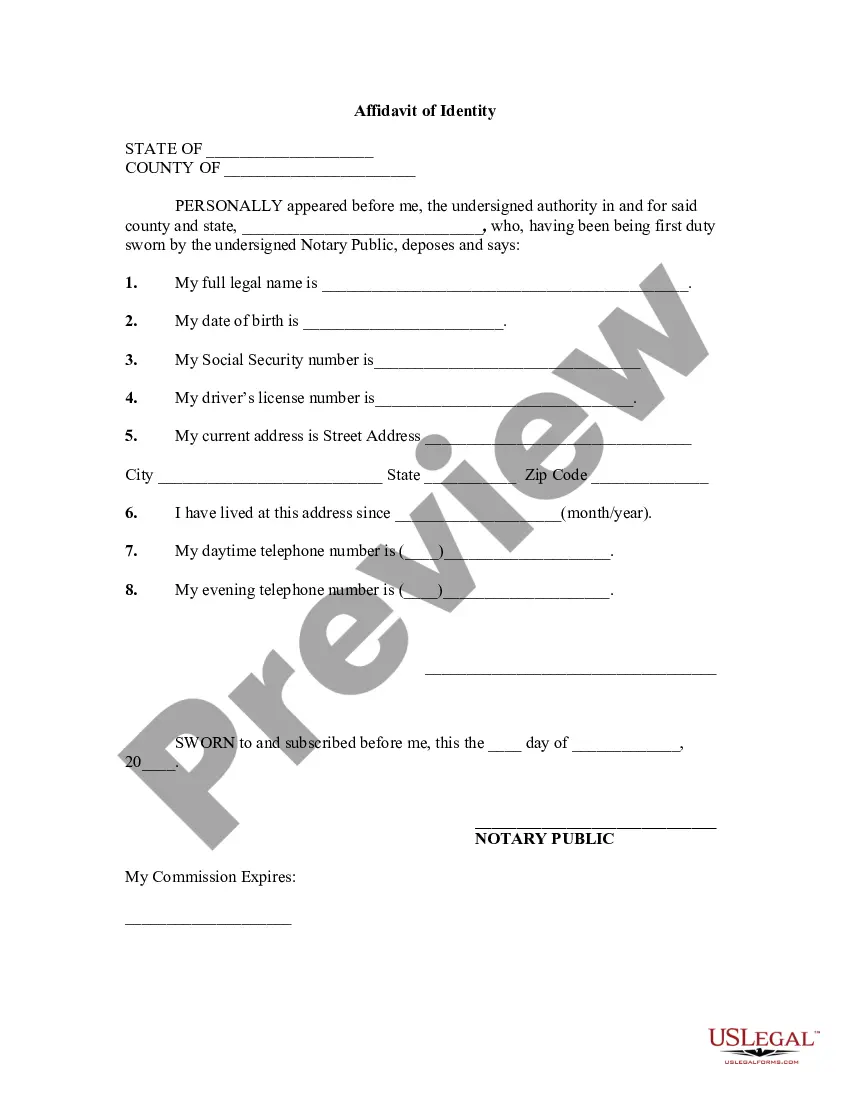
Affidavit of Identity
Understanding this form
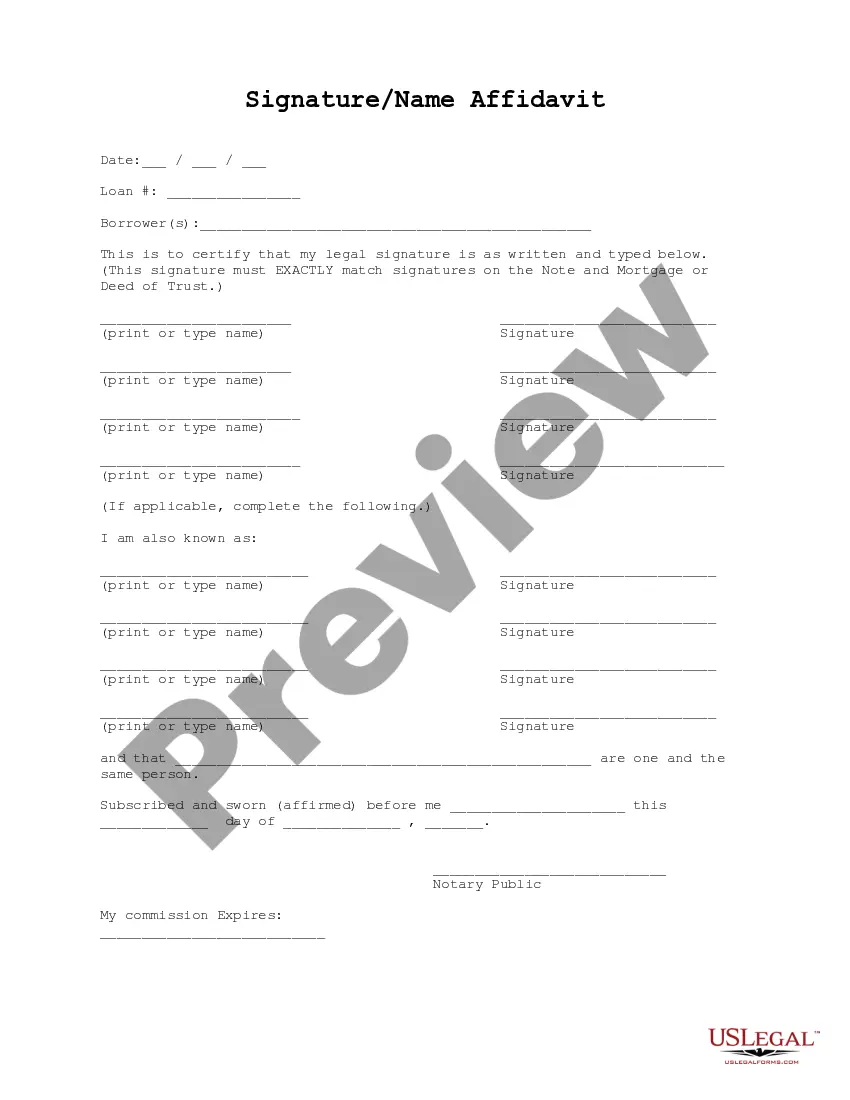
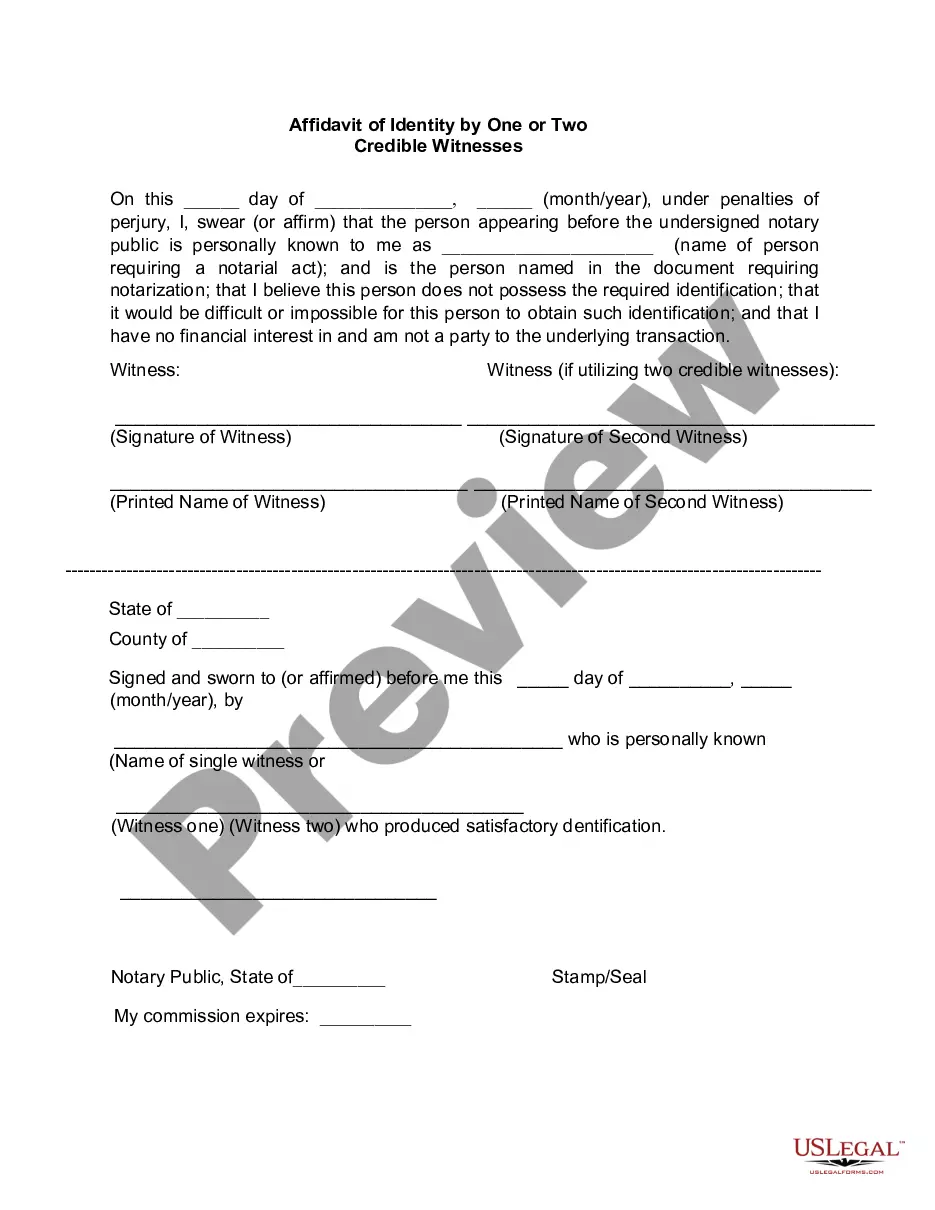
The Affidavit of Identity is a legal document used to verify an individual's identity in various situations. This form is essential when a person needs to prove their identity for legal processes, banking transactions, or other formal requirements. Unlike other identity verification forms, the Affidavit of Identity is sworn before a notary public, providing an added layer of credibility and affirmation of the information provided.
Main sections of this form
- Full legal name of the individual
- Date of birth for identification purposes
- Social Security number for personal identification
- Driver's license number for legal verification
- Current address to establish residency
- Contact telephone numbers for reachability
- Signature of the notary public confirming the affidavit
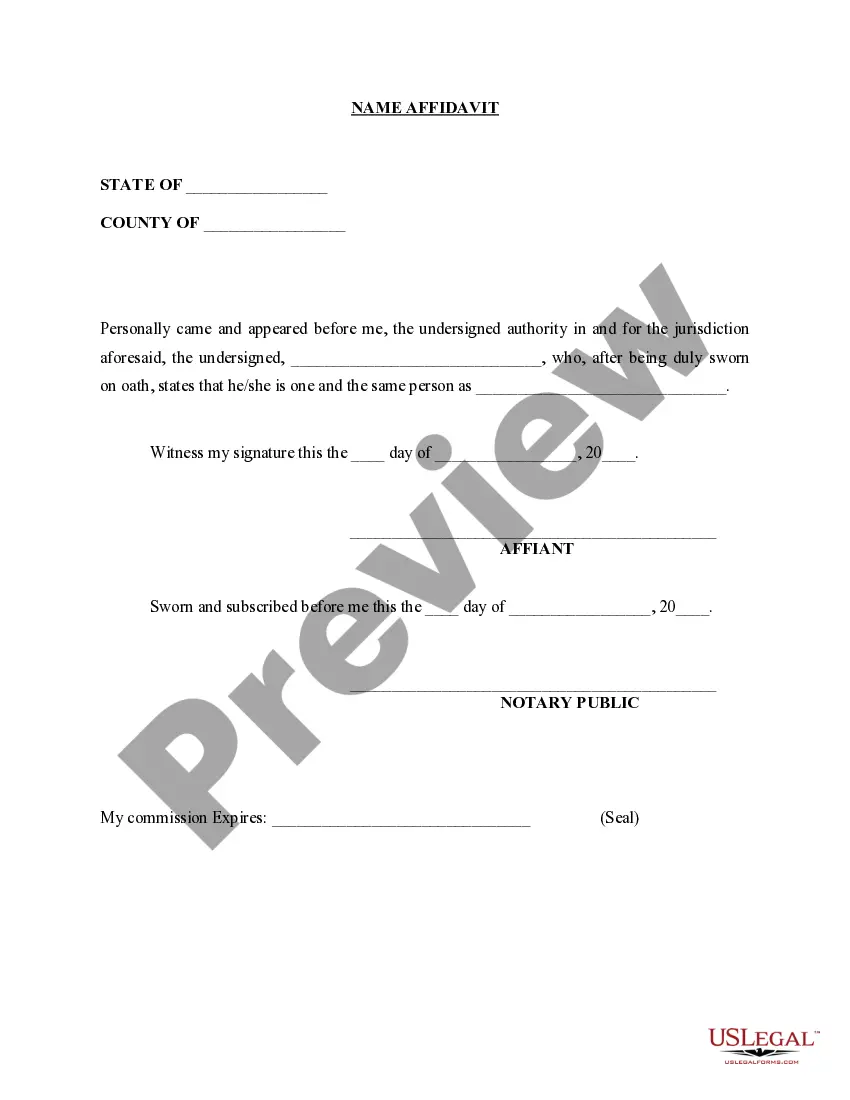
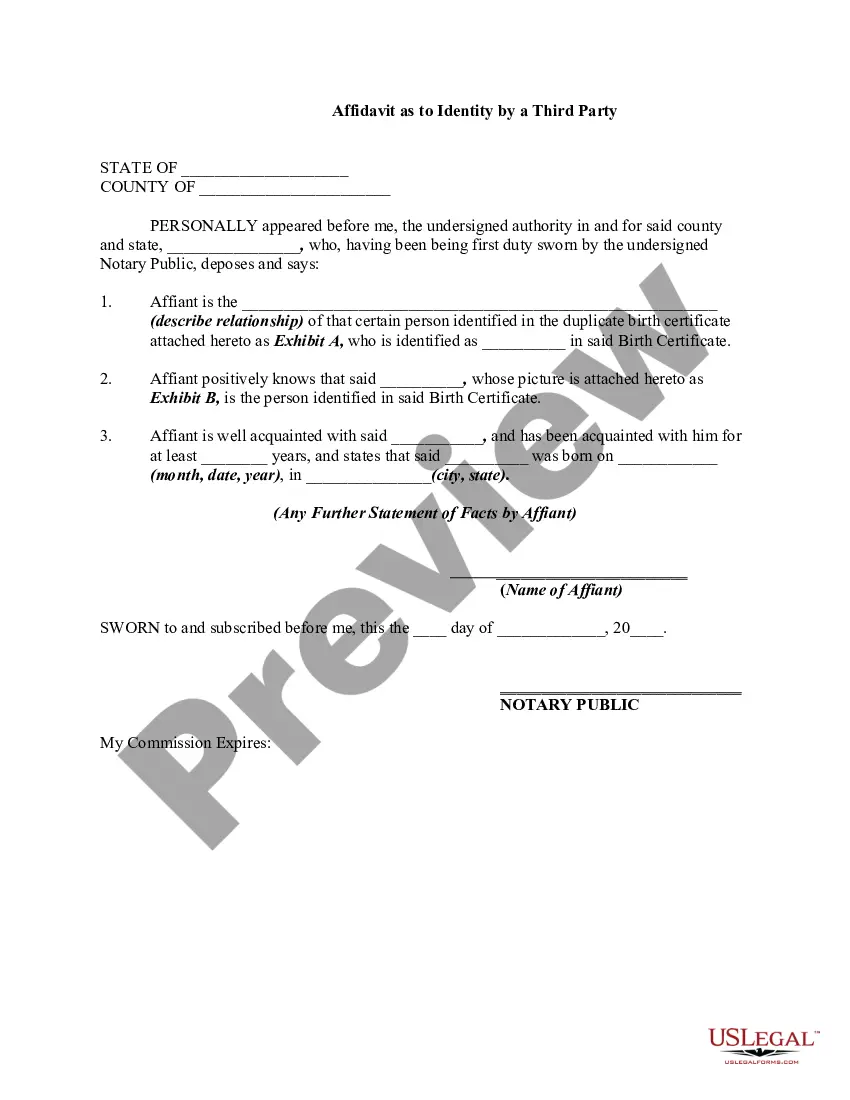
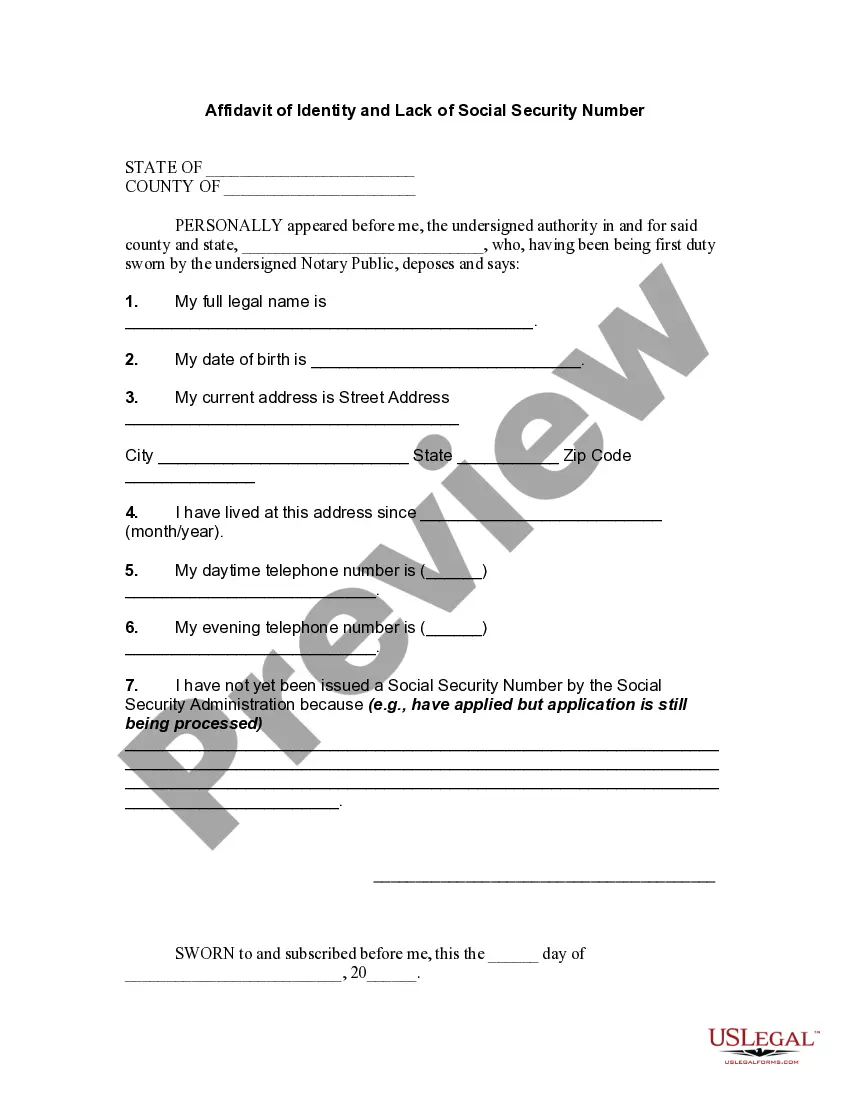
Situations where this form applies
This form is typically used in scenarios where formal proof of identity is required, such as:
- Opening a bank account
- Applying for a loan or credit
- Confirming identity in court proceedings
- Completing transactions that require identity validation
Who this form is for
This form is intended for:
- Individuals required to verify their identity for legal matters
- Persons applying for financial services where identity confirmation is necessary
- Anyone needing to provide sworn testimony regarding their identity
Steps to complete this form
- Enter your full legal name in the designated space.
- Provide your date of birth to verify your age.
- Fill in your Social Security number for additional verification.
- Include your driver's license number for identification purposes.
- Write your current address, including street, city, state, and zip code.
- Indicate how long you have resided at this address.
- Add your daytime and evening phone numbers for contact.
- Sign the affidavit in front of a notary public.
Notarization requirements for this form
Yes, this form must be notarized to be legally valid. US Legal Forms provides integrated online notarization services, allowing you to complete the process securely via a video call at any time, ensuring legal acceptance without the need for travel.
Get your form ready online
Our built-in tools help you complete, sign, share, and store your documents in one place.
Make edits, fill in missing information, and update formatting in US Legal Forms—just like you would in MS Word.
Download a copy, print it, send it by email, or mail it via USPS—whatever works best for your next step.
Sign and collect signatures with our SignNow integration. Send to multiple recipients, set reminders, and more. Go Premium to unlock E-Sign.
If this form requires notarization, complete it online through a secure video call—no need to meet a notary in person or wait for an appointment.
We protect your documents and personal data by following strict security and privacy standards.

Make edits, fill in missing information, and update formatting in US Legal Forms—just like you would in MS Word.

Download a copy, print it, send it by email, or mail it via USPS—whatever works best for your next step.

Sign and collect signatures with our SignNow integration. Send to multiple recipients, set reminders, and more. Go Premium to unlock E-Sign.

If this form requires notarization, complete it online through a secure video call—no need to meet a notary in person or wait for an appointment.

We protect your documents and personal data by following strict security and privacy standards.
Common mistakes
- Incorrectly filling out the name or other personal details.
- Failing to include the date of notarization.
- Not providing accurate contact information.
- Omitting to sign the document in front of a notary public.
Benefits of completing this form online
- Convenience of accessing and completing the form from anywhere at any time.
- Editability of the document allows for easy corrections and updates.
- Reliability of professionally drafted templates by licensed attorneys.
What to keep in mind
- The Affidavit of Identity is essential for verifying one's identity in legal and financial contexts.
- Ensure accuracy in all provided information to avoid processing delays.
- Always complete this form in the presence of a notary public to maintain its legal validity.
Looking for another form?




Form popularity
FAQ
Affidavits can be written in your own handwriting or typed. 2."Notarized" means that you have sworn under oath that the facts in the affidavit are true, the document has been signed in front of a notary public, and a notary public has signed and put a seal on the affidavit.
Title the affidavit. First, you'll need to title your affidavit. Craft a statement of identity. The very next section of your affidavit is what's known as a statement of identity. Write a statement of truth. State the facts. Reiterate your statement of truth. Sign and notarize.
In the Affidavit for Identity Proof, you have to provide your personal and identifiable information which includes your full name, date of birth and residential address. You will have to swear that the information given is true and correct. And have to get the Affidavit witnessed, signed and sealed by Notary public.
Step 3: Write the name of the parties in case of an affidavit being filled in Court or Write the name of the Deponent in case of other affidavits. Step 4: Write the complete address of the deponent. Step 5: Write the statements in point wise and state only the true facts.
I am _____ and my name _______, appearing on the enclosed ID proof, is single name.Both names denote one and the same person. I solemnly state that the contents of this affidavit are true to the best of my knowledge and belief and that it conceals nothing and that no part of it is false.
In the sentence, the person writing the statement must state that he or she is stating that the information is accurate. (Example: I, Jane Doe, solemnly swear that the contents of this document are true and correct, and that I agree to abide by the terms in this affidavit.)
Step 2: Write the purpose of the Affidavit or the Heading. Step 3: Write the name of the parties in case of an affidavit being filled in Court or Write the name of the Deponent in case of other affidavits. Step 4: Write the complete address of the deponent.
Although affidavits are considered legal documents, anyone can draft one. As long as it is signed, witnessed, and notarized correctly, it will be valid. That means that you do not have to use a lawyer to create an affidavit.