Lease of Taxicab
What this document covers
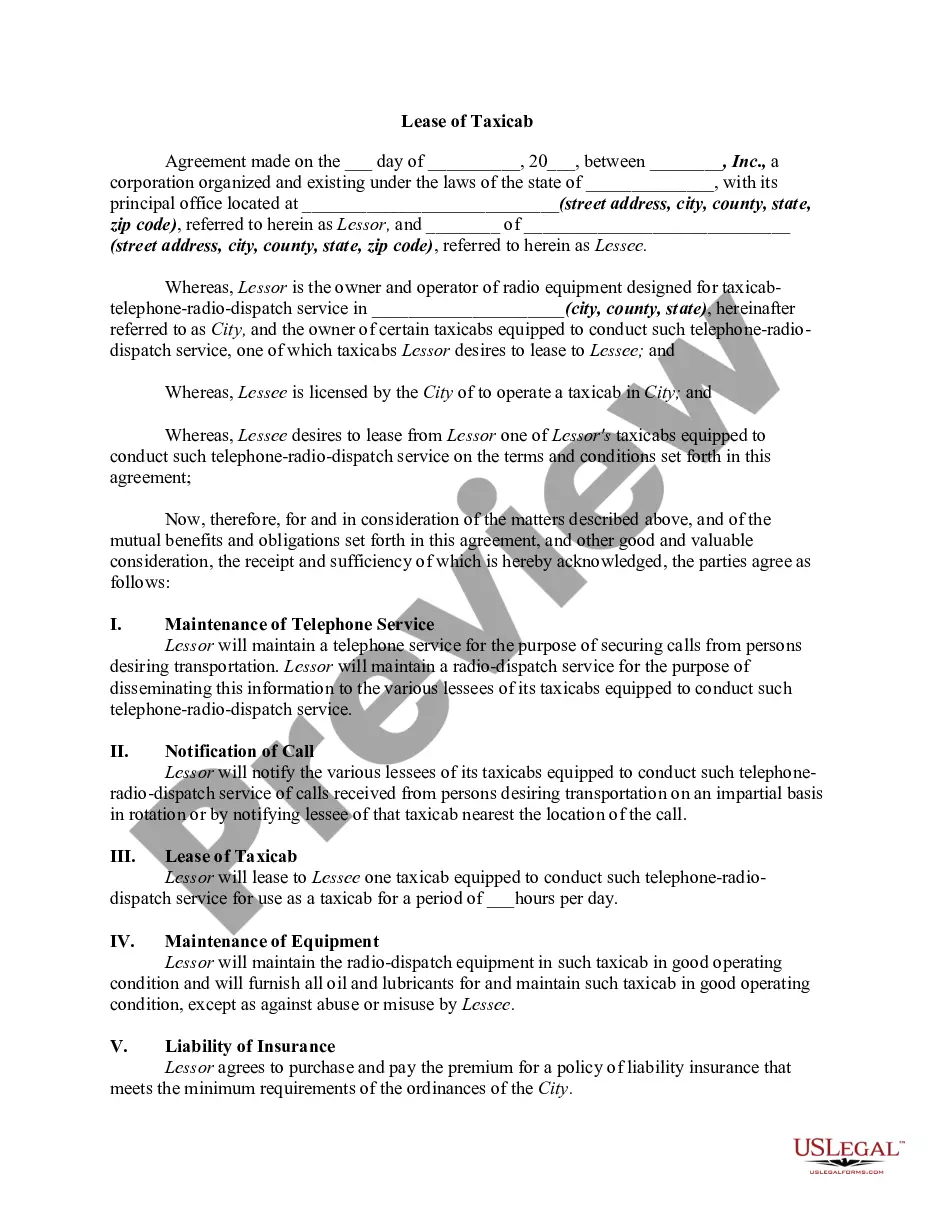
The Lease of Taxicab is a legal document that formalizes an agreement between a corporation that owns taxicabs and a licensed individual or entity wishing to operate one of these taxicabs in a specific area. This form outlines the rights and responsibilities of both parties, distinguishing itself as a comprehensive lease agreement tailored for the taxi industry. Users looking to lease a taxicab for operation can benefit from this precise and structured document.
Key components of this form
- Identification of the lessor (taxicab company) and lessee (operator).
- Details on the maintenance of telephone and radio-dispatch service.
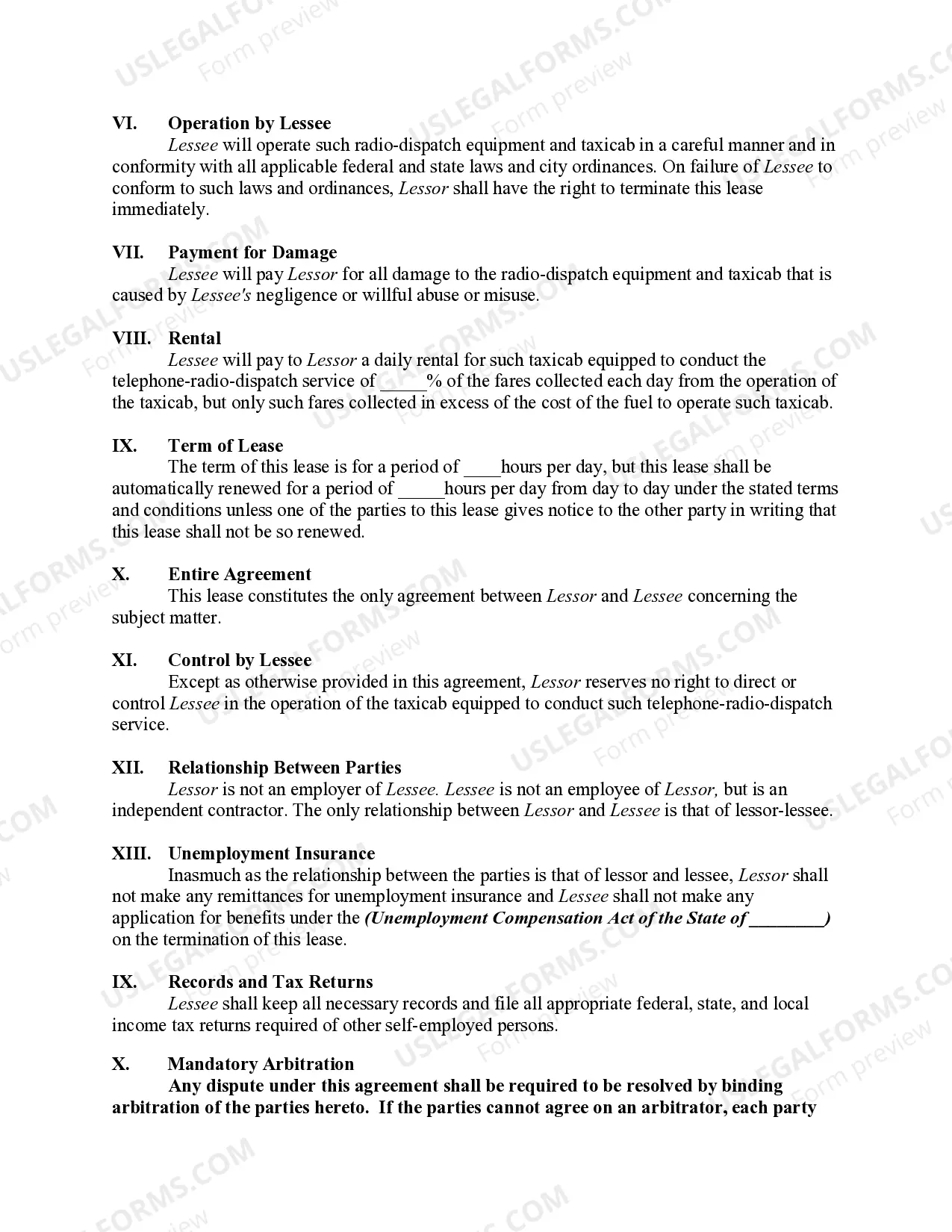
- Provisions for maintenance of equipment and liability insurance responsibilities.
- Terms regarding rental payments and duration of the lease.
- Clauses addressing the operational conduct of the lessee.
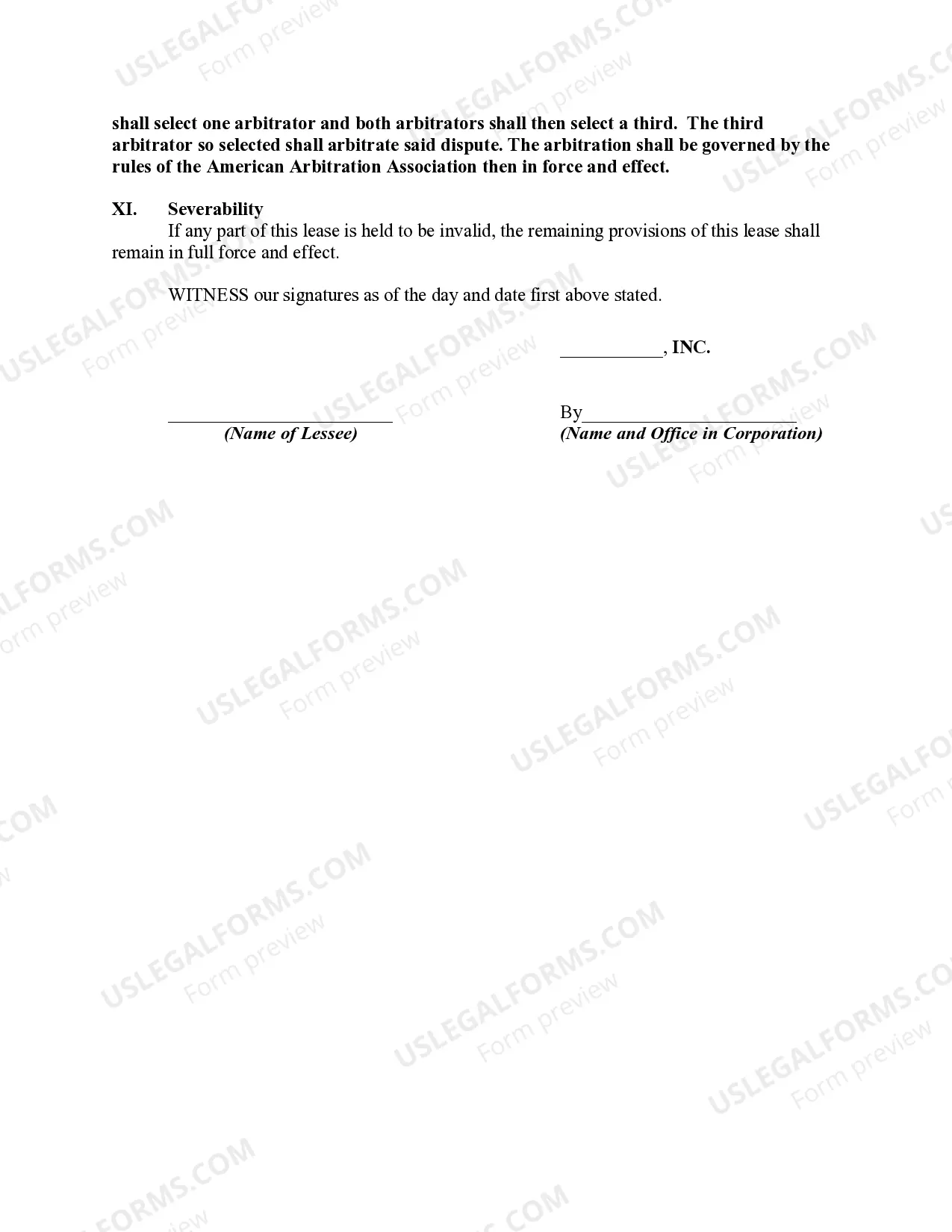
- Conditions for resolving disputes through binding arbitration.
When to use this document
This lease document is needed when a taxicab operator wants to legally lease a taxicab from a company that provides a fleet and dispatch service. This situation commonly arises in urban areas where independent operators seek to establish a compliant and profitable taxicab service within the constraints of local regulations.
Who this form is for
- Individuals or businesses looking to operate a taxicab in a specific city.
- Taxicab fleet owners who wish to lease their vehicles.
- Operators who require access to a dispatch service for their taxicab operations.
- Those unfamiliar with legal contracts and seeking a reliable, drafted agreement.
Completing this form step by step
- Identify the parties: Fill in the names and addresses of the Lessor and Lessee.
- Specify the terms: Indicate the duration of the lease and daily rental amount.
- Outline responsibilities: Review and fill in maintenance duties and insurance obligations.
- Enter the date: Clearly state the effective date of the lease agreement.
- Signatures: Ensure all parties sign and date the document to confirm agreement.
Does this document require notarization?
This form does not typically require notarization unless specified by local law. It is advisable to check with local authorities to confirm if notarization is necessary for your specific lease agreement.
Get your form ready online
Our built-in tools help you complete, sign, share, and store your documents in one place.
Make edits, fill in missing information, and update formatting in US Legal Forms—just like you would in MS Word.
Download a copy, print it, send it by email, or mail it via USPS—whatever works best for your next step.
Sign and collect signatures with our SignNow integration. Send to multiple recipients, set reminders, and more. Go Premium to unlock E-Sign.
If this form requires notarization, complete it online through a secure video call—no need to meet a notary in person or wait for an appointment.
We protect your documents and personal data by following strict security and privacy standards.

Make edits, fill in missing information, and update formatting in US Legal Forms—just like you would in MS Word.

Download a copy, print it, send it by email, or mail it via USPS—whatever works best for your next step.

Sign and collect signatures with our SignNow integration. Send to multiple recipients, set reminders, and more. Go Premium to unlock E-Sign.

If this form requires notarization, complete it online through a secure video call—no need to meet a notary in person or wait for an appointment.

We protect your documents and personal data by following strict security and privacy standards.
Common mistakes
- Failing to specify the rental amount or lease duration clearly.
- Not including all required signatures, which may invalidate the agreement.
- Misunderstanding maintenance responsibilities, leading to disputes.
- Ignoring local regulations that may affect lease terms.
Why use this form online
- Convenience: Downloaded forms can be completed at your convenience, eliminating the need for in-person consultations.
- Editability: Online forms allow for easy customization to fit specific needs.
- Reliability: Forms drafted by licensed attorneys ensure legal compliance and reduce the risk of issues.
- The lease is enforceable as long as it adheres to state and local laws governing taxicab operations.
- Ensure that both parties understand their rights and obligations as outlined in the agreement.
- Legal advice may be beneficial for parties unfamiliar with leasing regulations.
Quick recap
- The Lease of Taxicab is essential for formalizing the rental agreement between taxicab owners and operators.
- It includes critical components like lease terms, maintenance duties, and liability issues.
- Using the form properly can help prevent misunderstandings and ensure compliance with local regulations.
Looking for another form?


Form popularity
FAQ
The city can really charge whatever the want for them, but if the price is too high, then nobody would buy. So they're generally priced to be high enough that the city gets a lot of money, but low enough that cabs can actually be profitable, and thus the medallions will be bought.
A lease must also contain consideration, which means that the offeree must give something of value to the offeror. Consideration usually consists of money, but other things of value may be given to the offeror.Such leases usually concern real property that will be leased for a period of more than three years.
And while taxi medallions used to be considered a good long-term investment for these drivers many of whom are immigrants they've become a crushing liability as their value has plummeted. The value of a medallion went from $200,000 in 2002 to over $1 million in 2014, then crashed to less than $200,000 soon after.
A lease without consideration is still a lease; it's not an enforceable contract. Both parties to the lease must agree that consideration was or will be provided, and that the consideration is sufficient. Make sure the lease states how consideration is to been given.
Afterwards, prices dropped and many of those who bought medallions at high prices, are now paying debts that average ranging between $500,000 and $600,000 dollars. Currently, the price of a taxi medallion ranges between $120,000 and $150,000.
A lessor is the owner of an asset that is leased, or rented, to another party, known as the lessee. Lessors and lessees enter into a binding contract, known as the lease agreement, that spells out the terms of their arrangement.
Key Takeaways. A lease is a contract outlining the terms under which one party agrees to rent property owned by another party. The lease guarantees the tenant, also known as the lessee, use of an asset and guarantees the lessor, the property owner or landlord, regular payments for a specified period in exchange.
Few taxi drivers own theirs; most lease them, paying around $100 for one 12-hour shift. The limited number of medallions issued by the city made each one highly valuable; individual medallion sale prices went from $50,000 in the late 1970s to over $1m by 2014. For many taxi drivers, owning a medallion meant success.
The Gross Lease. The gross lease tends to favor the tenant. The Net Lease. The net lease, however, tends to favor the landlord. The Modified Gross Lease.