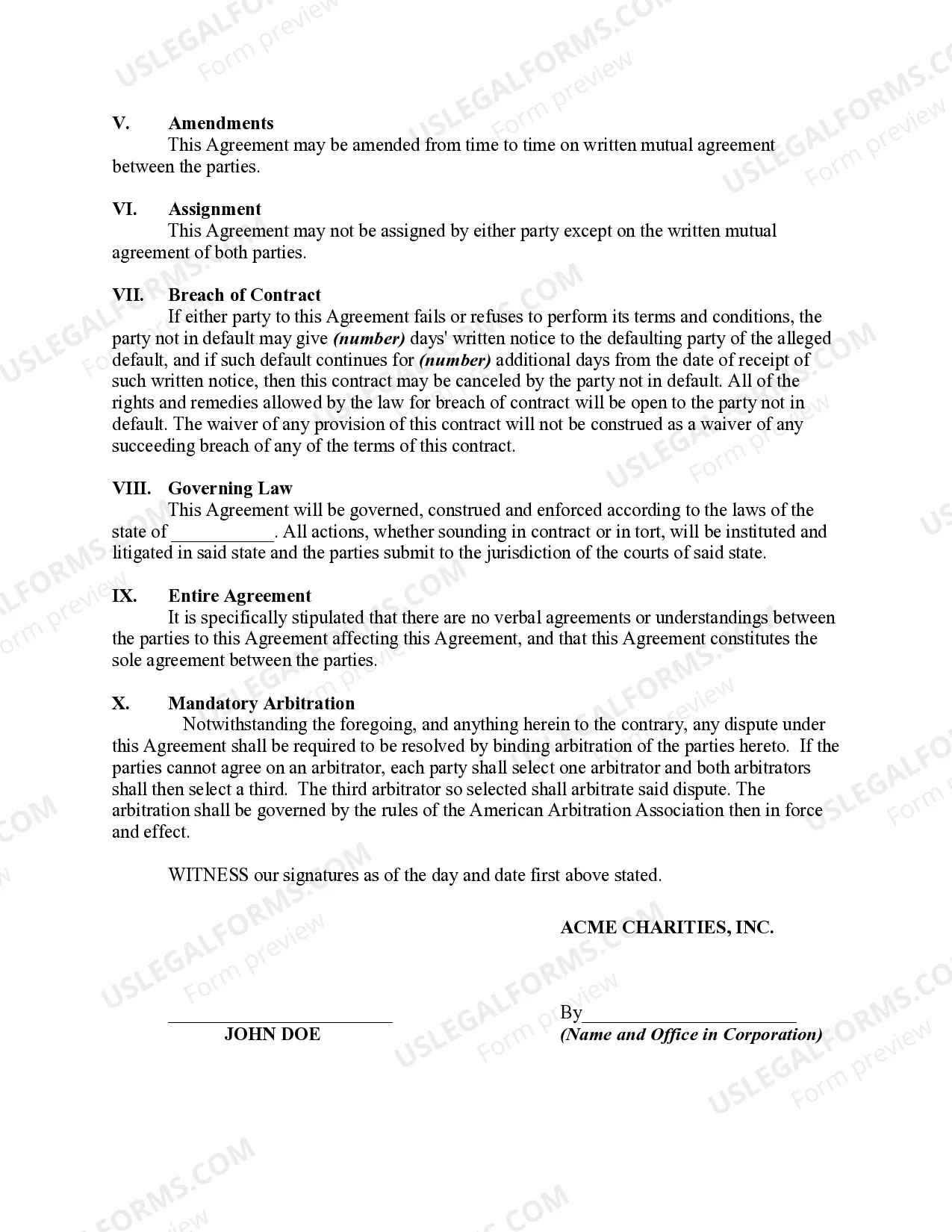
Employment of Executive Director by a Nonprofit Corporation
What this document covers
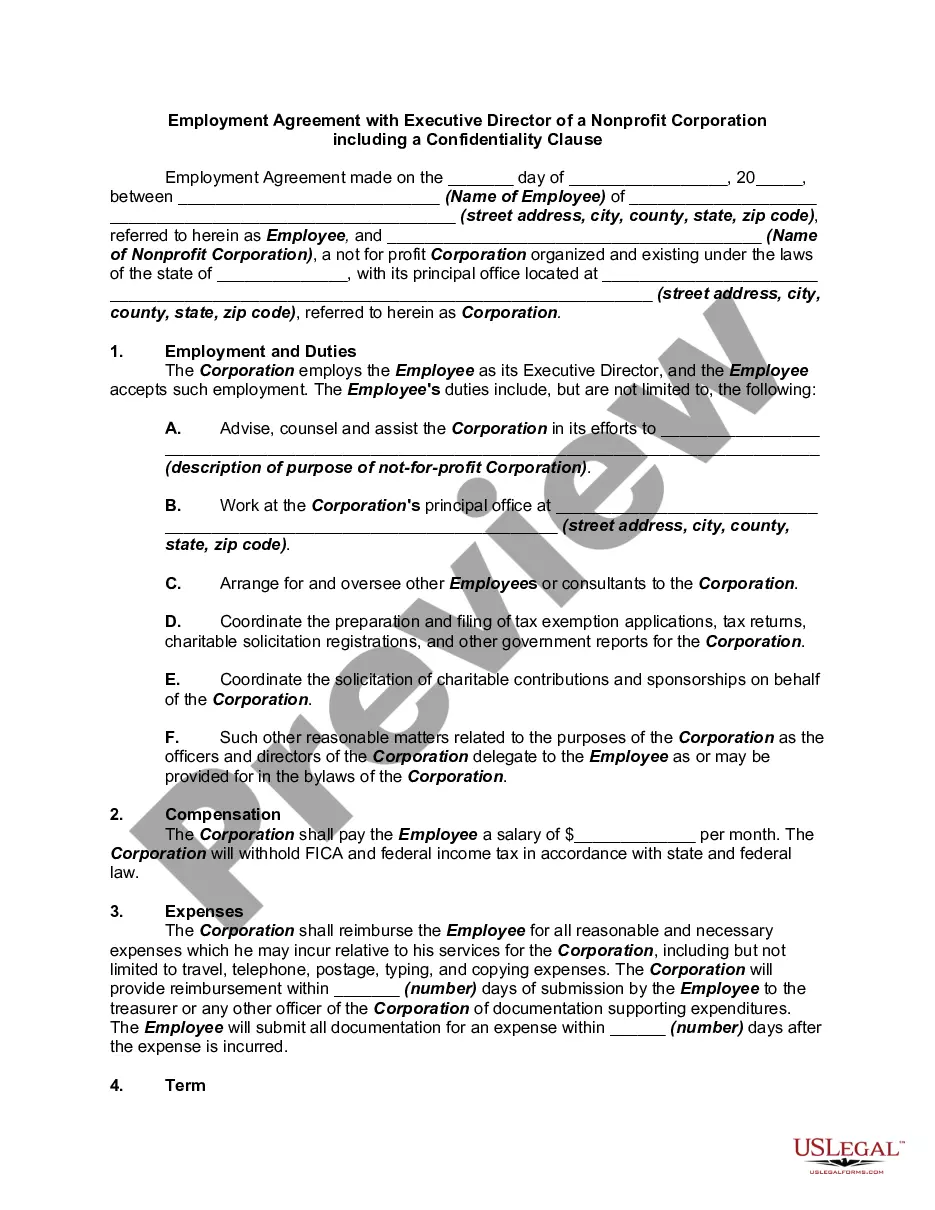
The Employment of Executive Director by a Nonprofit Corporation is a legal document that formalizes the working relationship between a nonprofit organization and its Executive Director. This form outlines the specific duties, compensation, and terms of employment, differentiating it from other employment agreements by focusing on the nonprofit sector and the unique responsibilities associated with such roles.
Key parts of this document
- Identification of the employer (the nonprofit corporation) and the employee (the Executive Director).
- Detailed description of the employee's duties and responsibilities.
- Compensation structure and tax withholding provisions.
- Reimbursement policy for expenses incurred by the employee.
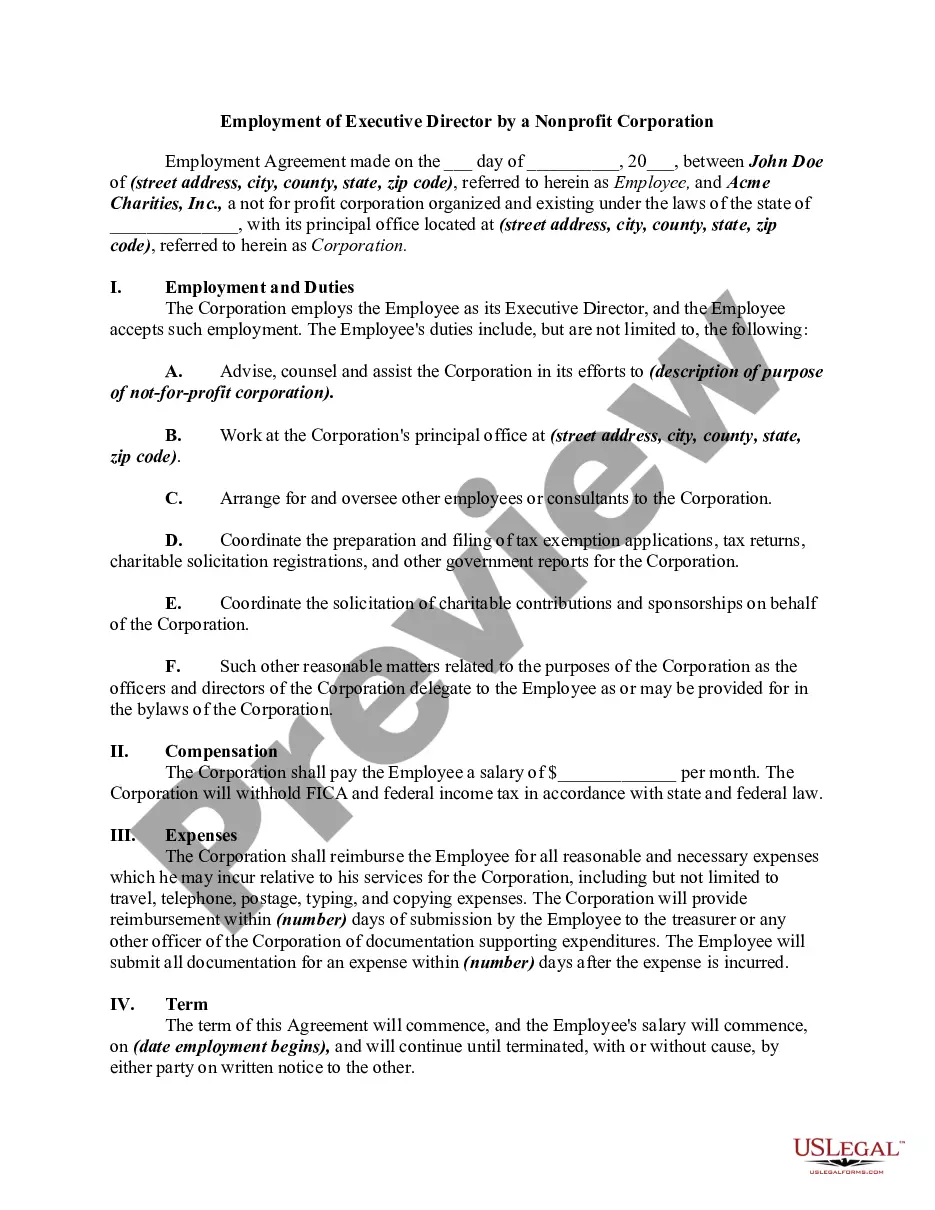
- Terms of the agreement, including duration and termination conditions.
- Governing law and dispute resolution mechanisms.
When to use this form
This form is essential when a nonprofit organization hires an Executive Director. It is used to clearly establish the terms of employment, ensuring both parties understand their duties, compensation, and rights. It is particularly important for organizations seeking to formalize the employment relationship in compliance with legal and organizational guidelines.
Who needs this form
- Nonprofit organizations looking to hire an Executive Director.
- Executive Directors entering into an employment agreement with a nonprofit corporation.
- Nonprofits seeking to ensure clarity and legal compliance in their employment practices.
Completing this form step by step
- Identify the parties involved, including their names and addresses.
- Outline the specific duties of the Executive Director in the appropriate section.
- Specify the salary and any reimbursement policies clearly.
- Indicate the term of employment and conditions for termination.
- Ensure both parties sign and date the agreement after reviewing its contents.
Is notarization required?
This form does not typically require notarization unless specified by local law. Ensure that both parties review the document and sign it to confirm their agreement.
Get your form ready online
Our built-in tools help you complete, sign, share, and store your documents in one place.
Make edits, fill in missing information, and update formatting in US Legal Forms—just like you would in MS Word.
Download a copy, print it, send it by email, or mail it via USPS—whatever works best for your next step.
Sign and collect signatures with our SignNow integration. Send to multiple recipients, set reminders, and more. Go Premium to unlock E-Sign.
If this form requires notarization, complete it online through a secure video call—no need to meet a notary in person or wait for an appointment.
We protect your documents and personal data by following strict security and privacy standards.

Make edits, fill in missing information, and update formatting in US Legal Forms—just like you would in MS Word.

Download a copy, print it, send it by email, or mail it via USPS—whatever works best for your next step.

Sign and collect signatures with our SignNow integration. Send to multiple recipients, set reminders, and more. Go Premium to unlock E-Sign.

If this form requires notarization, complete it online through a secure video call—no need to meet a notary in person or wait for an appointment.

We protect your documents and personal data by following strict security and privacy standards.
Mistakes to watch out for
- Failing to specify the duties of the Executive Director adequately.
- Not detailing terms of termination, leading to potential disputes.
- Ignoring state-specific employment laws that may require additional provisions.
Benefits of completing this form online
- Convenient to download and customize according to organizational needs.
- Editable format allows for easy updates and adjustments as necessary.
- Available 24/7, ensuring immediate access when needed.
Legal use & context
- This form serves as a legally binding document that protects the rights and responsibilities of both the employee and the employer.
- Under applicable state laws, this contract can be enforced in court, provided it meets legal standards for contracts.
- Including an arbitration clause can help resolve disputes more efficiently outside of traditional court systems.
Looking for another form?





Form popularity
FAQ
Nonprofit Officers A nonprofit's officers include its president, vice president, secretary, treasurer, executive director, and chief executive officer (CEO). Officers are usually classified as employees because they work under the board of directors' direction and control.
The executive director oversees hiring, firing, maintaining records, compliance, and other administrative duties. The director is also responsible for overseeing fundraising and ensuring sound financial practices.
Officers, unlike directors, each have individual duties related to managing some aspect of the corporation's activities and affairs. Such duties are generally not defined by corporate laws, but they are described in the bylaws and/or a written position description and defined in part by custom.
If employees appear confused about the organization's goals or operations, your nonprofit may benefit from hiring a different executive director. An ED can establish organizational-wide goals and make them known, guide employees at all levels of the organization, and serve as the leader for your nonprofit.
The Executive Director is responsible for overseeing the administration, programs and strategic plan of the organization. Other key duties include fundraising, marketing, and community outreach. The position reports directly to the Board of Directors.
Executive director and chief executive officer (CEO) are leadership titles in organizations.The term executive director is more frequently used in nonprofit entities, whereas CEO is used with for-profit entities and some large nonprofits.
Duties for the Executive Director will include managing company assets, optimizing financial operations, providing leadership to all staff, establishing business goals, ensuring tax compliance, advising the board of directors on organizational activities, overseeing and streamlining daily operations, improving staff
Great executive directors are goal driven and possess a high degree of motivation and energy. They are doers. They have a record of productivity. Passion for the Organization's Mission. They are driven by the importance of the organization's mission.
The answer is yes, although most nonprofit corporation laws contain a requirement that one person is designated as the president.A nonprofit can have a president/CEO and an executive director if the organization maintains a specific structure. For example: President/CEO who has full authority for operations.