Mutual Release of Claims based on Real Estate Purchase Contract
What this document covers
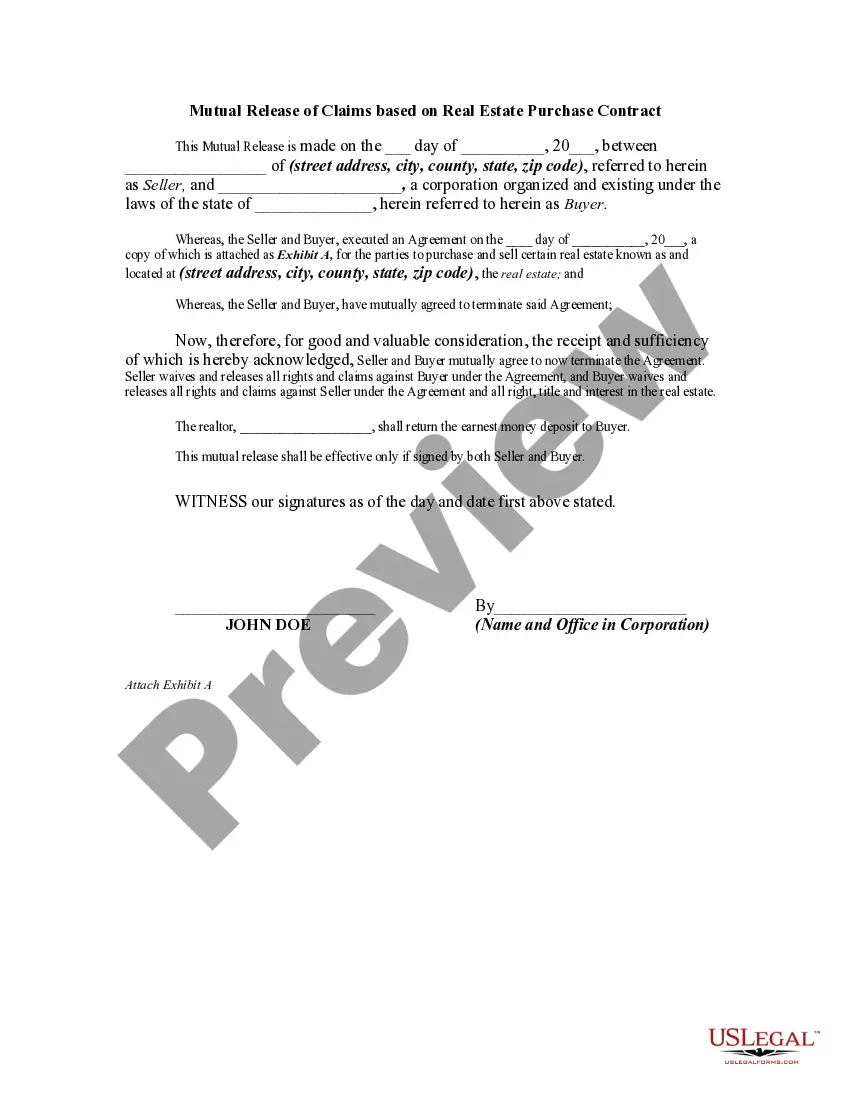
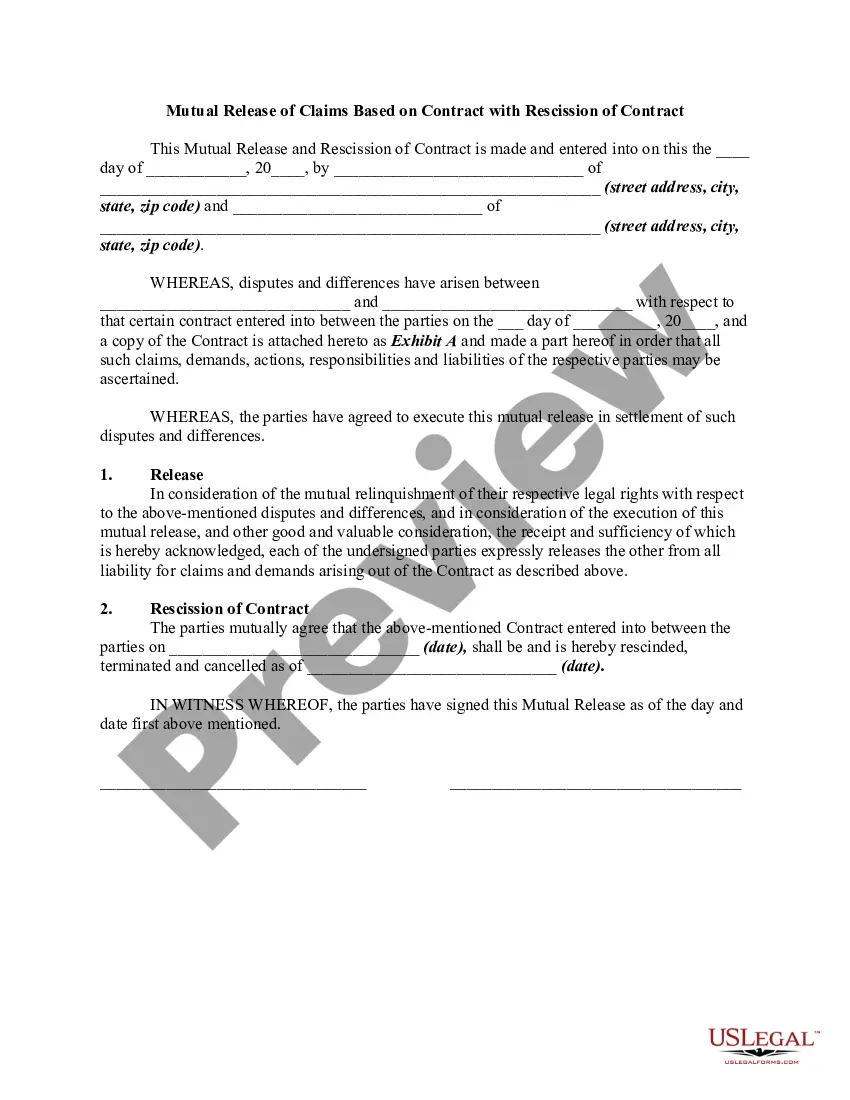
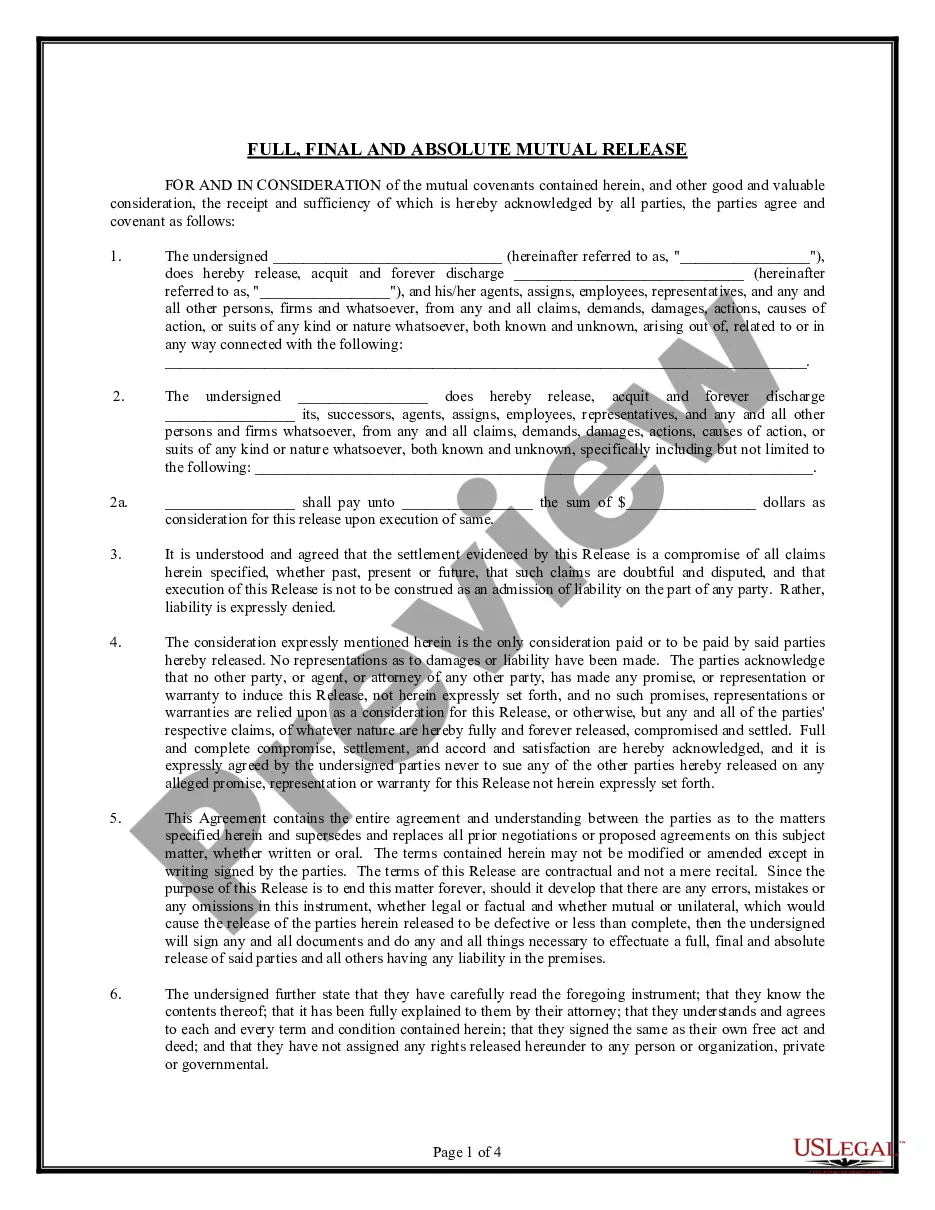
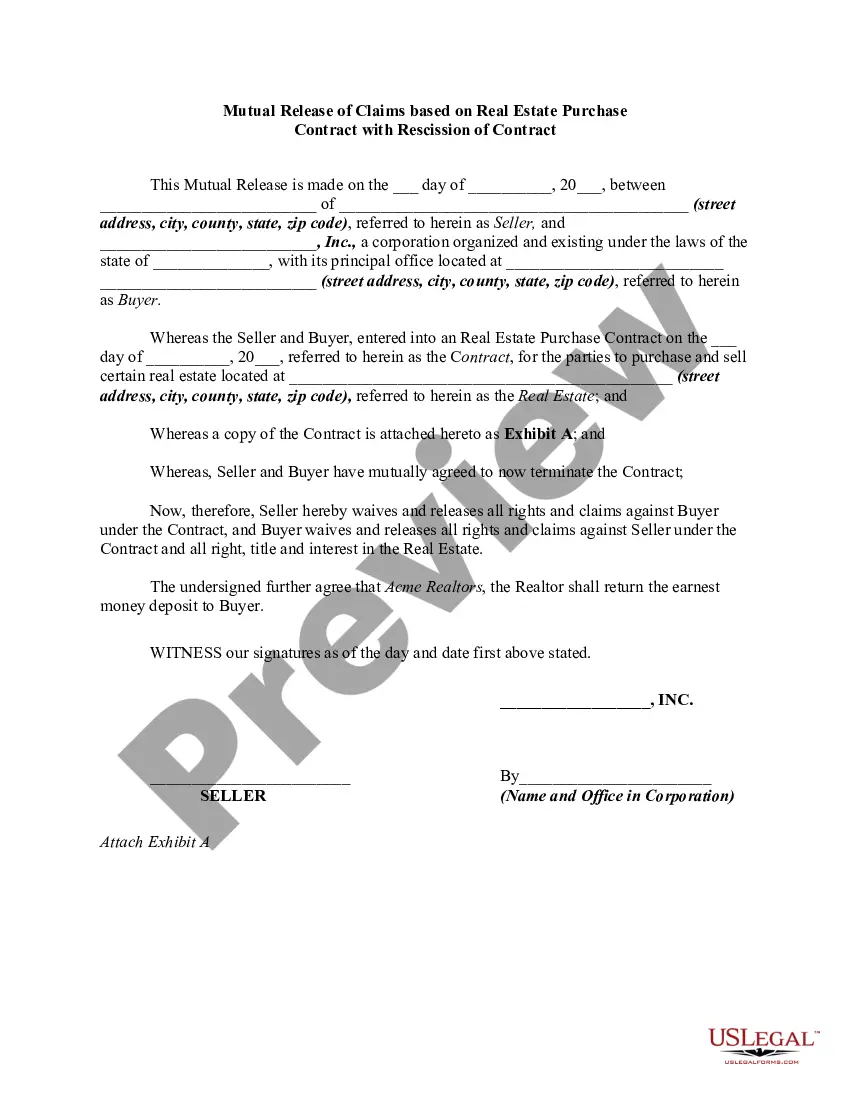
The Mutual Release of Claims based on Real Estate Purchase Contract is a legal document that formalizes an agreement between a buyer and a seller to rescind a real estate contract. This form ensures that neither party holds any liability against the other regarding the terminated agreement, offering them a clean break without future claims related to the property purchase. Unlike other legal documents, this form specifically focuses on the mutual release mechanism between the two parties after an unsuccessful transaction.
Key parts of this document
- Date of the mutual release agreement.
- Names and addresses of the Seller and Buyer.
- Reference to the original contract (exhibit A).
- Mutual agreement to terminate the previous agreement.
- Waiver of rights and claims by both parties.
- Instructions for the return of any earnest money deposit.
- Signatures of both parties for validation.
When to use this document
This form is typically used when a buyer and seller decide to abandon a real estate transaction after the purchase contract has been signed. Scenarios may include the buyer being unable to secure financing, the seller deciding not to sell the property, or other contractual disagreements. In such cases, using the Mutual Release of Claims helps ensure that both parties are freed from obligations and can avoid potential legal disputes in the future.
Who should use this form
- Individuals or corporations entering into a real estate transaction.
- Buyers who wish to release claims against the seller.
- Property sellers who need to absolve themselves from obligations following a contract failure.
- Real estate professionals facilitating the transaction.
How to complete this form
- Identify the date of the mutual release agreement.
- Fill in the names and complete addresses for both the Seller and Buyer.
- Provide the date the original purchase agreement was executed.
- Attach Exhibit A, the original contract, as a reference.
- Ensure both parties sign and date the agreement to validate it.
Does this document require notarization?
This form does not typically require notarization to be legally valid. However, some jurisdictions or document types may still require it. US Legal Forms provides secure online notarization powered by Notarize, available 24/7 for added convenience.
Get your form ready online
Our built-in tools help you complete, sign, share, and store your documents in one place.
Make edits, fill in missing information, and update formatting in US Legal Forms—just like you would in MS Word.
Download a copy, print it, send it by email, or mail it via USPS—whatever works best for your next step.
Sign and collect signatures with our SignNow integration. Send to multiple recipients, set reminders, and more. Go Premium to unlock E-Sign.
If this form requires notarization, complete it online through a secure video call—no need to meet a notary in person or wait for an appointment.
We protect your documents and personal data by following strict security and privacy standards.

Make edits, fill in missing information, and update formatting in US Legal Forms—just like you would in MS Word.

Download a copy, print it, send it by email, or mail it via USPS—whatever works best for your next step.

Sign and collect signatures with our SignNow integration. Send to multiple recipients, set reminders, and more. Go Premium to unlock E-Sign.

If this form requires notarization, complete it online through a secure video call—no need to meet a notary in person or wait for an appointment.

We protect your documents and personal data by following strict security and privacy standards.
Mistakes to watch out for
- Not including the date of the original agreement.
- Failure to attach the original purchase agreement as Exhibit A.
- Signing the form without both parties present.
- Neglecting to provide complete addresses for both parties.
Benefits of completing this form online
- Convenient access to a legally drafted document.
- Editable templates that can be tailored to your individual situation.
- Rapid availability, allowing quick execution of the mutual release.
- Designed by licensed attorneys to ensure compliance with current laws.
Looking for another form?

Form popularity
FAQ
A Mutual Release Agreement is a straightforward document that allows you to settle disputes quickly and professionally. No matter what your dispute, a Mutual Release Agreement allows both parties to agree to drop all claims and get out of the contract.
If the seller won't sign the addendum, then the terms of the contract remain as they are now. There should be a financing paragraph that specifies not only the date the commmitment is due, but what happens if the date is not met.
To be perfectly clear, you can always back out of a real estate purchase contract at any time before closing. There's no way the seller can force you to actually purchase the home. However, if there's no valid reason for backing out as defined in the contract, you'll likely lose your earnest deposit.
Yes -- but the wording of the purchase agreement makes a difference. Purchase agreements usually include contingencies or situations in which you can back out of the contract without penalty. As long as you're pulling out of the purchase due to one of the contingencies listed on the purchase agreement, you're golden.
Definition of Mutual AcceptanceMutual acceptance is the point at which both the buyer and seller agree on the price and terms of a deal and a binding contract is entered into. In most states, the Purchase and Sale Agreement is signed at mutual acceptance. BACK TO GLOSSARY. Search for homes by city. Albany Real Estate.
There is now a document called the mutual release whenever a purchase agreement does not go to closing. If the deal falls apart because of inspection, mortgage, or any issue the buyer and seller must sign and agree on who gets the earnest money. BOTH PARTIES MUST AGREE AND SIGN the mutual release.
Walking Away During The Inspection Contingency. Cancelling Purchase Contract Due To Appraisal Contingency. Cancelling Purchase Contract The Under Finance Contingency.
A mutual agreement is a binding contract between two or more parties and can cover any contingency. The difference between a mutual agreement and a settlement not creating a trust, is determined by the operative words, ie "mutually agrees" or "settles".
The identity of the buyer and of the seller. A sufficient description of the real property to be sold. The sale price, or consideration to be paid for the real property by the buyer. The amount of any earnest money deposit to be paid by the buyer.