Notice to Debtor of Authority Granted to Agent to Receive Payment
What is this form?
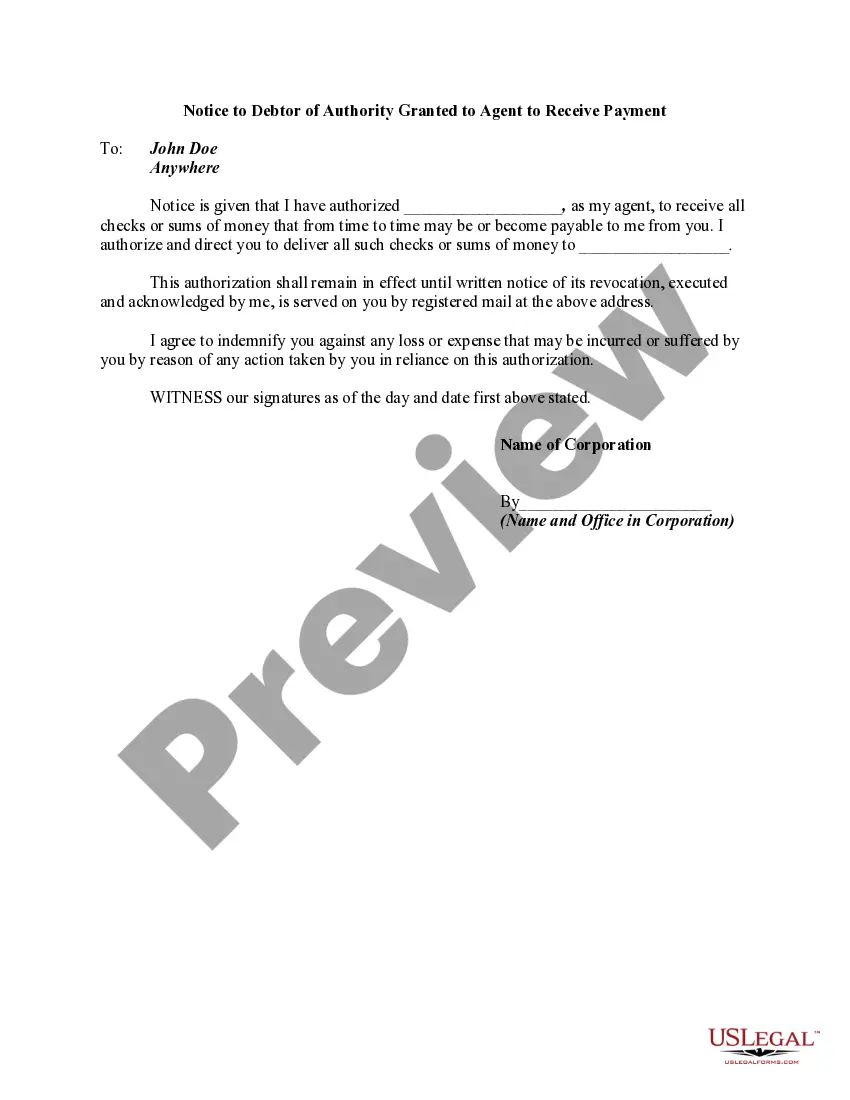
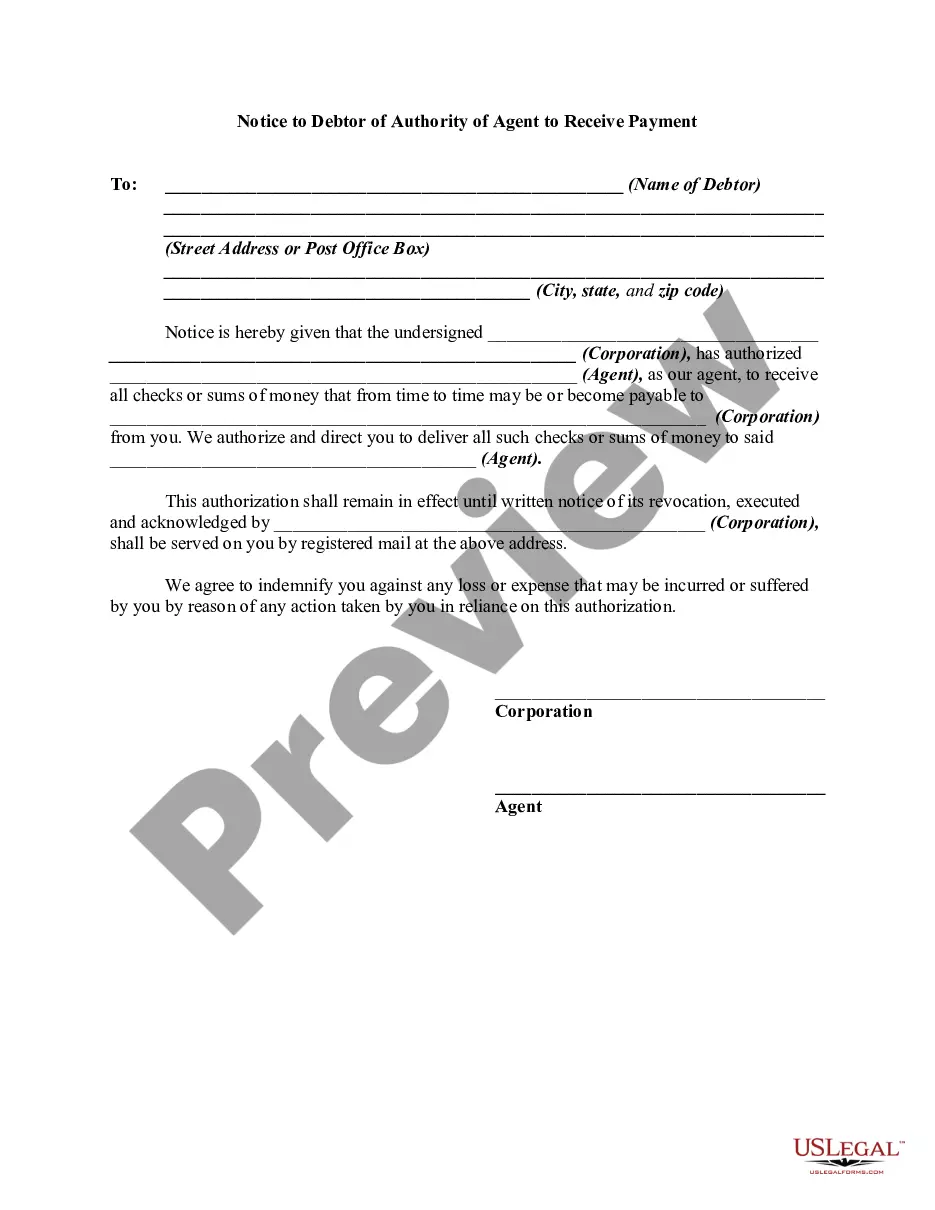
The Notice to Debtor of Authority Granted to Agent to Receive Payment is a formal document that notifies a debtor that a principal has authorized an agent to receive payments on their behalf. This form serves to clarify payment responsibilities and ensure that payments are directed appropriately, thereby preventing confusion in financial transactions.
Form components explained
- Identification of the principal and debtor.
- Name of the authorized agent designated to receive payments.
- Statement affirming the authority granted to the agent.
- Indemnification clause, protecting the debtor from loss due to reliance on the notice.
- Provision for revocation of the authorization through written notice.
When to use this document
This form is useful when a principal wants to delegate authority to an agent for payment collection. Situations may include when a business appoints an agent to handle payments from clients or when an individual authorizes someone to manage their financial transactions. Using this form ensures that all parties are aware of the delegated authority, reducing potential misunderstandings in payment execution.
Intended users of this form
- Individuals or businesses that wish to allow an agent to collect payments on their behalf.
- Debtors needing assurance of payment collection procedures.
- Corporations that require formal documentation of payments directed to an agent.
Instructions for completing this form
- Identify the principal and debtor, including their full names and addresses.
- Enter the name of the agent authorized to receive payments.
- Specify the payments or checks that the agent is authorized to receive.
- Include a date to indicate when the authority becomes effective.
- Have the principal sign the document to authenticate the authorization.
Notarization guidance
Notarization is not commonly needed for this form. However, certain documents or local rules may make it necessary. Our notarization service, powered by Notarize, allows you to finalize it securely online anytime, day or night.
Get your form ready online
Our built-in tools help you complete, sign, share, and store your documents in one place.
Make edits, fill in missing information, and update formatting in US Legal Forms—just like you would in MS Word.
Download a copy, print it, send it by email, or mail it via USPS—whatever works best for your next step.
Sign and collect signatures with our SignNow integration. Send to multiple recipients, set reminders, and more. Go Premium to unlock E-Sign.
If this form requires notarization, complete it online through a secure video call—no need to meet a notary in person or wait for an appointment.
We protect your documents and personal data by following strict security and privacy standards.

Make edits, fill in missing information, and update formatting in US Legal Forms—just like you would in MS Word.

Download a copy, print it, send it by email, or mail it via USPS—whatever works best for your next step.

Sign and collect signatures with our SignNow integration. Send to multiple recipients, set reminders, and more. Go Premium to unlock E-Sign.

If this form requires notarization, complete it online through a secure video call—no need to meet a notary in person or wait for an appointment.

We protect your documents and personal data by following strict security and privacy standards.
Avoid these common issues
- Failing to properly identify all parties involved.
- Not providing a clear definition of the authority being granted.
- Neglecting to sign the form, which could lead to disputes.
- Omitting the revocation process, which might cause confusion if changes are needed.
Why complete this form online
- Convenient access to the form for immediate usage.
- Editable format to accommodate specific details easily.
- Reliability of using templates prepared by licensed attorneys.
- Ability to download and store the form securely for your records.
Looking for another form?






Form popularity
FAQ
There are five types of authority of an agent, which are express authority, implied authority, ostensible authority, ratification and necessity.
F0d8 There are three types of authority: express, implied, and apparent. f050 Only express and implied are actual authority, because the agent is truly authorized. f050 In apparent authority, the agent seems to be authorized, but is actually not. The principal is still bound by the agent's actions.
The ability of an agent to act on behalf of a client in a way that binds the client. Actual express authority is authority the client states in a contract given to an agent.Apparent authority is given verbally by the client.
Actual express authority client expressly states the authority of the agent in a written contract. Apparent authority client gives agent authority verbally. Implied authority agent authority that is implied in order to execute actual or apparent authority.
Artists' agents. An artist's agent handles the business side of an artist's life. Sales agents. Distributors. Licensing agents.
Recurring issues in agency law include whether the agent really is such, the scope of the agent's authority, and the duties among the parties. The five types of agents include: general agent, special agent, subagent, agency coupled with an interest, and servant (or employee).
As these questions suggest, agency law often involves three partiesthe principal, the agent, and a third party. It therefore deals with three different relationships: between principal and agent, between principal and third party, and between agent and third party.
Actual authority is created by the principal's manifestations to the agent, whereas apparent authority is created by the principal's manifestations to a third party.Absent an express grant of authority, the relationship may result from implied or apparent agency.
Actual express authority client expressly states the authority of the agent in a written contract. Apparent authority client gives agent authority verbally. Implied authority agent authority that is implied in order to execute actual or apparent authority.