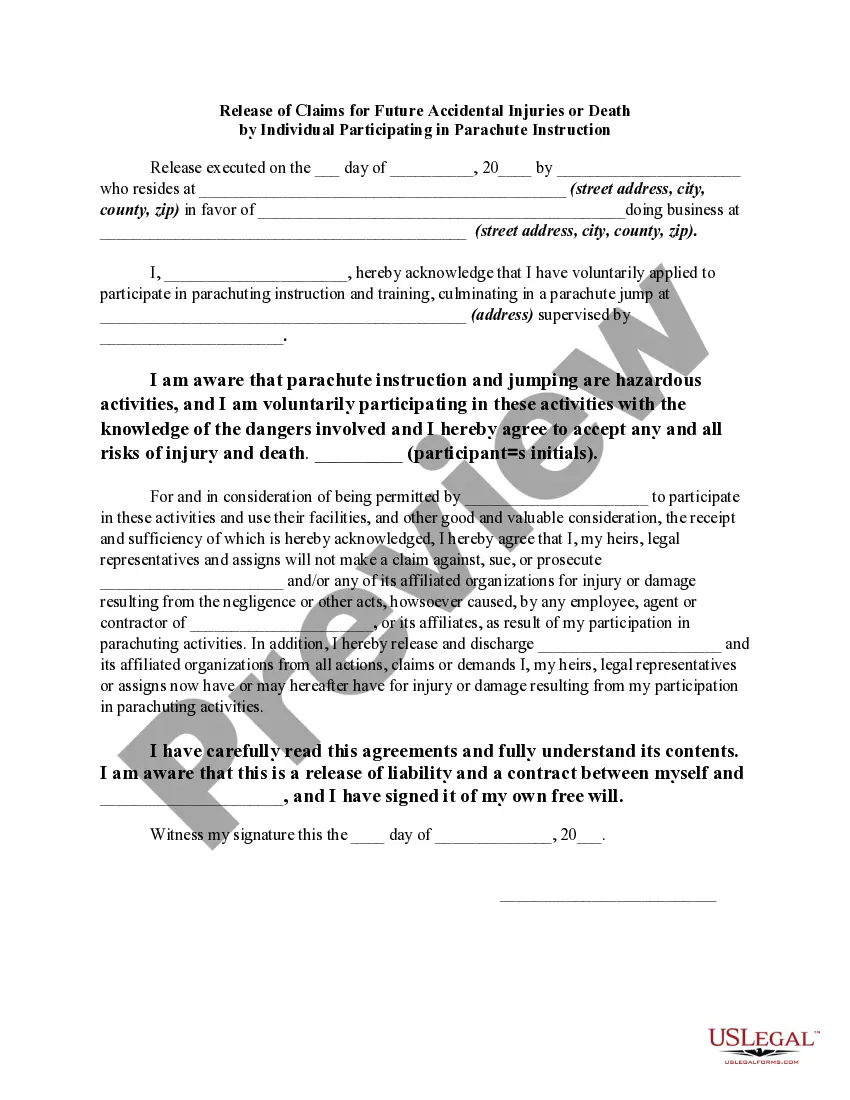
Release of Claims for Future Accidental Personal Injuries or Death by Individual Participating in Parachute Instruction
Overview of this form
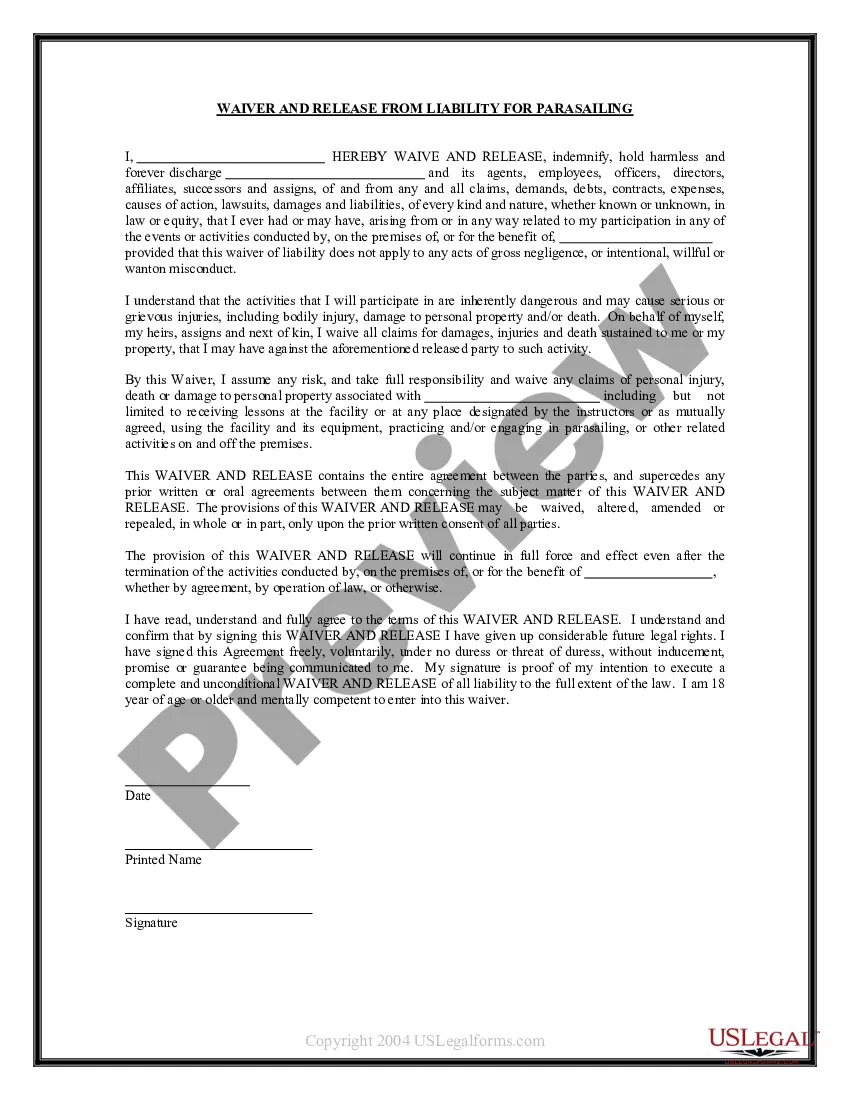
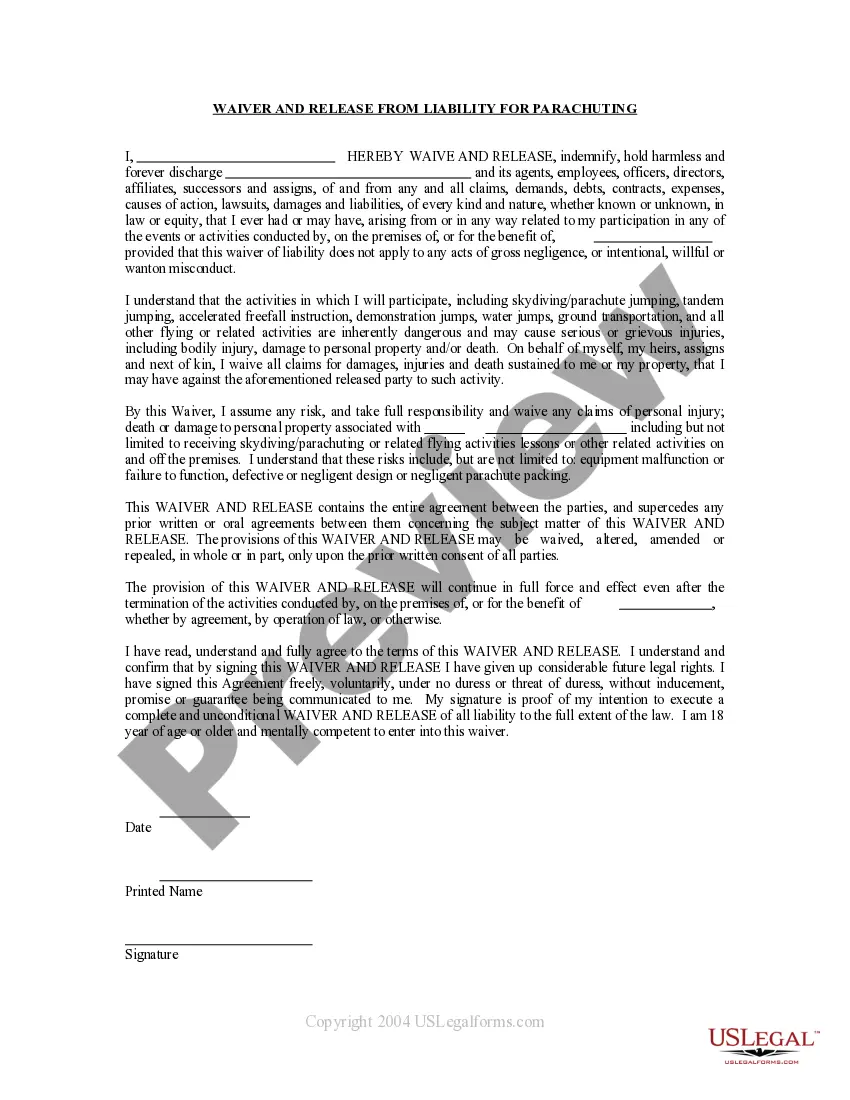
This form is a Release of Claims for Future Accidental Personal Injuries or Death by Individual Participating in Parachute Instruction. It is used by individuals participating in parachuting activities to waive their rights to make claims against the parachute instruction providers for any potential injuries or death resulting from those activities. By signing this waiver, participants acknowledge the inherent risks of parachuting and agree not to hold the service providers liable for injuries caused by negligence or other actions. This form differs from general waivers as it specifically pertains to parachuting and related activities, ensuring that instruction providers are protected while offering their services.
Key components of this form
- Participant information: Name and contact details of the individual participating in parachuting.
- Waiver statement: Acknowledgment of risks associated with parachuting and acceptance of those risks.
- Release of liability: Agreement not to sue the instruction provider or affiliated entities for injuries or damages.
- Date of agreement: Specific date when the release form is executed.
- Signature section: Area for the participant's signature to validate the release.
Common use cases
This form is appropriate for individuals who are engaging in parachuting instruction and intend to participate in jumps. It should be completed and signed before the individual begins any training or actual parachute jump. The form protects both the participant and the instruction provider from legal claims resulting from accidents that may occur during the activities.
Who can use this document
- Individuals planning to participate in parachuting instruction.
- Legal guardians of minors who are participating in parachuting activities.
- Organizations offering parachuting instruction seeking to protect themselves from liability.
How to complete this form
- Identify the participant: Fill out the full name and address of the individual participating in the parachuting instruction.
- Enter the instruction provider's details: Provide the name and address of the parachute instruction company or individual.
- Acknowledge the risks: Read the waiver statement carefully, confirming understanding and acceptance of the inherent risks.
- Sign and date: The participant (or guardian, if applicable) must sign and date the form to validate it.
- Witness signature: If required, ensure a witness signs the form as verification.
Does this document require notarization?
In most cases, this form does not require notarization. However, some jurisdictions or signing circumstances might. US Legal Forms offers online notarization powered by Notarize, accessible 24/7 for a quick, remote process.
Get your form ready online
Our built-in tools help you complete, sign, share, and store your documents in one place.
Make edits, fill in missing information, and update formatting in US Legal Forms—just like you would in MS Word.
Download a copy, print it, send it by email, or mail it via USPS—whatever works best for your next step.
Sign and collect signatures with our SignNow integration. Send to multiple recipients, set reminders, and more. Go Premium to unlock E-Sign.
If this form requires notarization, complete it online through a secure video call—no need to meet a notary in person or wait for an appointment.
We protect your documents and personal data by following strict security and privacy standards.
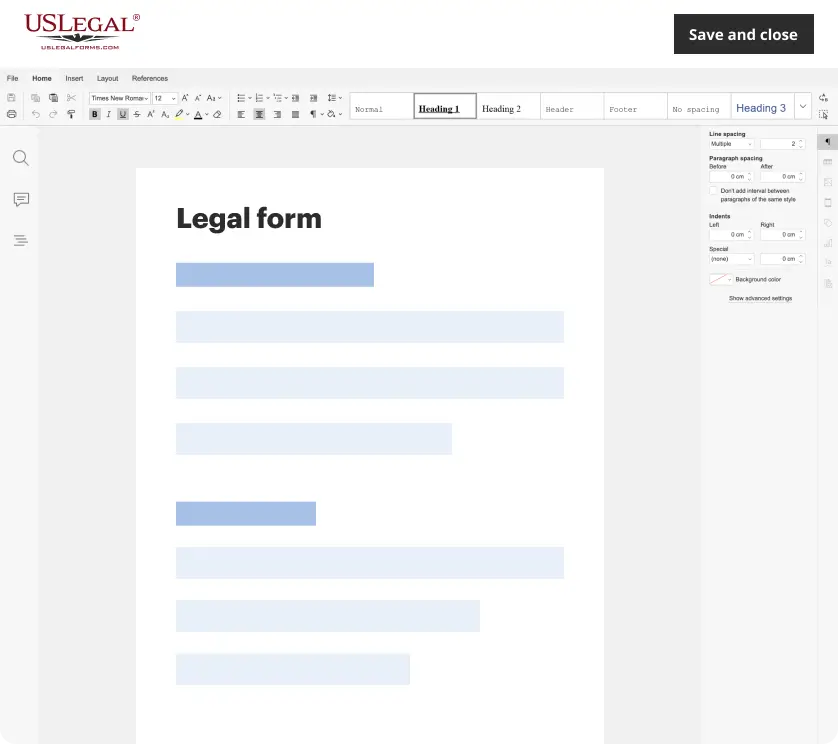
Make edits, fill in missing information, and update formatting in US Legal Forms—just like you would in MS Word.
Download a copy, print it, send it by email, or mail it via USPS—whatever works best for your next step.
Sign and collect signatures with our SignNow integration. Send to multiple recipients, set reminders, and more. Go Premium to unlock E-Sign.
If this form requires notarization, complete it online through a secure video call—no need to meet a notary in person or wait for an appointment.
We protect your documents and personal data by following strict security and privacy standards.
Avoid these common issues
- Failing to complete all required personal information, which may invalidate the form.
- Not reading the waiver in detail before signing, leading to misunderstandings about liability.
- Omitting to date the form, which is essential for legal validity.
- Not obtaining a witness signature when required, which can affect the enforcement of the waiver.
Benefits of using this form online
- Convenience: Download the form instantly and complete it at your own pace.
- Editability: Modify the document as needed to fit specific circumstances before printing.
- Legal accuracy: Ensure that the form complies with current legal standards and requirements.
- Cost-effective: Avoid legal fees associated with drafting custom forms from scratch.
Legal use & context
- This release is legally binding once signed, effectively limiting liability for the instruction provider.
- Participants must understand that signing the form waives their right to pursue damages in the event of an accident.
- The enforceability of this form may vary based on state laws regarding liability waivers.
Key takeaways
- The form is crucial for participants in parachuting to waive future claims of injury or death.
- It is important to accurately fill out all sections of the form.
- Consult local laws to ensure compliance with liability waiver requirements in your state.
Looking for another form?


Form popularity
FAQ
Other factors include the amount of insurance coverage available and the type of case. That said, from my personal experience, the typical payout for pain and suffering in most claims is under $15,000. This is because most claims involve small injuries.
Call your insurance company immediately after the accident and inform about the damage. Intimate the police about the incident and obtain an FIR. Record the details of the car, the driver, and the witnesses in the FIR. File a claim with your insurance company and ask them to assign a surveyor to evaluate the loss.
As we mentioned before, most injured victims receive their settlement funds within about six weeks from the end of negotiations. However, additional delays can happen. If your settlement gets delayed extensively and you're wondering what's going on, you should contact your personal injury lawyer.
That said, from my personal experience, the typical payout for pain and suffering in most claims is under $15,000. This is because most claims involve small injuries. The severity of the injury is a huge factor that affects the value of pain and suffering damages.
How Much Compensation Is Typical in Personal Injury Cases? More than half of our readers received payouts ranging from just $3,000 to $25,000. But another 26% of readers received over $25,000, making the overall average $52,900.
But many personal injury cases settle for much more. An average personal injury settlement amount is anywhere between $3,000 and $75,000. Be careful when using an average personal injury settlement calculator to give you an idea of what you may stand to collect.
The two basic categories of damages awarded in personal injury claims are compensatory and punitive.
There are two types of compensatory damagesgeneral and actual. Actual damages are intended to provide funds to only replace what was lost. General compensatory damages awarded are more complex, as these compensatory damages do not represent a monetary expenditure.
The common method used to calculate a personal injury settlement amount is to add up your hard costs, then add one to five times that amount for your pain and suffering. The tricky part of calculating a fair settlement amount is including the full value of your special damages and justifying your general damages.