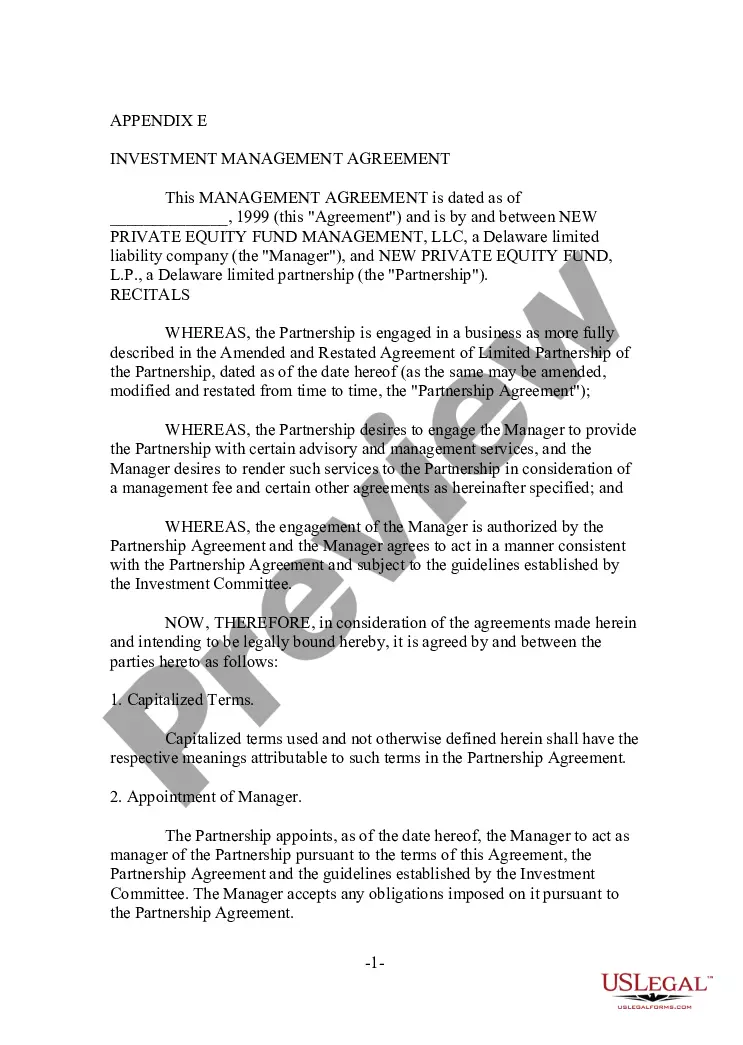
Release, Waiver of Liability, and Assumption of all Risks of Personal Bodily Injury for the Privilege to Use a Trampoline
Overview of this form
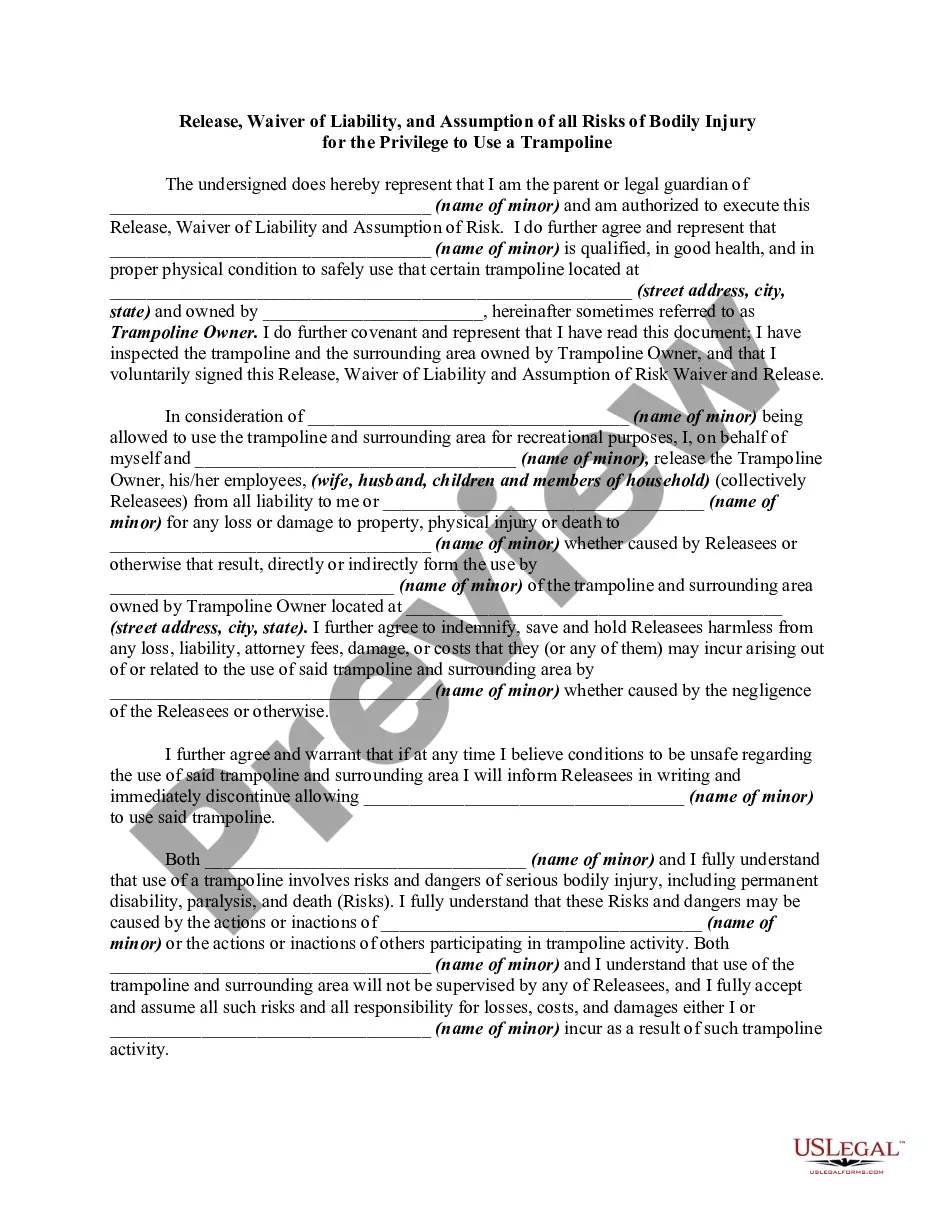
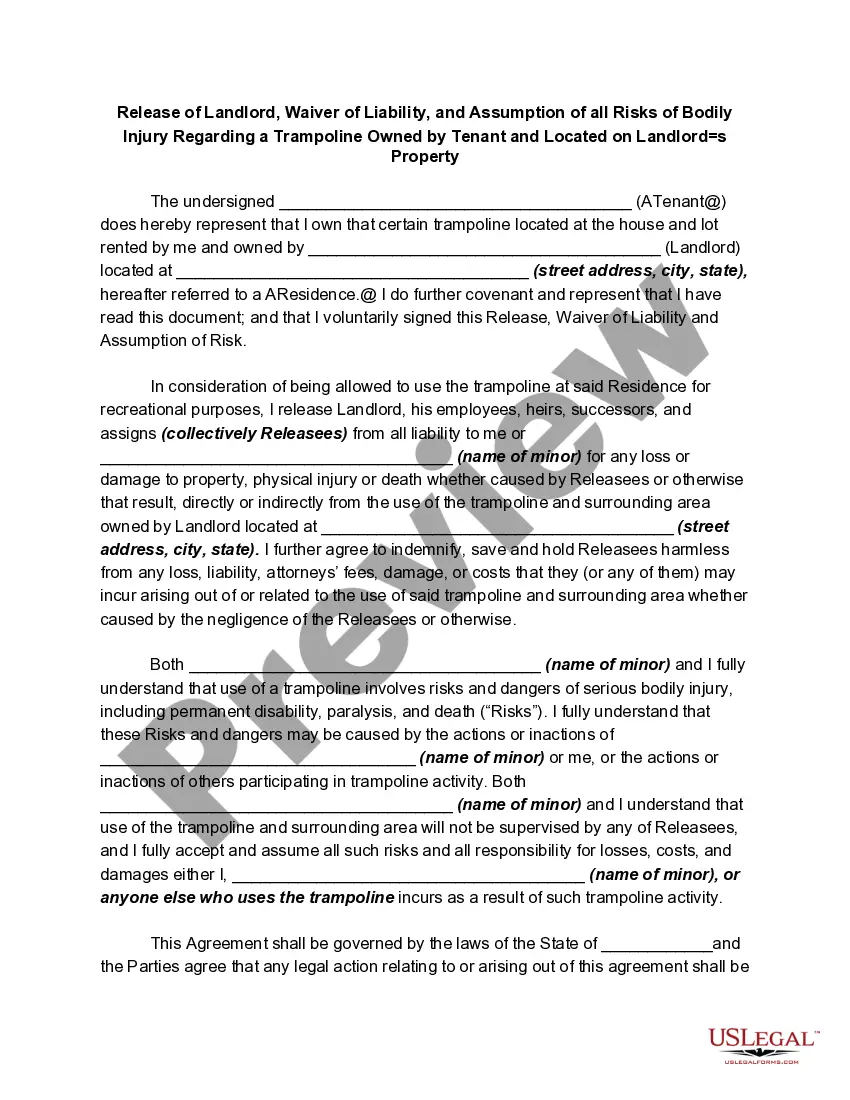
The Release, Waiver of Liability, and Assumption of all Risks of Personal Bodily Injury for the Privilege to Use a Trampoline is a legal document designed to protect trampoline owners and other associated parties from liability related to injuries that may occur while a minor uses their trampoline. This form differs from general liability waivers as it specifically focuses on the risks associated with trampoline use and includes provisions for the supervision and condition of the trampoline and surrounding area.
Form components explained
- Identification of the parent or guardian executing the waiver.
- Details about the minor using the trampoline.
- Assurances about the minor's health and fitness to use the trampoline.
- A release of liability for the trampoline owner and their household members.
- Indemnification clause protecting the trampoline owner from claims.
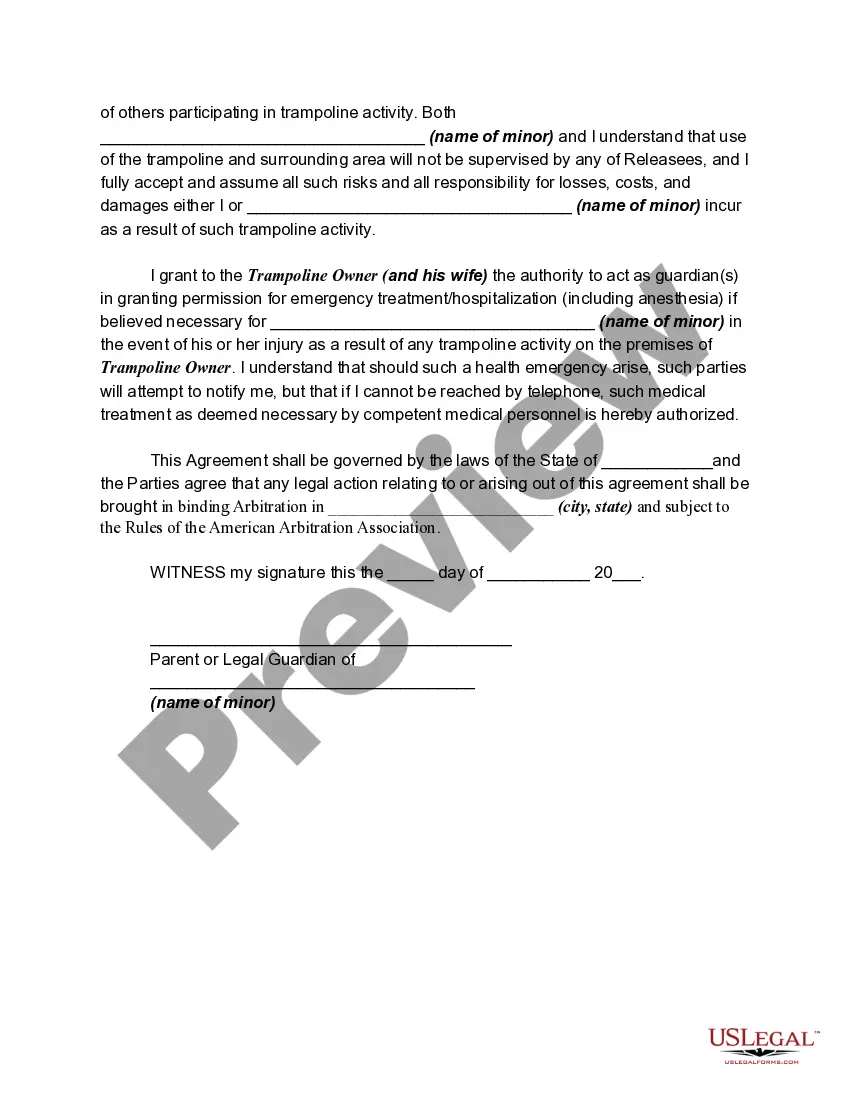
- Emergency treatment authorization clause for the minor.
- Governing law and dispute resolution provisions.
When this form is needed
This form should be used whenever a parent or legal guardian permits a minor to use a trampoline at a private residence. It is particularly important when the trampoline is located on private property to ensure that the trampoline owner is protected from legal claims in the event of an injury. This may be relevant for home gatherings, parties, or regular recreational use of the trampoline.
Who can use this document
- Parents or legal guardians of minors who will be using a trampoline.
- Trampoline owners who allow minors to use their trampoline at their home.
- Individuals hosting events or gatherings where trampoline use is intended.
Completing this form step by step
- Identify the parent or legal guardian and include their information.
- Clearly state the name of the minor who will be using the trampoline.
- Provide the address of the trampoline and confirm its ownership.
- Read the document thoroughly to understand the liability being waived.
- Sign and date the form in the designated area.
- Keep a copy for your records and give one to the trampoline owner.
Does this document require notarization?
Notarization is not commonly needed for this form. However, certain documents or local rules may make it necessary. Our notarization service, powered by Notarize, allows you to finalize it securely online anytime, day or night.
Get your form ready online
Our built-in tools help you complete, sign, share, and store your documents in one place.
Make edits, fill in missing information, and update formatting in US Legal Forms—just like you would in MS Word.
Download a copy, print it, send it by email, or mail it via USPS—whatever works best for your next step.
Sign and collect signatures with our SignNow integration. Send to multiple recipients, set reminders, and more. Go Premium to unlock E-Sign.
If this form requires notarization, complete it online through a secure video call—no need to meet a notary in person or wait for an appointment.
We protect your documents and personal data by following strict security and privacy standards.

Make edits, fill in missing information, and update formatting in US Legal Forms—just like you would in MS Word.

Download a copy, print it, send it by email, or mail it via USPS—whatever works best for your next step.

Sign and collect signatures with our SignNow integration. Send to multiple recipients, set reminders, and more. Go Premium to unlock E-Sign.

If this form requires notarization, complete it online through a secure video call—no need to meet a notary in person or wait for an appointment.

We protect your documents and personal data by following strict security and privacy standards.
Common mistakes
- Failing to fill out all relevant fields, particularly names and addresses.
- Not having the parent or legal guardian sign the form.
- Overlooking the need for the minor's medical condition assurance.
- Not providing a copy to the trampoline owner after signing.
Why complete this form online
- Immediate access to essential legal documentation without needing to visit a lawyer.
- Easy to fill out with guided prompts, reducing the likelihood of errors.
- Downloadable and printable for convenience and record-keeping.
- Drafted by licensed attorneys, ensuring enforceability and legal validity.
Legal use & context
- This form serves to limit liability for trampoline injuries during recreational use.
- It is important to ensure that both the minor and their guardian understand the risks involved.
- The form is generally enforceable as long as it is completed properly and signed by the appropriate parties.
Looking for another form?




Form popularity
FAQ
Assumption of risk refers to a legal doctrine under which an individual is barred from recovering damages for an injury sustained when he or she voluntarily exposed him or herself to a known danger.
In summary: The assumption of risk doctrine does have a place in cases in which a patient rejected proper treatment despite appropriate warning but it does not apply, through informed consent, to cases in which the patient agreed to a recommended treatment after having been warned of its risks.
"Assumption of the risk" is a legal doctrine that may prevent an injured person from winning a personal injury lawsuit or getting an injury-related insurance settlement. The idea is that the plaintiff can't hold the defendant responsible if the plaintiff knowingly exposed him or herself to the possibility of an injury.
Primary vs. "Primary" assumption of risk occurs when the plaintiff knows about a particular risk andthrough words or conductaccepts that risk, thereby relieving the defendant of its duty of care. The primary assumption of risk defense operates as a complete bar to recovery.
Terms in this set (12) General Principle of Assumption of Risk: A plaintiff who voluntarily assumes a risk of harm arising from the negligent or reckless conduct of the defendant cannot recover for such harm.Plaintiff voluntarily and reasonably encountering a known risk created by defendant's negligence.
Voluntary assumption of risk means that when a person engages in an activity, and they accept and are aware of the risks inherent in that activity, they cannot later complain if they sustain an injury during the activity.