Special Meeting of the Board of Directors Minutes - Corporate Resolutions
Overview of this form
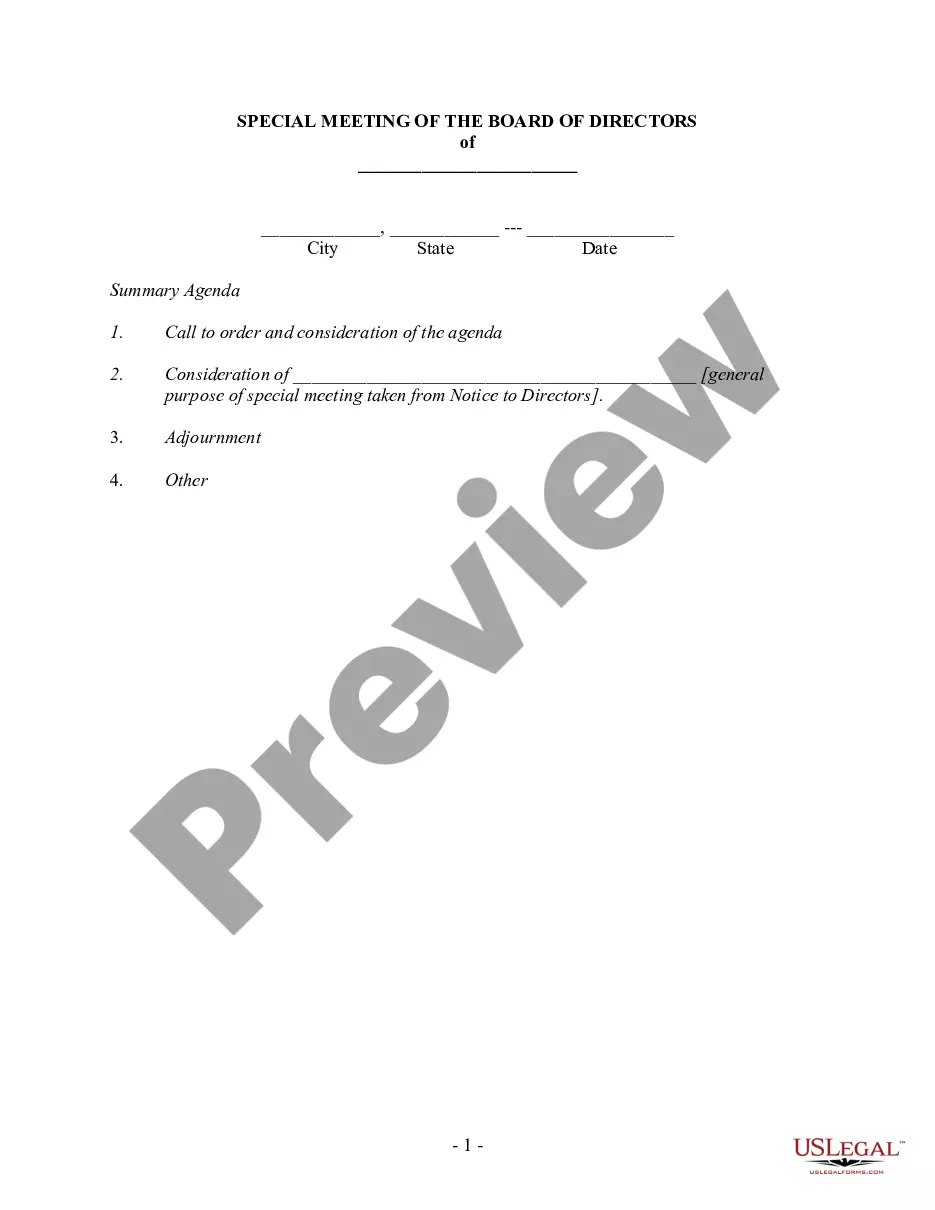
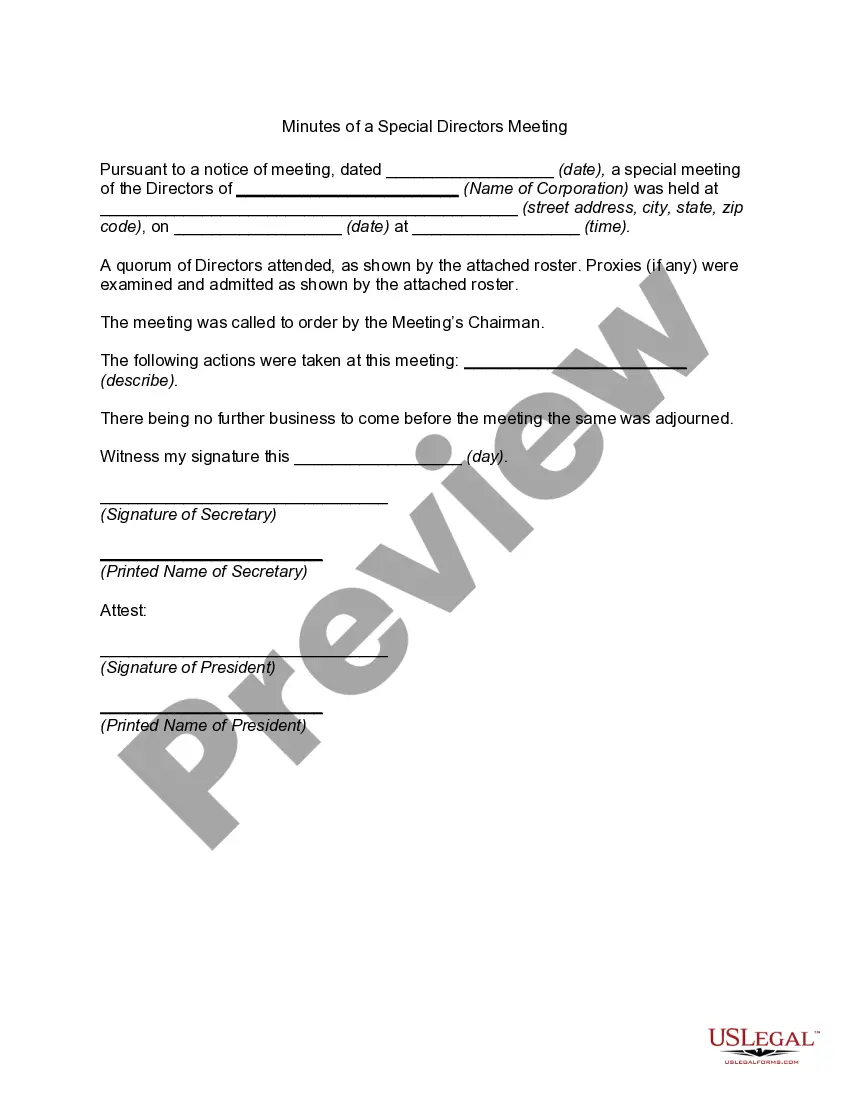
The Special Meeting of the Board of Directors Minutes form is a legal document used by a corporation to formally record the proceedings of a special meeting held by its board of directors. This form captures the discussions, decisions, and resolutions made during the meeting, providing an official account that differs from regular meeting minutes by focusing specifically on unique or urgent issues that necessitate a special session.
Key components of this form
- Header containing the name of the corporation, meeting location, and date.
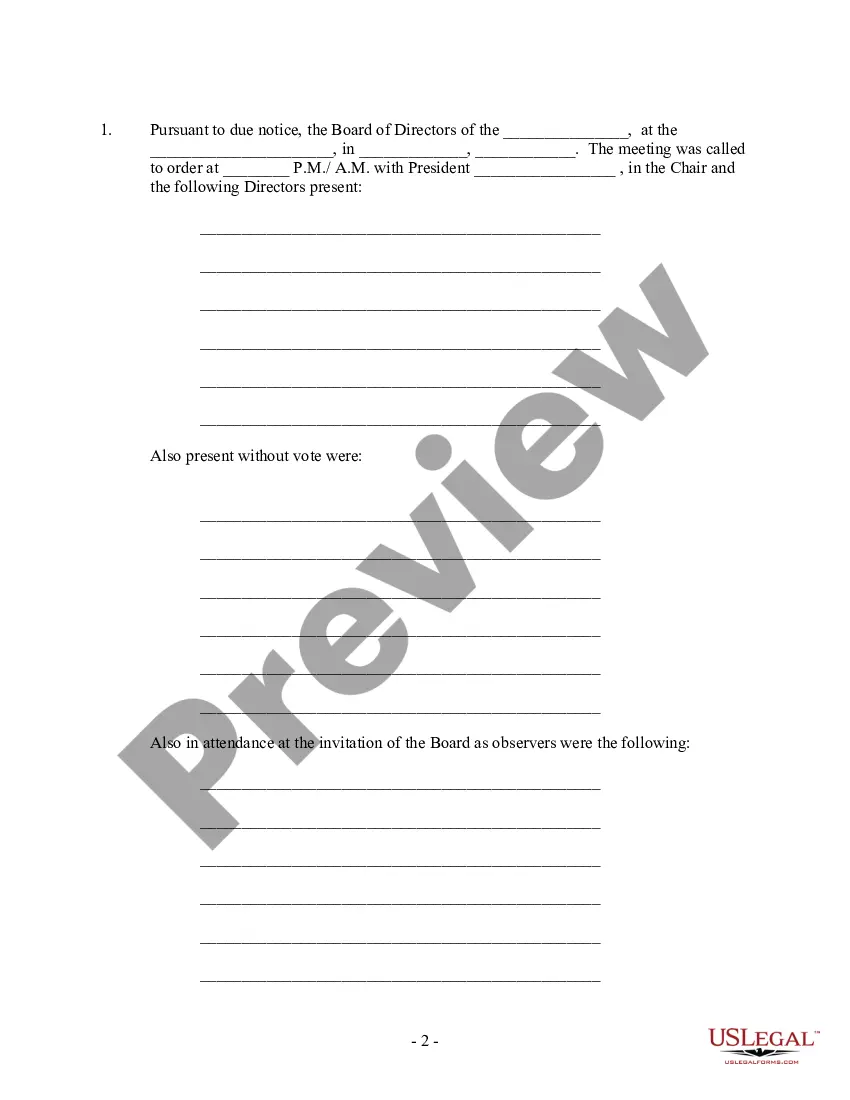
- Call to order section noting when the meeting begins and who is in attendance.
- Detailed agenda addressing the purpose and topics discussed during the meeting.
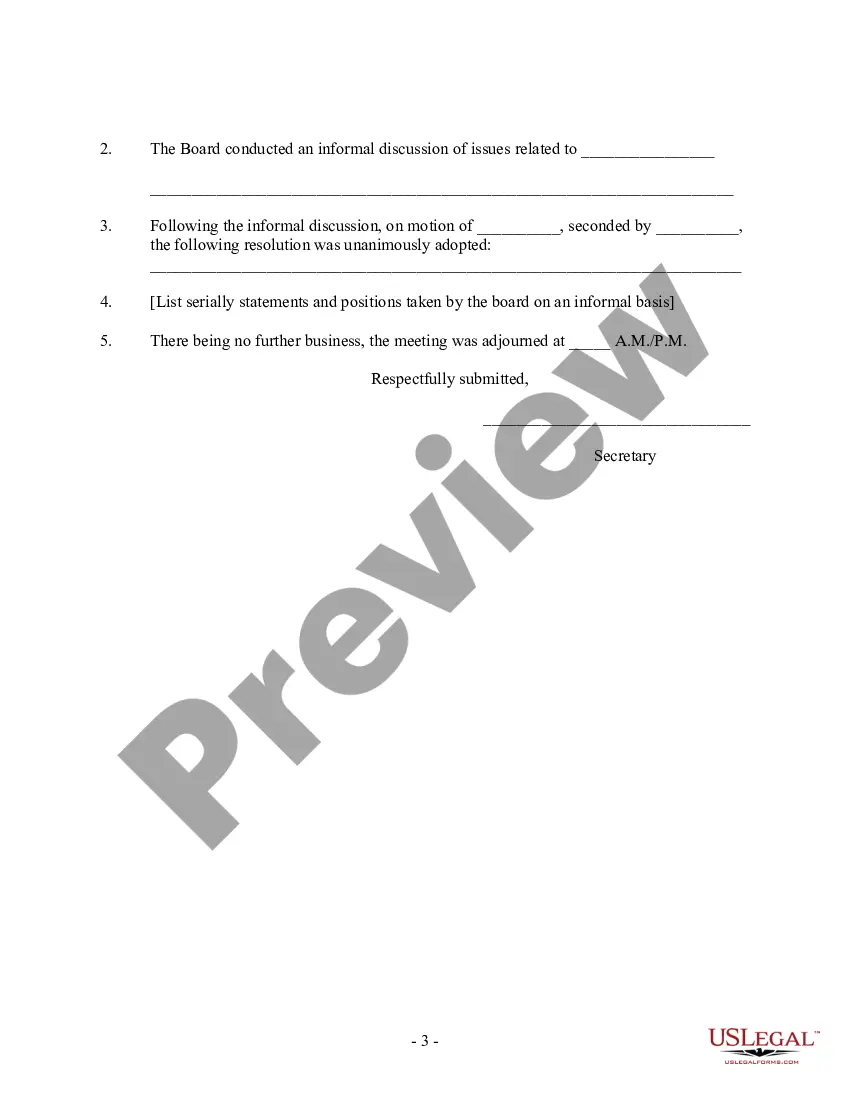
- Formal resolution section where decisions made are documented.
- Adjournment time marking the conclusion of the meeting.




When this form is needed
This form should be used whenever the board of directors convenes a special meeting outside of the regular meeting schedule. It's particularly necessary when urgent matters arise that require board approval or discussion, such as major corporate decisions, strategic changes, or pressing issues that cannot wait until the next regularly scheduled meeting.
Who needs this form
- Corporations needing to document special meetings of their board of directors.
- Secretaries of the corporation responsible for maintaining accurate records of board meetings.
- Directors participating in a special meeting who wish to ensure that decisions are formally recorded.
Completing this form step by step
- Enter the name of the corporation, the location of the meeting, and the date at the top of the form.
- Record the time the meeting was called to order and list all directors present.
- Summarize the agenda and any discussions that took place regarding the matters addressed in the special meeting.
- Document any resolutions adopted by the board, noting who made the motion and who seconded it.
- Indicate the time the meeting was adjourned and ensure that all entries are signed by the secretary.
Notarization guidance
In most cases, this form does not require notarization. However, some jurisdictions or signing circumstances might. US Legal Forms offers online notarization powered by Notarize, accessible 24/7 for a quick, remote process.
Get your form ready online
Our built-in tools help you complete, sign, share, and store your documents in one place.
Make edits, fill in missing information, and update formatting in US Legal Forms—just like you would in MS Word.
Download a copy, print it, send it by email, or mail it via USPS—whatever works best for your next step.
Sign and collect signatures with our SignNow integration. Send to multiple recipients, set reminders, and more. Go Premium to unlock E-Sign.
If this form requires notarization, complete it online through a secure video call—no need to meet a notary in person or wait for an appointment.
We protect your documents and personal data by following strict security and privacy standards.

Make edits, fill in missing information, and update formatting in US Legal Forms—just like you would in MS Word.

Download a copy, print it, send it by email, or mail it via USPS—whatever works best for your next step.

Sign and collect signatures with our SignNow integration. Send to multiple recipients, set reminders, and more. Go Premium to unlock E-Sign.

If this form requires notarization, complete it online through a secure video call—no need to meet a notary in person or wait for an appointment.

We protect your documents and personal data by following strict security and privacy standards.
Avoid these common issues
- Failing to include the full names of directors present during the meeting.
- Neglecting to document all discussions or resolutions accurately.
- Not specifying the date and time of the meeting clearly.
- Forgetting to include the signature of the secretary at the end of the minutes.
Benefits of using this form online
- Convenience of downloading and completing the form at your own pace.
- Editable format allows for easy customization to fit your corporation's specific needs.
- Reliability of using professionally drafted forms that comply with relevant legal standards.
Legal use & context
- Minutes from special meetings are legally binding as official records.
- Correct documentation may protect the corporation in potential disputes.
- Failure to maintain accurate minutes may lead to compliance issues.
Summary of main points
- The form records important decisions made at special board meetings.
- Accurate completion helps enforce legal and corporate governance standards.
- Always retain copies for official corporate records.
Looking for another form?


Form popularity
FAQ
Format the resolution by putting the date and resolution number at the top. Form a title of the resolution that speaks to the issue that you want to document. Use formal language in the body of the resolution, beginning each new paragraph with the word, whereas.
Use a template. Check off attendees as they arrive. Do introductions or circulate an attendance list. Record motions, actions, and decisions as they occur. Ask for clarification as necessary. Write clear, brief notes-not full sentences or verbatim wording.
Format the resolution by putting the date and resolution number at the top. Form a title of the resolution that speaks to the issue that you want to document. Use formal language in the body of the resolution, beginning each new paragraph with the word, whereas.
The name of the organization; The maximum and minimum loan amounts; The names, titles, and signatures of four officers referred to this Resolution; The place of the meeting during which the Resolution was adopted; The exact date of that meeting;
Date, time and location. Time the meeting was called to order and adjourned. Names of attendees and absentees. Corrections and amendments to previous meeting minutes. Additions to agenda. Status of quorum. Motions taken or rescinded.
CORPORATE SECRETARY / BOARD LIASON RESPONSIBILITIES The main responsibility of the Corporate Secretary is planning and preparing for meetings. At a minimum, this includes the following five areas: Scheduling, Agendas, Presentations, Executive Liaisons, and Documenting the Meeting.
Board meetings ordinarily bring together the directors of an organization.In a board meeting, the board reviews the past performance of the organization, engages in strategic deliberations and approves plans of action to provide ongoing support to the organization through its various stages of growth.
The purpose of board meetings is for the directors to talk about any issues that the company is facing, review the company's performance and discuss new policies to be enacted.
The bylaws typically state who can call a board meeting; this is usually the board chair or board president. About a week before the meeting, the board secretary should ask board members for any items that they want added to the agenda.