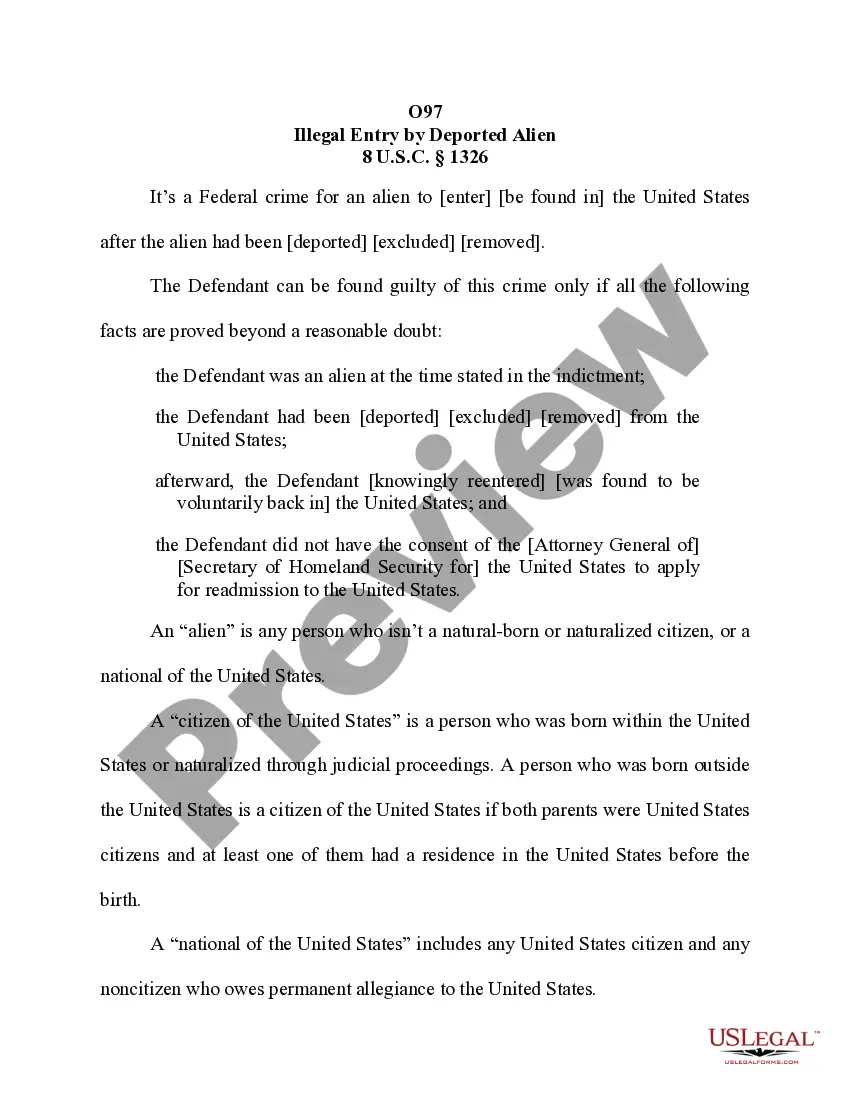
Illegal Entry by Deported Alien 8 U.S.C. Sec. 1326
About this form
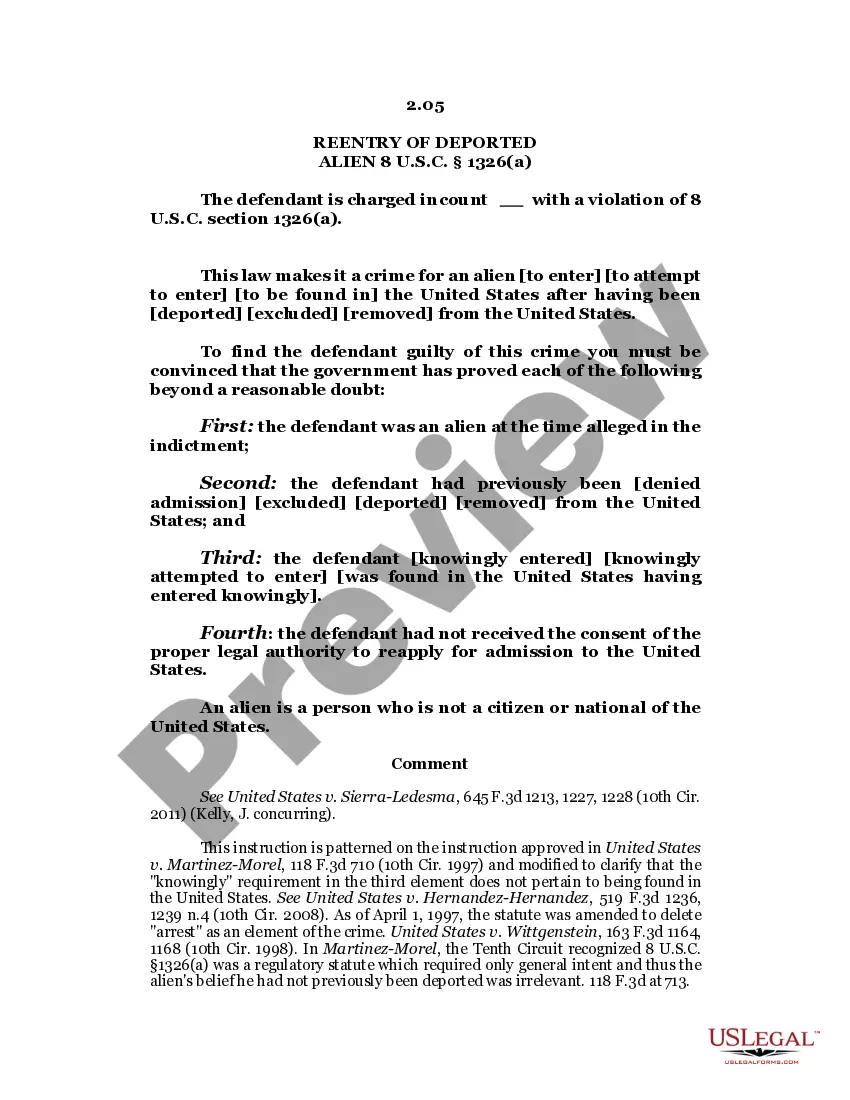
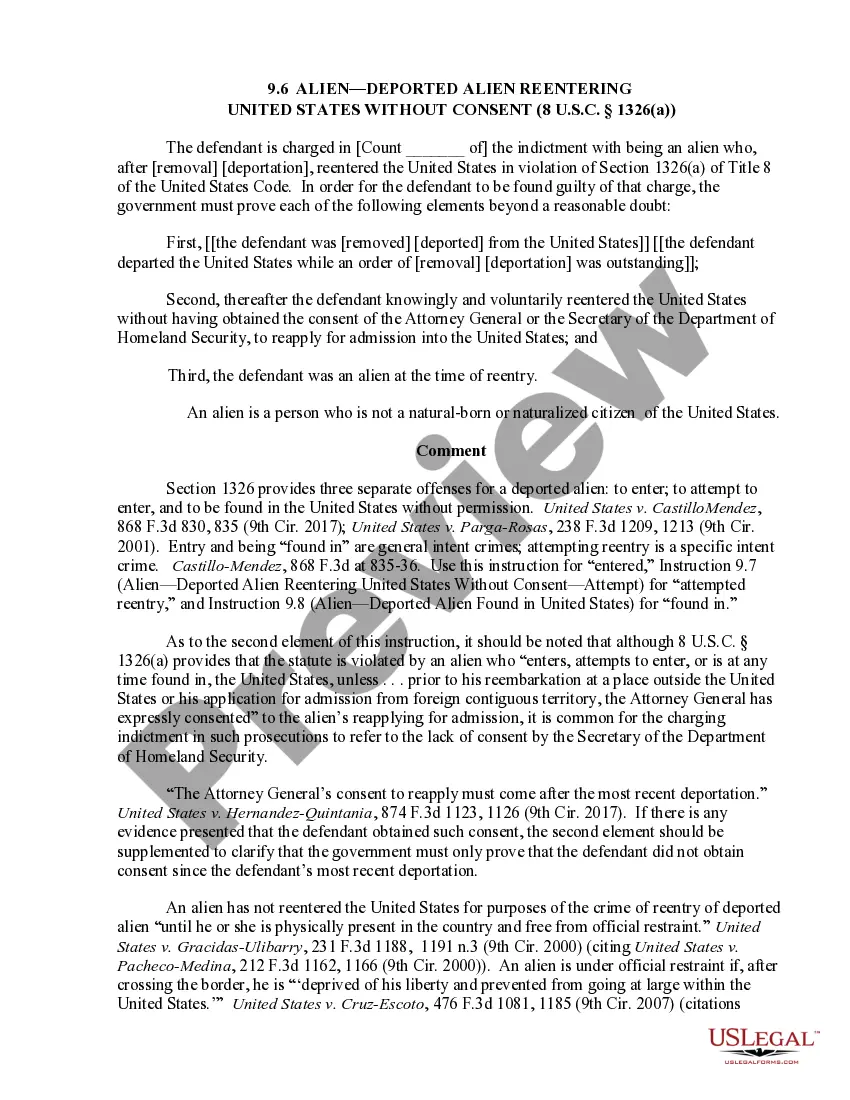
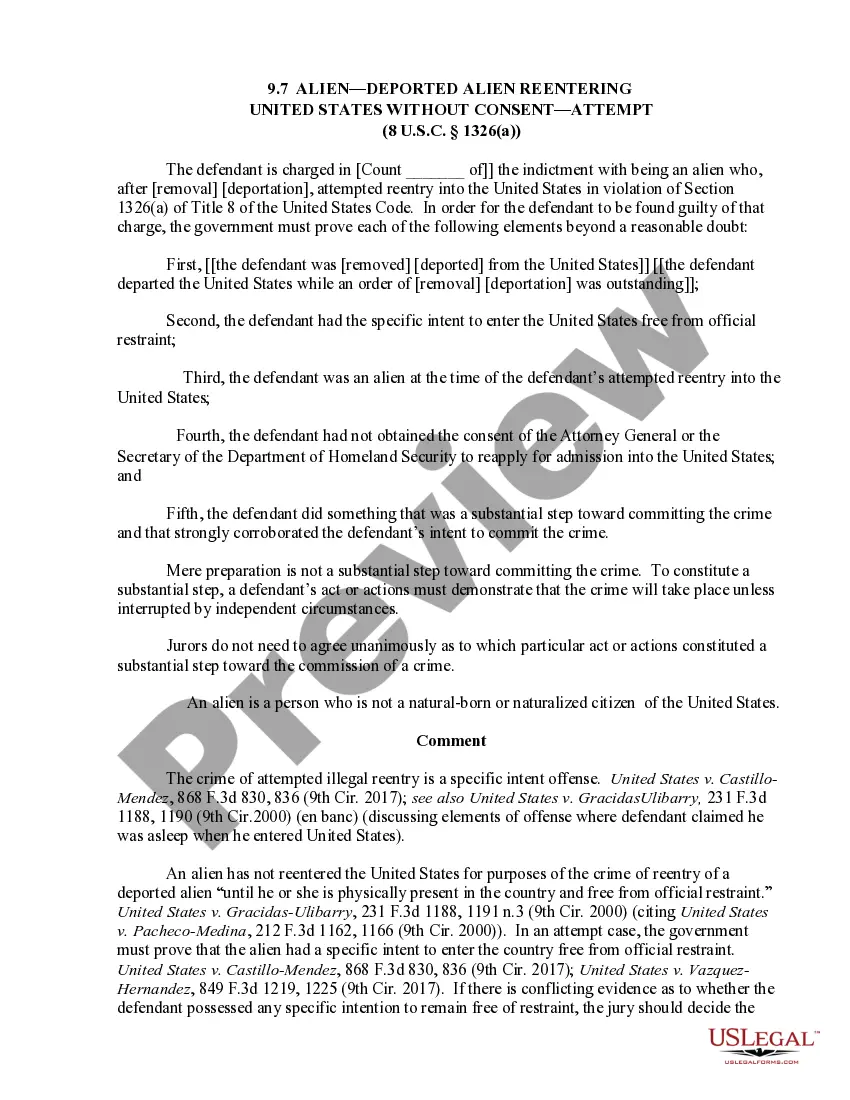
The Illegal Entry by Deported Alien form under 8 U.S.C. Sec. 1326 is a legal document that addresses the federal crime of unauthorized reentry into the United States by an individual who has previously been deported, excluded, or removed. This form is essential for understanding the legal implications of such actions, distinguishing it from other immigration-related documents, as it specifically pertains to the offense of illegal entry after deportation.
Key parts of this document
- Definition of "alien" and "citizen of the United States."
- Conditions establishing guilt, including prior deportation status.
- Requirement for proof of knowing reentry without consent for readmission.
- Consequences of the offense under federal law.
Common use cases
This form is applicable in situations where an individual has been previously deported from the United States and is found to have reentered the country unlawfully. It is crucial in cases where legal proceedings are initiated against an individual for violating immigration laws, specifically when determining criminal liability under federal regulations.
Intended users of this form
- Individuals who are charged with being in the United States after being deported.
- Attorneys representing clients facing immigration-related criminal charges.
- Legal professionals seeking to understand the implications of illegal reentry laws.
- Anyone involved in immigration law or policy advocacy.
Steps to complete this form
- Identify the defendant's personal details, including full name and immigration status.
- Confirm the details of the prior deportation, exclusion, or removal.
- Establish if the defendant knowingly reentered the United States.
- Document any evidence of consent from the Attorney General or Secretary of Homeland Security, if applicable.
- Review all entries for accuracy before submission to the court.
Does this document require notarization?
This form does not typically require notarization unless specified by local law. Ensure you check for any state-specific requirements that may apply.
Get your form ready online
Our built-in tools help you complete, sign, share, and store your documents in one place.
Make edits, fill in missing information, and update formatting in US Legal Forms—just like you would in MS Word.
Download a copy, print it, send it by email, or mail it via USPS—whatever works best for your next step.
Sign and collect signatures with our SignNow integration. Send to multiple recipients, set reminders, and more. Go Premium to unlock E-Sign.
If this form requires notarization, complete it online through a secure video call—no need to meet a notary in person or wait for an appointment.
We protect your documents and personal data by following strict security and privacy standards.

Make edits, fill in missing information, and update formatting in US Legal Forms—just like you would in MS Word.

Download a copy, print it, send it by email, or mail it via USPS—whatever works best for your next step.

Sign and collect signatures with our SignNow integration. Send to multiple recipients, set reminders, and more. Go Premium to unlock E-Sign.

If this form requires notarization, complete it online through a secure video call—no need to meet a notary in person or wait for an appointment.

We protect your documents and personal data by following strict security and privacy standards.
Common mistakes to avoid
- Failing to properly document prior deportation status.
- Not establishing the timeline of reentry accurately.
- Omitting the need for consent for reentry from relevant authorities.
- Overlooking important definitions such as "alien" and "national."
Why use this form online
- Access legal form templates crafted by licensed attorneys.
- Convenient download options allow for immediate use.
- Editability ensures you can customize the form to fit your specific case.
- Reliable legal information helps you better understand the process.
Looking for another form?
Form popularity
FAQ
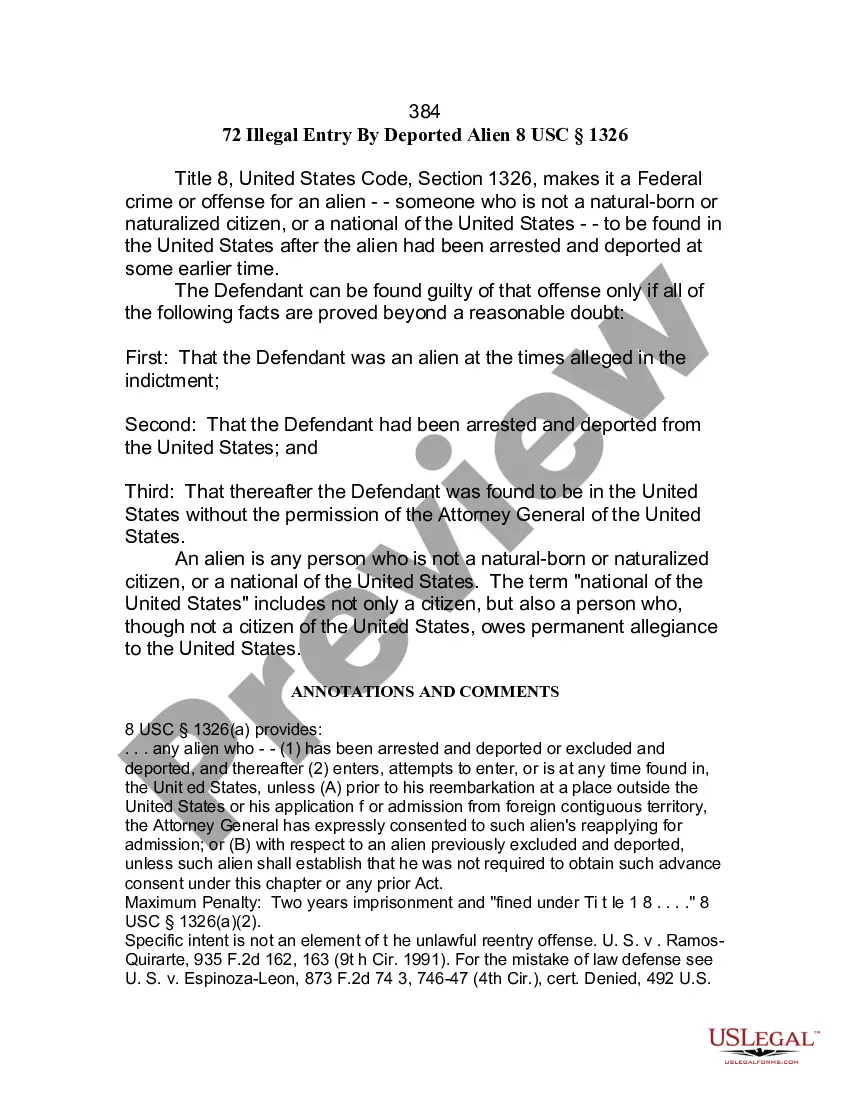
18 U.S.C. § 1326 provides punishment for illegal re-entry or attempted illegal re-entry. At the lowest level there could be significant fines and a prison sentence of up to 2 years.
What Is The I-601 Waiver Or Inadmissibility Waiver? If the alien is found inadmissible to re-enter the US, they can apply for this waiver through Form I-601. The Application for Waiver of Grounds of Inadmissibility is filed with USCIS, based on the reason for which they were previously removed.
What is Title 8? ing to U.S. Citizenship and Immigration Services, Title 8 of the U.S. Code covers "Aliens and Nationality." Under Title 8, non-citizens who cross the border illegally, without legal basis to remain will be processed for removal.
After the amendments made by the Illegal Immigration Reform and Immigrant Responsibility Act (IIRIRA), subsection 1326(a) now makes it an offense for any alien who has been denied admission, excluded, deported, or removed, or has departed the United States while an order of exclusion, deportation or removal is
8 USC 1326: Reentry of deported alien; criminal penalties for reentry of certain deported aliens.
Its sister statute, 8 U.S.C. § 1326, makes it a felony offense for anyone to reenter or attempt to reenter the U.S. after being removed or deported from this country. The Homeland Security secretary seem to suggest, as have many legal scholars, that a violation of § 1325 is a ?civil? and not a ?criminal? offense.
A federal district court has ruled that a provision of the Immigration and Nationality Act of 1952, 8 U.S.C. § 1326 (a) and (b) (section 1326), criminalizing the presence of deported persons found in the United States, violates the Equal Protection Clause of the.
The laws used to criminally prosecute people for entering and reentering the United States without permission are known as Sections 1325 ("illegal entry") and 1326 ("illegal reentry") of Chapter 8 of the U.S. Code. For decades, these laws have been used to advance racist, anti-immigrant policy goals.