Texas Quitclaim Deed from Corporation to Two Individuals
What this document covers
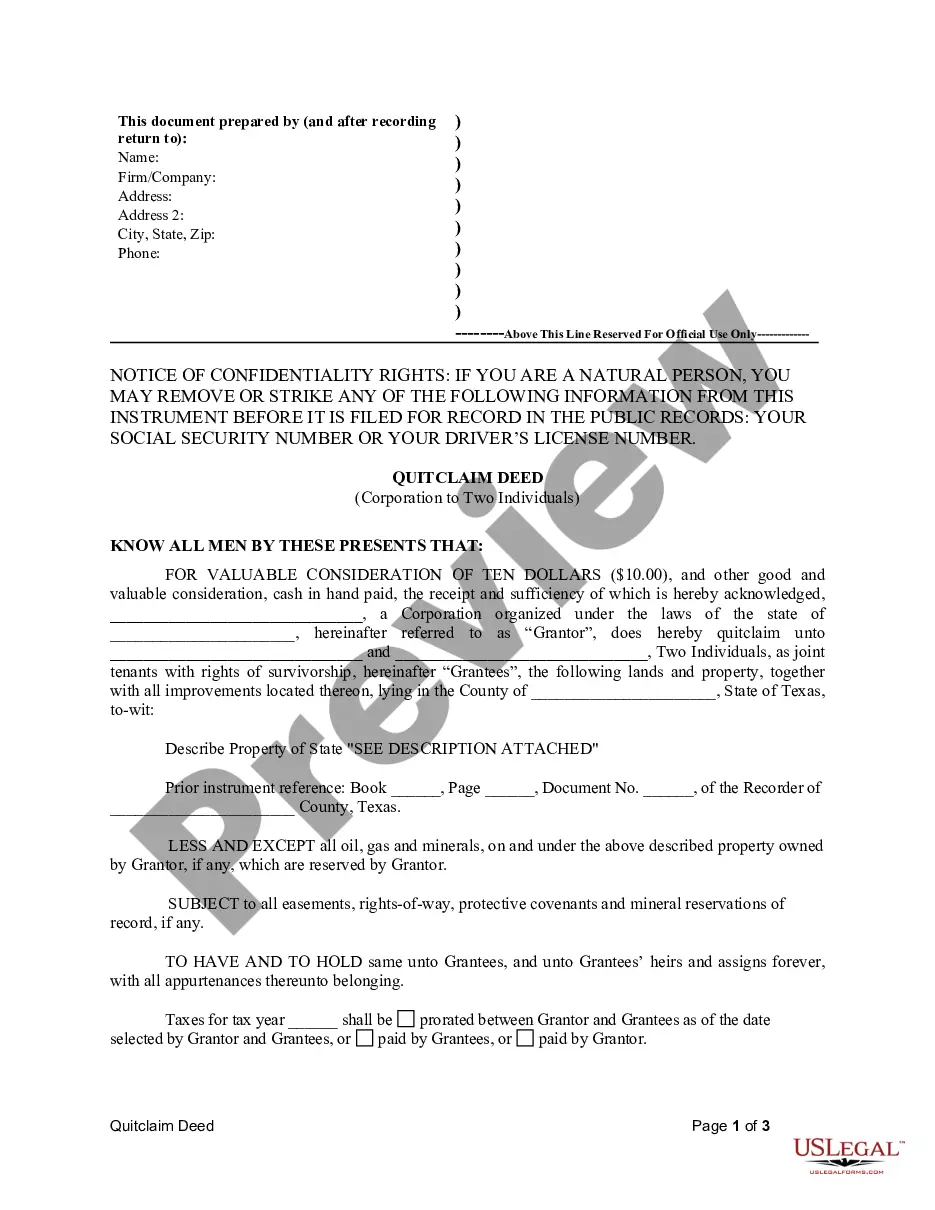
This Quitclaim Deed from Corporation to Two Individuals is a legal document that transfers ownership of a property from a corporation (the Grantor) to two individual parties (the Grantees). Unlike other types of deeds, it does not guarantee clear title but merely conveys whatever interest the Grantor has in the property. This form is essential for facilitating property ownership changes without the complications of a warranty deed.
Key components of this form
- Grantor and Grantees: Identifies the corporation transferring the property and the two individuals receiving it.
- Property Description: Details the specific property being transferred, including location and any improvements.
- Reservation of Rights: States that the Grantor retains rights to any oil, gas, and minerals under the property.
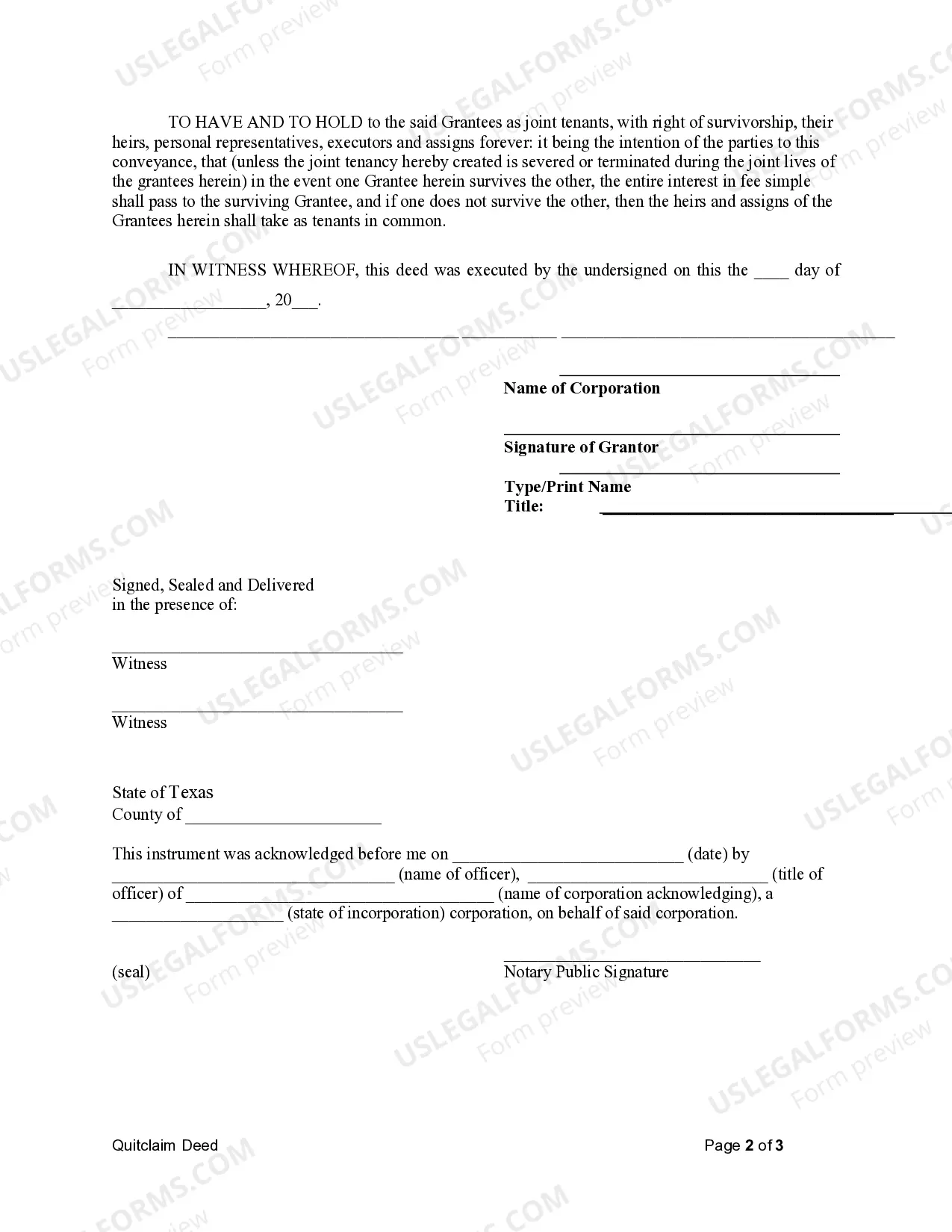
- Joint Tenancy: Establishes that the Grantees hold the property as joint tenants with rights of survivorship.
- Notarization: Indicates the need for an official acknowledgment to make the deed legally valid.




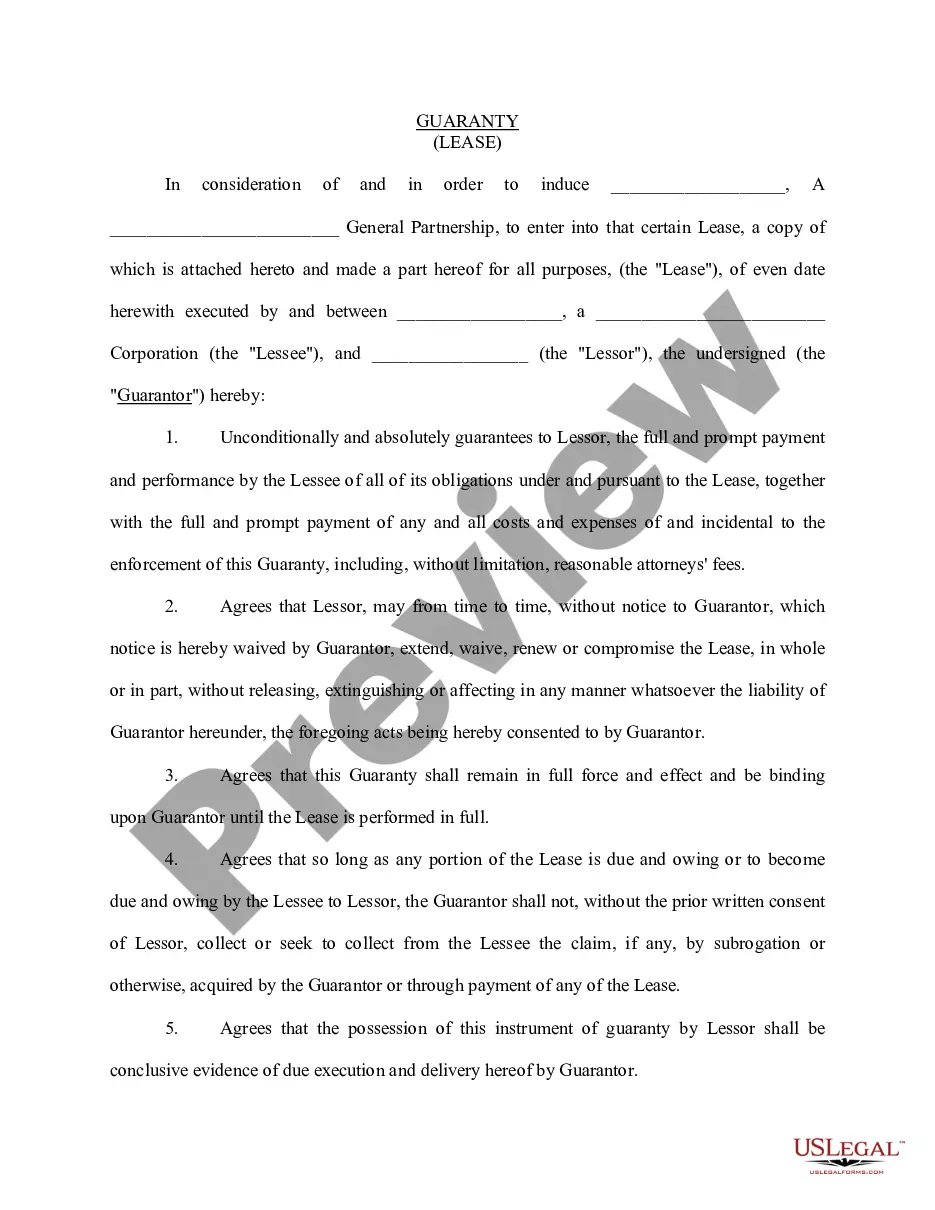
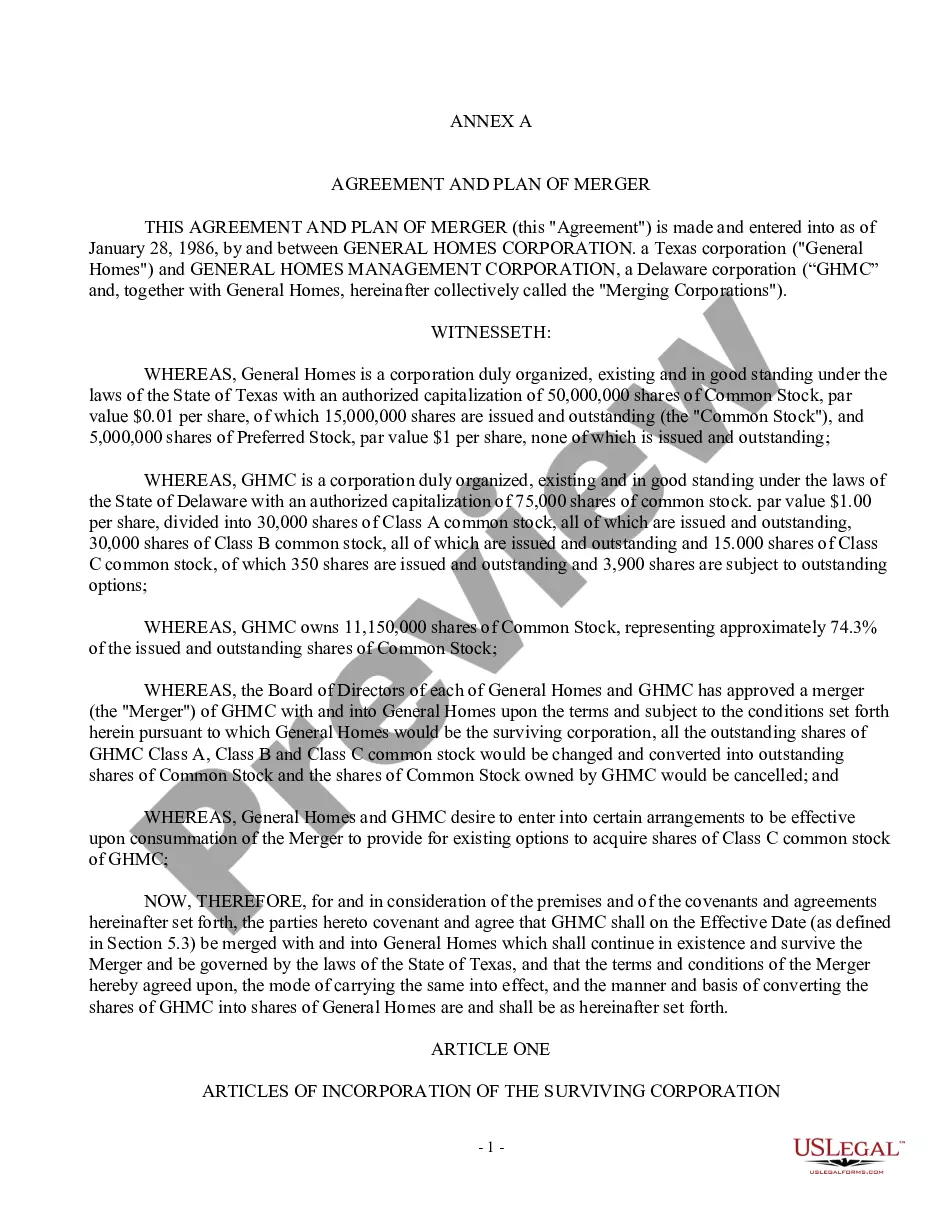
Common use cases
This Quitclaim Deed should be used when a corporation wishes to transfer property ownership to two individuals. It is typically utilized in situations where the corporation no longer needs the property or when simplifying property ownership matters, such as in estate planning or business dissolution scenarios.
Who should use this form
- Corporations looking to transfer property to individuals for various reasons.
- Individuals receiving property as part of a business transaction or estate arrangement.
- Real estate professionals facilitating property transfers involving corporate entities.
How to prepare this document
- Identify the Grantor: Enter the name of the corporation transferring the property.
- Complete the Grantees' Information: Specify the names of the two individuals receiving the property.
- Describe the Property: Provide a detailed description and include the property location.
- Include Retained Rights: Clearly state any reservations such as oil, gas, and minerals.
- Obtain Notarization: Ensure the document is signed before a notary public to validate the transfer.
Does this form need to be notarized?
This form needs to be notarized to ensure legal validity. US Legal Forms provides secure online notarization powered by Notarize, allowing you to complete the process through a verified video call, available anytime.
Get your form ready online
Our built-in tools help you complete, sign, share, and store your documents in one place.
Make edits, fill in missing information, and update formatting in US Legal Forms—just like you would in MS Word.
Download a copy, print it, send it by email, or mail it via USPS—whatever works best for your next step.
Sign and collect signatures with our SignNow integration. Send to multiple recipients, set reminders, and more. Go Premium to unlock E-Sign.
If this form requires notarization, complete it online through a secure video call—no need to meet a notary in person or wait for an appointment.
We protect your documents and personal data by following strict security and privacy standards.

Make edits, fill in missing information, and update formatting in US Legal Forms—just like you would in MS Word.

Download a copy, print it, send it by email, or mail it via USPS—whatever works best for your next step.

Sign and collect signatures with our SignNow integration. Send to multiple recipients, set reminders, and more. Go Premium to unlock E-Sign.

If this form requires notarization, complete it online through a secure video call—no need to meet a notary in person or wait for an appointment.

We protect your documents and personal data by following strict security and privacy standards.
Common mistakes
- Not providing a specific property description, leading to confusion over what is being transferred.
- Failing to include retained rights, which could lead to disputes later.
- Not obtaining notarization, resulting in an invalid deed.
Benefits of completing this form online
- Convenience of downloading from home without needing to visit a lawyer.
- Editability allows for easy adjustments as needed.
- Accessibility to forms drafted by licensed attorneys ensures legal compliance.
Looking for another form?


Form popularity
FAQ
The drawback, quite simply, is that quitclaim deeds offer the grantee/recipient no protection or guarantees whatsoever about the property or their ownership of it. Maybe the grantor did not own the property at all, or maybe they only had partial ownership.
A quitclaim deed is dangerous if you don't know anything about the person giving you the property. You should be sure that a person actually has rights to a property before signing it over with a quitclaim deed.
Laws Section 13.002. Recording This form must be filed at the Recorder's Office in the County Clerk's Office. Signing (Section 11.002(c)) The Grantor(s) has the choice of authorizing this form in the presence of Two (2) Witnesses or a Notary Public.
If the quitclaim deed requires the signature of all co-owners, the deed is invalid unless all co-owners have signed it and the deed is then delivered to the grantee.If one individual owns real estate and desires to add a co-owner such as a spouse, a quitclaim deed might be used.
A quitclaim deed transfers title but makes no promises at all about the owner's title.A person who signs a quitclaim deed to transfer property they do not own results in no title at all being transferred since there is no actual ownership interest. The quitclaim deed only transfers the type of title you own.
A quitclaim deed is a legal instrument that is used to transfer interest in real property.The owner/grantor terminates (quits) any right and claim to the property, thereby allowing the right or claim to transfer to the recipient/grantee.
It does not convey muniment of title. Instead, unlike a warranty deed, which conveys property, a quitclaim deed only conveys whatever interest the grantor has at the time of the transfer.Despite all of this, quitclaim deeds are still a valid, if unreliable, means of transferring title to real property in Texas.
A Quitclaim Deed must be notarized by a notary public or attorney in order to be valid. What does "Grantee's assigns" mean? Grantee's assigns refers to any person that the Grantee transfers the property to, after having received the property from the Grantor.
Rates vary by state and law office but typically fall in the range of $200 to $400 per hour. Title companies routinely prepare quitclaim deeds in many states.