South Dakota Last Will and Testament with All Property to Trust called a Pour Over Will
Understanding this form
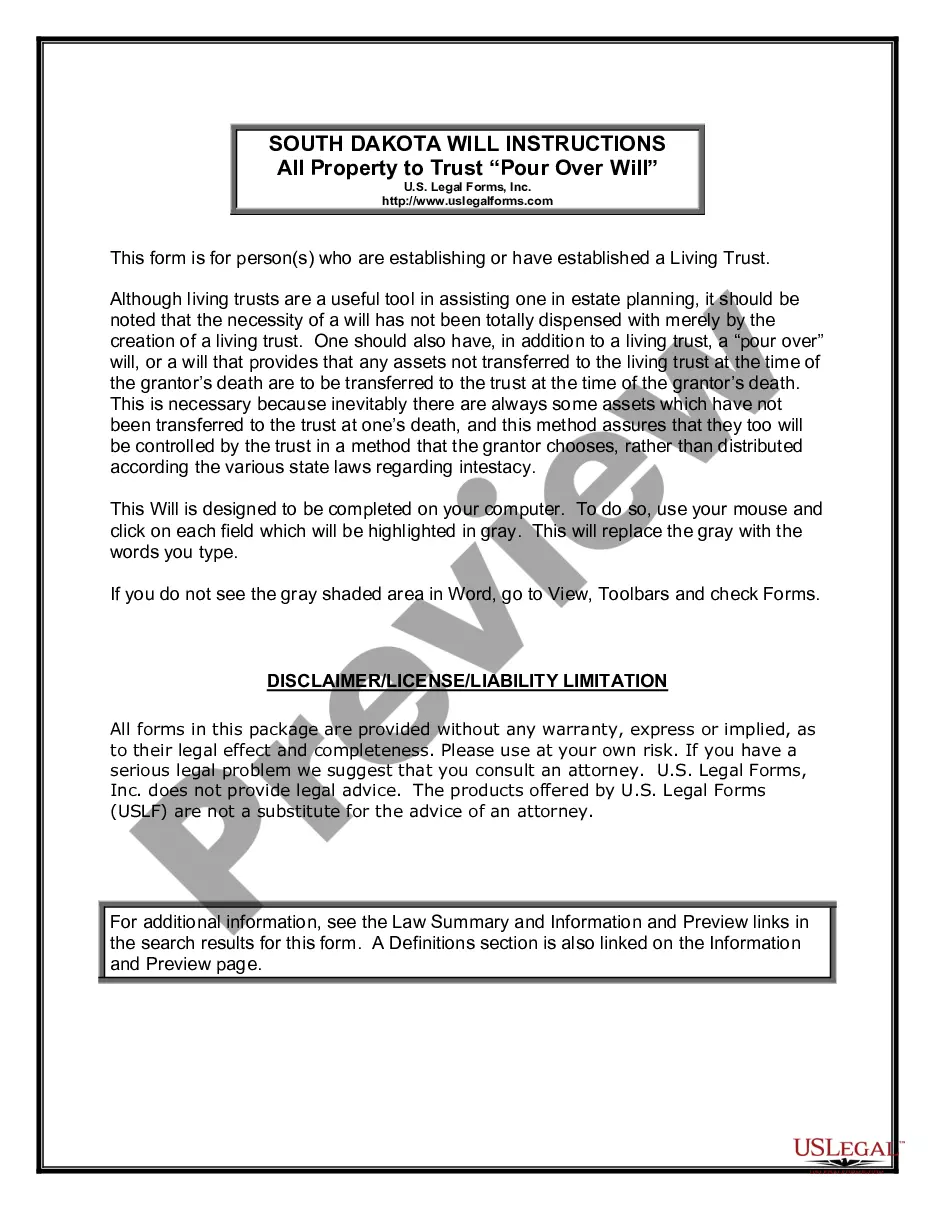
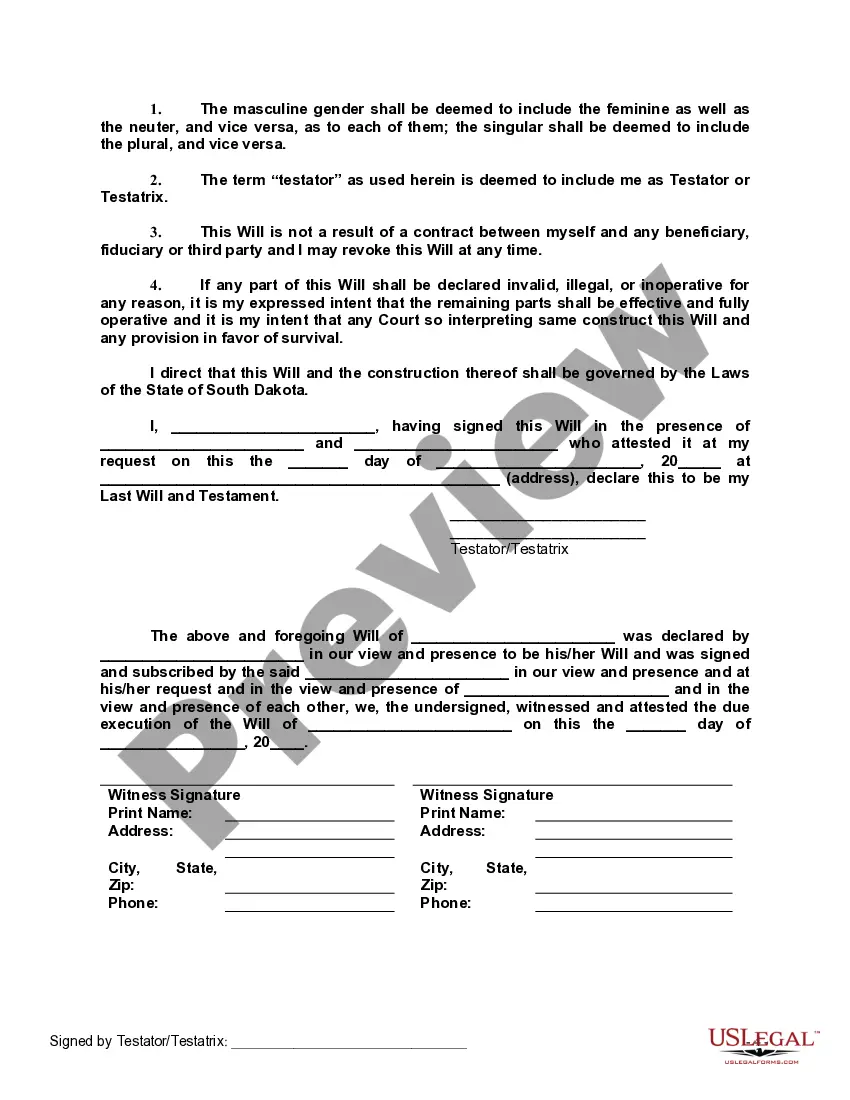
The Last Will and Testament with All Property to Trust, commonly known as a Pour Over Will, is a legal document that ensures all property not already transferred to a living trust is directed to that trust upon the individual's death. This form is particularly important for those who have established, or are establishing, a living trust as part of their estate planning. Unlike a standard will, a Pour Over Will seamlessly integrates with a trust, allowing for the effective management of assets while avoiding intestacy laws, which could dictate distribution contrary to the testator's wishes.
Main sections of this form
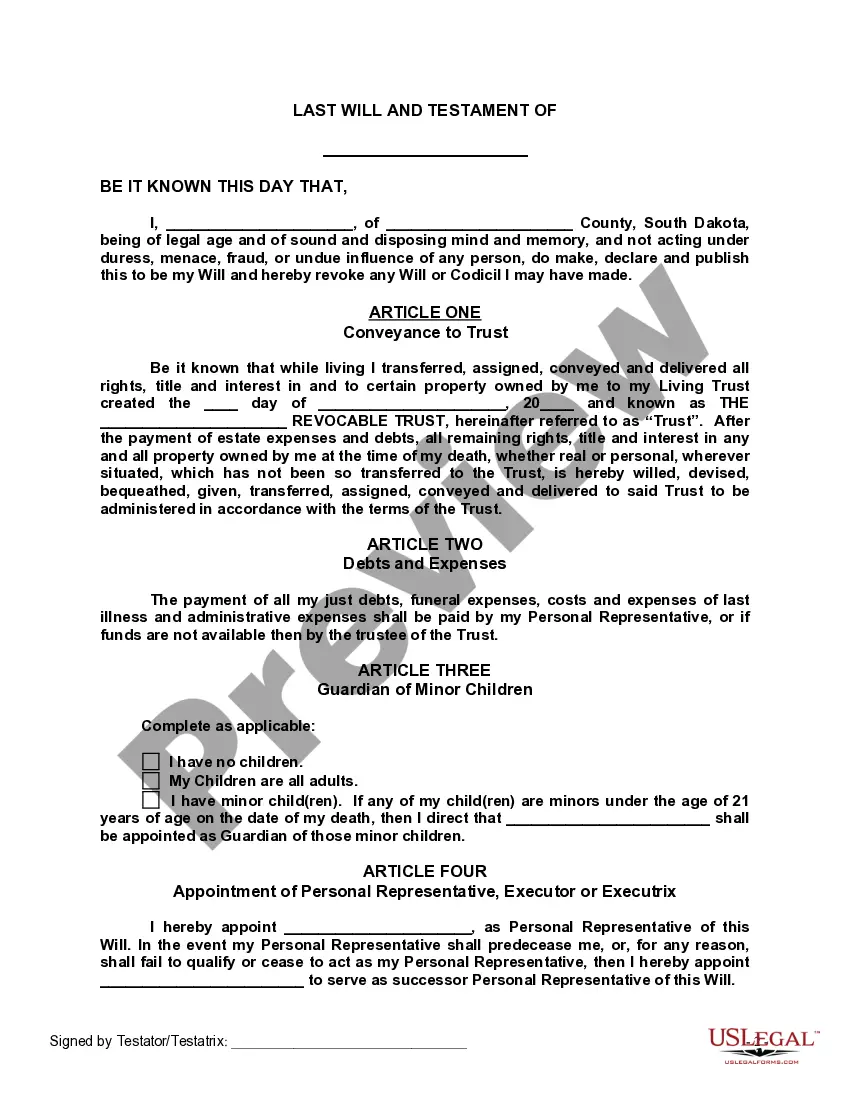
- Article One: Specifies the transfer of property to the trust.
- Article Two: Outlines the payment of debts and estate expenses.
- Article Three: Provides for guardianship of minor children, if applicable.
- Article Four: Appoints a Personal Representative to manage the estate.
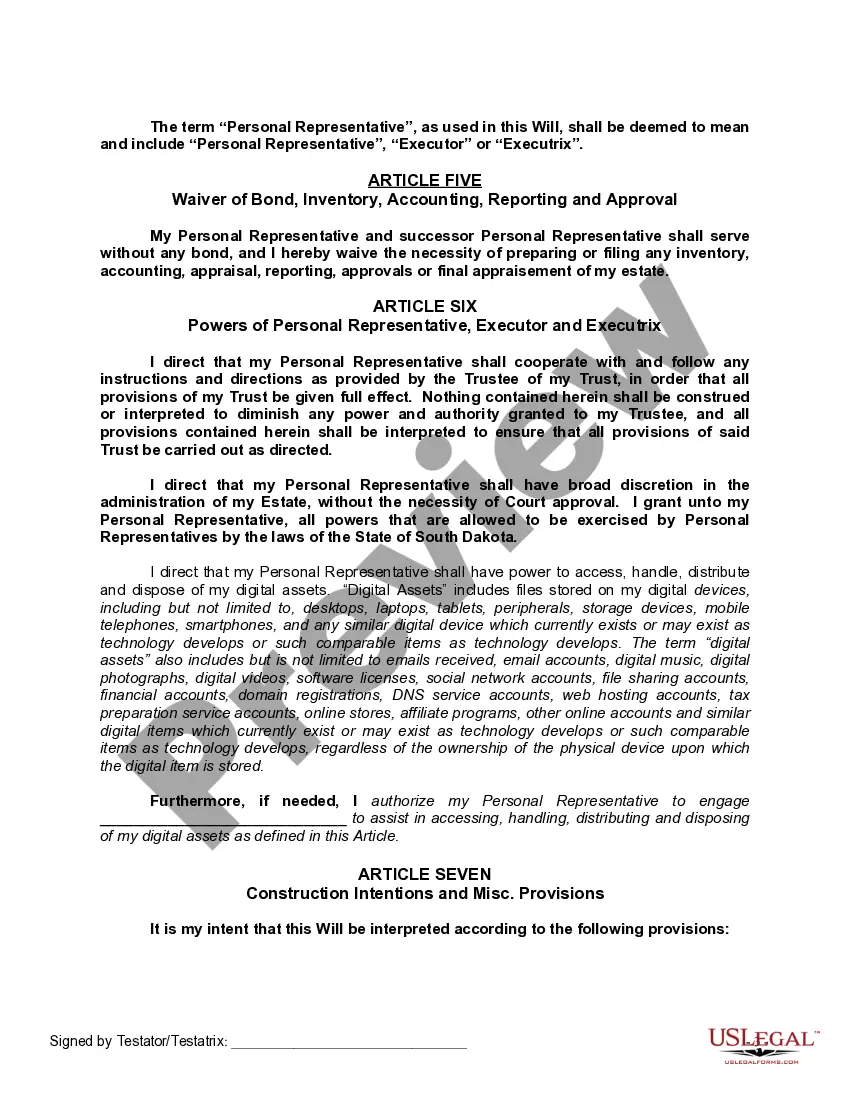
- Article Five: Waives the requirement for bond, inventory, and accounting.
- Article Six: Grants powers to the Personal Representative to follow the trust's instructions.
- Article Seven: Includes legal intentions and governing laws of South Dakota.



When to use this document
This form should be used by individuals who have set up or plan to set up a living trust and want to ensure their assets are appropriately directed to that trust after their passing. It is essential for those who wish to manage estate planning effectively and for maintaining control over asset distribution, particularly for cases where some assets may have been overlooked and not transferred to the trust prior to death.
Who should use this form
- Individuals establishing a living trust.
- Persons with property not yet conveyed to their trust.
- Parents with minor children who wish to designate guardianship.
- Anyone looking to maintain control over the distribution of their estate.
Completing this form step by step
- Identify yourself as the testator and include your personal information.
- Specify the trust to which your assets will be transferred, including the trust's name and creation date.
- Indicate if you have minor children and name a guardian if applicable.
- Appoint a Personal Representative to act on your behalf.
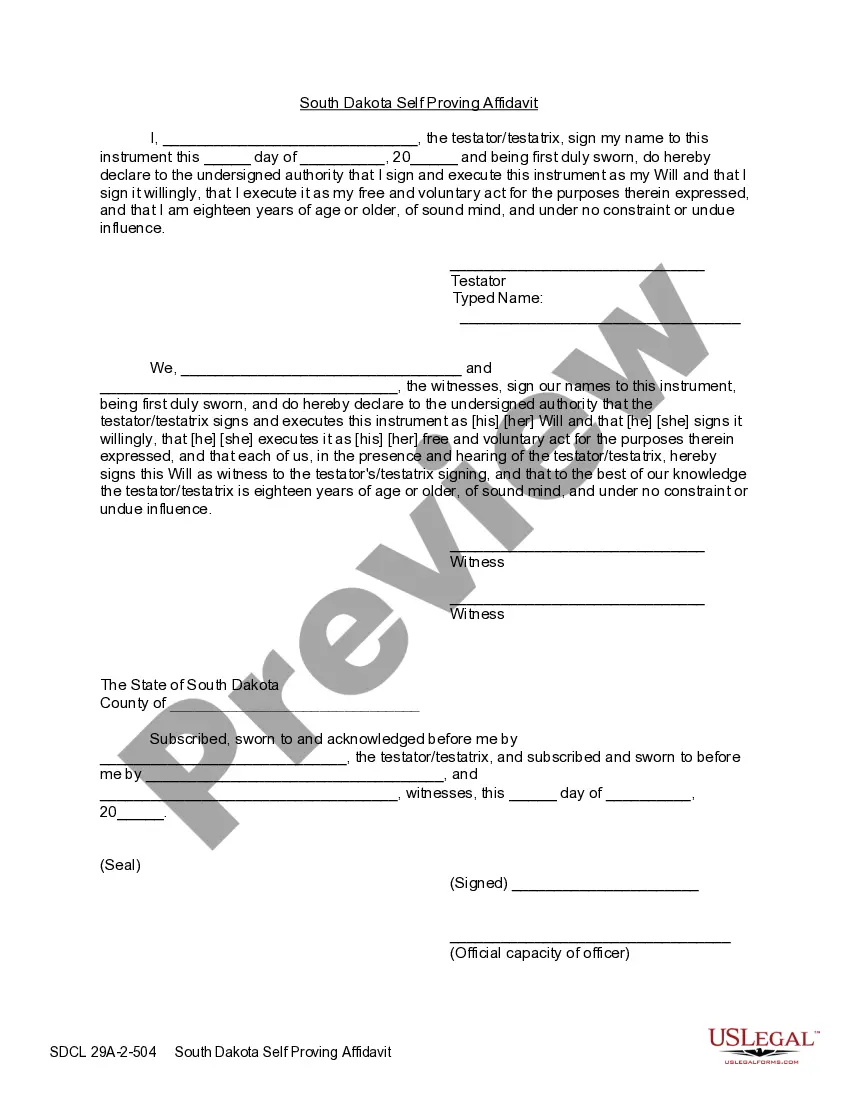
- Review and sign the document in the presence of witnesses to validate it.
Notarization guidance
To make this form legally binding, it must be notarized. Our online notarization service, powered by Notarize, lets you verify and sign documents remotely through an encrypted video session.
Get your form ready online
Our built-in tools help you complete, sign, share, and store your documents in one place.
Make edits, fill in missing information, and update formatting in US Legal Forms—just like you would in MS Word.
Download a copy, print it, send it by email, or mail it via USPS—whatever works best for your next step.
Sign and collect signatures with our SignNow integration. Send to multiple recipients, set reminders, and more. Go Premium to unlock E-Sign.
If this form requires notarization, complete it online through a secure video call—no need to meet a notary in person or wait for an appointment.
We protect your documents and personal data by following strict security and privacy standards.

Make edits, fill in missing information, and update formatting in US Legal Forms—just like you would in MS Word.

Download a copy, print it, send it by email, or mail it via USPS—whatever works best for your next step.

Sign and collect signatures with our SignNow integration. Send to multiple recipients, set reminders, and more. Go Premium to unlock E-Sign.

If this form requires notarization, complete it online through a secure video call—no need to meet a notary in person or wait for an appointment.

We protect your documents and personal data by following strict security and privacy standards.
Common mistakes to avoid
- Failing to transfer all assets into the trust before death.
- Not naming a guardian for minor children.
- Overlooking the need for witnesses when signing the will.
- Not keeping the will updated after significant life changes.
Benefits of completing this form online
- Convenience of completing the form from home.
- Easy editing and personalization options.
- Quick access to legal guidance and instructions.
- Immediate download and print capability.
Legal use & context
- A Pour Over Will ensures all assets are managed according to the trust's terms.
- Helps avoid intestacy laws that might apply in the absence of a valid will.
- A legally binding document once signed and witnessed as per state requirements.
Quick recap
- A Pour Over Will is essential for anyone with a living trust.
- It directs any remaining assets to the trust after the testator's death.
- Key components include naming a Personal Representative and potential guardians for minors.
- This form should be regularly reviewed and updated as circumstances change.
Looking for another form?



Form popularity
FAQ
One main difference between a will and a trust is that a will goes into effect only after you die, while a trust takes effect as soon as you create it. A will is a document that directs who will receive your property at your death and it appoints a legal representative to carry out your wishes.
Deciding between a will or a trust is a personal choice, and some experts recommend having both. A will is typically less expensive and easier to set up than a trust, an expensive and often complex legal document.
No, you don't need a lawyer to set up a trust, but it might be a good idea to seek legal advice to ensure the trust is set up correctly and that you have considered all long-term financial and estate planning aspects of the trust.Some living trusts are revocable, which means the trust can be changed at any time.
This should include the titles and deeds to real property, bank account information, investment accounts, stock certificates, life insurance policies, and other assets you will be using to fund the trust. Having this information available will make it easier to prepare your trust distribution provisions.
Pick a type of living trust. If you're married, you'll first need to decide whether you want a single or joint trust. Take stock of your property. Choose a trustee. Draw up the trust document. Sign the trust. Transfer your property to the trust.
No. You can make your own will in South Dakota, using Nolo's do-it-yourself will software or online will programs. However, you may want to consult a lawyer in some situations. For example, if you think that your will might be contested or if you want to disinherit your spouse, you should talk with an attorney.
Sure you can write your own revocable living trust. In fact, you can do it better than a lot of the attorneys. First you have to ascertain that you really want a trust.This is true whether you are preparing a revocable living trust, corporate bylaws, LLC documents, or any other legal documents.
2. Organize your paperwork. Gather together documentation pertaining to your assets. This should include the titles and deeds to real property, bank account information, investment accounts, stock certificates, life insurance policies, and other assets you will be using to fund the trust.
A Living Trust is a document that allows individual(s), or 'Grantor', to place their assets to the benefit of someone else at their death or incapacitation. Unlike a Will, a Trust does not go through the probate process with the court.