South Dakota Notice of Default for Past Due Payments in connection with Contract for Deed
Overview of this form
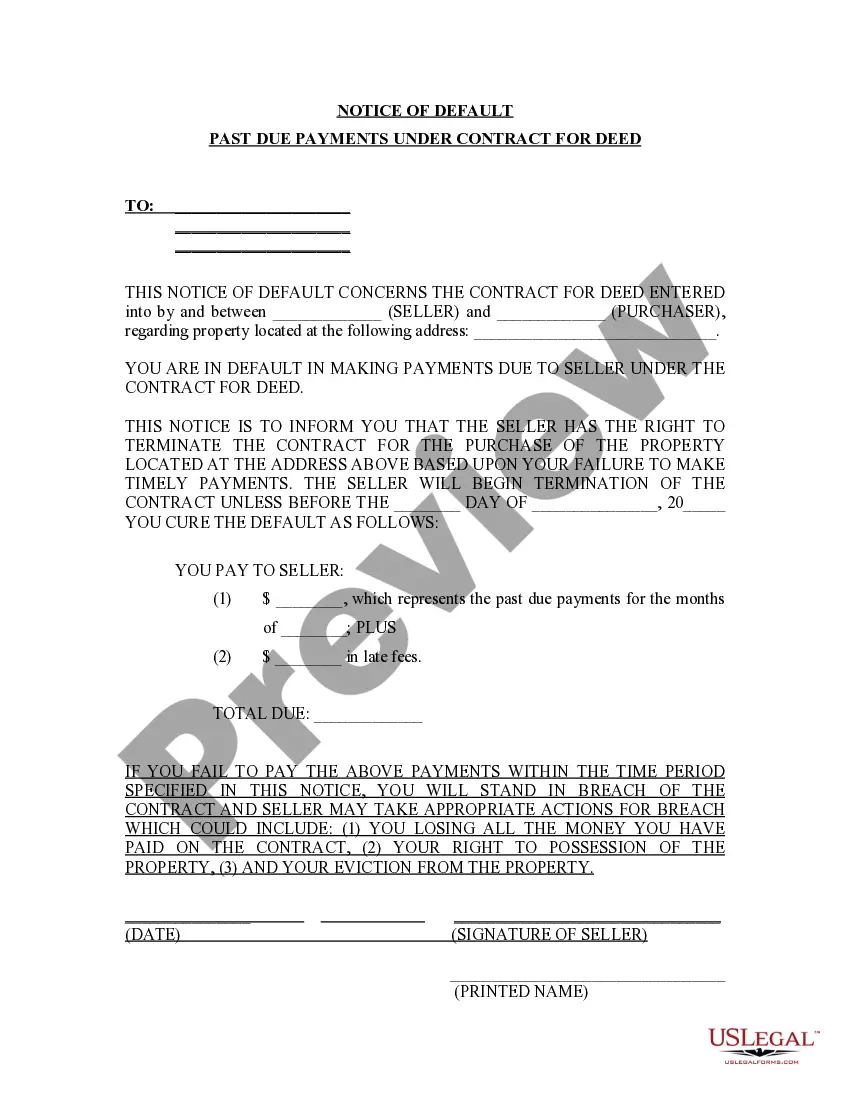
The Notice of Default for Past Due Payments in connection with Contract for Deed is a legal document used by the Seller to notify the Purchaser that their payment for the property per the contract for deed has not been received on time. This form serves as an official warning that if the Purchaser fails to address the late payment, it may result in a default of the contract for deed. Unlike other payment notices, this form specifically relates to the contractual obligations associated with purchasing property through a contract for deed arrangement.
What’s included in this form
- Identification of the Seller and Purchaser
- Date of the notice issuance
- Details of the past due payments
- Statement of the default and required actions to rectify
- Consequences of failing to comply with the notice

Common use cases
This form should be used when a Purchaser has failed to make timely payments as agreed upon in a contract for deed. It is essential for Sellers to formally communicate this breach of contract, allowing for an opportunity for the Purchaser to rectify the situation before further legal action may be required. Common scenarios include missed monthly payments or failure to pay a lump sum specified in the contract.
Intended users of this form
This form is intended for use by:
- Sellers who have entered into a contract for deed with a Purchaser
- Purchasers who have received a notice of default and need to understand their obligations
- Legal professionals assisting clients with contract for deed transactions
How to complete this form
- Identify the Seller and Purchaser by entering their full names and contact information.
- Specify the date when the notice is issued.
- Detail the past due payments, including amounts and due dates.
- Clearly state the default and outline any actions required to remedy the situation.
- Include any consequences that may occur if the Purchaser does not respond appropriately.
Notarization requirements for this form
To make this form legally binding, it must be notarized. Our online notarization service, powered by Notarize, lets you verify and sign documents remotely through an encrypted video session.
Get your form ready online
Our built-in tools help you complete, sign, share, and store your documents in one place.
Make edits, fill in missing information, and update formatting in US Legal Forms—just like you would in MS Word.
Download a copy, print it, send it by email, or mail it via USPS—whatever works best for your next step.
Sign and collect signatures with our SignNow integration. Send to multiple recipients, set reminders, and more. Go Premium to unlock E-Sign.
If this form requires notarization, complete it online through a secure video call—no need to meet a notary in person or wait for an appointment.
We protect your documents and personal data by following strict security and privacy standards.

Make edits, fill in missing information, and update formatting in US Legal Forms—just like you would in MS Word.

Download a copy, print it, send it by email, or mail it via USPS—whatever works best for your next step.

Sign and collect signatures with our SignNow integration. Send to multiple recipients, set reminders, and more. Go Premium to unlock E-Sign.

If this form requires notarization, complete it online through a secure video call—no need to meet a notary in person or wait for an appointment.

We protect your documents and personal data by following strict security and privacy standards.
Avoid these common issues
- Failing to include accurate contact information for both parties.
- Not specifying the total amount due or the due dates clearly.
- Using ambiguous language that may confuse the Purchaser.
- Not providing sufficient time for the Purchaser to respond to the notice.
Benefits of using this form online
- Convenience of downloading and completing the form from home.
- Editability allows Sellers to customize the form to meet specific circumstances.
- Reliability with templates drafted by licensed attorneys ensures legal correctness.
Summary of main points
- The Notice of Default alerts a Purchaser of late payments on a contract for deed.
- Utilizing this form can prevent further legal complications and facilitate communication.
- Ensure that all parties involved understand their obligations and the consequences of non-compliance.
Looking for another form?







Form popularity
FAQ
A contract for deed is an agreement for buying property without going to a mortgage lender. The buyer agrees to pay the seller monthly payments, and the deed is turned over to the buyer when all payments have been made.
In the first instance, if your deed is not recorded, there is nothing in the public record to stop the seller from conveying the property to another person.The second situation could happen if your seller fails to pay his or her debts and the seller's creditors file liens or judgments against your property.
Usually the contract requires the buyer to make payments over time with interest payable on the unpaid balance. Once a buyer pays all of the payments called for under the contract, the owner transfers to the buyer a deed to the property.
The Difference Between Renting to Own and a Contract for Deed. Renting to own usually means renting now, with an option to buy later. When you make this kind of deal, you are still a tenant, and the seller is still a landlord, until the final purchase. A contract for deed is very different.
A disadvantage to the seller is that a contract for deed is frequently characterized by a low down payment and the purchase price is paid in installments instead of one lump sum. If a seller needs funds from the sale to buy another property, this would not be a beneficial method of selling real estate.
Should I record the contract? The seller must record the contract or a memorandum of the contract within 10 days of the date of sale. They must do this at the county recorder of deeds where the property is located.
The average length of a Contract for Deed is five years, but it can be for any amount of time that the buyer and seller agree on. Interest rates on a Contract for Deed are not regulated, so they can be as high or as low as the buyer and seller can agree on.
Contract for Deed Seller Financing. A contract for deed is used by some sellers who finance the sale of their homes. Seller's Ownership Liability. Buyer Default Risk. Seller Performance. Property Liens Could Hinder Purchase.
A disadvantage to the seller is that a contract for deed is frequently characterized by a low down payment and the purchase price is paid in installments instead of one lump sum.The legal fees and time frame for this process will be more extensive than a standard Power of Sale foreclosure.