Rhode Island Name Affidavit of Buyer
What this document covers
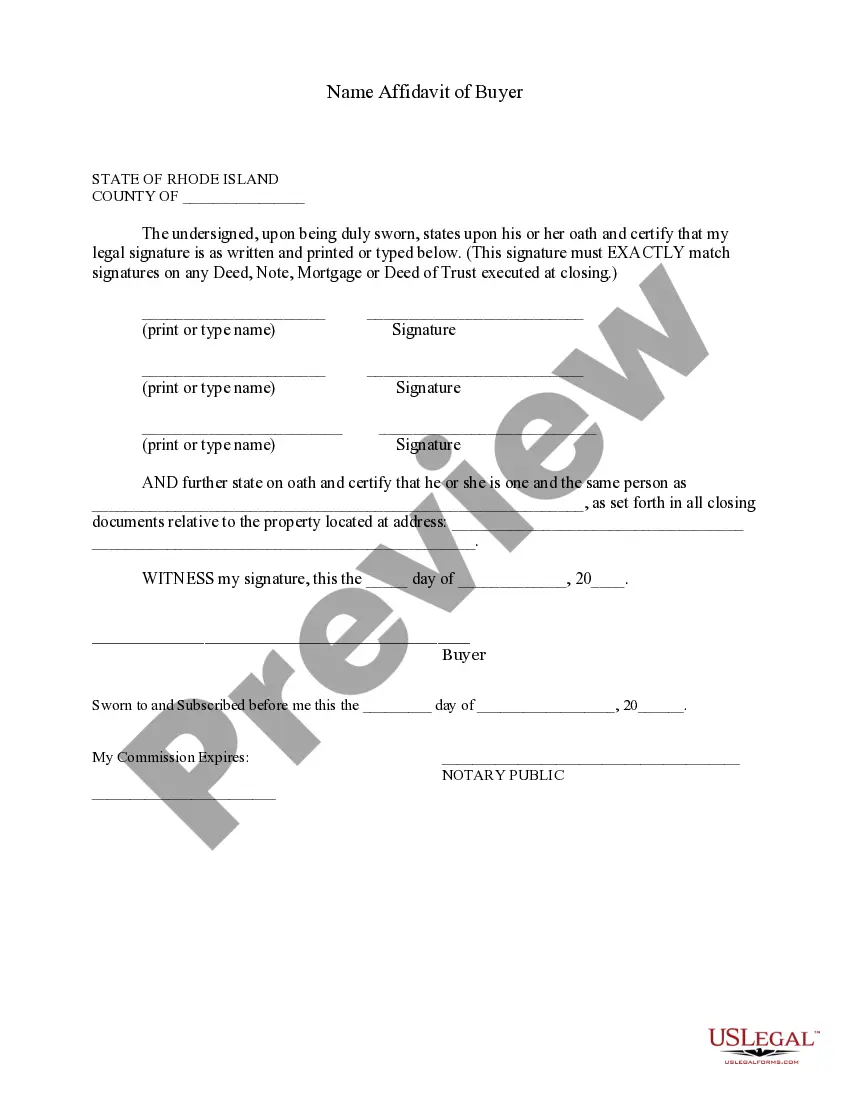
The Name Affidavit of Buyer is a legal document that allows a buyer to formally declare their legal name and any other names they are known by. This affidavit serves to clarify that different signatures, such as John Jones, John T. Jones, and J.T. Jones, all refer to the same individual. It is particularly useful in real estate transactions to ensure all documentation is consistent and legally binding.
Key components of this form
- State and county declaration to establish jurisdiction.
- Statement of the buyer's legal name and known alias names.
- Signature fields that must match signatures on other relevant documents.
- Certification confirming that all names belong to the same person.
- Notary section to acknowledge the validity of the affidavit.

Common use cases
This form is typically used in real estate transactions when a buyer has utilized different names on various documents. For instance, if a buyer's name appears differently on a mortgage, deed, or other closing documents, this affidavit helps clarify identity and prevent disputes. It is essential when one needs to ensure that all legal documents align with the buyer's actual identity.
Who this form is for
- Individuals participating in real estate transactions.
- Buyers with multiple names or signatures on official documents.
- Anyone needing to establish consistency in their legal name across various forms.
- People required by lenders or title companies to verify their identity.
Completing this form step by step
- Enter the name of the county and state at the top of the form.
- Fill in your legal name and any other known names in the designated spaces.
- Sign the document where indicated, ensuring the signature matches your other legal documents.
- Include the address of the property related to the transaction.
- Have the document notarized by a licensed notary public, confirming the authenticity of your signature.
Notarization requirements for this form
Yes, this form must be notarized to be legally valid. Using US Legal Forms' integrated online notarization service, you can easily have your affidavit notarized 24/7 through a secure video call, ensuring a convenient and reliable process without the need to travel.
Get your form ready online
Our built-in tools help you complete, sign, share, and store your documents in one place.
Make edits, fill in missing information, and update formatting in US Legal Forms—just like you would in MS Word.
Download a copy, print it, send it by email, or mail it via USPS—whatever works best for your next step.
Sign and collect signatures with our SignNow integration. Send to multiple recipients, set reminders, and more. Go Premium to unlock E-Sign.
If this form requires notarization, complete it online through a secure video call—no need to meet a notary in person or wait for an appointment.
We protect your documents and personal data by following strict security and privacy standards.

Make edits, fill in missing information, and update formatting in US Legal Forms—just like you would in MS Word.

Download a copy, print it, send it by email, or mail it via USPS—whatever works best for your next step.

Sign and collect signatures with our SignNow integration. Send to multiple recipients, set reminders, and more. Go Premium to unlock E-Sign.

If this form requires notarization, complete it online through a secure video call—no need to meet a notary in person or wait for an appointment.

We protect your documents and personal data by following strict security and privacy standards.
Common mistakes
- Failing to match signatures with those on other legal documents.
- Not properly notarizing the affidavit, which can invalidate the document.
- Leaving sections of the form incomplete, which may lead to legal complications.
- Providing incorrect or inconsistent names that do not align with identification documents.
Why complete this form online
- Convenient access to legal form templates from any location.
- Immediate downloads, minimizing delays in real estate transactions.
- Editability allows buyers to customize the affidavit easily.
- Reliability of forms drafted by licensed attorneys.
Main things to remember
- The Name Affidavit of Buyer affirms your legal identity in real estate transactions.
- It is critical for preventing disputes related to name discrepancies.
- Notarization is required for this form to be valid in Rhode Island.
- Utilizing online forms enhances convenience and accuracy.
Looking for another form?
Form popularity
FAQ
When a property is sold in Rhode Island for over $100 a transfer tax must be paid, usually by the seller (RIGL 44-25-1). Proof of payment is stamped on the deed so the recording clerk can see it was paid.
If a title is clean, that means there has never been a major accident claimed on the car. Two other common title statuses are "salvage" and "rebuilt." Sometimes these terms are used interchangeably, but from a legal standpoint, there are important differences between the two.
In simple situations where you own the vehicle outright and wish to transfer ownership to someone else, all you must do is complete a title certificate. Once you have filled out and signed the certificate, the buyer or recipient can take the title to a local DMV office and officially transfer ownership.
In Rhode Island, while you can't drive a salvage vehicle on the road, you can repair the vehicle and get it into roadworthy shape, at which point you could be eligible to get a rebuilt title.
If you do not have the title, you must apply for a duplicate title at the Cranston DMV location. This process can take up to 90 days, so you should do this as soon as possible. Costs are listed in the DMV Fee Table. You must also give the new owner a bill of sale.
Is It Possible to Insure a Car With a Rebuilt or Salvage Title? You cannot get insurance for a salvage title car. Salvage title cars are declared a "total loss" by an insurance company, so you can't register them, drive them on public roads, or get insurance for them.
When you purchase a vehicle in Rhode Island, you are required to pay sales tax on the vehicle and obtain a title in your own name, even if you do not register the vehicle. You will need to complete both a Sales Tax form and a Application for Title (TR-2/TR-9) form.
Pricing will also vary by insurer, but you shouldn't expect a break on your premiums for a salvage car because you got a deal on the purchase price. If anything, the opposite will be true: Some insurance companies will add a surcharge of up to 20% to the policy when insuring a salvage-title vehicle.
Provide the buyer with the title, with all of the seller's information completed. You must complete the Application for Title (the seller's section). You must complete the Use Tax Return (the seller's section). Give the buyer a bill of sale. Give the buyer a lien release.