Rhode Island Warranty Deed from Husband to Himself and Wife
What is this form?
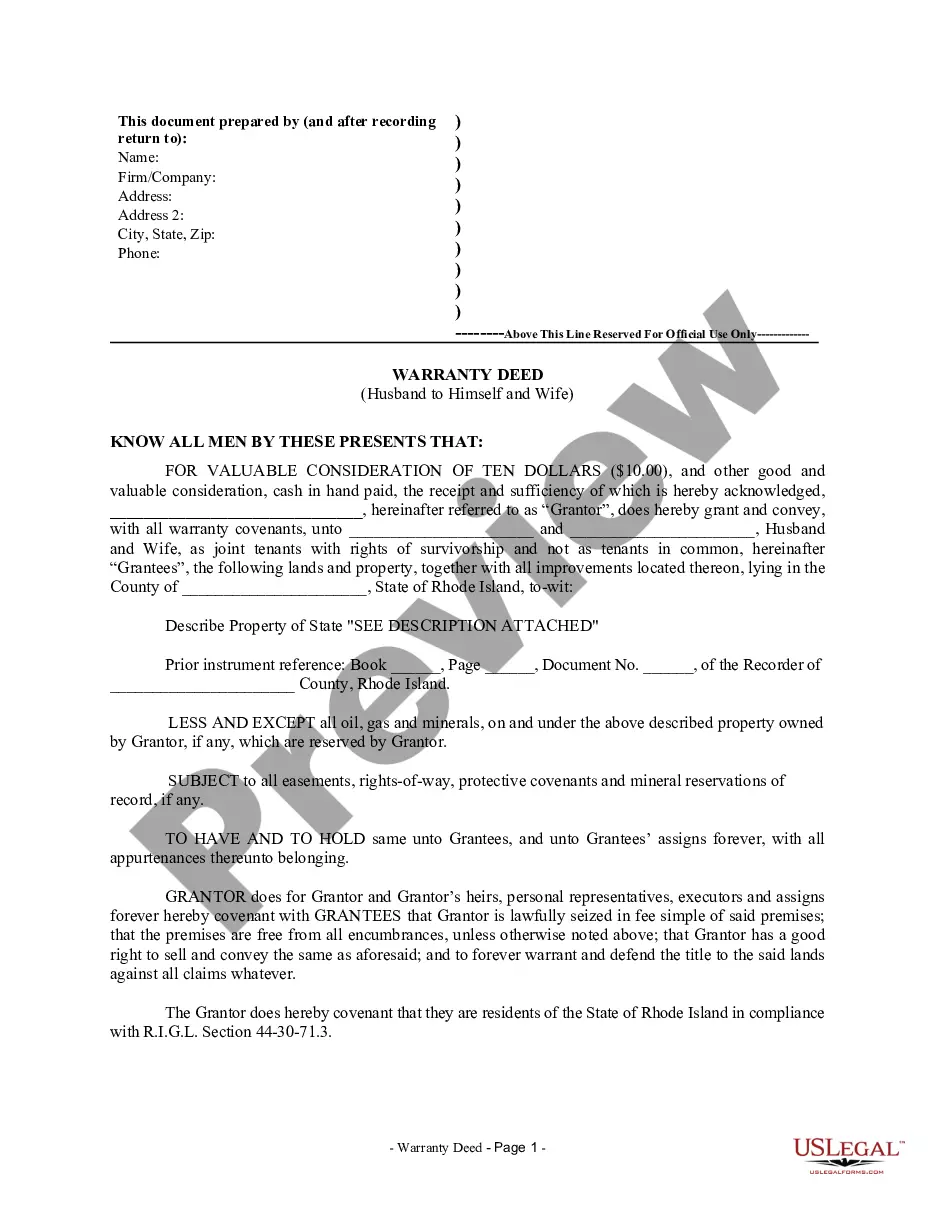
The Warranty Deed from Husband to Himself and Wife is a legal document used to transfer property ownership from a husband to himself and his wife as joint tenants. This form ensures that both parties hold rights to the property, including the right of survivorship, meaning if one owner passes away, the other automatically inherits their share. This type of warranty deed is distinct from other forms, such as quitclaim deeds, as it provides a guarantee of clear title to the property, free from claims and encumbrances, unless otherwise noted.
Main sections of this form
- Description of the property being conveyed, including references to prior instruments.
- Statement of reservation for oil, gas, and minerals beneath the property.
- Covenant of seisin, ensuring the grantor legally owns the property and has the right to transfer it.
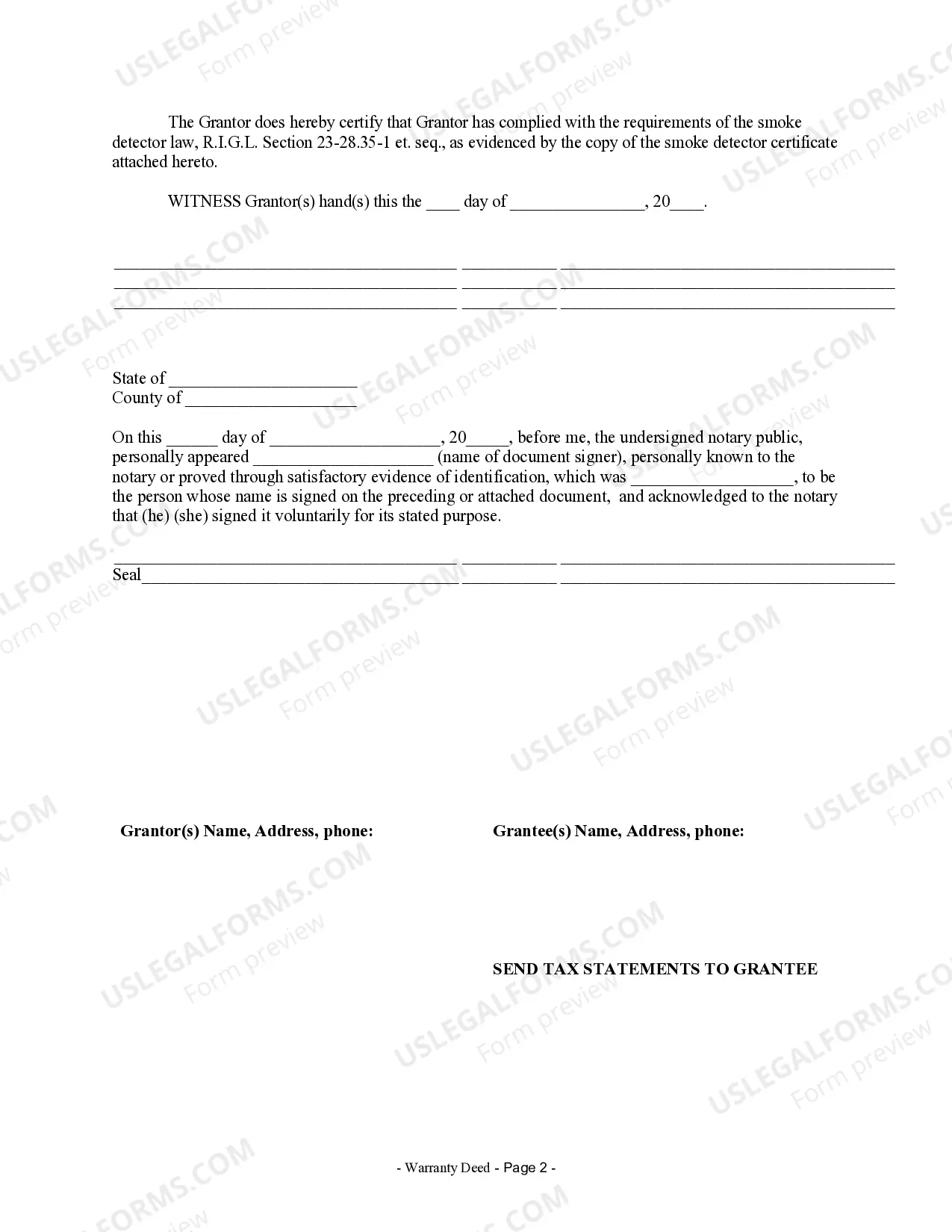
- Provision for the smoke detector law compliance certificate.
- Signature section for the grantor and notary acknowledgment section.



Common use cases
This form is typically used when a husband wishes to transfer real estate that he owns solely to both himself and his wife. Common scenarios include estate planning considerations, simplifying property ownership in marriage, or resolving ownership issues among family members. This deed can also be beneficial in ensuring both spouses have equal ownership rights, particularly in states that recognize joint tenancy with rights of survivorship.
Who needs this form
- Married couples looking to hold property together as joint tenants.
- Individuals seeking to clarify property ownership in their marital home.
- Homeowners involved in estate planning or transfer of property interests.
- Residents of Rhode Island, where the form adheres to state laws regarding property deeds.
Instructions for completing this form
- Identify the grantor (husband) and grantees (husband and wife).
- Describe the property, ensuring to include any relevant prior instrument references.
- Specify any exceptions to the transfer, such as reservations for oil, gas, and minerals.
- Complete the signature section, including the date of signing and notary public acknowledgment.
- Attach any necessary documentation, such as the smoke detector compliance certificate.
Is notarization required?
Notarization is required for this form to take effect. Our online notarization service, powered by Notarize, lets you verify and sign documents remotely through an encrypted video session, available 24/7.
Get your form ready online
Our built-in tools help you complete, sign, share, and store your documents in one place.
Make edits, fill in missing information, and update formatting in US Legal Forms—just like you would in MS Word.
Download a copy, print it, send it by email, or mail it via USPS—whatever works best for your next step.
Sign and collect signatures with our SignNow integration. Send to multiple recipients, set reminders, and more. Go Premium to unlock E-Sign.
If this form requires notarization, complete it online through a secure video call—no need to meet a notary in person or wait for an appointment.
We protect your documents and personal data by following strict security and privacy standards.

Make edits, fill in missing information, and update formatting in US Legal Forms—just like you would in MS Word.

Download a copy, print it, send it by email, or mail it via USPS—whatever works best for your next step.

Sign and collect signatures with our SignNow integration. Send to multiple recipients, set reminders, and more. Go Premium to unlock E-Sign.

If this form requires notarization, complete it online through a secure video call—no need to meet a notary in person or wait for an appointment.

We protect your documents and personal data by following strict security and privacy standards.
Avoid these common issues
- Neglecting to include a complete legal description of the property.
- Failing to specify exceptions or reservations, which may lead to ownership disputes.
- Omitting the notarization of signatures, rendering the document invalid.
- Not attaching required compliance certificates, like smoke detector validation.
Why use this form online
- Convenience of instant download from any location.
- Editable fields allowing you to customize the document to your specific needs.
- Access to legally compliant templates drafted by licensed attorneys.
- Easy storage and electronic submission capabilities.
Looking for another form?
Form popularity
FAQ
Two of the most common ways to transfer property in a divorce are through an interspousal transfer deed or quitclaim deed. When spouses own property together, but then one spouse executes an interspousal transfer or a quitclaim deed, this is known as transmutation.
In California, all property bought during the marriage with income that was earned during the marriage is deemed "community property." The law implies that both spouses own this property equally, regardless of which name is on the title deed.
If you live in a common-law state, you can keep your spouse's name off the title the document that says who owns the property.You can put your spouse on the title without putting them on the mortgage; this would mean that they share ownership of the home but aren't legally responsible for making mortgage payments.
Retrieve your original deed. Get the appropriate deed form. Draft the deed. Sign the deed before a notary. Record the deed with the county recorder. Obtain the new original deed.
A In order to make your partner a joint owner you will need to add his name at the Land Registry, for which there is a fee of £280 (assuming you transfer half the house to him). You won't, however, have to pay capital gains tax, as gifts between civil partners (and spouses) are tax free.
Adding someone to your house deed requires the filing of a legal form known as a quitclaim deed. When executed and notarized, the quitclaim deed legally overrides the current deed to your home. By filing the quitclaim deed, you can add someone to the title of your home, in effect transferring a share of ownership.
If you've recently married and already own a home or other real estate, you may want to add your new spouse to the deed for your property so the two of you own it jointly. To add a spouse to a deed, all you have to do is literally fill out, sign and record a new deed in your county recorder's office.
Adding someone to your house deed requires the filing of a legal form known as a quitclaim deed. When executed and notarized, the quitclaim deed legally overrides the current deed to your home. By filing the quitclaim deed, you can add someone to the title of your home, in effect transferring a share of ownership.