Pennsylvania Fiduciary Deed for Two Executors to an Individual
What is this form?
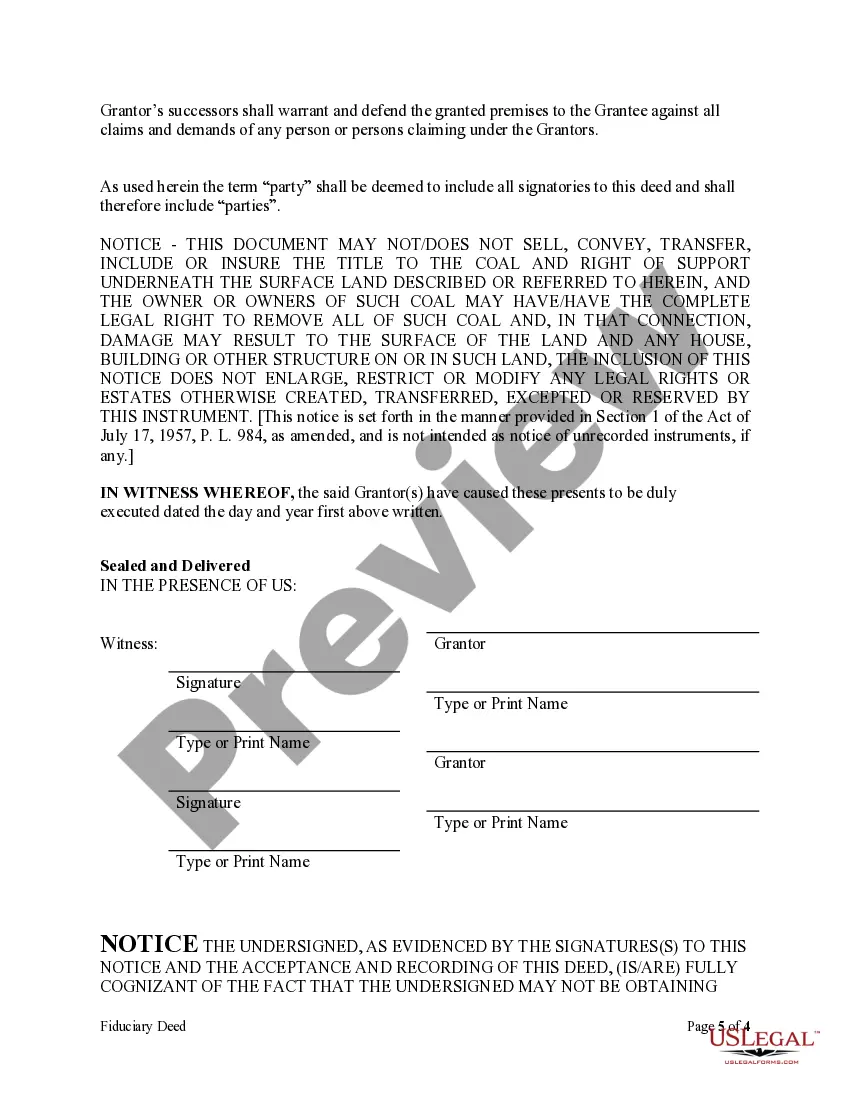
The Fiduciary Deed for Two Executors to an Individual is a legal document that allows two executors to transfer property ownership to a specific individual. This form differs from standard deeds as it specifically identifies executors acting on behalf of the estate they represent, ensuring that the transfer adheres to legal standards set forth by Pennsylvania law.
What’s included in this form
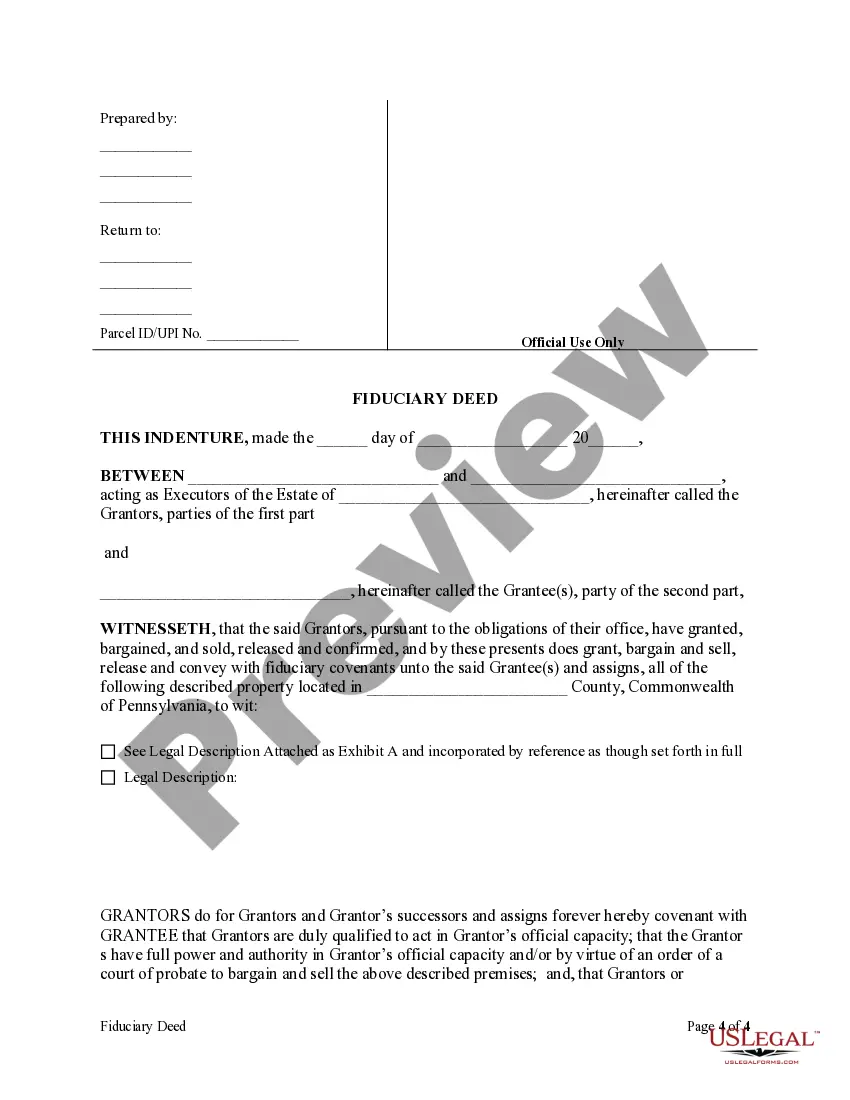
- Grantors: The two executors who are transferring the property.
- Grantee: The individual receiving property ownership.
- Legal descriptions of the property being transferred.
- Date of execution and signatures of the grantors.
- Notary acknowledgment for validating the authenticity of the signatures.





Common use cases
This form is necessary when the estate of a deceased individual is distributed and two executors are specifically tasked with transferring property to a designated individual. It is used when there are no disputes regarding the estate and the property title needs to be officially transferred following the decedent's wishes as outlined in their will.
Who should use this form
- Executors of an estate who are legally authorized to manage and distribute estate assets.
- Individuals designated to receive property as outlined in a will or estate documents.
- Lawyers who assist clients in estate management and property transfers.
Instructions for completing this form
- Identify and enter the names of both executors as grantors.
- Specify the name of the individual receiving the property.
- Provide a detailed legal description of the property being transferred.
- Enter the date of execution and have the grantors sign the form.
- Obtain a notary public's acknowledgment to validate the signatures.
Notarization guidance
Notarization is required for this form to take effect. Our online notarization service, powered by Notarize, lets you verify and sign documents remotely through an encrypted video session, available 24/7.
Get your form ready online
Our built-in tools help you complete, sign, share, and store your documents in one place.
Make edits, fill in missing information, and update formatting in US Legal Forms—just like you would in MS Word.
Download a copy, print it, send it by email, or mail it via USPS—whatever works best for your next step.
Sign and collect signatures with our SignNow integration. Send to multiple recipients, set reminders, and more. Go Premium to unlock E-Sign.
If this form requires notarization, complete it online through a secure video call—no need to meet a notary in person or wait for an appointment.
We protect your documents and personal data by following strict security and privacy standards.

Make edits, fill in missing information, and update formatting in US Legal Forms—just like you would in MS Word.

Download a copy, print it, send it by email, or mail it via USPS—whatever works best for your next step.

Sign and collect signatures with our SignNow integration. Send to multiple recipients, set reminders, and more. Go Premium to unlock E-Sign.

If this form requires notarization, complete it online through a secure video call—no need to meet a notary in person or wait for an appointment.

We protect your documents and personal data by following strict security and privacy standards.
Common mistakes to avoid
- Failing to have both executors sign the deed.
- Not providing a complete legal description of the property.
- Neglecting to get the document notarized, which can invalidate the transfer.
- Completing the form without checking for compliance with Pennsylvania law.
Why use this form online
- Easy access to legal forms that are drafted by licensed attorneys.
- Convenient online completion allows for quick and efficient data entry.
- Automatically formatted to meet legal standards for Pennsylvania.
Looking for another form?






Form popularity
FAQ
Both executors must sign the initial petition with the probate court. Typically, both executors will have to sign checks and other estate paperwork. Both executors may be responsible for filing tax returns. You have a duty to monitor the actions of the other executor and to report any unethical or illegal behavior.
In most situations, it's not a good idea to name co-executors. When you're making your will, a big decision is who you choose to be your executorthe person who will oversee the probate of your estate. Many people name their spouse or adult child. You can, however, name more than one person to serve as executor.
A joint Executor will not usually be able to act alone unless the other Executors formally agree to this.It is common for Will Writers to recommend a minimum of two Executors when someone is making a Will, but it's still a common occurrence for only one Executor to be been appointed.
The only circumstances in which jointly appointed Executors can act alone is if the other Executor(s) formally step down from their role. There are two ways in which they can do this.The other option is for the Executor who doesn't want to act to have Power Reserved to them.
If one of the co-executors does not agree, then the estate cannot take the action. So, each co executor should be working together with the other co executor to administer the estate.
When you and someone else are named as co-executors in a Will, that essentially means that you must execute the Will together. You must both apply to Probate the Will together. You must both sign checks and title transfers together. Basically, neither of you may act independently of the other.
Can I start the estate process without them? Co-Executors in Pennsylvania must serve jointly.
If the will names multiple executors, but only one person wishes to take out a grant of probate, it is wise for at least one of the others to sign a power reserved letter, just in case the acting executor cannot complete the administration of the estate.
A sole Executor is usually able to act alone during Probate, although there are some important factors to consider. A joint Executor will not usually be able to act alone unless the other Executors formally agree to this.