Pennsylvania Notice of Dishonored Check - Civil - Keywords: bad check, bounced check
What is this form?
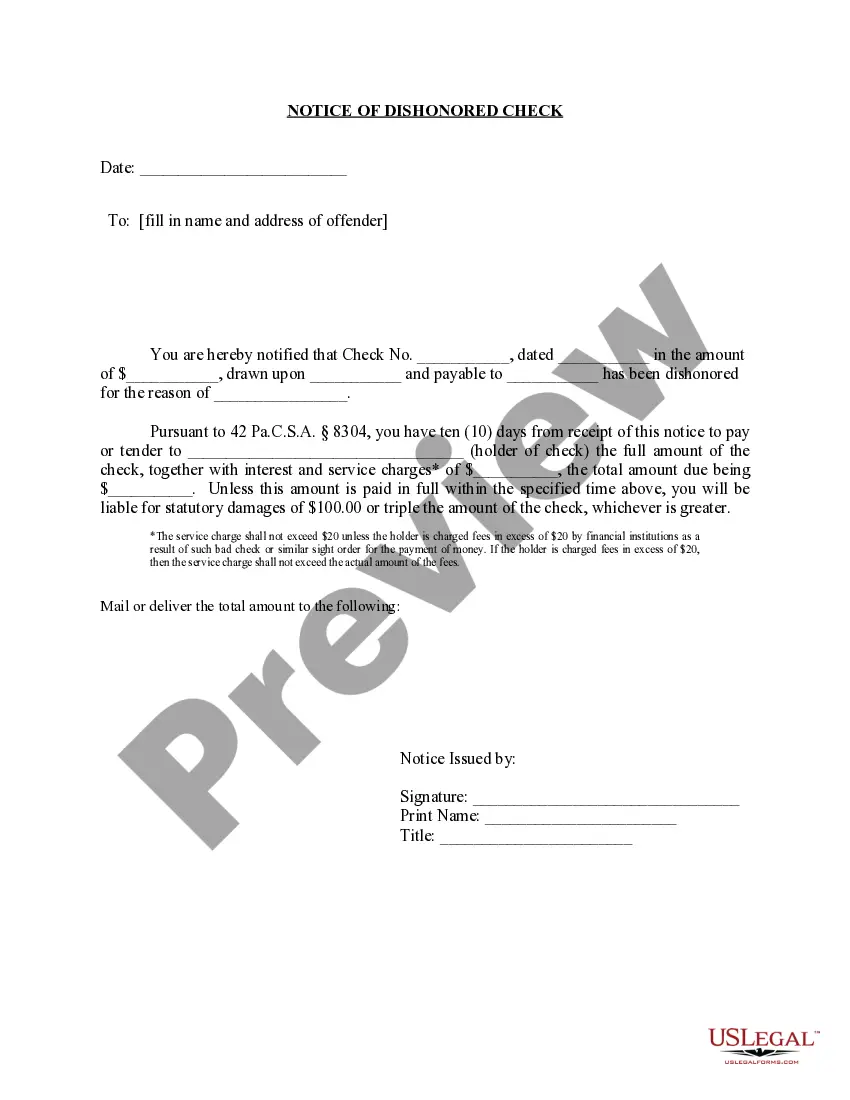
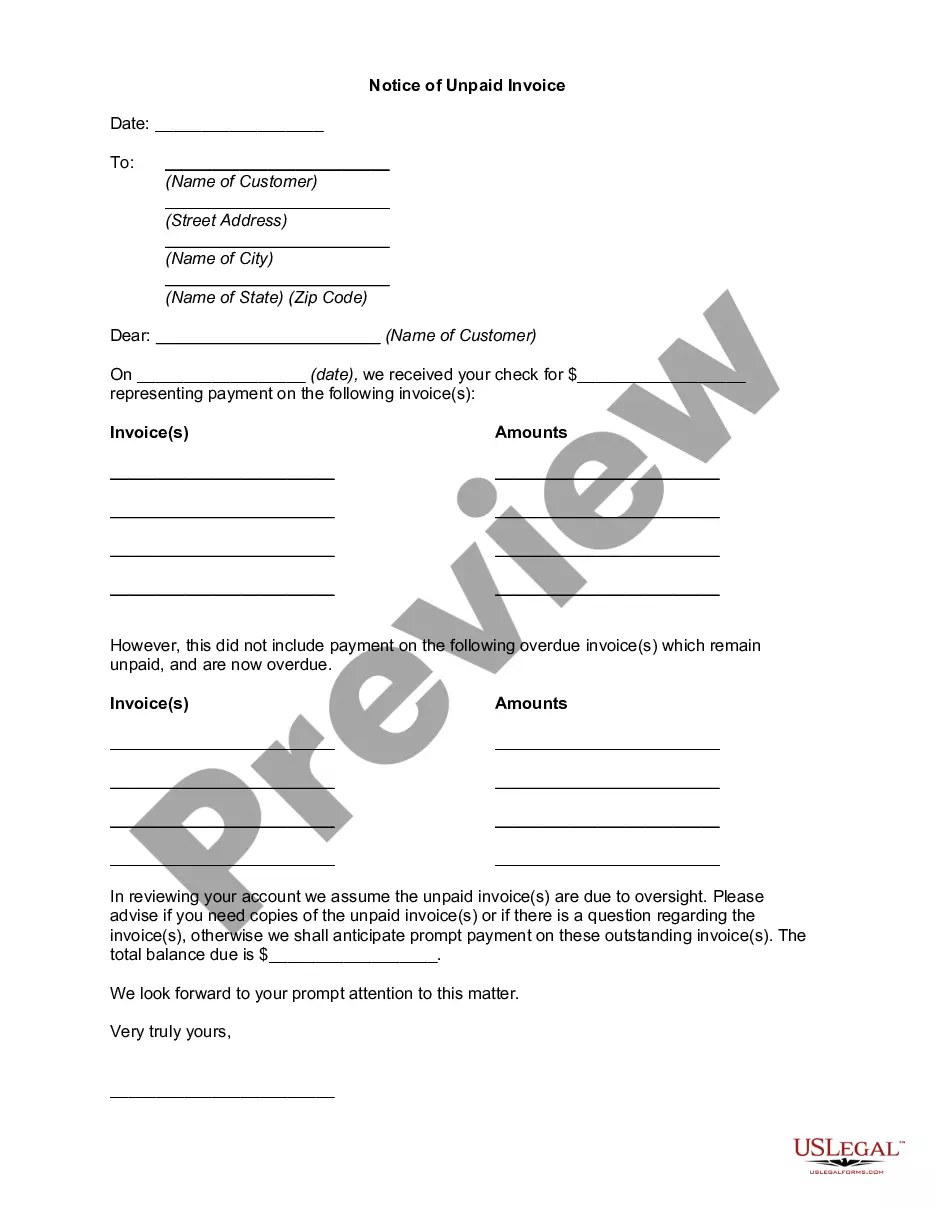
A Notice of Dishonored Check is a formal document that notifies a debtor that their check has bounced due to insufficient funds or a closed account. This form is essential for individuals and businesses seeking to recover funds from bad checks and also serves as a legal step in the recovery process. Unlike other types of demand letters, this notice may have specific statutory requirements under state law, making it crucial to use the correct template for your jurisdiction.
Form components explained
- Recipient's name: Identify the person or entity that issued the dishonored check.
- Amount due: State the total amount owed, including the check amount, interest, and service charges.
- Payment deadline: Specify the ten-day period for the debtor to settle the amount owed.
- Consequences of non-payment: Outline potential statutory damages for failing to pay.
- Signature and title: Include the holder's name and position for verification.

Situations where this form applies
This form should be used when you receive a bounced check or a bad check from an individual or a business. It is a necessary step before pursuing further legal action, such as filing a lawsuit to recover the owed funds. Use it to formally inform the check issuer of the dishonored check and provide them an opportunity to rectify the situation.
Intended users of this form
- Businesses that have received a bounced check from a customer.
- Individuals who have accepted a bad check as payment for goods or services.
- Legal representatives managing accounts receivable or collections.
Instructions for completing this form
- Identify the holder of the check and enter their name in the designated field.
- Calculate the total amount due, including the check value, any applicable interests, and service charges.
- Clearly state the ten-day period allowed for payment in the notice.
- Detail the potential statutory damages that may apply if payment is not made.
- Have the holder print their name and sign to validate the form.
Does this form need to be notarized?
In most cases, this form does not require notarization. However, some jurisdictions or signing circumstances might. US Legal Forms offers online notarization powered by Notarize, accessible 24/7 for a quick, remote process.
Get your form ready online
Our built-in tools help you complete, sign, share, and store your documents in one place.
Make edits, fill in missing information, and update formatting in US Legal Forms—just like you would in MS Word.
Download a copy, print it, send it by email, or mail it via USPS—whatever works best for your next step.
Sign and collect signatures with our SignNow integration. Send to multiple recipients, set reminders, and more. Go Premium to unlock E-Sign.
If this form requires notarization, complete it online through a secure video call—no need to meet a notary in person or wait for an appointment.
We protect your documents and personal data by following strict security and privacy standards.

Make edits, fill in missing information, and update formatting in US Legal Forms—just like you would in MS Word.

Download a copy, print it, send it by email, or mail it via USPS—whatever works best for your next step.

Sign and collect signatures with our SignNow integration. Send to multiple recipients, set reminders, and more. Go Premium to unlock E-Sign.

If this form requires notarization, complete it online through a secure video call—no need to meet a notary in person or wait for an appointment.

We protect your documents and personal data by following strict security and privacy standards.
Common mistakes to avoid
- Failing to provide complete information about the check issuer.
- Not specifying the total amount due accurately, including all charges.
- Not sending the notice within the required ten-day period.
Benefits of using this form online
- Convenience: Download and fill out the form at your convenience.
- Editability: Easily customize the form to fit your unique situation.
- Reliability: Trusted templates drafted by licensed attorneys ensure legal accuracy.
Legal use & context
- This form serves as a formal notice to the debtor, establishing a timeline for payment.
- Failure to issue this notice may limit legal recovery options for the creditor.
- Statutory damages outlined in the notice serve to discourage default on payments.
What to keep in mind
- A Notice of Dishonored Check is crucial for recovering funds from a bounced check.
- Timely notification of the debtor is essential for legal recovery efforts.
- Ensure all details on the form are complete and accurate to avoid delays.
Glossary of terms
- Dishonored Check: A check that the bank refuses to pay due to insufficient funds or a nonexistent account.
- Statutory Damages: Financial penalties set by law that a debtor must pay if they fail to respond to this notice.
- Service Charges: Additional fees imposed for processing a dishonored check.
Looking for another form?
Form popularity
FAQ
Knowingly writing a bad check is an act of fraud, and is punishable by law. Writing bad checks is a crime.Civil penalties apply in all cases, with a common penalty amount equivalent to the check's face value, a multiple of the check amount with a cap, or the check amount plus court and attorney fees.
If the tellers at the checks bank tell you there ARE sufficient funds you have three options: cash the check immediately (actually get cash - probably not recommended if it's several thousand dollars), take the check to YOUR bank and deposit the funds (this will take 2-3 days for the check to clear - not recommended),
Bouncing a check can happen to anyone. Write one and you'll owe your bank an NSF fee of between $27 and $35, and the recipient of the check is permitted to charge a returned-check fee of between $20 and $40 or a percentage of the check amount.
Send the letter certified mail. Visit your local district attorney's office if you do not hear back from the debtor. Bring your correspondence with you and a copy of the bad check. He will take the case over, and likely prosecute the check writer.
Writing a bad check can land you in prison. In Pennsylvania, bad checks under $200 constitute a summary offense.Bad checks between $1,000 and $75,000 are a first degree misdemeanor, and bad checks over $75,000 are a felony.
Writing a bad check is considered a wobbler crime in California, meaning it can be charged as either a misdemeanor or felony depending on circumstances of the crime. If the value of the check was under $450, the offense is generally charged as a misdemeanor. If the amount is over $450, you can be charged with a felony.
Penal Code 476a PC is the California statute that makes it a crime for a person to write or pass a bad check, knowing there are insufficient funds to cover payment of the check. The offense can be charged as a felony if the value of the bad checks is more than $950.00. Otherwise, the offense is only a misdemeanor.
A bounced check occurs when the writer of the check has insufficient funds available to fulfill the payment amount on the check to the payee. When a check bounces, they are not honored by the depositor's bank, and may result in fees and banking restrictions.
People who write bad checks are normally charged fees by their banks and could be on the hook for any fees incurred by the payee. Knowingly writing a bad check may constitute a misdemeanor or felony, depending on the amount of the check and the state in which it was written.