Cook Services Contract - Self-Employed
Understanding this form
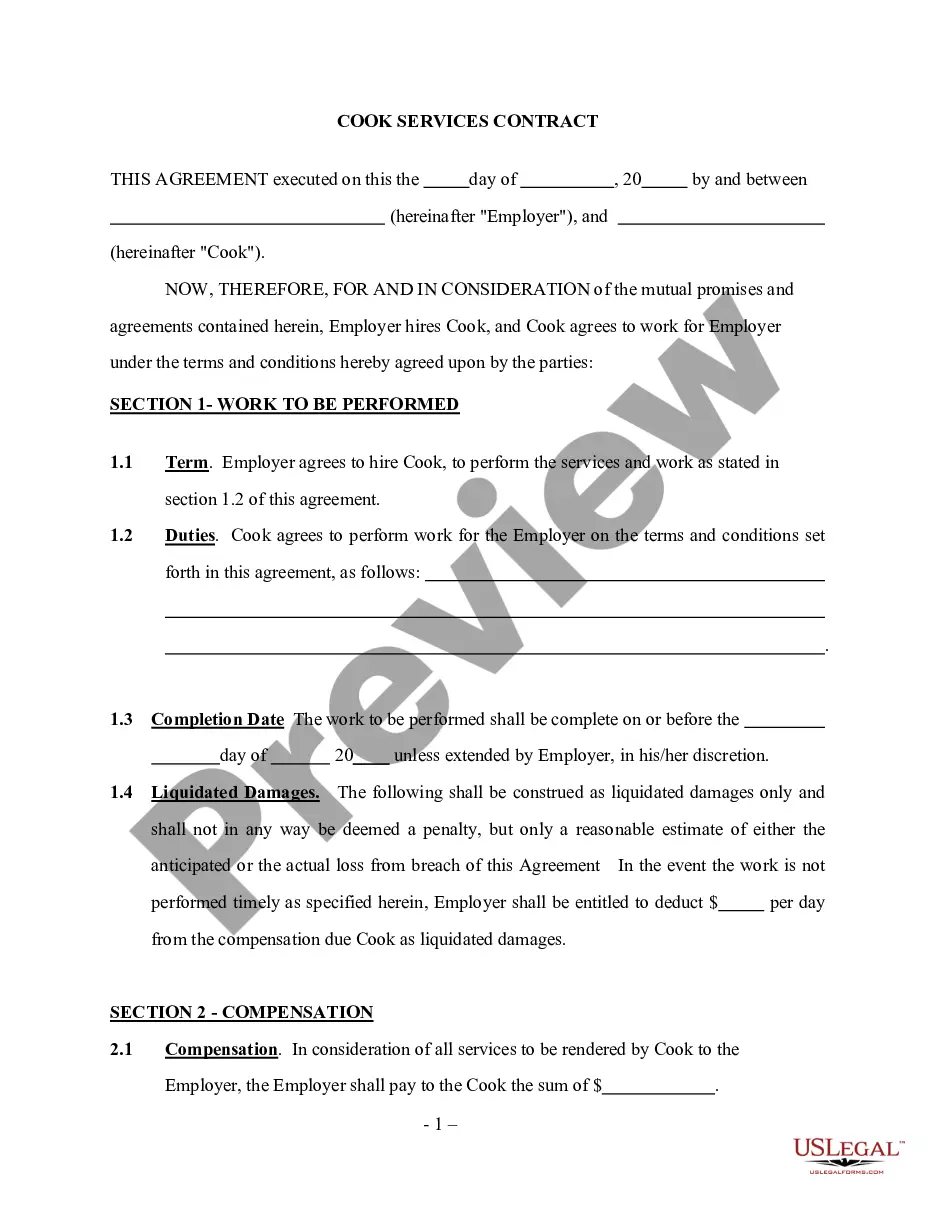
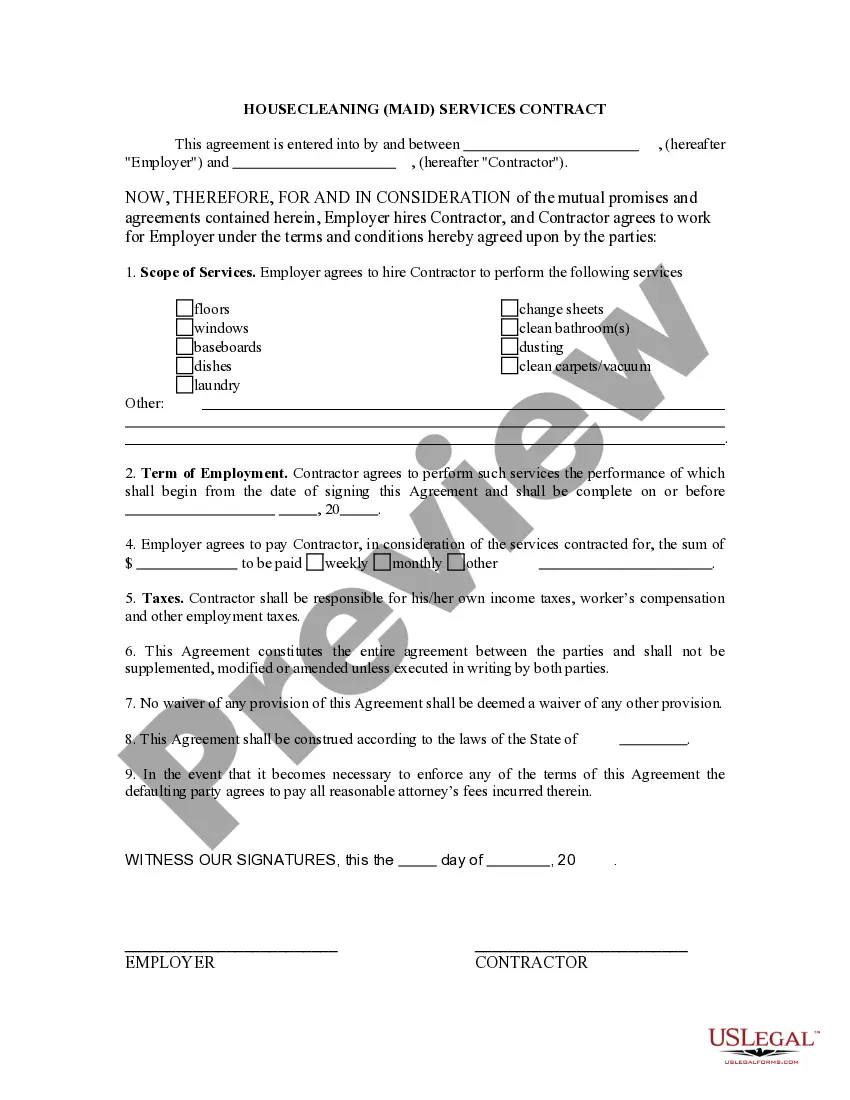
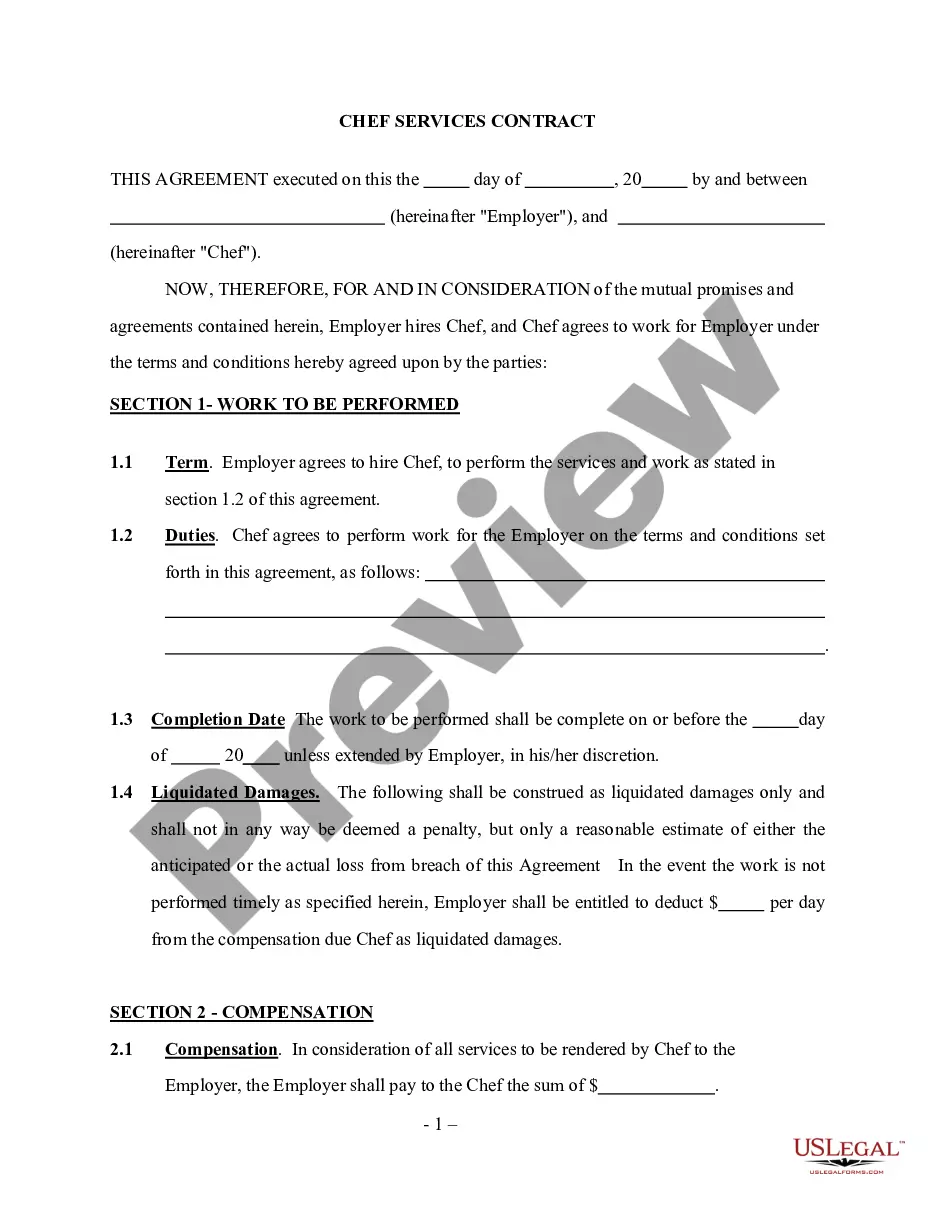
The Cook Services Contract - Self-Employed is a legal document that outlines the agreement between an employer and a cook who is hired as an independent contractor. This form details the specific cooking services to be performed and clarifies the legal status of the cook as not being an employee of the employer. Unlike traditional employment contracts, this contract is tailored for situations where the cook operates as a self-employed individual, allowing for greater flexibility and independence in their work.
Key parts of this document
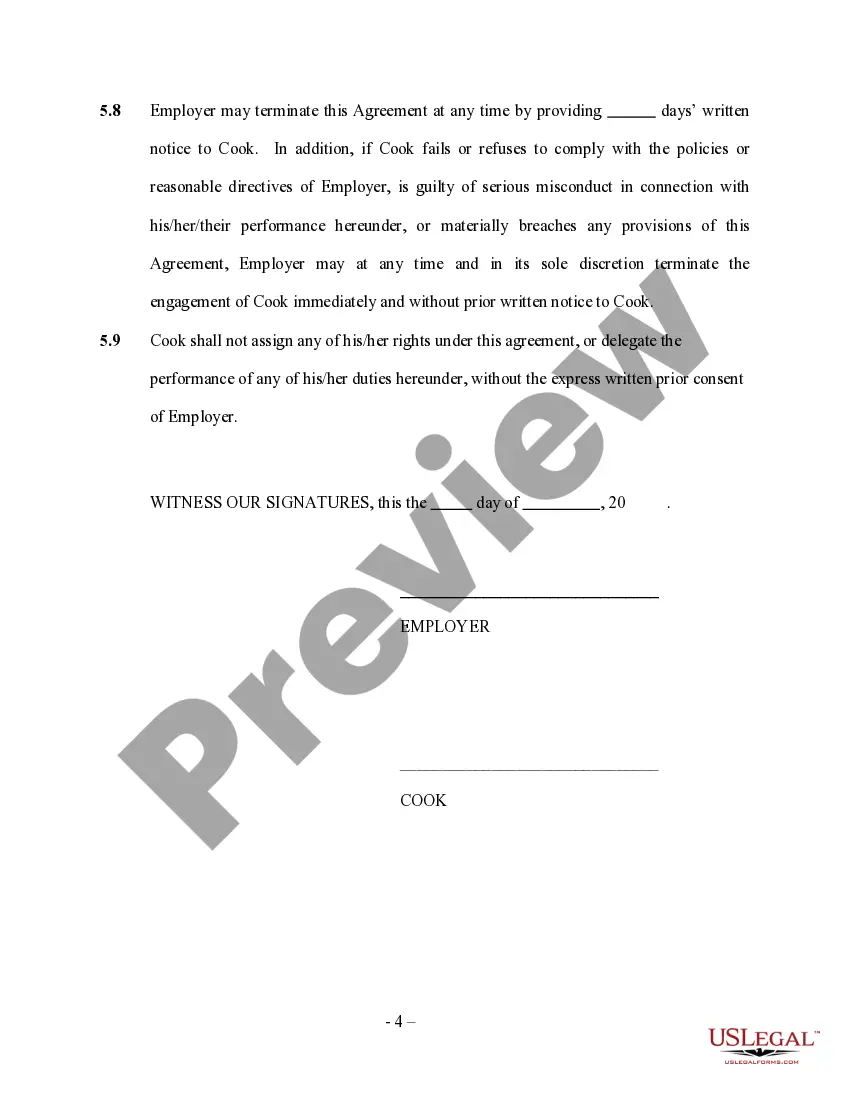
- Work to be performed: Outlines the specific cooking services the cook will provide.
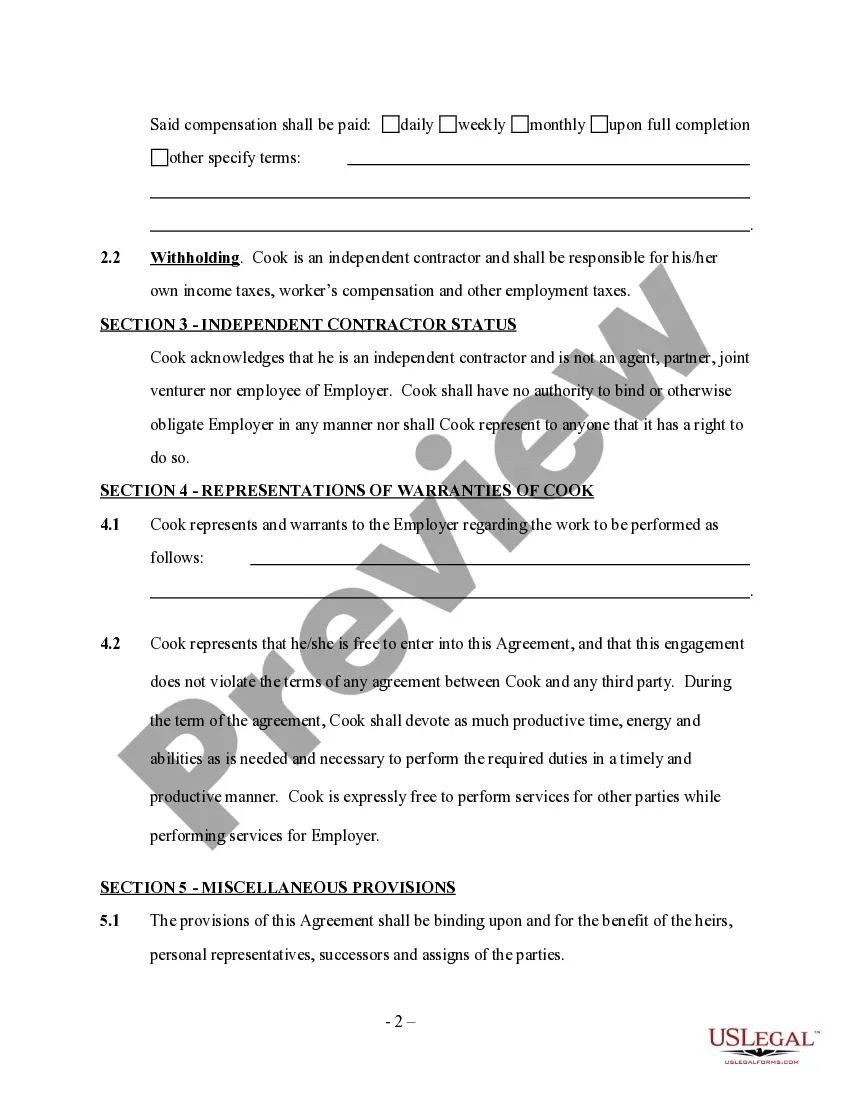
- Independent contractor status: Affirms that the cook is not an employee and outlines their limited authority.
- Warranties and representations: Details any guarantees made by the cook regarding their services.
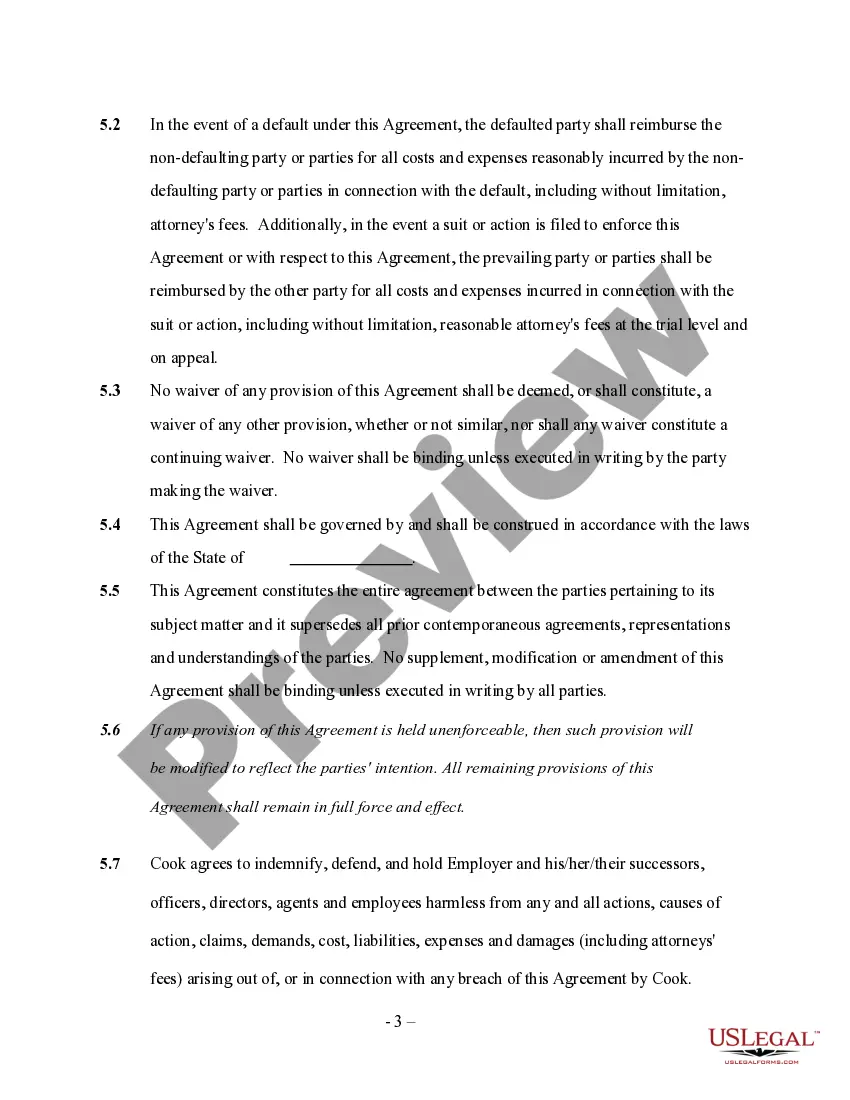
- Miscellaneous provisions: Covers binding agreements, reimbursement for defaults, and waivers.
When to use this document
This form should be used when an employer wants to hire a cook as an independent contractor rather than as an employee. It is ideal for personal chefs, caterers, or any cooking services that do not require full-time employment arrangements or employee benefits. Using this contract helps establish clear expectations and protect both parties in professional cooking engagements.
Who this form is for
This contract is intended for:
- Employers seeking to hire self-employed cooks for specific cooking tasks.
- Cooks operating as independent contractors looking to formalize their working agreements.
- Individuals or businesses in need of temporary cooking services for events or ongoing engagements.
Completing this form step by step
Follow these steps to complete the Cook Services Contract - Self-Employed:
- Identify the parties involved: clearly list the employer and the cook.
- Specify the services: outline the cooking functions the cook is expected to perform.
- Define the term: state the duration of the agreement, including start and end dates.
- Review representations: ensure the cook agrees to the necessary warranties and representations.
- Sign and date: both parties should sign and date the contract to make it legally binding.
Notarization requirements for this form
This form does not typically require notarization unless specified by local law. However, it is a good practice to have the contract witnessed or notarized to enhance its legal validity and prevent disputes over authenticity in the event of a conflict.
Get your form ready online
Our built-in tools help you complete, sign, share, and store your documents in one place.
Make edits, fill in missing information, and update formatting in US Legal Forms—just like you would in MS Word.
Download a copy, print it, send it by email, or mail it via USPS—whatever works best for your next step.
Sign and collect signatures with our SignNow integration. Send to multiple recipients, set reminders, and more. Go Premium to unlock E-Sign.
If this form requires notarization, complete it online through a secure video call—no need to meet a notary in person or wait for an appointment.
We protect your documents and personal data by following strict security and privacy standards.

Make edits, fill in missing information, and update formatting in US Legal Forms—just like you would in MS Word.

Download a copy, print it, send it by email, or mail it via USPS—whatever works best for your next step.

Sign and collect signatures with our SignNow integration. Send to multiple recipients, set reminders, and more. Go Premium to unlock E-Sign.

If this form requires notarization, complete it online through a secure video call—no need to meet a notary in person or wait for an appointment.

We protect your documents and personal data by following strict security and privacy standards.
Typical mistakes to avoid
- Failing to clearly define the services to be performed, leading to misunderstandings.
- Not specifying the term of the contract, which can cause confusion about the agreementâs duration.
- Using vague terms about payment or responsibilities, which can lead to disputes later.
Advantages of online completion
- Easy access to legal templates: download and customize forms at your convenience.
- Editability: modify specific details to meet your particular needs without needing legal assistance.
- Time-saving: quickly fill out the form and get contracts in place without delays.
Legal use & context
- The Cook Services Contract is legally binding when signed by both parties.
- It helps protect the rights of both the employer and the cook in case of disputes.
- Understanding each clause can prevent misunderstandings and legal issues down the road.
Summary of main points
- This contract defines the relationship between an employer and a cook as independent contractors.
- Clear terms regarding services and payment help avoid misunderstandings.
- Following the form template ensures compliance with legal standards.
Looking for another form?



Form popularity
FAQ
Yes, if you have 1099 income you are considered to be self-employed, and you will need to pay self-employment taxes (Social Security and Medicare taxes) on this income.
A sole proprietorship can use independent contractors for the term of the contract without any further obligation. If the sole proprietor no longer needs the independent contractor, the sole proprietor is under no obligation to extend the contract.
Most chefs go the traditional route of working their way up in the same business over a period of years, but in recent years many chefs are exploring freelance and private work. Here we explore everything you need to know about how a career as a freelance chef for hire can work for you.
A chef is integral to the business of preparing food and would not be considered an independent contractor. A specialist chef, who prepares food for a one-time event for the restaurant, could be considered an independent contractor.
An independent contractor is a self-employed person or entity contracted to perform work foror provide services toanother entity as a nonemployee. As a result, independent contractors must pay their own Social Security and Medicare taxes.
People who work for themselves or who own their own company are sometimes alternately referred to as self-employed or independent contractors, though there is a difference between the two. In general, all independent contractors are self-employed, but not all self-employed people are independent contractors.
Simply put, being an independent contractor is one way to be self-employed. Being self-employed means that you earn money but don't work as an employee for someone else. An independent contractor is someone who provides a service on a contractual basis.
The law codifies and expands on an April 2018 California Supreme Court decision that set a strict new test for employers. Independent contractors must be free to perform their work as they wish, must be in a different line of work from the company contracting with them and must operate their own business.
A self employed person will not usually have a contract of employment; they will usually be hired for a certain amount of time. The contract that exists between the self employed person and the person or company supplying the work will have a number of rules or conditions set down within it.