Ohio Letter from Tenant to Landlord about Fair Housing Reduction or Denial of services to Family with Children
Understanding this form
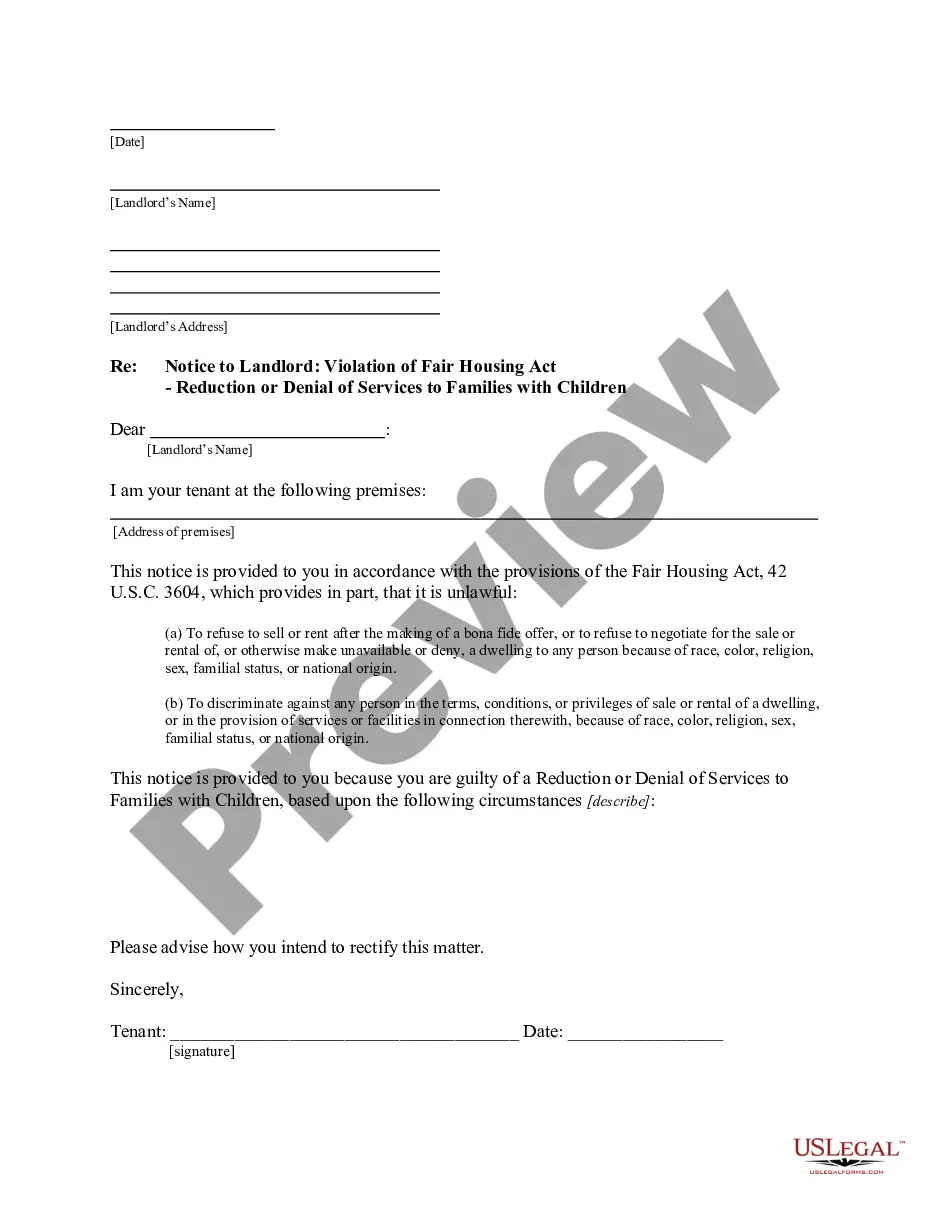
This form is a letter from a tenant to a landlord regarding a violation of the Fair Housing Act. It specifically addresses situations where the landlord has reduced or denied services to families with children. This form is vital for ensuring compliance with fair housing laws and protecting the rights of tenants, particularly families, against discrimination based on familial status and other protected categories.
Form components explained
- Identification of the tenant and landlord.
- A clear statement of the alleged violation under the Fair Housing Act.
- Specific details regarding the reduction or denial of services.
- A call to action for the landlord to correct the violation.

When to use this form
This form should be used when a tenant believes that their landlord is unlawfully discriminating against them by denying or reducing services to their family because they have children. It is essential for addressing issues before they escalate further and is a crucial step in advocating for fair housing rights.
Who should use this form
- Tenants who are families with children.
- Individuals facing service reduction or denial issues from their landlords.
- Anyone wanting to formally notify their landlord of potential Fair Housing Act violations.
Steps to complete this form
- Identify the parties: include the names and addresses of the tenant and landlord.
- State the date of the letter clearly at the top.
- Detail the specific violation, explaining how services have been denied or reduced.
- Request a remedy or correction from the landlord.
- Sign and date the letter to formalize it.
Is notarization required?
Notarization is not commonly needed for this form. However, certain documents or local rules may make it necessary. Our notarization service, powered by Notarize, allows you to finalize it securely online anytime, day or night.
Get your form ready online
Our built-in tools help you complete, sign, share, and store your documents in one place.
Make edits, fill in missing information, and update formatting in US Legal Forms—just like you would in MS Word.
Download a copy, print it, send it by email, or mail it via USPS—whatever works best for your next step.
Sign and collect signatures with our SignNow integration. Send to multiple recipients, set reminders, and more. Go Premium to unlock E-Sign.
If this form requires notarization, complete it online through a secure video call—no need to meet a notary in person or wait for an appointment.
We protect your documents and personal data by following strict security and privacy standards.

Make edits, fill in missing information, and update formatting in US Legal Forms—just like you would in MS Word.

Download a copy, print it, send it by email, or mail it via USPS—whatever works best for your next step.

Sign and collect signatures with our SignNow integration. Send to multiple recipients, set reminders, and more. Go Premium to unlock E-Sign.

If this form requires notarization, complete it online through a secure video call—no need to meet a notary in person or wait for an appointment.

We protect your documents and personal data by following strict security and privacy standards.
Typical mistakes to avoid
- Failing to include specific incidents of discrimination.
- Not providing adequate contact information for follow-up.
- Neglecting to keep a copy of the letter for personal records.
Benefits of completing this form online
- Convenience of downloading and printing the form from anywhere.
- Easy to edit with personalized information.
- Access to professionally drafted templates, ensuring legal accuracy.
Legal use & context
- This letter is a formal notification of a Fair Housing Act violation.
- It can be used as evidence if further legal action becomes necessary.
- Ensure that you keep a copy of the letter for your records after sending it to your landlord.
Key takeaways
- The form serves as a formal notification of discrimination based on familial status.
- Utilizing this form can help assert your rights under the Fair Housing Act.
- Be thorough and precise in detailing the landlord's violations to strengthen your case.
Looking for another form?
Form popularity
FAQ
A renter is a person who pays rent in other to use something that to belongs to someone else be it a house, room or even a car. But a tenant can be a renter, free occupier or a caretaker of someone's property eg.
The rights of a tenant The right to live in a property that's safe and in a good state of repair. The right to have your deposit returned at the end of the tenancy (provided that you meet the terms of your tenancy agreement).
The cost of registering a lease is generally paid by a tenant. Leases with a lease period of more than three years, including any option period, must be registered. This helps to protect the tenant's interests.