New York Warning of Default on Residential Lease
What is this form?
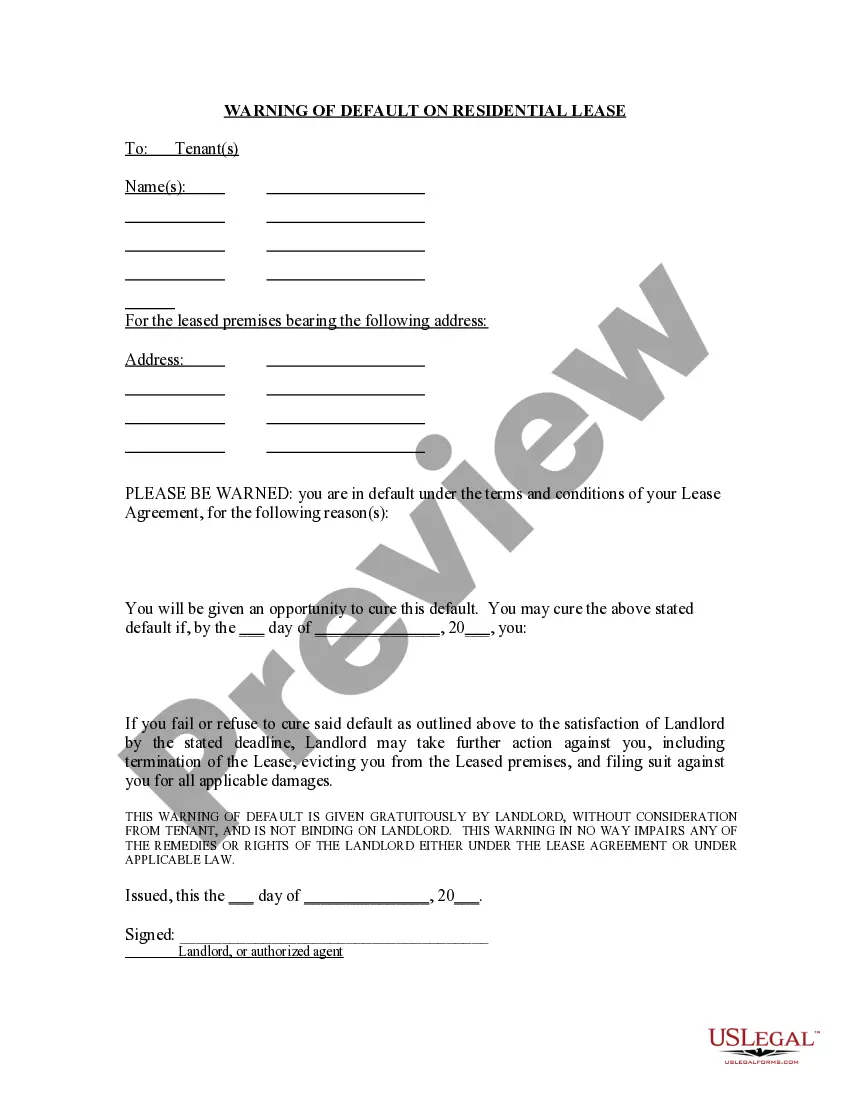
The Warning of Default on Residential Lease is a notice sent from a landlord to a tenant, indicating concerns that the tenant may be in violation of their lease agreement. This form is essential for landlords to formally communicate their issues with a tenant, ensuring that both parties are aware of the potential consequences if the situation is not resolved. Unlike other forms such as eviction notices, this warning serves as an initial step to notify tenants of their default status before further legal action is taken.
Form components explained
- Identification of the landlord and tenant
- Date of issuance
- Description of the conditions leading to the warning
- Signature line for the landlord or authorized agent



Situations where this form applies
This form should be used when a landlord suspects that a tenant is not complying with the terms of their residential lease. Common situations include failure to pay rent, unauthorized modifications to the property, or disturbances caused by the tenant. By issuing this warning, the landlord provides the tenant an opportunity to address the problematic behavior before more serious legal steps are taken, such as eviction proceedings.
Who should use this form
- Landlords seeking to formally warn tenants about lease violations
- Property managers acting on behalf of property owners
- Real estate professionals involved in property rentals
Steps to complete this form
- Identify the landlord and tenant by entering their full names.
- Specify the date the warning is issued.
- Clearly state the grounds for default, including specific lease violations.
- Sign the form in the designated area provided for the landlord or authorized agent.
Notarization guidance
This form does not typically require notarization to be legally valid. However, some jurisdictions or document types may still require it. US Legal Forms provides secure online notarization powered by Notarize, available 24/7 for added convenience.
Get your form ready online
Our built-in tools help you complete, sign, share, and store your documents in one place.
Make edits, fill in missing information, and update formatting in US Legal Forms—just like you would in MS Word.
Download a copy, print it, send it by email, or mail it via USPS—whatever works best for your next step.
Sign and collect signatures with our SignNow integration. Send to multiple recipients, set reminders, and more. Go Premium to unlock E-Sign.
If this form requires notarization, complete it online through a secure video call—no need to meet a notary in person or wait for an appointment.
We protect your documents and personal data by following strict security and privacy standards.

Make edits, fill in missing information, and update formatting in US Legal Forms—just like you would in MS Word.

Download a copy, print it, send it by email, or mail it via USPS—whatever works best for your next step.

Sign and collect signatures with our SignNow integration. Send to multiple recipients, set reminders, and more. Go Premium to unlock E-Sign.

If this form requires notarization, complete it online through a secure video call—no need to meet a notary in person or wait for an appointment.

We protect your documents and personal data by following strict security and privacy standards.
Common mistakes to avoid
- Failing to include important details about the lease violations.
- Not providing a clear deadline for the tenant to resolve the issues.
- Omitting the date of issuance, which is critical for documentation.
Advantages of online completion
- Convenient access to legal forms anytime, anywhere.
- Edit and customize the form to meet specific needs before downloading.
- Trustworthy templates drafted by licensed attorneys for reliability.
Legal use & context
- This warning serves as a formal method of notifying tenants and may be required before initiating eviction proceedings.
- It reaffirms the landlord's rights under the lease and applicable laws.
- The form must be used in accordance with state-specific regulations regarding residential leases.
Key takeaways
- The Warning of Default on Residential Lease is primarily intended as a proactive communication tool between landlords and tenants.
- Completing the form accurately is essential to maintain its effectiveness.
- Review state-specific regulations to ensure compliance with local laws and procedures.
Looking for another form?


Form popularity
FAQ
A rental agreement will be void and unenforceable if it allows the landlord to terminate the tenancy of a tenant for a crime committed in relation to the rental property if it does not also include the new domestic abuse protection language set forth in sec.
In landlord-tenant law, default refers to the failure of a tenant to timely pay rent due.In general, the landlord is required to give the tenant notice of the default before bringing eviction proceedings or applying security deposit proceeds to the payment in default.
A lease is automatically void when it is against the law, such as a lease for an illegal purpose. In other circumstances, like fraud or duress, a lease can be declared void at the request of one party but not the other.
Protect your rental income. Even the most reliable tenants sometimes struggle to pay their rent.Tenant default insurance from Simply Business provides vital back-up for landlords it can cover your rental income if your tenant fails to pay rent.
Unless your lease says otherwise simply breaking it is not an option. This is known as "unilateral breach" and typical penalties can include: Paying the rent - One way or another, if you walk away from your lease and no one else rents the apartment then you will owe the landlord this money.
Default by landlord The most common form of landlord default is failure to provide services and maintain the property condition. When a landlord defaults on the terms of the lease, tenants may sue for damages.
The notice must state that the tenant has 14 days to pay rent or move out of the rental unit. If the tenant does not pay the rent or move out of the rental unit within the 14 days, the landlord can begin eviction proceedings against the tenant (see N.Y. Real Prop. Acts § 711(2)).
Step 1: Speak to your tenant. Step 2: Provide notice of contract breach. Step 3: Decide between an interdict or cancellation. Step 4: Eviction process. Step 5: Eviction notice. Final advice.
Tenant default occurs when a Tenant breaches one of the tenant's covenants in its lease. Tenant default can arise in a number of different ways but will typically be for one of the following: Non-payment of rent or other sums reserved under the lease.