New Mexico Letter from Tenant to Landlord about Landlord's refusal to allow sublease is unreasonable
About this form
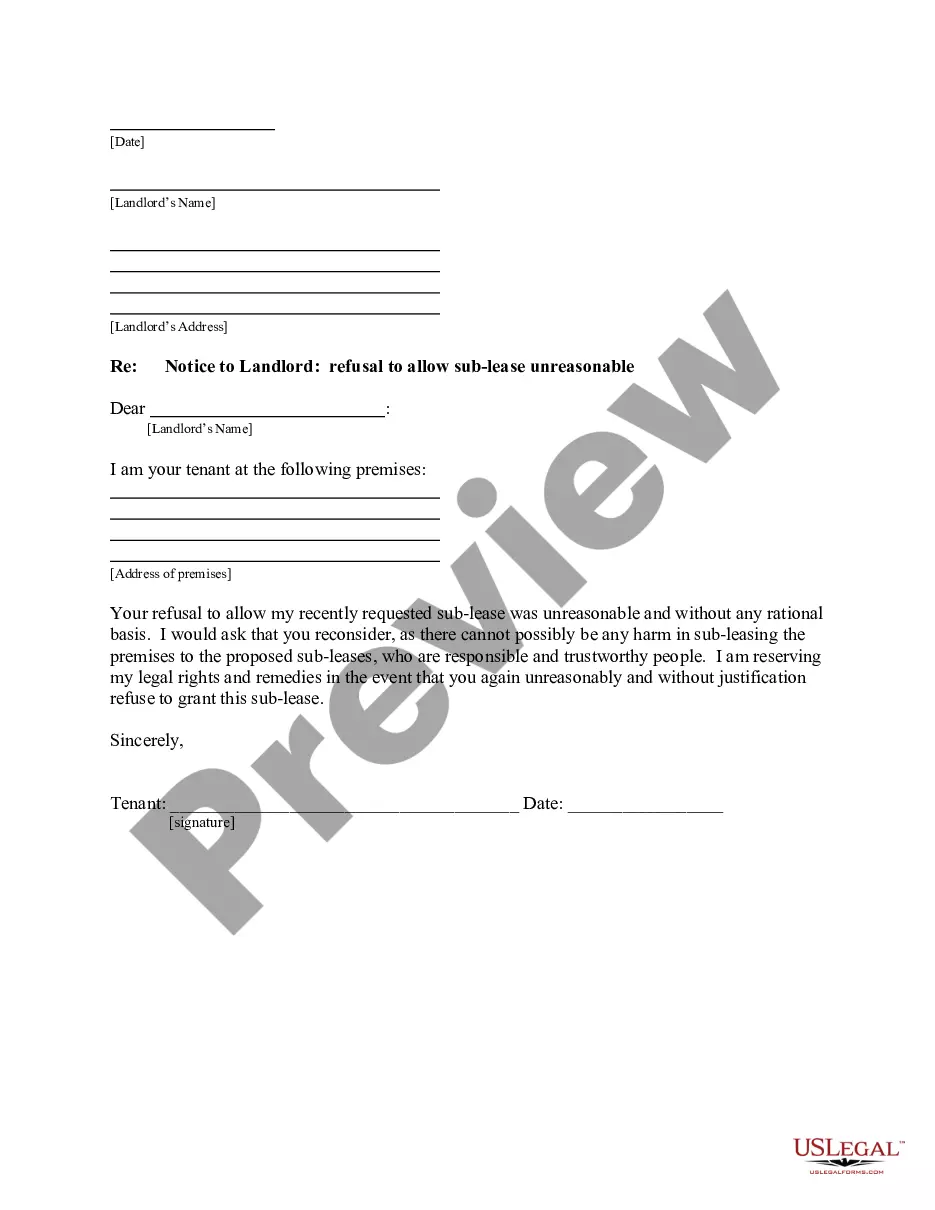
This form is a letter from a tenant to the landlord, addressing the landlord's unreasonable refusal to allow the tenant to sublease the property. It serves to formally communicate the tenant's disagreement with the landlord's decision while reserving legal rights for further action, should the landlord continue to deny the request. This form is crucial for tenants who wish to establish their position regarding subleasing and ensure their legal rights are preserved in the process.
Key parts of this document
- Addressee details: Landlord's name and address.
- Tenant's information: Name and address of the tenant.
- Statement of disagreement: Clear articulation of the tenant's objections.
- Reservation of rights: Notification that the tenant reserves legal rights.
- Signature: Space for the tenantâs signature and date.

When to use this document
You should use this letter when your landlord has denied your request to sublease the property you are renting. It is important to document your disagreement formally, especially if you believe the refusal is unjustified. This letter helps protect your rights as a tenant and serves as a record of your position should further actions be necessary.
Who can use this document
- Current tenants wishing to sublease their rental unit.
- Tenants who have received a refusal from their landlord.
- Individuals seeking to preserve their legal rights regarding subleasing.
- Tenants uncertain about their rights in relation to subleasing.
How to prepare this document
- Clearly state the landlord's name and address at the top of the letter.
- Provide your name and address to establish your identity as the tenant.
- Include a detailed explanation of why you believe the landlord's refusal is unreasonable.
- Express that you are reserving your legal rights if the landlord continues to deny your request.
- Sign and date the letter before sending it to the landlord.
Is notarization required?
This form does not typically require notarization unless specified by local law. It is advisable to check local regulations to ensure compliance.
Get your form ready online
Our built-in tools help you complete, sign, share, and store your documents in one place.
Make edits, fill in missing information, and update formatting in US Legal Forms—just like you would in MS Word.
Download a copy, print it, send it by email, or mail it via USPS—whatever works best for your next step.
Sign and collect signatures with our SignNow integration. Send to multiple recipients, set reminders, and more. Go Premium to unlock E-Sign.
If this form requires notarization, complete it online through a secure video call—no need to meet a notary in person or wait for an appointment.
We protect your documents and personal data by following strict security and privacy standards.

Make edits, fill in missing information, and update formatting in US Legal Forms—just like you would in MS Word.

Download a copy, print it, send it by email, or mail it via USPS—whatever works best for your next step.

Sign and collect signatures with our SignNow integration. Send to multiple recipients, set reminders, and more. Go Premium to unlock E-Sign.

If this form requires notarization, complete it online through a secure video call—no need to meet a notary in person or wait for an appointment.

We protect your documents and personal data by following strict security and privacy standards.
Typical mistakes to avoid
- Failing to include specific reasons why the landlord's refusal is unreasonable.
- Not providing complete contact information for both parties.
- Neglecting to sign and date the letter.
- Using unclear language that could confuse the landlord about the request.
Why use this form online
- Convenient access: Download and fill out the form at your own pace.
- Editable: Tailor the letter to fit your specific situation easily.
- Reliable: Ensures you have a properly formatted document vetted by attorneys.
- Efficient: Save time with a straightforward template.
Legal use & context
- This form is intended to protect tenants' rights related to subleasing.
- It serves as formal notification, which can be used in legal proceedings if necessary.
- Understanding local landlord-tenant laws can impact the enforceability of this letter.
Summary of main points
- This form is essential for tenants facing unreasonable landlord refusals to sublease.
- Completing the form accurately is crucial for preserving tenant rights.
- Reviewing local laws can provide additional protections and requirements.
Looking for another form?
Form popularity
FAQ
Introductory Letter with Essential Information (such as Emergency Numbers and House Rules) PAT Report (Portable Appliance Test) Current Gas Check. Guide to Utilities. How to Rent Leaflet (Government Document) E.P.C. Copy of Tenancy Agreement.
Withholding Rent Payments. Security Deposit. Pet Deposits. Failure to Maintain Cleanliness at Premise. Habitability Covenant. Disclosures. Right to Repairs. Lease Breaking.
Renter Responsibilities You will maintain the property in a clean and habitable condition. You will inform the landlord when issues arise that could harm the value of the property. You will pay for any repairs due to your negligence or misuse of the property.
A landlord cannot evict a tenant without an adequately obtained eviction notice and sufficient time. A landlord cannot retaliate against a tenant for a complaint. A landlord cannot forego completing necessary repairs or force a tenant to do their own repairs.A landlord cannot remove a tenant's personal belongings.
If you think your landlord is violating the Fair Housing Act, you can get that landlord in trouble by filing a complaint at HUD.gov. Your remedy for breach of quiet enjoyment is to terminate the lease and move or sue in small claims court.