New Hampshire Letter from Tenant to Landlord about Landlord's refusal to allow sublease is unreasonable
Understanding this form
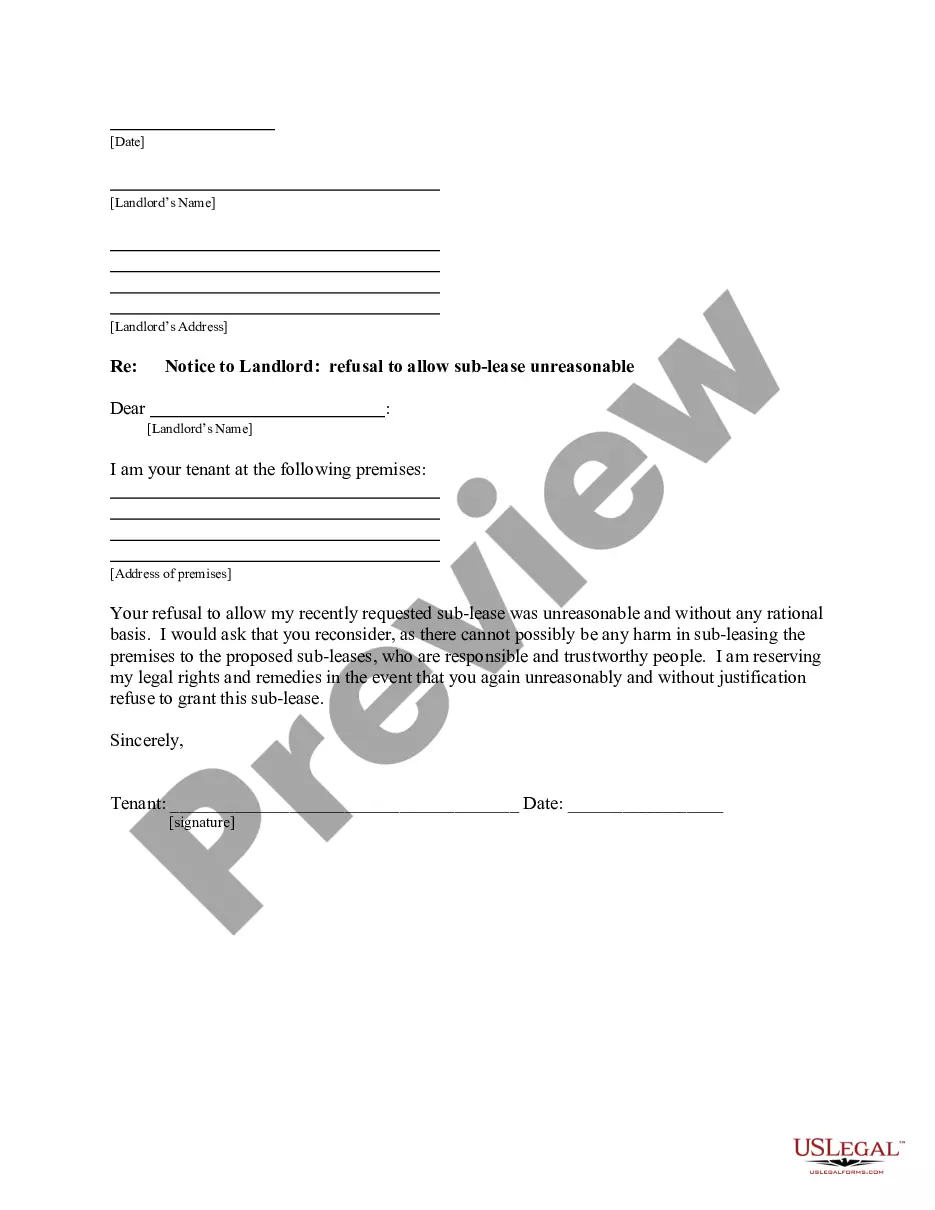
This form is a letter from a tenant to their landlord regarding the landlord's refusal to allow the tenant to sublease the property. The letter serves to inform the landlord of the tenant's position that this refusal is unreasonable while also reserving the tenant's legal rights and remedies should the landlord continue to deny the sublease request. It is essential for tenants to understand their rights regarding subleasing, as it establishes clear communication and documentation, differing from other forms such as lease agreements or eviction notices.
What’s included in this form
- Tenant's contact information: Clearly identifies the party sending the letter.
- Landlord's contact information: Specifies the recipient of the letter.
- Date of the letter: Records when the letter was sent.
- Statement of intent: Clearly states the tenant's desire to sublease the property.
- Legal rights reservation: Indicates that the tenant reserves their legal rights if the refusal continues.
- Signature section: Provides a space for the tenant's signature.

Common use cases
This form is useful when a tenant wishes to contest a landlord's refusal to allow subleasing. It's applicable in scenarios where the tenant has found a suitable subtenant but is facing unreasonable denial from the landlord. Additionally, this letter can be used as documentation for any future legal proceedings regarding the sublease, helping to establish the tenant's intentions and actions.
Who this form is for
- Tenants who wish to sublease their rental unit.
- Tenants facing unreasonable refusal from their landlord regarding subleasing.
- Individuals seeking to reserve their legal rights in the event of a rental dispute.
How to complete this form
- Identify the parties: Write the tenant's and landlord's names and contact information at the top.
- Enter the date: Fill in the date of when the letter is being sent.
- State your intent: Clearly express the request to sublease the property.
- Reserve legal rights: Include a statement that reserves the tenant's rights and remedies.
- Sign the letter: Provide a space for your signature to validate the document.
Does this form need to be notarized?
In most cases, this form does not require notarization. However, some jurisdictions or signing circumstances might. US Legal Forms offers online notarization powered by Notarize, accessible 24/7 for a quick, remote process.
Get your form ready online
Our built-in tools help you complete, sign, share, and store your documents in one place.
Make edits, fill in missing information, and update formatting in US Legal Forms—just like you would in MS Word.
Download a copy, print it, send it by email, or mail it via USPS—whatever works best for your next step.
Sign and collect signatures with our SignNow integration. Send to multiple recipients, set reminders, and more. Go Premium to unlock E-Sign.
If this form requires notarization, complete it online through a secure video call—no need to meet a notary in person or wait for an appointment.
We protect your documents and personal data by following strict security and privacy standards.

Make edits, fill in missing information, and update formatting in US Legal Forms—just like you would in MS Word.

Download a copy, print it, send it by email, or mail it via USPS—whatever works best for your next step.

Sign and collect signatures with our SignNow integration. Send to multiple recipients, set reminders, and more. Go Premium to unlock E-Sign.

If this form requires notarization, complete it online through a secure video call—no need to meet a notary in person or wait for an appointment.

We protect your documents and personal data by following strict security and privacy standards.
Avoid these common issues
- Failing to include the correct contact information for both parties.
- Not clearly stating the reasons for requesting the sublease.
- Neglecting to reserve legal rights, which may be crucial for future disputes.
- Submitting the letter without a signature or date.
Benefits of completing this form online
- Easy access: Downloadable at your convenience without needing to find physical forms.
- Editability: Fill in the necessary information directly, ensuring all details are accurate and tailored to your situation.
- Reliability: Prepared by licensed attorneys to ensure legal compliance and effectiveness.
Looking for another form?
Form popularity
FAQ
Give these tenants notice to move with the proper waiting period (30 day notice). If the tenants don't want to move, the landlords can file for eviction with the courts. The landlord can prepare documents explaining they acquired the property without plans to keep the tenants or why they must leave.
1 Do the legal and financial homework. 2 Accept that your roommate might not be the one leaving. 3 Write an e-mail. 4 Sit down and have The Conversation 5 Offer to pay or help. 6 If you need to evict, give official notice.
It's best if your roommate leaves quietly during the 30-day notice period after you give him the eviction paperwork. If he doesn't, however, you must take him to court so a judge can demand he vacate the apartment. Even if his name isn't on the lease, you must follow formal eviction procedure to force him to leave.
Legally Removing People. Send a certified letter asking them to leave in 30 days or less. While a house guest is not technically a tenant, certain tenant-landlord laws still apply to the relationship if they've been with your for more than 30 days. Talk to an attorney who will help you draft and send an eviction notice
Eviction for not paying rent, damages to the property or danger to the health or safety of others require seven days' notice. All other grounds for eviction require 30 days' notice.
In most cases, you will want to send a certified letter to the house guest asking them to leave in 30 days. Even though the guest is not formally a tenant, certain principles of landlord-tenant law may apply.
You can only evict your roommate if they aren't on the lease or are your subtenant. Most of the laws relevant to leased apartments in Texas can be found in Title 8, Chapter 92 of the Texas Property Code. This law says that a lease can be oral or written, and can be made between a tenant and a subtenant.
To evict your roommate in California, you need to start by giving them a three-day notice to cure or quit. If they ignore you, then you'll have to begin an unlawful detainer action.