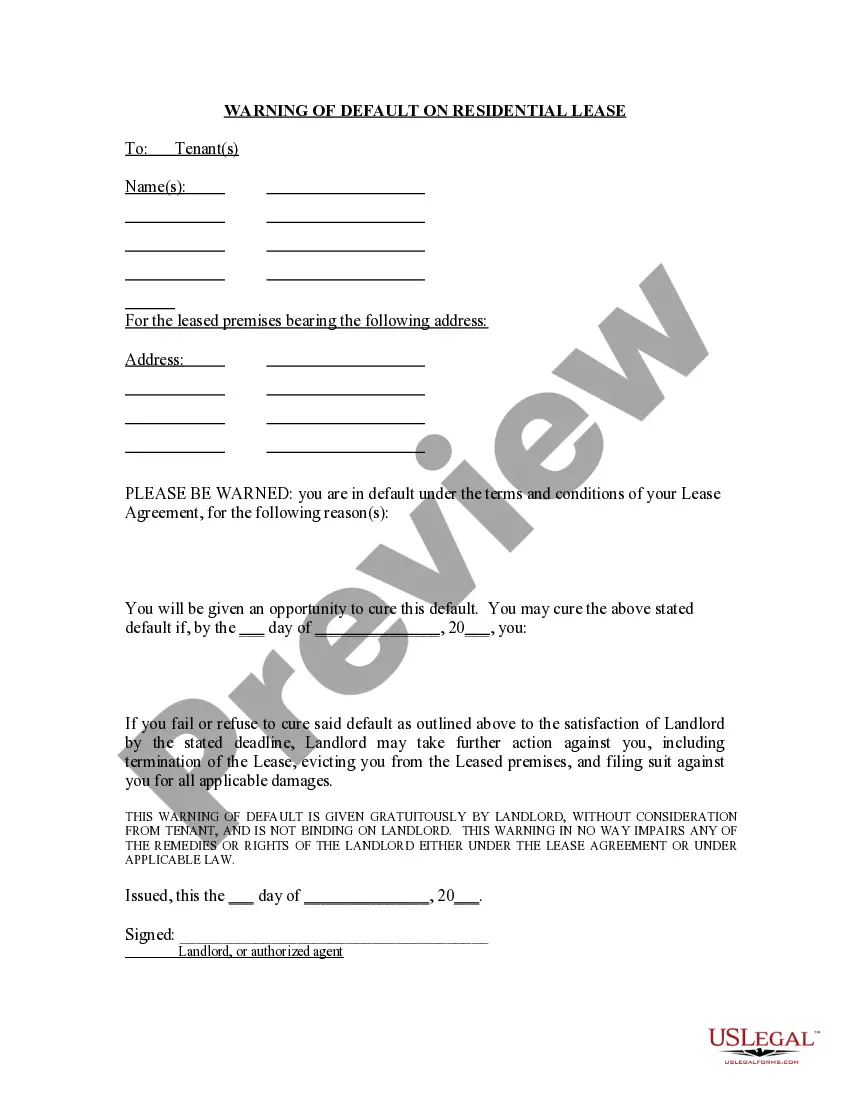
Nebraska Warning of Default on Residential Lease
Overview of this form
The Warning of Default on Residential Lease is a legal document used by landlords to notify tenants of potential lease violations. This form serves as an official warning that if certain conditions are not addressed, the tenant may be considered in default of the lease agreement. It is essential to recognize that this warning letter does not impose any legal obligations on the landlord and is distinct from eviction notices or breach of contract actions.
Key parts of this document
- The introductory statement clarifying the non-binding nature of the warning on the landlord.
- The date of issuance, which is necessary for legal record-keeping.
- Signature line for the landlord or their authorized agent.


Common use cases
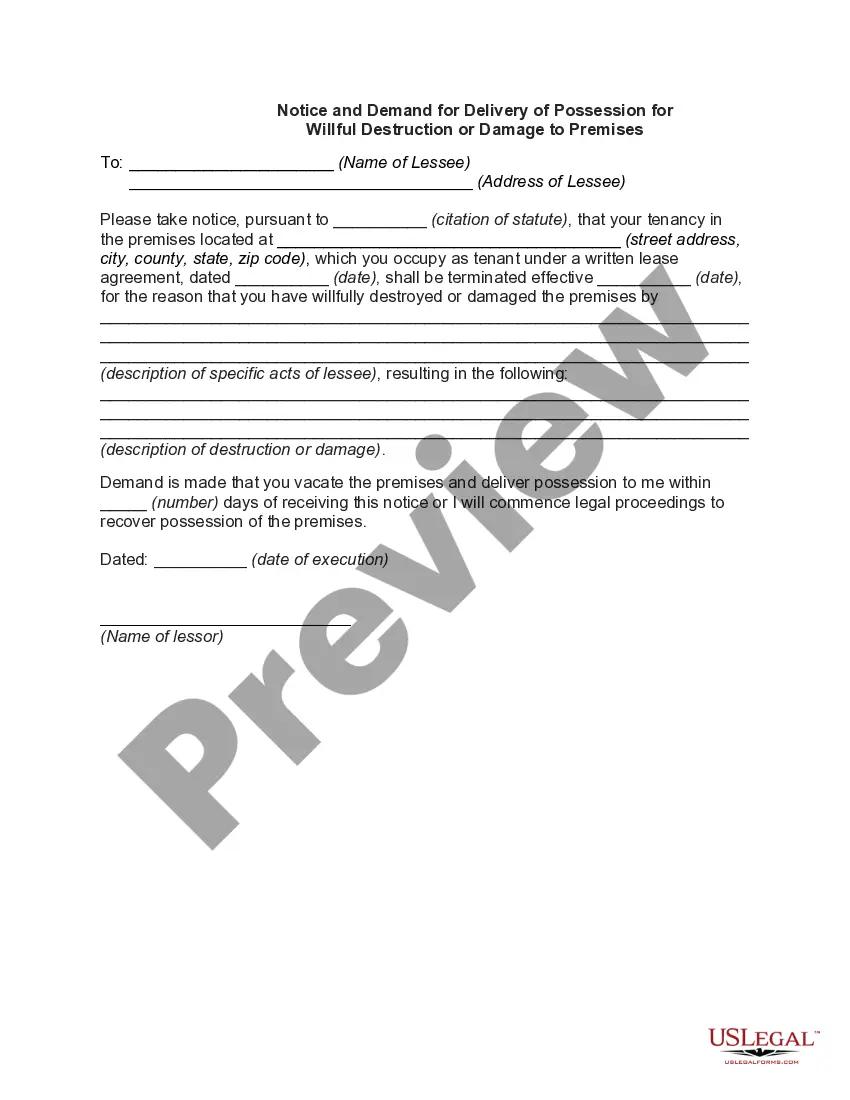
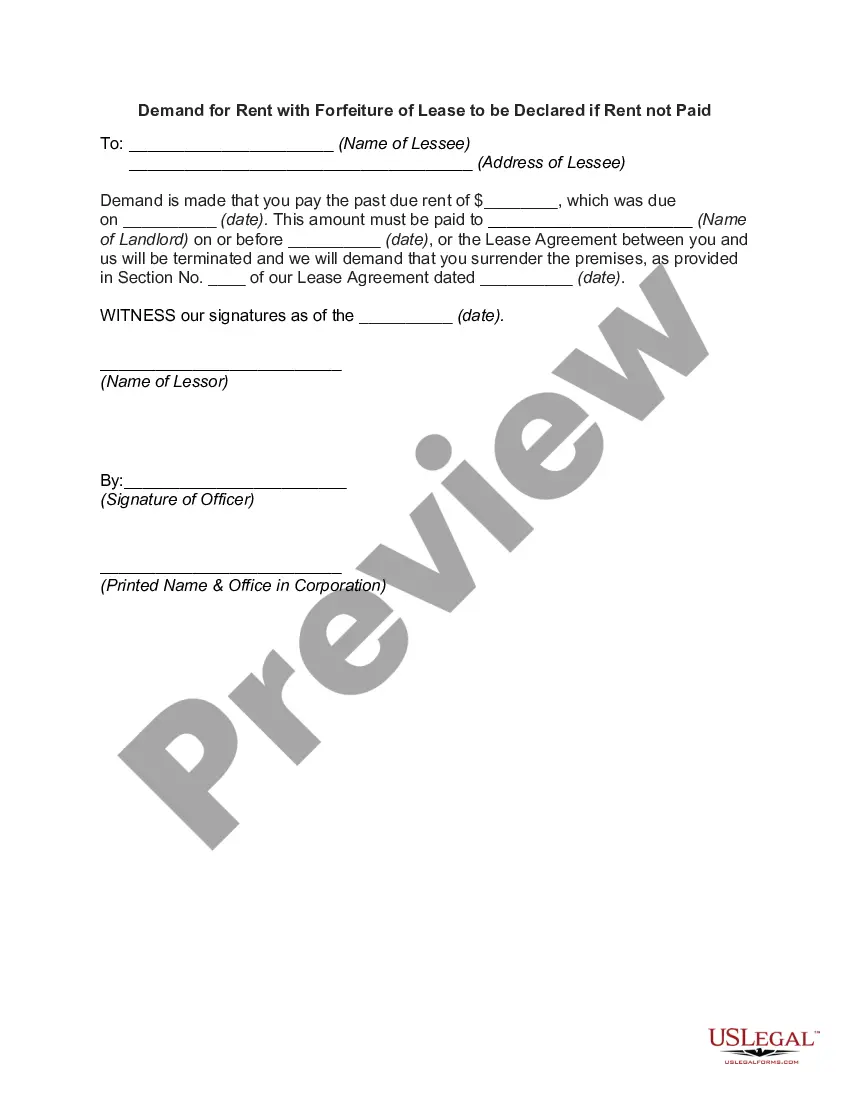
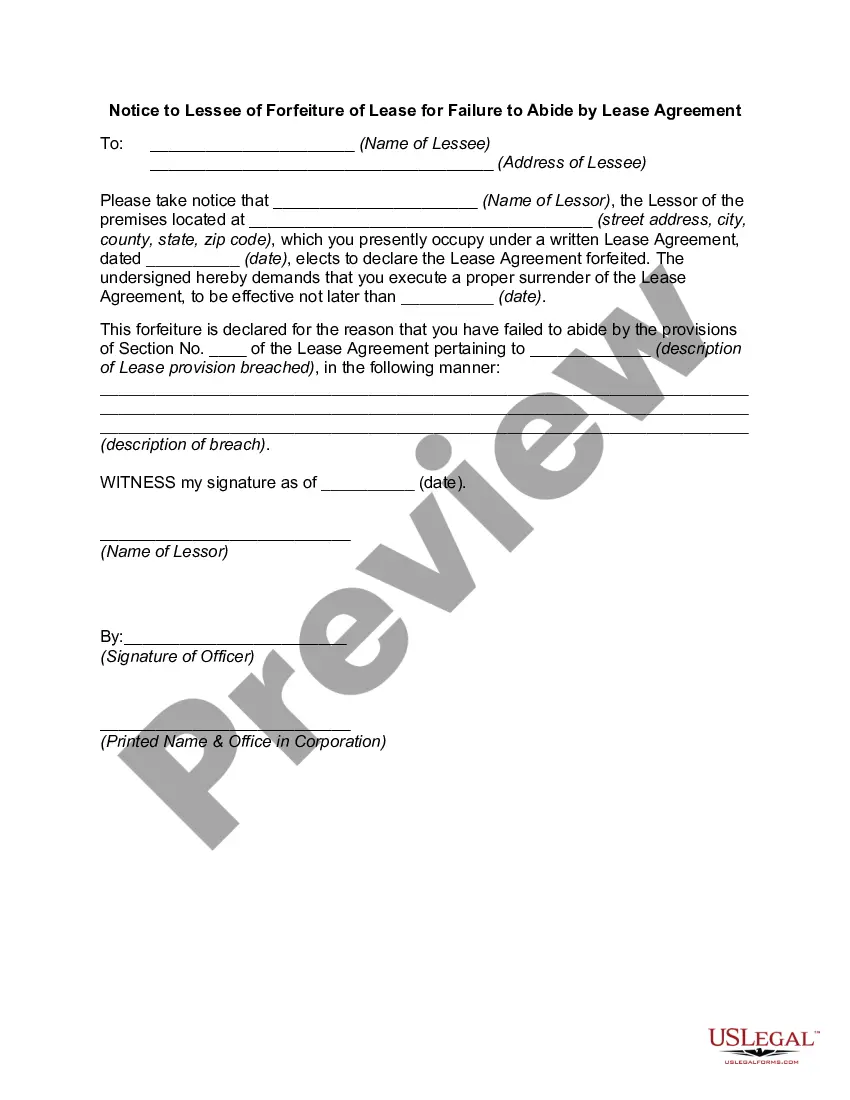
This form should be used when a landlord suspects that a tenant is not complying with the terms of their residential lease. Common reasons for issuing this warning include late rent payments, damage to the property, or failure to maintain the premises as required. The warning serves as a formal notice, giving the tenant an opportunity to remedy the situation before further legal action is taken.
Who can use this document
- Landlords looking to address lease violations with their tenants.
- Property management companies acting on behalf of landlords.
- Tenants needing to understand their rights upon receiving such a warning.
Steps to complete this form
- Enter the current date in the designated blank space.
- Specify the tenant's address and the property involved in the lease.
- Clearly state the reasons for the warning of default.
- Sign the document as the landlord or authorized agent.
- Provide a copy to the tenant and retain a copy for your records.
Does this form need to be notarized?
Notarization is generally not required for this form. However, certain states or situations might demand it. You can complete notarization online through US Legal Forms, powered by Notarize, using a verified video call available anytime.
Get your form ready online
Our built-in tools help you complete, sign, share, and store your documents in one place.
Make edits, fill in missing information, and update formatting in US Legal Forms—just like you would in MS Word.
Download a copy, print it, send it by email, or mail it via USPS—whatever works best for your next step.
Sign and collect signatures with our SignNow integration. Send to multiple recipients, set reminders, and more. Go Premium to unlock E-Sign.
If this form requires notarization, complete it online through a secure video call—no need to meet a notary in person or wait for an appointment.
We protect your documents and personal data by following strict security and privacy standards.

Make edits, fill in missing information, and update formatting in US Legal Forms—just like you would in MS Word.

Download a copy, print it, send it by email, or mail it via USPS—whatever works best for your next step.

Sign and collect signatures with our SignNow integration. Send to multiple recipients, set reminders, and more. Go Premium to unlock E-Sign.

If this form requires notarization, complete it online through a secure video call—no need to meet a notary in person or wait for an appointment.

We protect your documents and personal data by following strict security and privacy standards.
Mistakes to watch out for
- Failing to specify the exact reasons for the warning.
- Not providing the form to the tenant in a timely manner.
- Incomplete or incorrect signatures, which may invalidate the document.
Advantages of online completion
- Convenience of immediate access and download at any time.
- Easy customization to fit specific circumstances and legal requirements.
- Reliability with professionally drafted templates ensuring legal compliance.
Main things to remember
- The Warning of Default on Residential Lease notifies tenants about lease violations.
- The form helps prevent further legal actions by allowing tenants to rectify issues.
- Proper completion and delivery of the form are essential for enforceability.
Looking for another form?
Form popularity
FAQ
The 14-day/30-day notice must say how the tenant is breaching the lease and that the lease will automatically terminate 30 days (or more) from the date of the notice unless the tenant fixes the problem within 14 days of the date of the notice.
Once the notice is mailed or delivered, your tenancy will terminate 30 days after the date that rent is next due, even if that date is several months before your lease expires.
Giving written notice to landlord that tenant will terminate the lease 30 days from the date of the notice if the landlord does not fix the problem within 14 days; contacting a local housing code enforcement agency (if any);
In some circumstances, a tenant can break a fixed-term agreement early without penalty. A tenant can give 14 days' written notice to end an agreement early without penalty if: they have accepted an offer of social housing (e.g. from DCJ Housing)
In Nebraska, a tenant is not required to provide notice for fixed end date leases, the lease expires on the last day of the lease. Nebraska tenants have to provide written notice for the following lease terms: Notice to terminate a week-to-week lease. Seven days prior to the termination date specified in the notice.
Give the landlord/agent a written termination notice and vacate move out and return the keys according to your notice, and/or. apply to the NSW Civil & Administrative Tribunal (NCAT) for a termination order.
Tenant Rights to Withhold Rent in Nebraska Tenants may withhold rent or exercise the right to repair and deduct if a landlord fails to take care of important repairs, such as a broken heater. For specifics, see Nebraska Tenant Rights to Withhold Rent or Repair and Deduct.
Nebraska Eviction is 3 Days or 30 Days And it must state that the tenant may halt the eviction process by paying the rent or curing the violation within the notice period.