Nebraska Residential Lease Renewal Agreement
Overview of this form
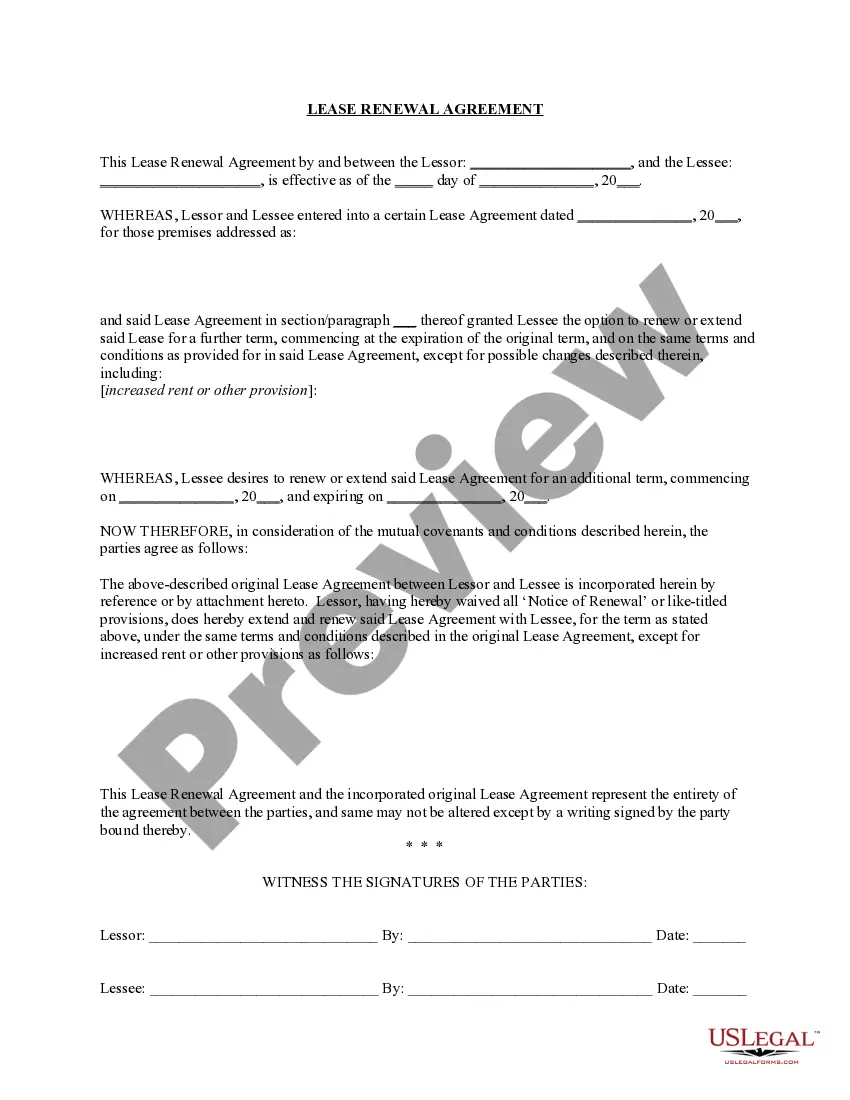
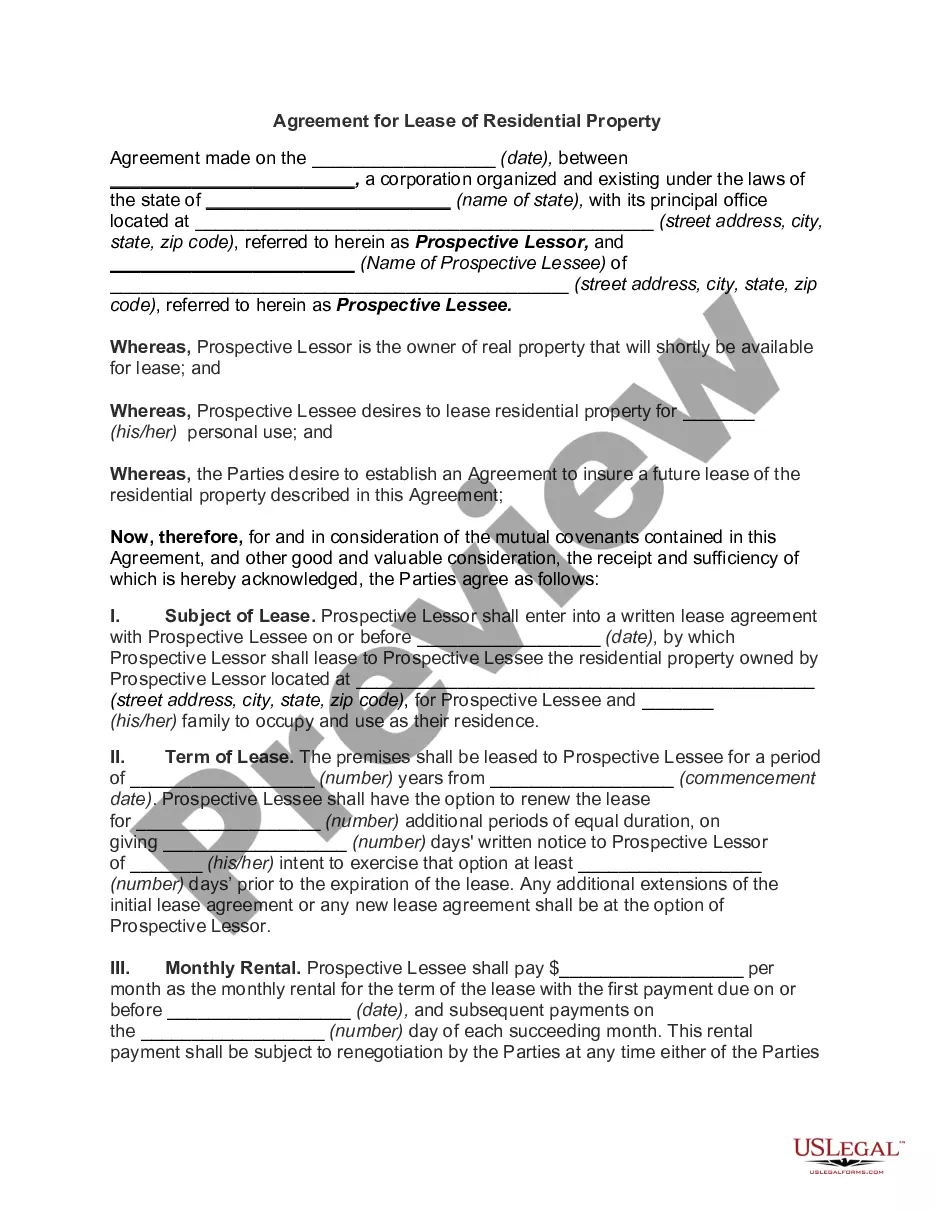
The Residential Lease Renewal Agreement is a legal document used to extend an existing lease for a residential property. This form facilitates the continuation of the rental terms in accordance with state statutory laws. Unlike a new lease, this agreement modifies the existing lease, ensuring that both parties agree to the renewal and any potential changes in terms. It serves as a crucial tool for landlords and tenants who wish to maintain their rental relationship without entering into a completely new lease.
Key components of this form
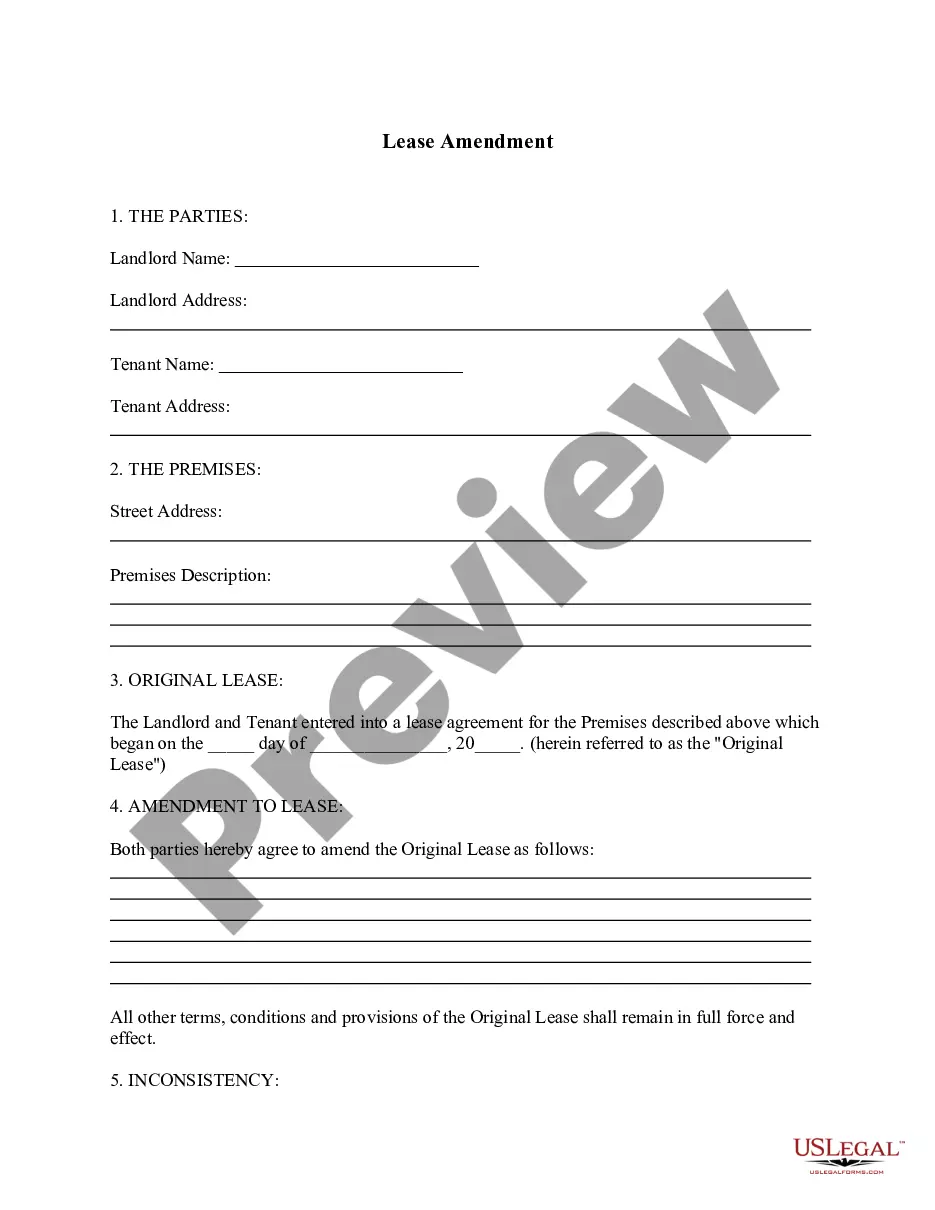
- Identification of the parties: Names of the Lessor (landlord) and Lessee (tenant).
- Effective date: The date when the lease renewal agreement becomes effective.
- Reference to the original lease: Date of the original lease that is being renewed.
- Property address: Location of the rental property covered under this agreement.
- Signatures: Signature lines for both the Lessor and Lessee with corresponding dates.
When to use this document
This form is needed when both the landlord and tenant wish to renew an existing lease agreement for a residential property. It is ideal for situations where the original lease is nearing its end, and both parties want to continue their agreement, potentially with modifications to terms such as rent, duration, or other specifics.
Who can use this document
This form is intended for:
- Landlords who wish to continue renting a property to the same tenant.
- Tenants who want to extend their rental arrangement without creating a new lease.
- Individuals looking for a straightforward way to formalize the renewal of their residential lease.
Steps to complete this form
- Identify the parties: Fill in the names of the Lessor and Lessee.
- Enter the effective date: Specify the date when the renewal agreement starts.
- Reference the original lease: Indicate the date of the current lease being renewed.
- Describe the property: Provide the full address of the rental property.
- Sign and date: Both the Lessor and Lessee should sign and date the document to finalize the agreement.
Notarization requirements for this form
This form does not typically require notarization to be legally valid. However, some jurisdictions or document types may still require it. US Legal Forms provides secure online notarization powered by Notarize, available 24/7 for added convenience.
Get your form ready online
Our built-in tools help you complete, sign, share, and store your documents in one place.
Make edits, fill in missing information, and update formatting in US Legal Forms—just like you would in MS Word.
Download a copy, print it, send it by email, or mail it via USPS—whatever works best for your next step.
Sign and collect signatures with our SignNow integration. Send to multiple recipients, set reminders, and more. Go Premium to unlock E-Sign.
If this form requires notarization, complete it online through a secure video call—no need to meet a notary in person or wait for an appointment.
We protect your documents and personal data by following strict security and privacy standards.

Make edits, fill in missing information, and update formatting in US Legal Forms—just like you would in MS Word.

Download a copy, print it, send it by email, or mail it via USPS—whatever works best for your next step.

Sign and collect signatures with our SignNow integration. Send to multiple recipients, set reminders, and more. Go Premium to unlock E-Sign.

If this form requires notarization, complete it online through a secure video call—no need to meet a notary in person or wait for an appointment.

We protect your documents and personal data by following strict security and privacy standards.
Mistakes to watch out for
- Failing to include all necessary parties' names.
- Not referencing the correct date of the original lease.
- Overlooking to update any modified terms that may differ from the previous lease.
- Neglecting to have both parties sign and date the agreement.
Advantages of online completion
- Convenience: Easily access and download the form from anywhere at any time.
- Editability: Customize the terms to fit your specific circumstances.
- Reliability: Ensure compliance with legal standards by using attorney-drafted templates.
Summary of main points
- The Residential Lease Renewal Agreement is essential for formalizing lease extensions.
- Completing the form accurately is vital to avoid legal issues.
- Both parties must sign the agreement for it to be valid.
Looking for another form?
Form popularity
FAQ
Start the conversation. Know what your apartment is worth. Learn something, even one small thing, about the market that works in your favor. Show off what a great tenant you are! Try to extend your lease. Offer money up-front. Provide services for the home or building. Come up with some requests.
Yes, a lease can automatically renew in California. If neither the tenant or the landlord give notice that they want to terminate the tenancy when the lease expires, the lease can be renewed.
When a lease ends, a tenant may choose to move, continue to pay rent as a month-to-month tenant, or sign a new lease. If a tenant continues to pay rent after a lease ends, in most states the terms of the expired lease carry over into a month-to-month tenancy.
We recommend offering your tenant a lease renewal 90 days before the lease expires. You can offer in-person, send via email, or send a letter. The goal is to receive a reply within 30 days so that you have at least 60 days to find a new tenant if your current tenant declines the renewal offer.
An estate from period to period, or periodic tenancy, is a type of leasehold estate that automatically renews at the end of a specific period of time unless either party gives notice of termination.A tenancy at will is also known as a freehold estate.
Lease Renewal Agreements are used to extend a lease for another term. They offer the ability to renew the lease for the same length and to memorialize any changes to the lease, if needed.
By definition, a lease renewal is a new lease agreement, whereas a lease extension is a continuation of the original lease agreement. Generally speaking, the practical effect of either is that the parties to the lease continue the landlord-tenant relationship beyond the expiration of the original term of the lease.
As a general rule of thumb, if the lease is less than 90 years you should almost certainly try to extend it because: Properties with shorter leases are less valuable than ones with long leases (this is particularly true if leases are below 80 years)
Contract extension: an existing contract is continued for a period of time.Contract renewal: an existing contract endsby, for example, expiringand the parties agree to enter into a new contract (usually for the same or very similar services).