Nebraska Quitclaim Deed from Individual to Husband and Wife
Overview of this form
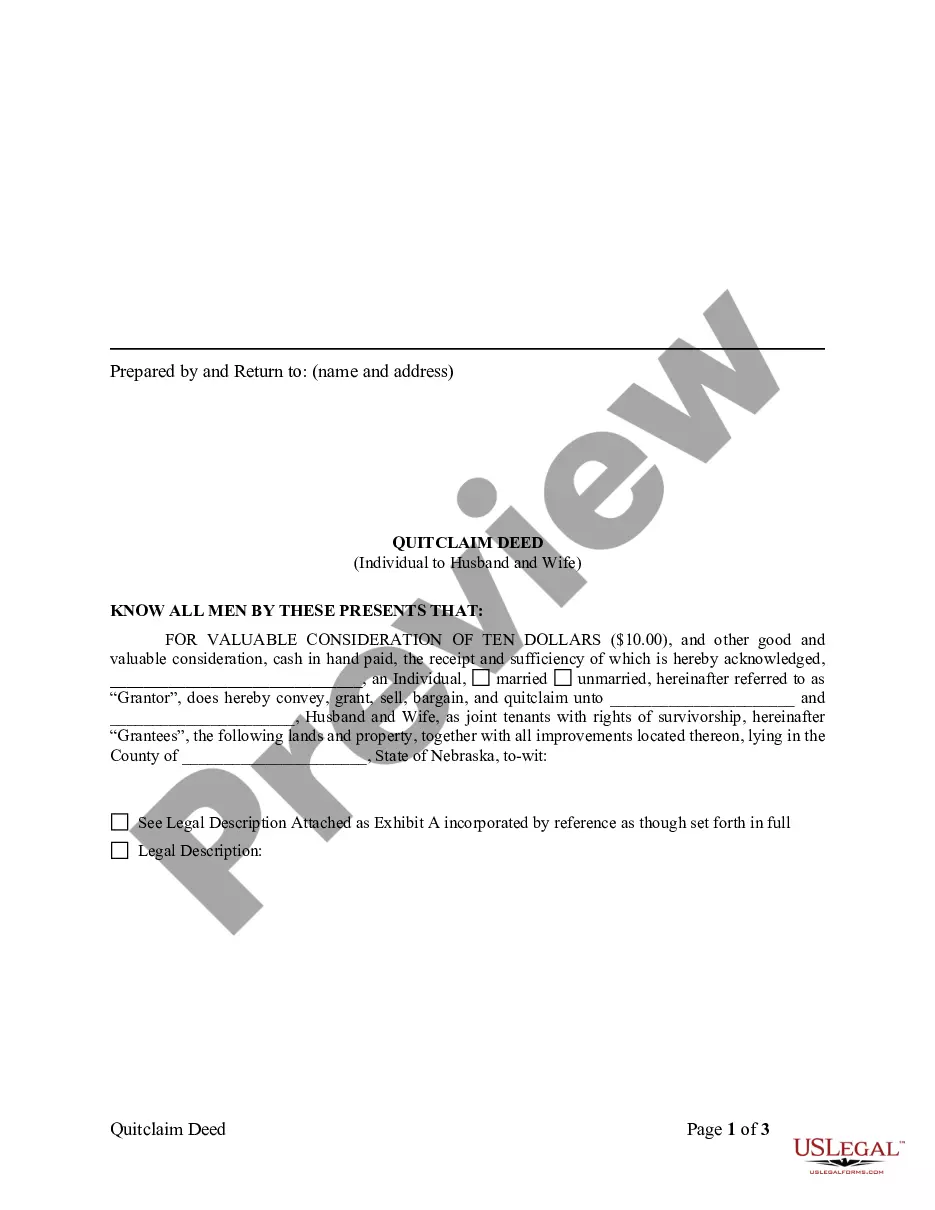
This Quitclaim Deed from Individual to Husband and Wife is a legal document that allows one individual (the Grantor) to transfer their interest in a property to a married couple (the Grantees). Unlike other types of deeds, this quitclaim deed conveys any interest the Grantor has in the property without any warranties regarding the property's title. This form is specifically designed for transfers between individuals and their spouses, making it straightforward for couples to handle their property rights effectively.
Key parts of this document
- Identification of the Grantor and Grantees involved in the transaction.
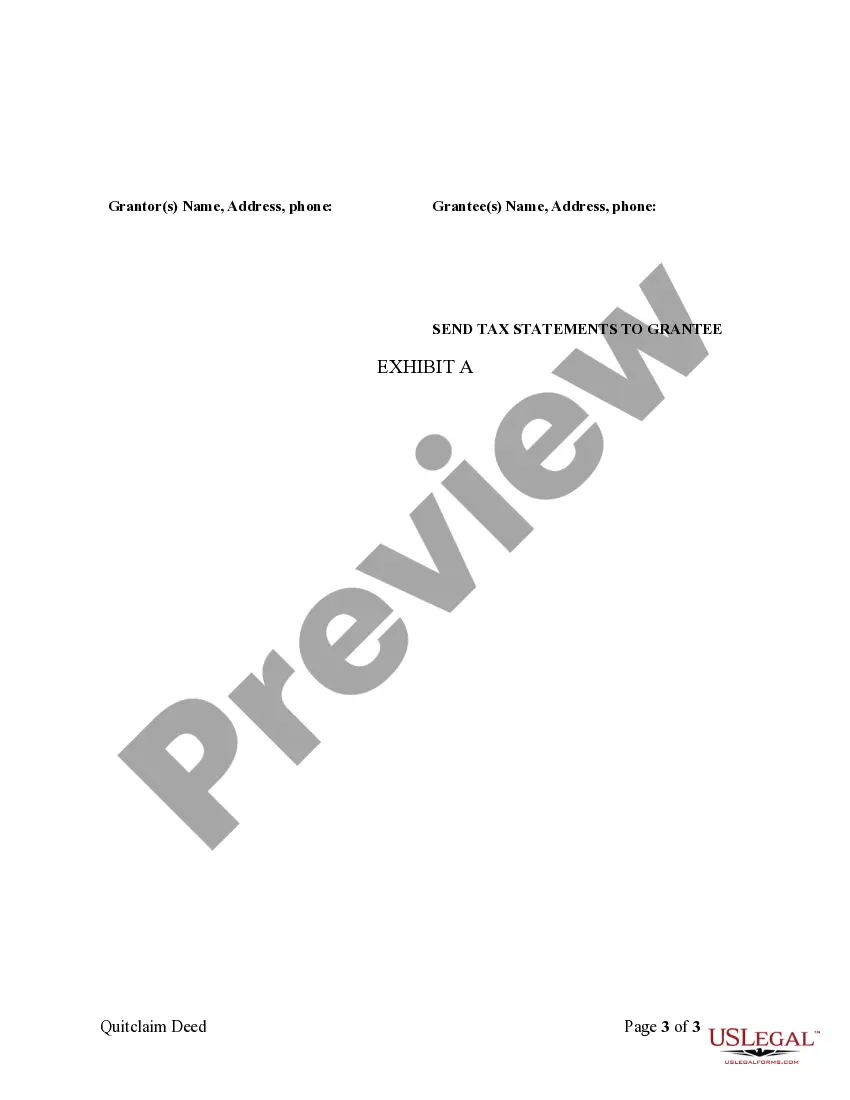
- Legal description of the property being conveyed, as attached in Exhibit A.
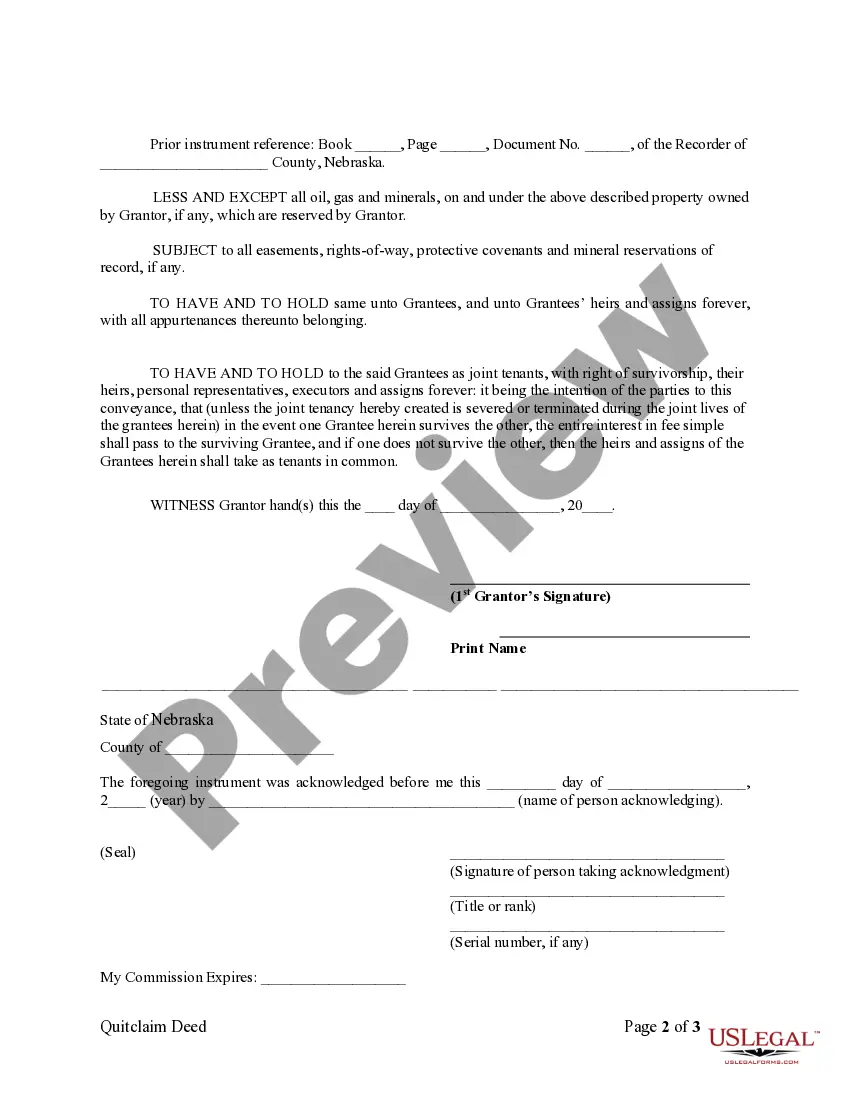
- Provisions stating all oil, gas, and mineral rights are reserved by the Grantor.
- Clauses outlining how the property will be held by the Grantees, including joint tenancy with right of survivorship.
- Signature and notarization sections to validate the deed.






When this form is needed
You should use this quitclaim deed when an individual wants to transfer their property rights to their spouse. This scenario often occurs during marriage, estate planning, or when simplifying ownership of jointly held property. It is particularly useful when the parties wish to clarify ownership without the complexities of a warranty deed.
Intended users of this form
- Individuals who own real estate and wish to transfer property to their spouse.
- Married couples looking to clarify or consolidate ownership of their property.
- Those involved in estate planning that requires the transfer of property rights to a partner.
Instructions for completing this form
- Identify the parties involved: enter the full names of the Grantor and Grantees.
- Specify the property: include the legal description of the property in Exhibit A.
- Detail any reservations: note that oil, gas, and mineral rights are reserved by the Grantor.
- Sign the deed: ensure the Grantor signs the form in the presence of a notary.
- Complete notarization: have the deed notarized to finalize the transfer.
Notarization guidance
This form needs to be notarized to ensure legal validity. US Legal Forms provides secure online notarization powered by Notarize, allowing you to complete the process through a verified video call, available anytime.
Get your form ready online
Our built-in tools help you complete, sign, share, and store your documents in one place.
Make edits, fill in missing information, and update formatting in US Legal Forms—just like you would in MS Word.
Download a copy, print it, send it by email, or mail it via USPS—whatever works best for your next step.
Sign and collect signatures with our SignNow integration. Send to multiple recipients, set reminders, and more. Go Premium to unlock E-Sign.
If this form requires notarization, complete it online through a secure video call—no need to meet a notary in person or wait for an appointment.
We protect your documents and personal data by following strict security and privacy standards.

Make edits, fill in missing information, and update formatting in US Legal Forms—just like you would in MS Word.

Download a copy, print it, send it by email, or mail it via USPS—whatever works best for your next step.

Sign and collect signatures with our SignNow integration. Send to multiple recipients, set reminders, and more. Go Premium to unlock E-Sign.

If this form requires notarization, complete it online through a secure video call—no need to meet a notary in person or wait for an appointment.

We protect your documents and personal data by following strict security and privacy standards.
Avoid these common issues
- Failing to include a complete legal description of the property.
- Not reserving rights, such as minerals, which could lead to future disputes.
- Overlooking notarization, which is crucial for the deed's legality.
- Not clearly defining the nature of joint tenancy, which affects ownership after death.
Benefits of using this form online
- Convenience: Download and complete the form at your own pace.
- Editability: Customize the form to suit your specific property situation.
- Reliability: The templates are prepared by licensed attorneys to ensure legal compliance.
Looking for another form?

Form popularity
FAQ
Two of the most common ways to transfer property in a divorce are through an interspousal transfer deed or quitclaim deed. When spouses own property together, but then one spouse executes an interspousal transfer or a quitclaim deed, this is known as transmutation.
The easiest way to grant your spouse title to your home is via a quitclaim deed (Californians generally use an interspousal grant deed). With a quitclaim deed, you can name your spouse as the property's joint owner. The quitclaim deed must include the property's description, including its boundary lines.
In states like California and Florida, the spouses may use a quitclaim deed to transfer the property without warranting title. Other stateslike Texasrecognize a similar type of deed called a deed without warranty.
Identify the donee or recipient. Discuss terms and conditions with that person. Complete a change of ownership form. Change the title on the deed. Hire a real estate attorney to prepare the deed. Notarize and file the deed.
But you might be wondering if an owner can transfer a deed to another person without a real estate lawyer. The answer is yes. Parties to a transaction are always free to prepare their own deeds.A quitclaim deed, for example, is far simpler than a warranty deed.
Laws NRS 23-1510. Recording Must be filed in the County Recorder's Office where the property is located (See County List). Signing (NRS 76-211) All quit claim deeds must be signed with the Grantor(s) being acknowledged by a Notary Public.
You can gift property to spouse, child or any relative and register the same. Under section 122 of the Transfer of Property Act, 1882, you can transfer immovable property through a gift deed. The deed should contain your details as well as those of the recipient.
You may be able to transfer your interest in the property through a quitclaim deed, where you relinquish all ownership of the property to someone else. Your lender may also agree to add another name to the mortgage. In this case, someone else would be able to legally make payments on the mortgage.