North Dakota General Power of Attorney for Care and Custody of Child or Children

Understanding this form
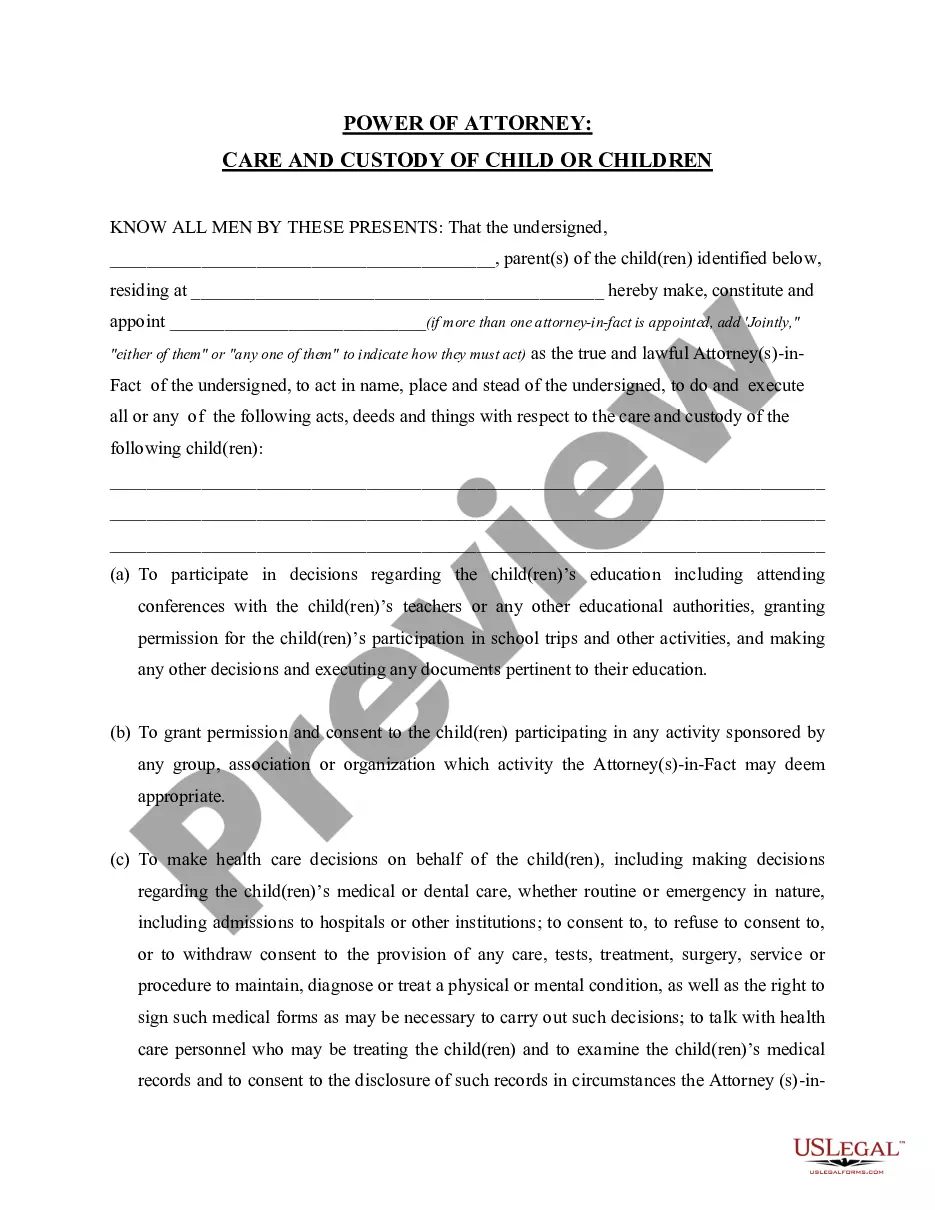
The General Power of Attorney for Care and Custody of Child or Children is a legal document that allows a parent to appoint an attorney-in-fact to make decisions regarding the care and custody of their child or children. This form is particularly important when parents are unable to care for their children due to various circumstances. Unlike other power of attorney forms, this document specifically addresses the authority over personal care and health decisions for minors.
What’s included in this form
- Identification of the parent(s) granting authority and the child(ren) involved.
- Appointment of one or more attorneys-in-fact to act on behalf of the parent(s).
- Powers related to the child's education, including attending meetings and granting permissions.
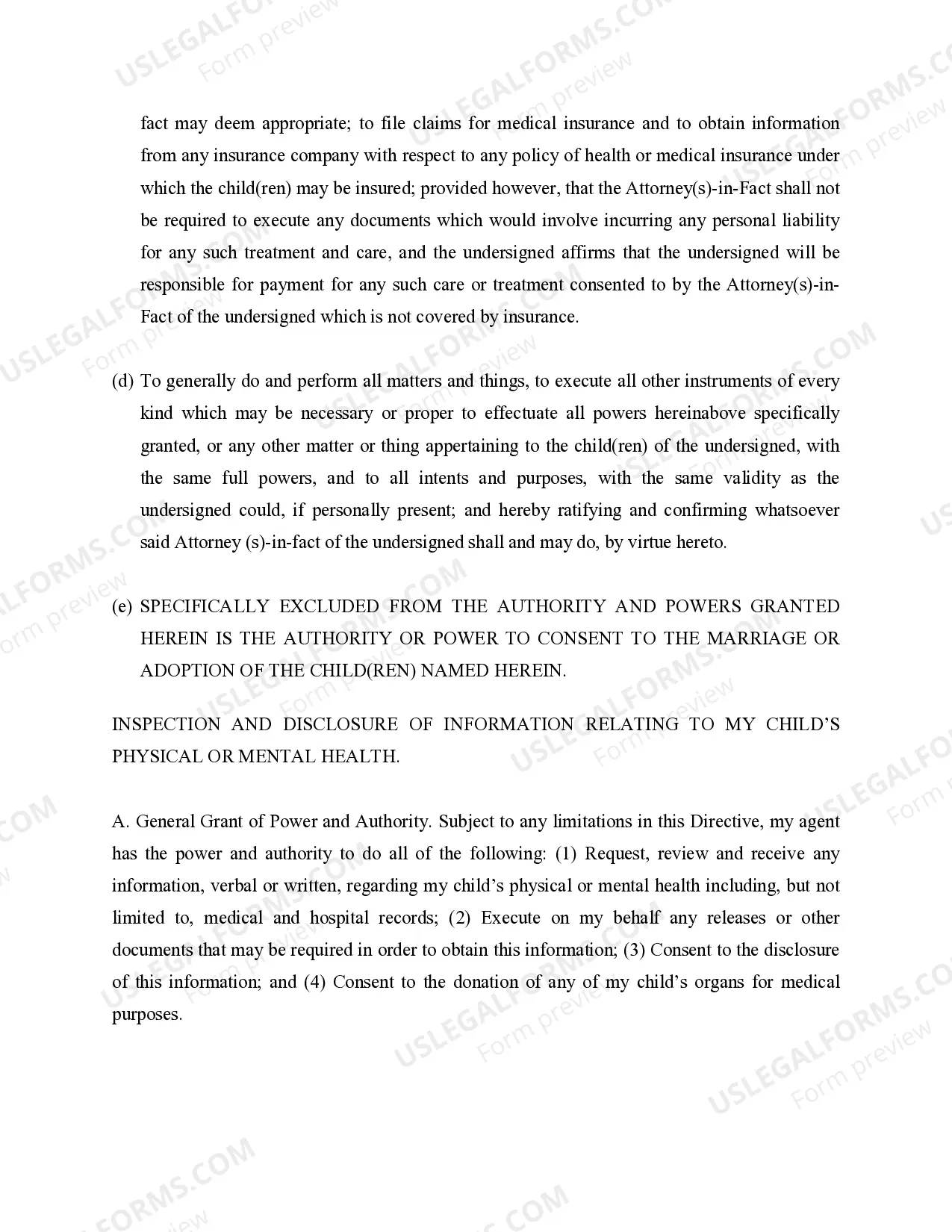
- Powers to make health care decisions, including consent for medical treatment.
- Exclusions from authority, such as consent for marriage or adoption of the child(ren).
- Notarization requirement to validate the document.

When to use this document
This form is used when a parent must delegate authority to another individual to care for their children. Common scenarios include when parents are traveling, undergoing medical treatment, or temporarily unable to fulfill caregiving responsibilities. It ensures that the appointed individual can make critical decisions about the childâs welfare, education, and health care when necessary.
Who needs this form
- Parents needing to grant temporary guardianship while away.
- Parents who are dealing with illness or incapacitation.
- Individuals looking to ensure an alternative caregiver has the authority to act on behalf of their children.
- Guardians who need to manage the care of children placed under their responsibility.
Instructions for completing this form
- Identify the parent(s) granting the authority and provide their residence information.
- Designate the attorney(s)-in-fact authorized to act on behalf of the parent(s).
- List the child(ren) covered by the power of attorney.
- Specify the powers granted related to care, education, and health decisions.
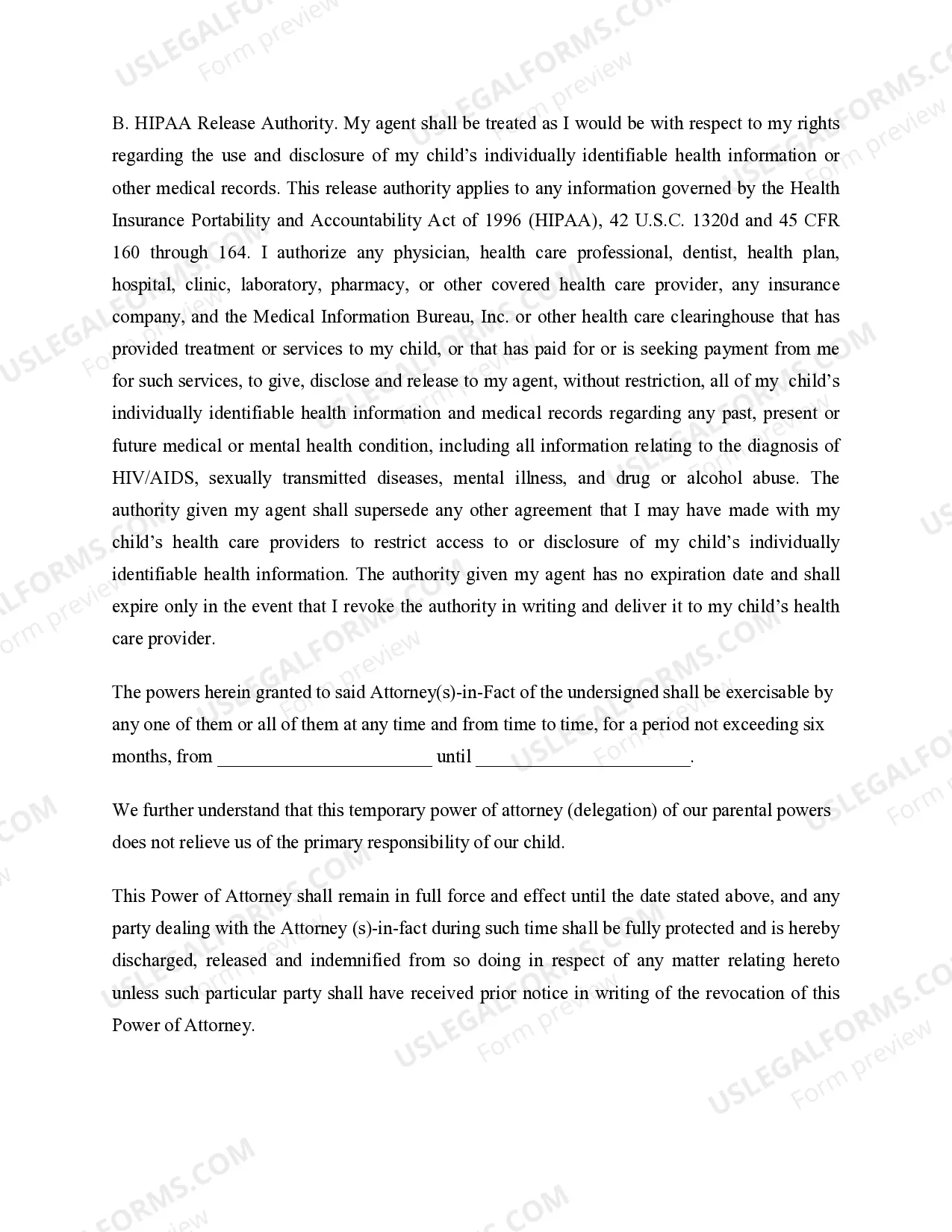
- Include the effective dates for the authority being granted.
- Sign and date the document in the presence of a notary public.
Notarization requirements for this form
Yes, this form must be notarized to be legally valid. US Legal Forms offers integrated online notarization options, available 24/7, through secure video calls. This service ensures that you can complete the process without needing to travel, while maintaining legal equivalence.
Get your form ready online
Our built-in tools help you complete, sign, share, and store your documents in one place.
Make edits, fill in missing information, and update formatting in US Legal Forms—just like you would in MS Word.
Download a copy, print it, send it by email, or mail it via USPS—whatever works best for your next step.
Sign and collect signatures with our SignNow integration. Send to multiple recipients, set reminders, and more. Go Premium to unlock E-Sign.
If this form requires notarization, complete it online through a secure video call—no need to meet a notary in person or wait for an appointment.
We protect your documents and personal data by following strict security and privacy standards.

Make edits, fill in missing information, and update formatting in US Legal Forms—just like you would in MS Word.

Download a copy, print it, send it by email, or mail it via USPS—whatever works best for your next step.

Sign and collect signatures with our SignNow integration. Send to multiple recipients, set reminders, and more. Go Premium to unlock E-Sign.

If this form requires notarization, complete it online through a secure video call—no need to meet a notary in person or wait for an appointment.

We protect your documents and personal data by following strict security and privacy standards.
Avoid these common issues
- Failing to identify all children covered by the power of attorney.
- Not specifying the powers clearly, leading to potential misunderstanding.
- Omitting the notarization, which may render the document invalid.
- Not setting a clear expiration date for the authority granted.
Advantages of online completion
- Convenience of downloading and printing the form from home.
- Ability to fill out and customize the document to meet specific needs.
- Access to templates prepared by licensed attorneys for reliability.
- Easy record-keeping for future reference and legal protection.
Legal use & context
- This form is legally binding once completed and notarized.
- It grants specific authority to the attorney-in-fact for managing care decisions related to the child or children.
- The parent remains liable for any decisions made under this authority.
Main things to remember
- The General Power of Attorney for Care and Custody of Child or Children allows for critical decision-making by a trusted individual.
- This form covers important areas such as education and health care for the child.
- Notarization is required for the form to be effective and enforceable.
- Parents can specify the duration of the power of attorney, adding flexibility.
Looking for another form?
Form popularity
FAQ
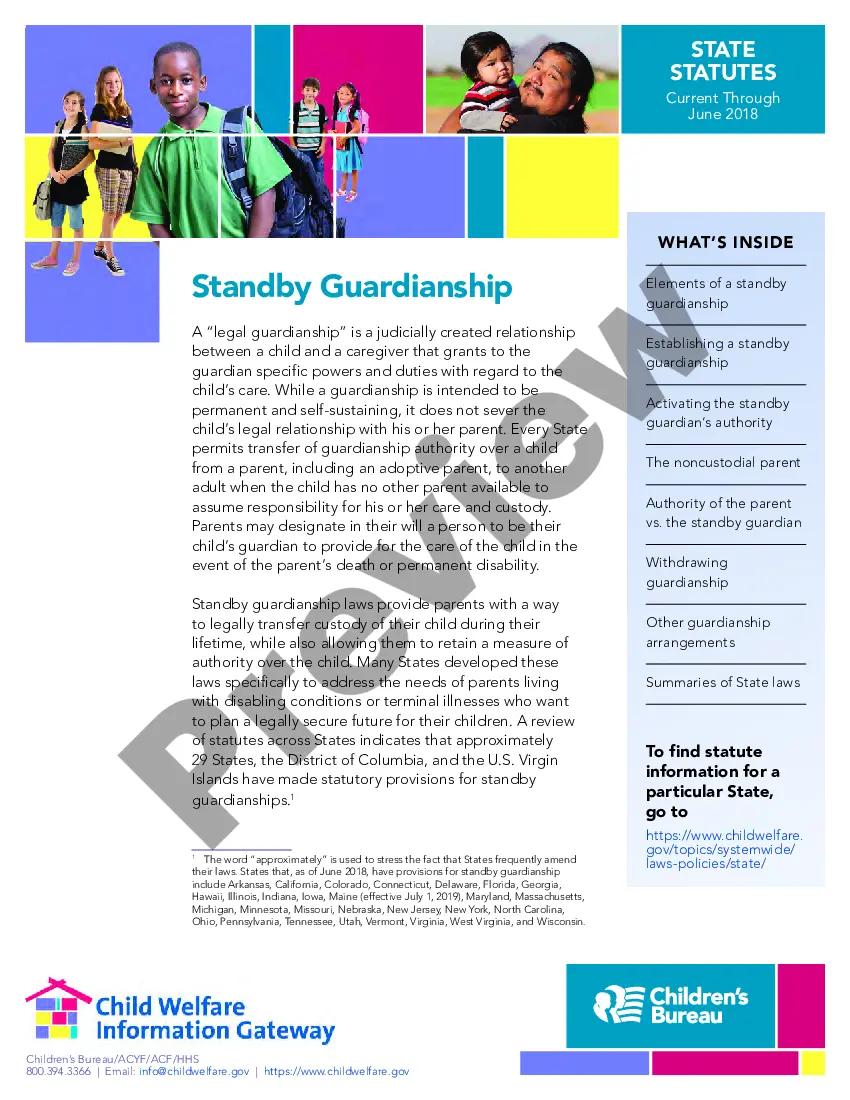
In most cases, power of attorney is preferred to legal guardianship because more control is retained by the person being protected. However, if court supervision is needed, guardianship may be more appropriate. Guardianship also gives the guardian court-ordered authority that third parties, like banks, must recognize.
In most cases, power of attorney is preferred to legal guardianship because more control is retained by the person being protected. However, if court supervision is needed, guardianship may be more appropriate. Guardianship also gives the guardian court-ordered authority that third parties, like banks, must recognize.
A power of attorney and a guardianship are tools that help someone act in your stead if you become incapacitated. With a power of attorney, you choose who you want to act for you. In a guardianship proceeding, the court chooses who will act as guardian.
A guardianship is for managing the person's personal affairs; a conservatorship is for managing the person's financial matters. A conservatorship generally supercedes a power of attorney.
Another big difference is that if you execute a Power of Attorney, you will be able to choose the person who will be handling your financial matters. Under a Guardianship proceeding, the guardian is chosen by the judge.There is no monitoring over agents under a Power of Attorney.
There are two types of guardianships, a full guardianship and a limited guardianship.
General Power of Attorney. Durable Power of Attorney. Special or Limited Power of Attorney. Springing Durable Power of Attorney.
Once a parent is no longer competent, he or she cannot revoke the power of attorney.If the court finds the agent is not acting in the principal's best interest, the court can revoke the power of attorney and appoint a guardian. The power of attorney ends at death.