North Carolina Letter from Tenant to Landlord about Fair Housing Reduction or Denial of services to Family with Children
About this form
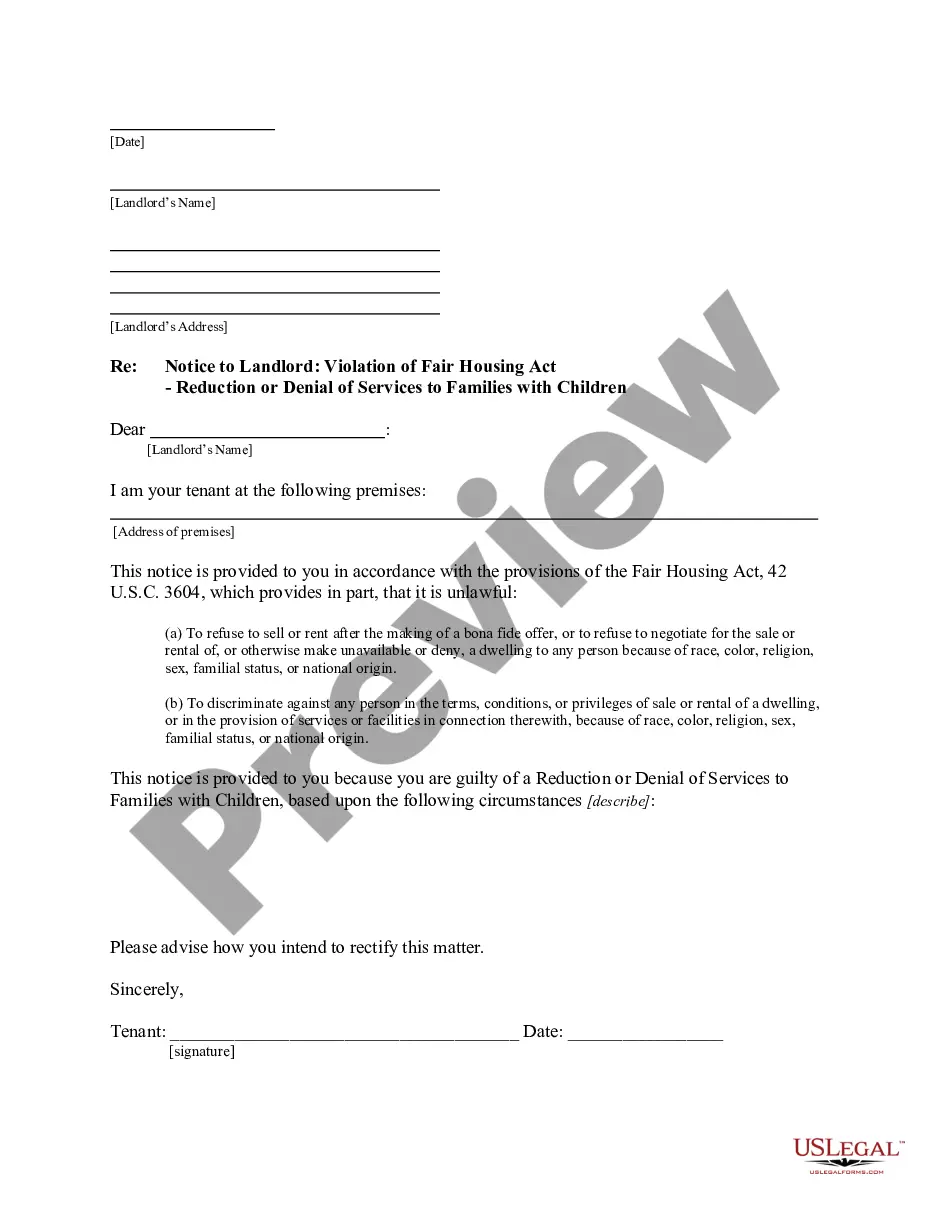
This form is a Letter from Tenant to Landlord about Fair Housing Reduction or Denial of Services to Families with Children. It serves as a formal notice to the landlord that they may be violating the Fair Housing Act by discriminating against families with children. This letter is essential for tenants seeking to address unfair treatment based on familial status, as it clearly articulates the tenant's concerns and initiates a conversation regarding their housing rights.
What’s included in this form
- Identification of the tenant and landlord involved in the dispute.
- Description of the specific reduction or denial of services experienced by families with children.
- Citation of relevant laws and protections under the Fair Housing Act.
- A request for action or remedy from the landlord regarding the observed discrimination.

When to use this form
This form should be used when a tenant believes that their landlord is discriminating against them or their family due to having children. Situations could include refusal to lease a unit, added restrictions on services provided, or different treatment compared to other tenants without children. It is crucial for initiating a formal complaint and documenting the issue before pursuing further actions.
Who needs this form
- Tenants who are part of a family with children.
- Individuals who believe they are facing discrimination based on familial status.
- Those who wish to formally notify their landlord about potential violations of the Fair Housing Act.
How to prepare this document
- Identify yourself as the tenant and provide your contact information.
- Clearly state the landlordâs name and address.
- Explain the specific reduction or denial of services related to your familial status.
- Cite the Fair Housing Act and any relevant laws that support your claim.
- Request a corrective action or response from the landlord.
- Sign and date the letter, keeping a copy for your records.
Is notarization required?
This form does not typically require notarization unless specified by local law. It is advisable to check local regulations to ensure compliance.
Get your form ready online
Our built-in tools help you complete, sign, share, and store your documents in one place.
Make edits, fill in missing information, and update formatting in US Legal Forms—just like you would in MS Word.
Download a copy, print it, send it by email, or mail it via USPS—whatever works best for your next step.
Sign and collect signatures with our SignNow integration. Send to multiple recipients, set reminders, and more. Go Premium to unlock E-Sign.
If this form requires notarization, complete it online through a secure video call—no need to meet a notary in person or wait for an appointment.
We protect your documents and personal data by following strict security and privacy standards.

Make edits, fill in missing information, and update formatting in US Legal Forms—just like you would in MS Word.

Download a copy, print it, send it by email, or mail it via USPS—whatever works best for your next step.

Sign and collect signatures with our SignNow integration. Send to multiple recipients, set reminders, and more. Go Premium to unlock E-Sign.

If this form requires notarization, complete it online through a secure video call—no need to meet a notary in person or wait for an appointment.

We protect your documents and personal data by following strict security and privacy standards.
Avoid these common issues
- Failing to provide specific details about the reduction or denial of services.
- Not citing the Fair Housing Act or other supporting laws.
- Neglecting to keep a copy of the letter for personal records.
- Addressing the letter incorrectly, which may delay communication.
Benefits of completing this form online
- Immediate access to a professionally drafted letter tailored to your needs.
- Edit the form easily to reflect your specific situation.
- Downloadable for convenient printing and mailing.
- Ensures compliance with legal standards for tenant communication.
Legal use & context
- This letter serves as an official notification to your landlord regarding potential discrimination.
- Using this form correctly can help establish a documented record of the violation for future legal actions if necessary.
- Landlords are required by law to respond to such notices and take appropriate action.
Looking for another form?
Form popularity
FAQ
Punitive damages are appropriate in a federal civil rights action "when the defendant's conduct is shown to be motivated by evil motive or intent, or when it involves reckless or callous indifference to the federally protected rights of others." Smith v.
HUD Settles Disability Discrimination Fair Housing Act Case For $80,000.
It's fair to be angry and scaredthe direct federal fines for violations of the Fair Housing Act are usually $17,000 per violation; total settlements on race, familial status, age and sex discrimination cases often reach well into the six figuresbut those overwhelming emotions are why you should go straight to your
Tenants alleging discrimination can file a complaint with the California Department of Fair Employment and Housing (DFEH) or the San Francisco Human Rights Commission (HRC). Tenants can also file a complaint in civil court.
Start a written record. The problems with my landlord started almost immediately after I moved in. Check your lease agreement. If your landlord agreed to something in your lease, he has to follow it. Send written requests. Decide if you have a case. Seek legal assistance. File a civil lawsuit. Fight discrimination.
If the Federal Court decides in your favor, a Judge or jury may order the following relief: Compensation for actual damages, including out-of-pocket expenses and emotional distress damages. Permanent injunctive relief, such as an order not to discriminate.
The person can establish a case against the landlord by proving four things: that the plaintiff is a member of a protected group; that the plaintiff applied for and was qualified to rent a certain property; that the plaintiff was rejected by the landlord; and that the property remained unrented thereafter.