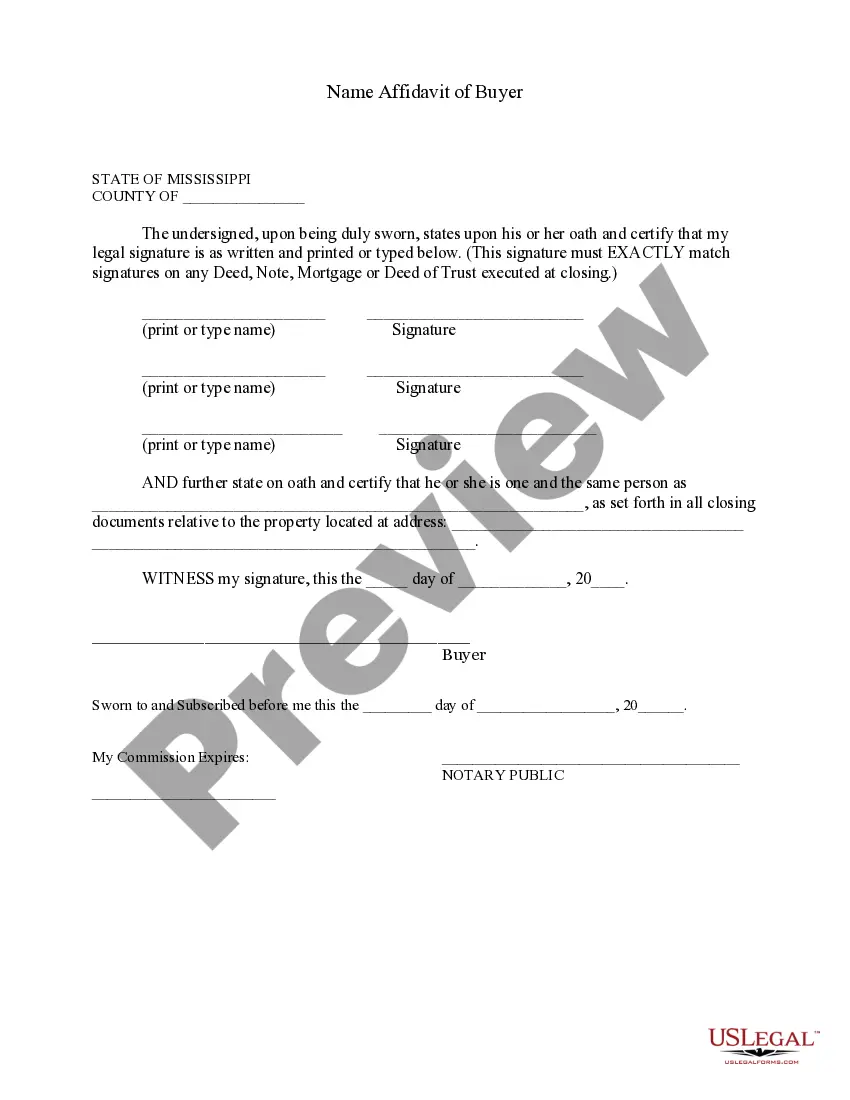
Mississippi Name Affidavit of Buyer
Understanding this form
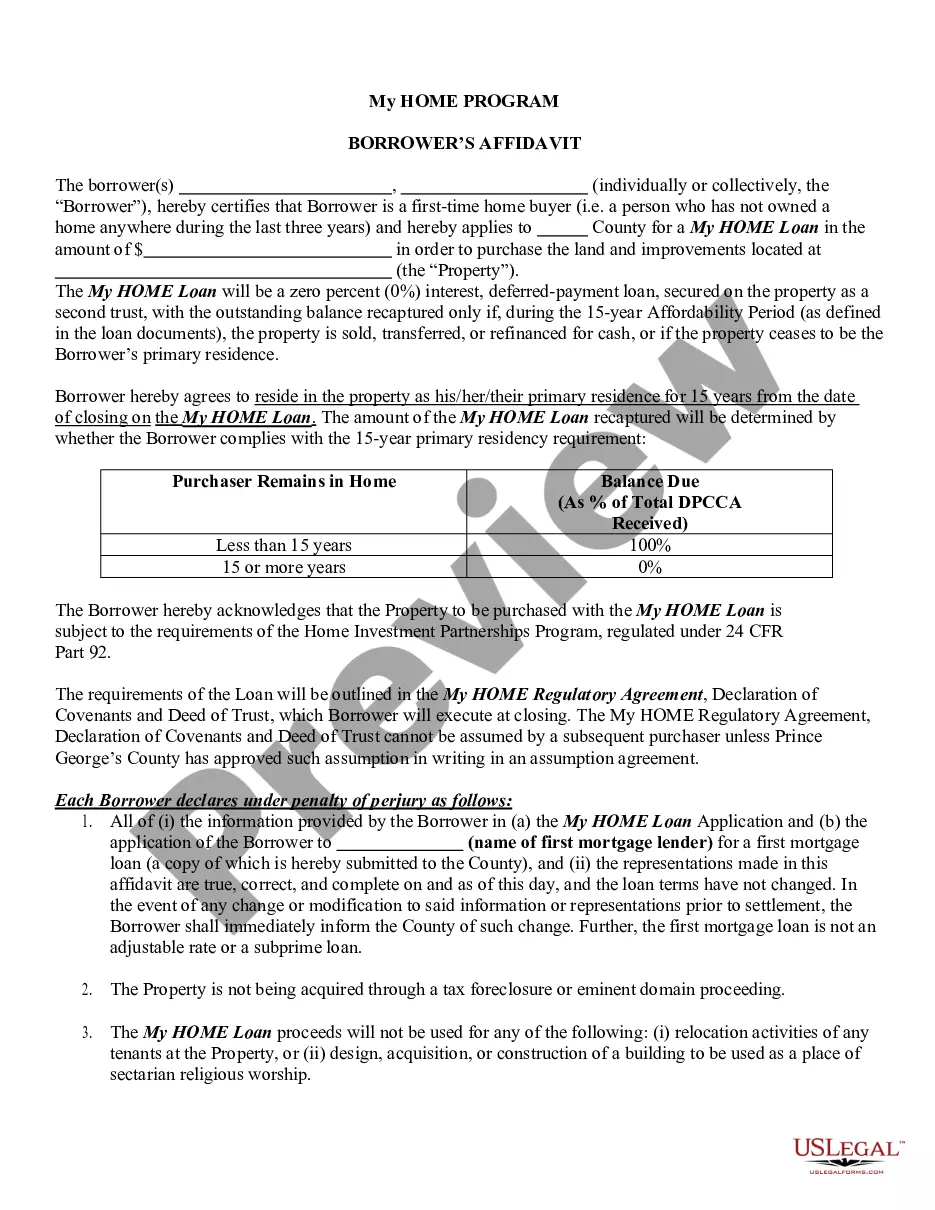
The Name Affidavit of Buyer is a legal document used to affirm the buyer's legal identity and any other names they may be known by. This affidavit helps clarify that various signatures, such as John Jones, John T. Jones, and J.T. Jones, belong to the same individual. This form is essential in real estate transactions to ensure accuracy and legality in closing documents.
Key parts of this document
- State and county declaration for jurisdiction.
- Legal name and signatures of the buyer to confirm identity.
- Certification of any known aliases or variations of the buyer's name.
- Affirmation of the property details relevant to the transaction.
- Notary section for legal validation and witness of the affidavit.

When to use this document
This form is typically used when a buyer is involved in a real estate transaction and needs to confirm their identity. It is particularly useful if the buyer has signed documents under different variations of their name, ensuring all parties to the transaction recognize them as the same individual. Use this form during the closing process of property transactions to avoid any legal disputes regarding identity.
Intended users of this form
- Buyers involved in real estate transactions.
- Individuals who have used different names or variations while signing documents.
- Legal representatives or agents handling real estate transactions on behalf of the buyer.
Steps to complete this form
- Enter the state and county in which the affidavit is being executed.
- Print or type your legal name and provide the signature that matches all related documents.
- List any aliases or additional names you are known by to clarify your identity.
- Provide details about the property involved in the transaction.
- Sign and date the affidavit before a notary public.
Does this form need to be notarized?
This document requires notarization to meet legal standards. US Legal Forms provides secure online notarization powered by Notarize, allowing you to complete the process through a verified video call, available 24/7.
Get your form ready online
Our built-in tools help you complete, sign, share, and store your documents in one place.
Make edits, fill in missing information, and update formatting in US Legal Forms—just like you would in MS Word.
Download a copy, print it, send it by email, or mail it via USPS—whatever works best for your next step.
Sign and collect signatures with our SignNow integration. Send to multiple recipients, set reminders, and more. Go Premium to unlock E-Sign.
If this form requires notarization, complete it online through a secure video call—no need to meet a notary in person or wait for an appointment.
We protect your documents and personal data by following strict security and privacy standards.

Make edits, fill in missing information, and update formatting in US Legal Forms—just like you would in MS Word.

Download a copy, print it, send it by email, or mail it via USPS—whatever works best for your next step.

Sign and collect signatures with our SignNow integration. Send to multiple recipients, set reminders, and more. Go Premium to unlock E-Sign.

If this form requires notarization, complete it online through a secure video call—no need to meet a notary in person or wait for an appointment.

We protect your documents and personal data by following strict security and privacy standards.
Avoid these common issues
- Failing to match the signed name exactly with that on other documents.
- Leaving out aliases that may create confusion about identity.
- Not having the affidavit notarized when required.
Benefits of using this form online
- Convenience of downloading and completing the form at your own pace.
- Access to attorney-drafted templates ensuring compliance with legal standards.
- Easy editing capabilities to update names and property details as needed.
Quick recap
- The Name Affidavit of Buyer confirms the legal identity of property buyers.
- It is essential for avoiding confusion due to name variations during real estate transactions.
- Notarization is required for the form to have legal standing.
Looking for another form?






Form popularity
FAQ
The Signature and Name Affidavit is a document used to protect the lender and title company from possible fraud by confirming the following:The borrower is signing documents with his or her correct legal name.
A person can use any name they want to use, as long as it isn't for fraudulent purposes. For instance, unless it's a formal setting, I usually go by "Bob" instead of "Robert."
An Affidavit of Discrepancy is a statement under oath attesting the truthfulness of a fact, in this case, the discrepancy in the entries in documents, with the purpose of explaining and clearing the discrepancy.
An affidavit is a sworn or affirmed statement made before a notary public or any public official who has the authority to administer oaths. It is made under penalty of perjury.A notarized affidavit is one in which you swear the content is true before a notary public.
When two or more people or things are thought to be separate and you say that they are one and the same, you mean that they are in fact one single person or thing. Luckily, Nancy's father and her attorney were one and the same person.
The affidavit reflects both your old and new names. Affidavits can be used for changing the whole name, surname or just a few letters. Keep a copy of the affidavit. This is a crucial document and comes in handy for any future legal formalities.
The affidavit of one and the same person is used to declare that two (or more) names pertain to the same person.
Title the affidavit. First, you'll need to title your affidavit. Craft a statement of identity. The very next section of your affidavit is what's known as a statement of identity. Write a statement of truth. State the facts. Reiterate your statement of truth. Sign and notarize.
An Affidavit of One and the Same Person is a written document that establishes that two different names found on different documents refer to one person, the Affiant.The difference can be due to a erroneous spelling of the name, a missing first or second name, or even an additional name, among others.