Minnesota Notice of Default for Past Due Payments in connection with Contract for Deed
Overview of this form
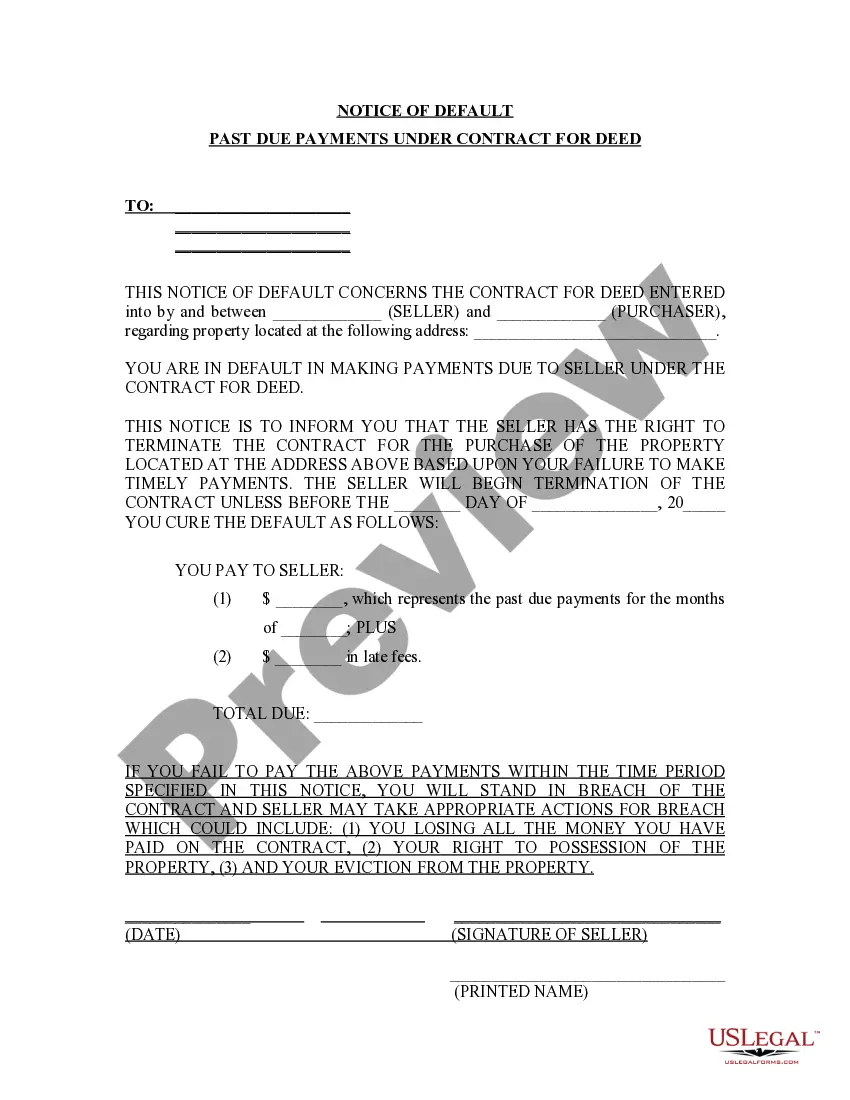
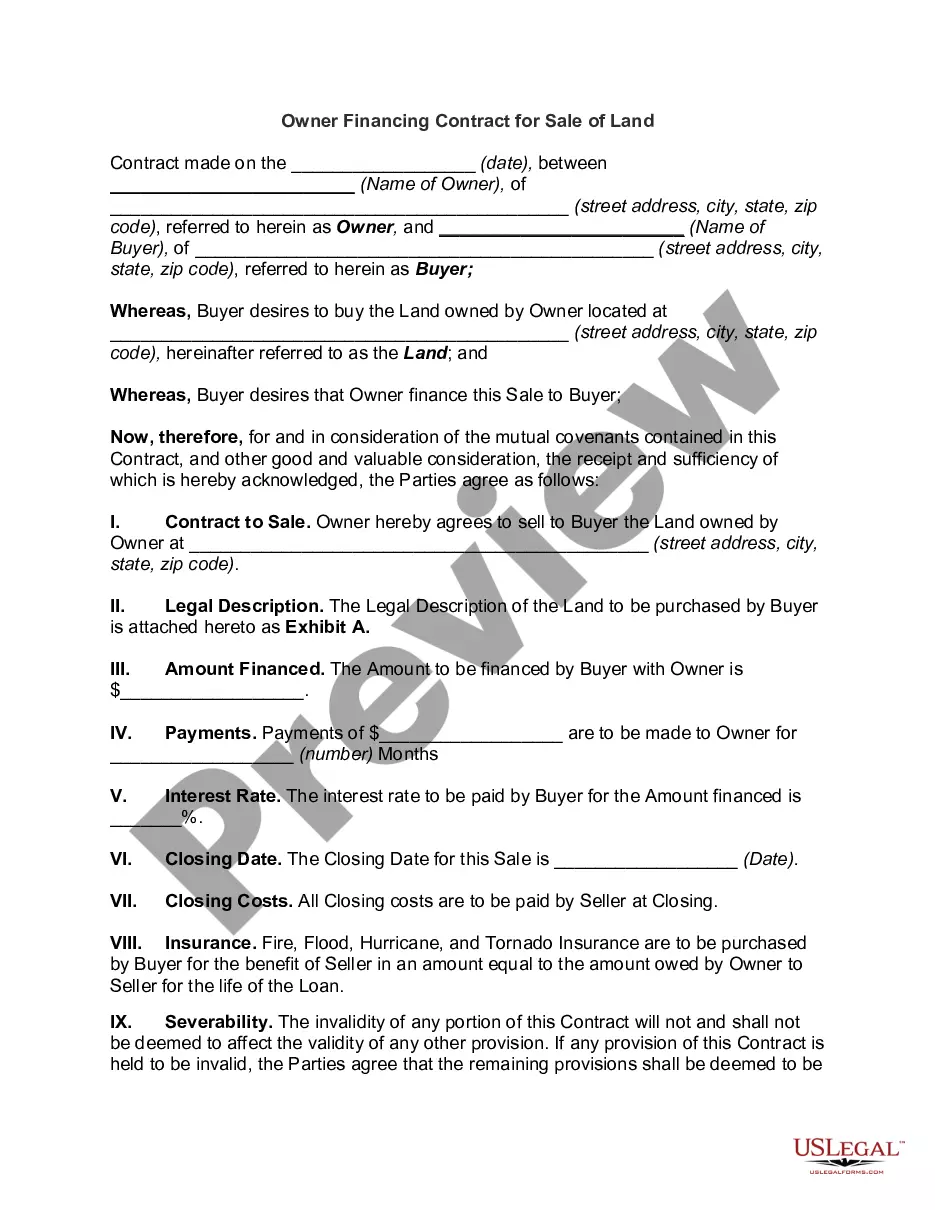
The Notice of Default for Past Due Payments in connection with Contract for Deed serves as a formal notification from the seller to the purchaser when payments have not been made as stipulated in the contract. This document alerts the purchaser to their late payment and outlines the consequences of failing to rectify the default as per the contract's terms. Unlike other notifications, this form specifically addresses defaults related to payments for a property acquired through a contract for deed arrangement.
Key components of this form
- Details of the seller and purchaser involved in the contract for deed.
- Date of the notice and reference to the contract date.
- Description of the payment terms that have not been met.
- Notification of the default status and required actions to remedy it.
- Consequences of failing to comply with the notice.
When to use this document
This form is needed when a seller of a property under a contract for deed has not received timely payments from the purchaser. It is essential to document this delay and formally notify the purchaser, allowing them an opportunity to cure the default before further actions are taken. This situation typically arises when a purchaser misses one or more scheduled payments, jeopardizing the agreement.
Who can use this document
- Sellers of property under a contract for deed.
- Purchasers who have fallen behind on contracted payments.
- Real estate professionals assisting clients in managing defaults on contract for deed agreements.
Instructions for completing this form
- Identify the seller and purchaser by entering their full names and addresses.
- Specify the property involved in the contract for deed arrangement.
- Clearly state the payment terms that have not been met, including amounts and due dates.
- Include the date of the notice and reference the original contract date to establish timelines.
- Clearly outline the remedy period given to the purchaser to resolve the default.
- Provide space for signatures to acknowledge receipt of the notice.
Does this form need to be notarized?
This form must be notarized to be legally valid. US Legal Forms provides secure online notarization powered by Notarize, allowing you to complete the process through a verified video call.
Get your form ready online
Our built-in tools help you complete, sign, share, and store your documents in one place.
Make edits, fill in missing information, and update formatting in US Legal Forms—just like you would in MS Word.
Download a copy, print it, send it by email, or mail it via USPS—whatever works best for your next step.
Sign and collect signatures with our SignNow integration. Send to multiple recipients, set reminders, and more. Go Premium to unlock E-Sign.
If this form requires notarization, complete it online through a secure video call—no need to meet a notary in person or wait for an appointment.
We protect your documents and personal data by following strict security and privacy standards.

Make edits, fill in missing information, and update formatting in US Legal Forms—just like you would in MS Word.

Download a copy, print it, send it by email, or mail it via USPS—whatever works best for your next step.

Sign and collect signatures with our SignNow integration. Send to multiple recipients, set reminders, and more. Go Premium to unlock E-Sign.

If this form requires notarization, complete it online through a secure video call—no need to meet a notary in person or wait for an appointment.

We protect your documents and personal data by following strict security and privacy standards.
Common mistakes
- Failing to include all required parties' names and contact information.
- Not specifying the exact terms of the default clearly.
- Omitting a deadline for the purchaser to rectify the missed payments.
- Not signing the notice, which can undermine its validity.
Why use this form online
- Instant access to a legally vetted template, reducing the risk of errors.
- Ability to easily edit and customize the form for specific needs.
- Secure download ensures that your document is stored safely for future reference.
- Quick completion compared to drafting a notice from scratch.
Legal use & context
- The form serves as an initial step in the enforcement of payment obligations within a contract for deed.
- It establishes documentation of the default, which may be necessary for any subsequent legal actions.
- Proper use of this form can help in resolving disputes amicably before escalation.
Main things to remember
- This notice is crucial for sellers to formally communicate late payments to purchasers.
- Completing this form accurately can prevent misunderstandings and potential legal issues.
- Always check state-specific rules to ensure compliance with local requirements.
Looking for another form?
Form popularity
FAQ
The prompt payment law in Minnesota ensures that payments for services or goods are made in a timely manner. This law is particularly important in the context of financial agreements, such as a Contract for Deed. If you are facing issues with past due payments, understanding the Minnesota Notice of Default for Past Due Payments in connection with Contract for Deed can help you navigate your rights and responsibilities. For comprehensive assistance, consider using US Legal Forms, which provides resources to help you manage your legal obligations effectively.
Statute 507.45 in Minnesota addresses the Minnesota Notice of Default for Past Due Payments in connection with Contract for Deed. This statute outlines the requirements for notifying parties involved in a contract when payments are overdue. Essentially, it provides a structured process to help protect the rights of both buyers and sellers. Utilizing this statute can help ensure compliance and clarity in financial transactions related to contracts for deed.
If you default on a contract for deed, the seller may issue a Minnesota Notice of Default for Past Due Payments as a formal notification. This notice allows you a specific timeframe to address the overdue payments. Failing to resolve the default can result in the seller terminating the contract and taking back the property, making it essential to communicate and seek solutions promptly.
Statute 548.101 in Minnesota outlines the requirements and procedures related to contracts for deed. This statute is vital for understanding how to properly execute and enforce these agreements, including the process for issuing a Minnesota Notice of Default for Past Due Payments. Familiarity with this statute can help prevent misunderstandings and disputes.
In Minnesota, failing to record a contract for deed on time can lead to penalties, including potential fines. The law emphasizes the importance of timely recordation to protect both parties' interests. Buyers and sellers should stay informed about these regulations to avoid complications related to a Minnesota Notice of Default for Past Due Payments.
The new contract for deed law in Minnesota aims to provide better protections for buyers and sellers involved in these agreements. It includes requirements for clear terms and conditions, as well as the process for issuing a Minnesota Notice of Default for Past Due Payments. Understanding this law is essential for both parties to ensure compliance and avoid disputes.
A significant danger in a contract for deed is the risk of losing the property if payments are not made on time. If the buyer defaults, the seller may issue a Minnesota Notice of Default for Past Due Payments, leading to potential foreclosure. Buyers should ensure they can meet payment obligations to safeguard their investment.
If a party defaults on a contract, the other party typically has the right to seek remedies, such as enforcing the contract or pursuing damages. In the case of a contract for deed, this often involves issuing a Minnesota Notice of Default for Past Due Payments. It is crucial for both parties to understand their rights and obligations to avoid complications.
When someone defaults on a contract for deed, the seller may initiate a Minnesota Notice of Default for Past Due Payments. This notice serves to inform the buyer that they have fallen behind in payments and provides a timeline for them to remedy the situation. If the buyer fails to act, the seller may have the right to terminate the contract and reclaim the property.