Michigan Statutory Uniform Donor Card for Anatomical Gift Act Donation
Understanding this form
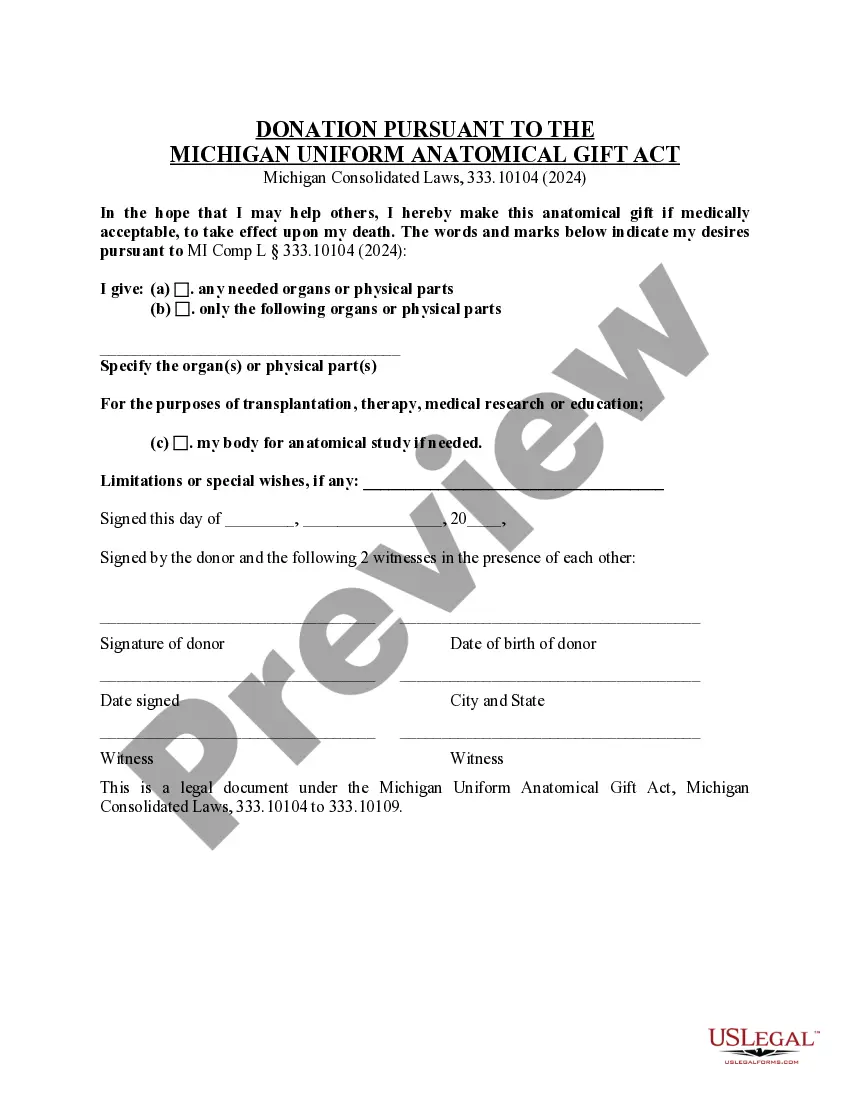
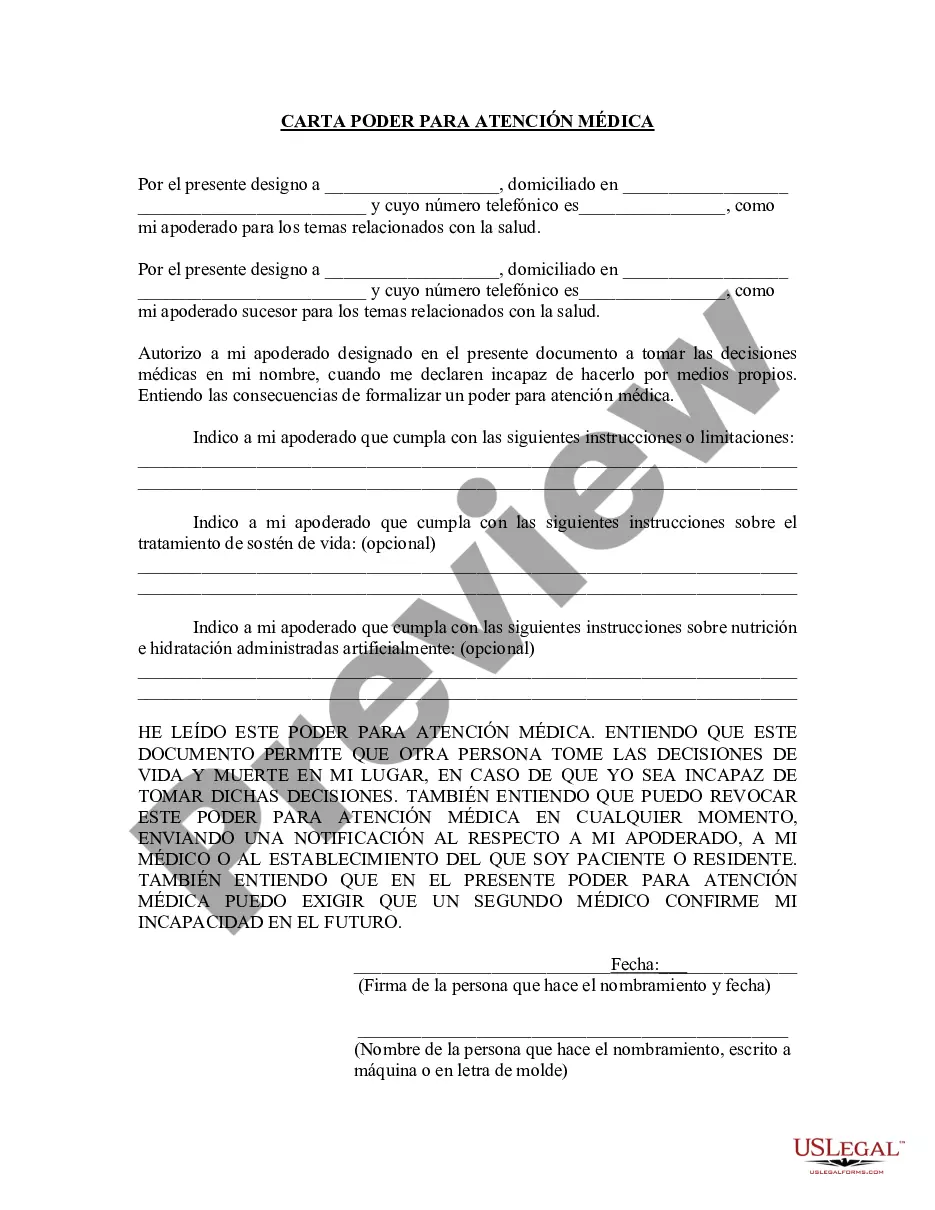
The Statutory Uniform Donor Card is a legal document that allows individuals to specify the body parts and organs they wish to donate at the time of death. It is designed under the Michigan Uniform Anatomical Gift Act, facilitating ethical donations for medical purposes. This form differs from general wills as it directly addresses anatomical gifts, making your intentions clear to family and healthcare providers during a critical time.
Form components explained
- Name of the donor, ensuring identification
- Options for donation, including any needed organs, specific organs, or the entire body for study
- Section for limitations or special wishes regarding the donation
- Signature line for the donor and two witnesses to ensure validity
Situations where this form applies
This form should be used when an individual decides to make an anatomical gift of their body or parts upon death. It is particularly relevant for those who have clear intentions about organ donation or wish to contribute to medical research and education. Utilizing this form can ease the burden on loved ones by eliminating uncertainty during emotionally challenging times.
Who needs this form
- Individuals aged 18 and older who are of sound mind.
- People who want to ensure their wish to donate organs or body parts is honored.
- Anyone looking to provide clarity on their donation preferences to family members and healthcare providers.
Completing this form step by step
- Print or type your name clearly in the designated area.
- Select the type of anatomical gift you wish to make.
- Specify any limitations or special wishes regarding your donation.
- Sign the form in the presence of two witnesses.
- Ensure witnesses also sign the document in your presence.
Does this document require notarization?
This form does not typically require notarization unless specified by local law. Ensure that you follow the signing requirements, which include having two witnesses present during the signing process to validate the document.
Get your form ready online
Our built-in tools help you complete, sign, share, and store your documents in one place.
Make edits, fill in missing information, and update formatting in US Legal Forms—just like you would in MS Word.
Download a copy, print it, send it by email, or mail it via USPS—whatever works best for your next step.
Sign and collect signatures with our SignNow integration. Send to multiple recipients, set reminders, and more. Go Premium to unlock E-Sign.
If this form requires notarization, complete it online through a secure video call—no need to meet a notary in person or wait for an appointment.
We protect your documents and personal data by following strict security and privacy standards.

Make edits, fill in missing information, and update formatting in US Legal Forms—just like you would in MS Word.

Download a copy, print it, send it by email, or mail it via USPS—whatever works best for your next step.

Sign and collect signatures with our SignNow integration. Send to multiple recipients, set reminders, and more. Go Premium to unlock E-Sign.

If this form requires notarization, complete it online through a secure video call—no need to meet a notary in person or wait for an appointment.

We protect your documents and personal data by following strict security and privacy standards.
Avoid these common issues
- Not having two witnesses sign the form, which may invalidate the document.
- Failing to specify limitations or preferences, leading to confusion after death.
- Not keeping the form in an accessible location for family members to find easily.
Benefits of completing this form online
- Convenient and easy access to the form from anywhere.
- Potential for instant downloads, allowing immediate completion.
- Reliability, as the forms are drafted by licensed attorneys to ensure compliance with legal standards.
Legal use & context
- This form serves as a legal declaration of a person's wishes concerning organ donation, protected under the Michigan Uniform Anatomical Gift Act.
- It allows individuals to ensure their preferences for organ donation are respected and legally enforced.
What to keep in mind
- The Statutory Uniform Donor Card allows individuals to express their wishes regarding organ donation.
- Completing this form ensures that your decisions about anatomical gifts are known and respected.
- It is important to adhere to signature and witness requirements to validate the form.
Looking for another form?



Form popularity
FAQ
The Uniform Anatomical Gift Act is a federal law that facilitates organ and tissue donation across the United States. The act aims to promote and simplify the donation process, supporting initiatives like the Michigan Statutory Uniform Donor Card for Anatomical Gift Act Donation. This legislation allows individuals to make anatomical gifts, ensuring their valuable contributions are recognized and executed. If you're considering donation, understanding this act can be a vital part of your decision.
The Uniform Anatomical Gift Act in Michigan outlines the process for individuals to voluntarily donate their organs and tissues upon death. This law supports the use of the Michigan Statutory Uniform Donor Card for Anatomical Gift Act Donation, allowing residents to make their intentions clear. By registering through this act, you can help save lives by ensuring that your wishes are honored. It's an essential step towards making a lasting impact in your community.
The Uniform Anatomical Gift Act establishes the legal framework for organ donation in the United States, including Michigan. This act allows individuals to voluntarily donate their organs and tissues after death through a legal document, such as the Michigan Statutory Uniform Donor Card for Anatomical Gift Act Donation. This process ensures that the donation occurs in a respectful manner and according to the donor's preferences. By understanding this act, you can make informed decisions about donating and potentially saving lives.
A declaration of anatomical gift is a formal statement made by an individual regarding their wish to donate their organs or tissues after death. This declaration can be communicated through the Michigan Statutory Uniform Donor Card for Anatomical Gift Act Donation, which serves as a legal document affirming one's intent. By declaring this gift, individuals can help save lives and enhance the quality of life for others in need of transplants. It is essential to inform family members as well, so they are aware of your wishes.
An anatomical gift donor is an individual who voluntarily decides to donate their body or specific organs for the purpose of medical research or education. This act is formalized through the Michigan Statutory Uniform Donor Card for Anatomical Gift Act Donation, which ensures that your wishes are respected. Anatomical gifts empower medical professionals to learn and improve healthcare practices, benefiting future generations. By choosing to be an anatomical gift donor, you contribute significantly to advancements in science and medicine.
To donate your body to science in Michigan, you need to complete the Michigan Statutory Uniform Donor Card for Anatomical Gift Act Donation. This card allows you to legally consent to gift your body for medical education or research. It’s a straightforward process that involves filling out the card and possibly informing your family of your decision. For assistance, you can visit the US Legal Forms platform, which provides comprehensive resources and guidance on anatomical gift laws.
: a card that says a person wants to donate his or her organs when he or she dies.
The uniform donor card is the most commonly used document to express donative intent. Although the public is told the uniform donor card is a legal document, signing one does not impose the same legal weight as signing other legal documents such as a contract, a will, or durable power of attorney.
Simply sign a Uniform Donor Card. It is a legal document under state law through which you can express your wishes about donating organs and tissues. You may obtain a card at your local National Kidney Foundation affiliate. Carry the card with you at all times.
The Act sets a regulatory framework for the donation of organs, tissues, and other human body parts in the US. The UAGA helps regulate body donations to science, medicine, and education. The Act has been consulted in discussions about abortion, fetal tissue transplants, and Body Worlds, an anatomy exhibition.