Michigan Letter from Tenant to Landlord about Fair Housing Reduction or Denial of services to Family with Children
What this document covers
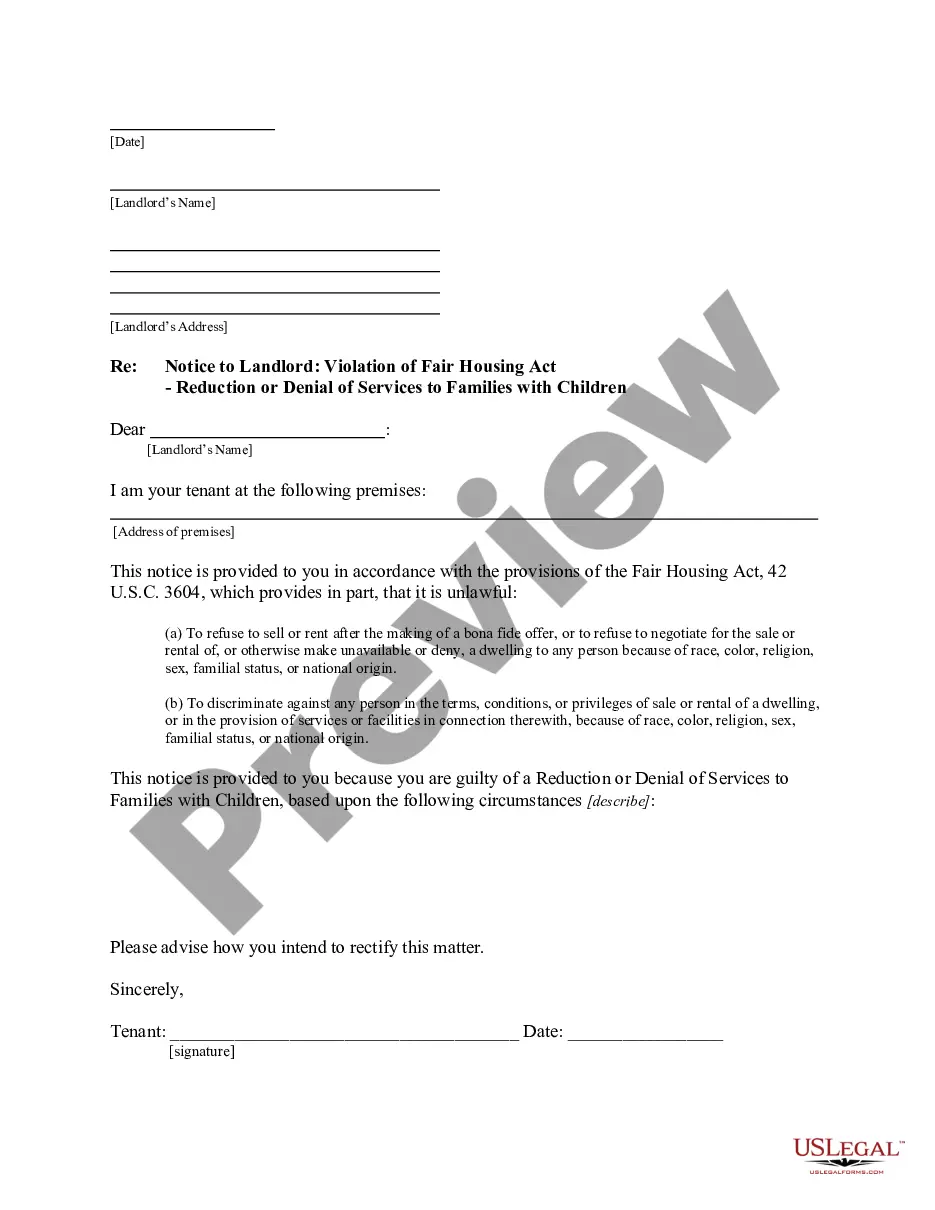
This letter from tenant to landlord regarding fair housing reduction or denial of services to families with children is used to formally notify the landlord of their potential violation of the Fair Housing Act. This form is essential to address any unjust treatment based on familial status, highlighting that it is illegal to discriminate against tenants based on their family composition. Unlike general complaint letters, this form specifically focuses on violations related to housing and family status rights.
Main sections of this form
- Identification of the tenant and landlord involved.
- Description of the relevant circumstances that demonstrate reduction or denial of services.
- Citation of the Fair Housing Act and specific legal protections against discrimination.
- Request for corrective action from the landlord.
- Date of the notice and signature of the tenant.

When this form is needed
This form should be used when a landlord has refused to provide services, has made adverse changes to tenancy conditions, or has otherwise discriminated against tenants based on their family status. Situations may include rental agreements that exclude children or reduced services that directly impact families, which necessitate a formal notification to ensure compliance with the Fair Housing Act.
Who should use this form
- Tenants who feel they are being discriminated against due to having children.
- Families encountering unfair treatment in their housing situation.
- Individuals seeking to formally address a landlord's potential violation of fair housing laws.
Instructions for completing this form
- Identify and enter the names and contact information of both the tenant and the landlord.
- Clearly describe the circumstances and examples of how the landlord has discriminated against the tenant or family.
- Cite the relevant sections of the Fair Housing Act that apply to the situation.
- State the specific changes or actions you want the landlord to take to remedy the situation.
- Date the letter and provide your signature to validate the notice.
Does this form need to be notarized?
In most cases, this form does not require notarization. However, some jurisdictions or signing circumstances might. US Legal Forms offers online notarization powered by Notarize, accessible 24/7 for a quick, remote process.
Get your form ready online
Our built-in tools help you complete, sign, share, and store your documents in one place.
Make edits, fill in missing information, and update formatting in US Legal Forms—just like you would in MS Word.
Download a copy, print it, send it by email, or mail it via USPS—whatever works best for your next step.
Sign and collect signatures with our SignNow integration. Send to multiple recipients, set reminders, and more. Go Premium to unlock E-Sign.
If this form requires notarization, complete it online through a secure video call—no need to meet a notary in person or wait for an appointment.
We protect your documents and personal data by following strict security and privacy standards.

Make edits, fill in missing information, and update formatting in US Legal Forms—just like you would in MS Word.

Download a copy, print it, send it by email, or mail it via USPS—whatever works best for your next step.

Sign and collect signatures with our SignNow integration. Send to multiple recipients, set reminders, and more. Go Premium to unlock E-Sign.

If this form requires notarization, complete it online through a secure video call—no need to meet a notary in person or wait for an appointment.

We protect your documents and personal data by following strict security and privacy standards.
Avoid these common issues
- Failing to provide specific details about the reduction or denial of services.
- Not citing the Fair Housing Act or relevant laws appropriately.
- Neglecting to sign or date the letter.
- Using ambiguous language that may weaken the complaint.
Benefits of using this form online
- Convenient access: Download and fill out the form at your own pace from any location.
- Editability: Customize the form to fit your specific situation before submission.
- Reliability: Use a professionally drafted document that adheres to legal standards for your state.
Legal use & context
- This letter serves as a formal notification to the landlord, which can be critical in resolving disputes.
- It may be used as evidence in legal proceedings if the issue is not resolved promptly.
- Understanding your rights under the Fair Housing Act is essential for effective communication with landlords.
Key takeaways
- The form is used to formally notify landlords of discrimination related to families with children.
- Completing the form accurately and thoroughly is essential for it to be effective.
- This process serves to assert your rights under the Fair Housing Act and seek resolution.
Looking for another form?



Form popularity
FAQ
Examples of familial status discrimination include: Refusing to rent to families with children. Evicting families once a child joins the family through, e.g., birth, adoption, custody. Requiring families with children to live on specific floors or in specific buildings or areas.
If the tenant refuses, you are permitted to send them a notice to agree or quit the property. The tenant refusing you access constitutes a breach in the lease agreement, so they could be evicted if they continue to deny access.
Under the FHA, familial status discrimination occurs when a landlord, property manager, real estate agent, or property owner treats someone differently because they have a family with one or more individuals who are under 18 years of age.
What does "familial status" mean? Familial status means the makeup of your family. The FHA prohibits discrimination on this basis including: children under the age of 18 living with parents/guardians, pregnant women, and people seeking custody of children under 18.
The Fair Housing Act prohibits discrimination on the basis of disability in all types of housing transactions. The Act defines persons with a disability to mean those individuals with mental or physical impairments that substantially limit one or more major life activities.
Showing the premises to prospective tenants 'reasonable' notice / number of times. The law does not say what 'reasonable' means.If you refuse access, the landlord/agent can apply to the Tribunal for an order that authorises them or any other person to enter the premises.
The Fair Housing Act prohibits this discrimination because of race, color, national origin, religion, sex, familial status, and disability.If you believe you have been discriminated against in violation of any of these federal fair housing laws, you can file a complaint with FHEO.
While tenants cannot unreasonably deny access to a landlord, landlords must also follow all of the state and local rules regarding access to tenants' apartments. Roughly half of states have rules governing landlord entry into tenants' apartments.
Every tenant has a right to enjoy peaceful possession of the property without any disturbance or encumbrance from anyone including the owner. At no point of time under your tenancy can your landlord ask you to evict or leave the premises without assigning a valid reason.