Michigan Claim of Lien by Individual
About this form
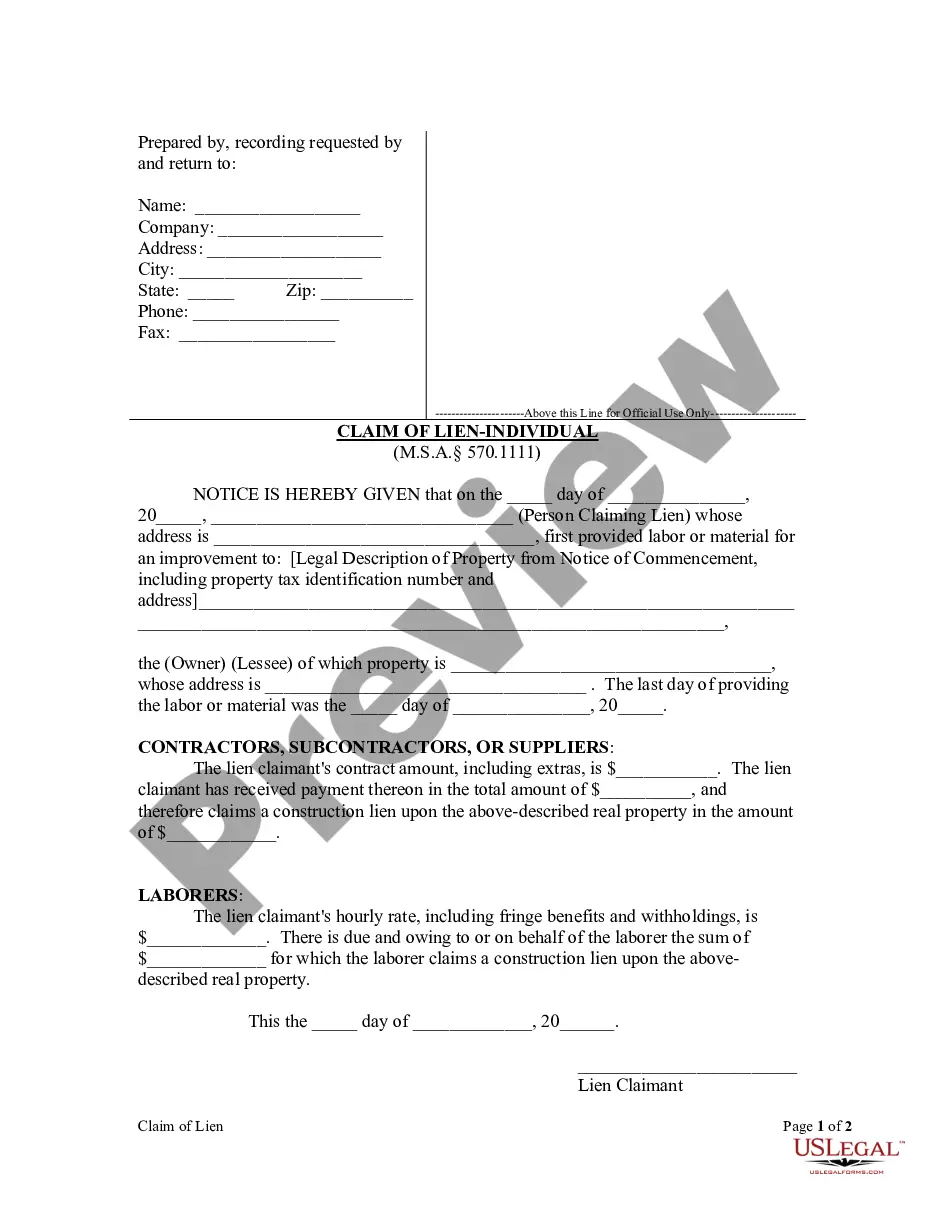
The Claim of Lien by Individual is a legal document that allows an individual to assert a lien against real property. This form is essential for individuals who have provided labor or materials for an improvement on a property but have not been paid. Unlike general contractor lien forms, this document is specifically tailored for individuals, such as subcontractors or suppliers, who want to protect their right to compensation for their work.
Main sections of this form
- Name and address of the lien claimant.
- Legal description of the property and its owner.
- Date labor or materials were last provided.
- Total contract amount and received payments.
- Claimed amount for the lien.
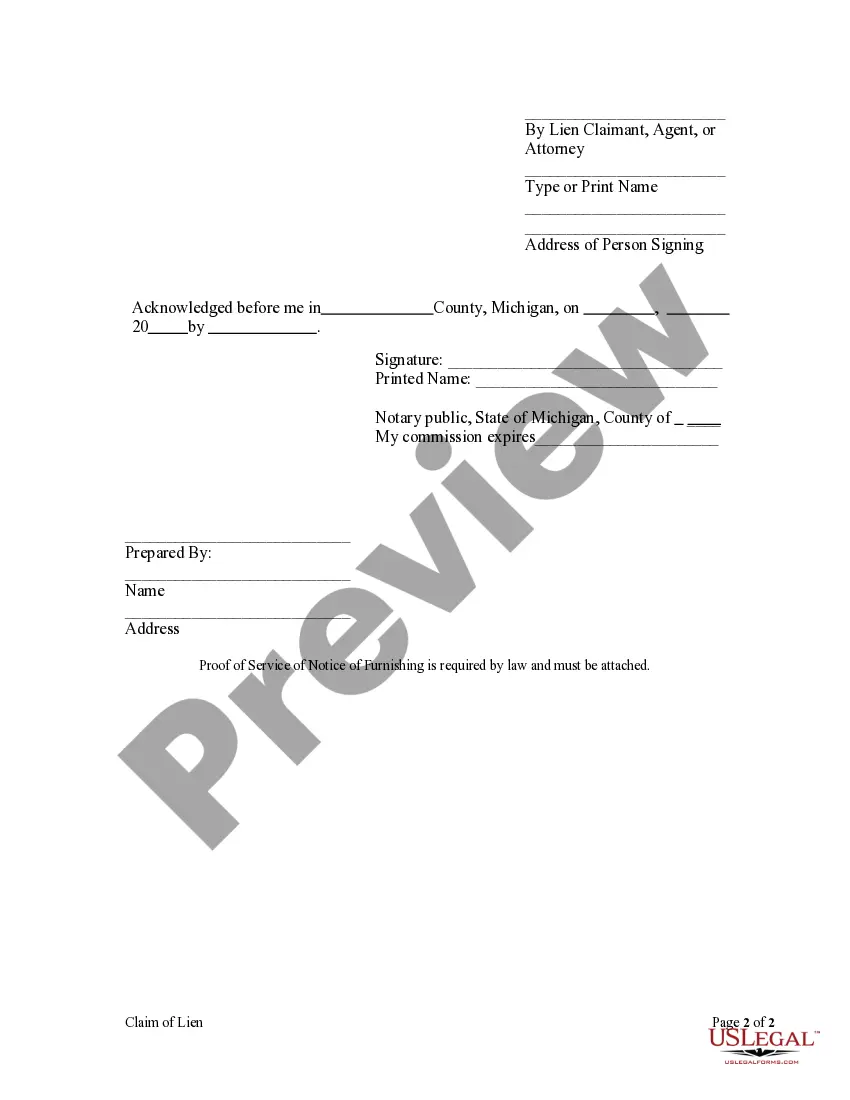
- Notary acknowledgment for legal validation.
Common use cases
This form should be used when an individual has provided labor or materials for a property improvement and has not received the full payment as agreed. It is typically filed within ninety days of the last service rendered to formalize the claim and secure a legal right over the property in question.
Who should use this form
This form is intended for individuals including:
- Subcontractors who have performed work on a property.
- Suppliers of materials used in construction or improvement.
- Laborers owed payment for their services.
- Independent contractors providing professional services related to the property.
Steps to complete this form
- Identify the lien claimant and enter their name and address.
- Provide the legal description of the property, including the property tax identification number.
- State the last date labor or materials were provided.
- Fill in total contract amount and any payments received.
- Sign before a notary public to validate the document.
Notarization requirements for this form
To make this form legally binding, it must be notarized. Our online notarization service, powered by Notarize, lets you verify and sign documents remotely through an encrypted video session.
Get your form ready online
Our built-in tools help you complete, sign, share, and store your documents in one place.
Make edits, fill in missing information, and update formatting in US Legal Forms—just like you would in MS Word.
Download a copy, print it, send it by email, or mail it via USPS—whatever works best for your next step.
Sign and collect signatures with our SignNow integration. Send to multiple recipients, set reminders, and more. Go Premium to unlock E-Sign.
If this form requires notarization, complete it online through a secure video call—no need to meet a notary in person or wait for an appointment.
We protect your documents and personal data by following strict security and privacy standards.

Make edits, fill in missing information, and update formatting in US Legal Forms—just like you would in MS Word.

Download a copy, print it, send it by email, or mail it via USPS—whatever works best for your next step.

Sign and collect signatures with our SignNow integration. Send to multiple recipients, set reminders, and more. Go Premium to unlock E-Sign.

If this form requires notarization, complete it online through a secure video call—no need to meet a notary in person or wait for an appointment.

We protect your documents and personal data by following strict security and privacy standards.
Typical mistakes to avoid
- Not filing the lien within the required ninety-day period.
- Failing to include complete property information, such as the legal description.
- Omitting signatures or not having the form properly notarized.
- Incorrectly calculating the amount claimed for the lien.
Advantages of online completion
- Easy access to the form allows for quick completion and filing.
- Templates are drafted by licensed attorneys, ensuring legal compliance.
- Downloadable forms can be customized to fit specific needs.
- Reliability of using official formats that meet local requirements.
Looking for another form?



Form popularity
FAQ
In Michigan, a mechanics lien, called a Claim of Lien, must be filed with the Register of Deeds within 90 days after the lien claimant last furnished labor or materials to the project.
Which is a voluntary lien against a person's property? Mortgage lien.
A judgment lien in Michigan will remain attached to the debtor's property (even if the property changes hands) for five years.
If you're claiming a lien on real property, it must be filed in the recorder's office of the county where the property is located. Expect to pay a filing fee between $25 and $50 depending on the location where you file.
2. States where the lien law doesn't require a written contract. In these states, contractors and suppliers are generally allowed to file a lien even if they don't have a written contract.These states typically permit parties with verbal, oral, or even implied contracts to claim lien rights.
A Lien Demand Letter or Notice of Intent to Lien is a formal demand for payment.A lien demand letter puts a debtor on notice of your intent to lien the job site property by a specific date deadline. Increase your odds of getting paid with a lien demand letter.
Who you are. The services or materials you provided. The last date you provided the services or materials. How much payment should be. The date on which you will file a lien if you do not receive payment. How the debtor should pay.
A mortgage creates a lien on your property that gives the lender the right to foreclose and sell the home to satisfy the debt. A deed of trust (sometimes called a trust deed) is also a document that gives the lender the right to sell the property to satisfy the debt should you fail to pay back the loan.
Someone who is owed money is generally not able to just put a lien on property without first securing a judgment. Securing a judgment requires the creditor to sue the debtor. This may be through circuit court in many jurisdictions. If under a certain dollar amount, this suit may be through the small claims court.