Michigan Final Notice of Forfeiture and Request to Vacate Property under Contract for Deed
What is this form?
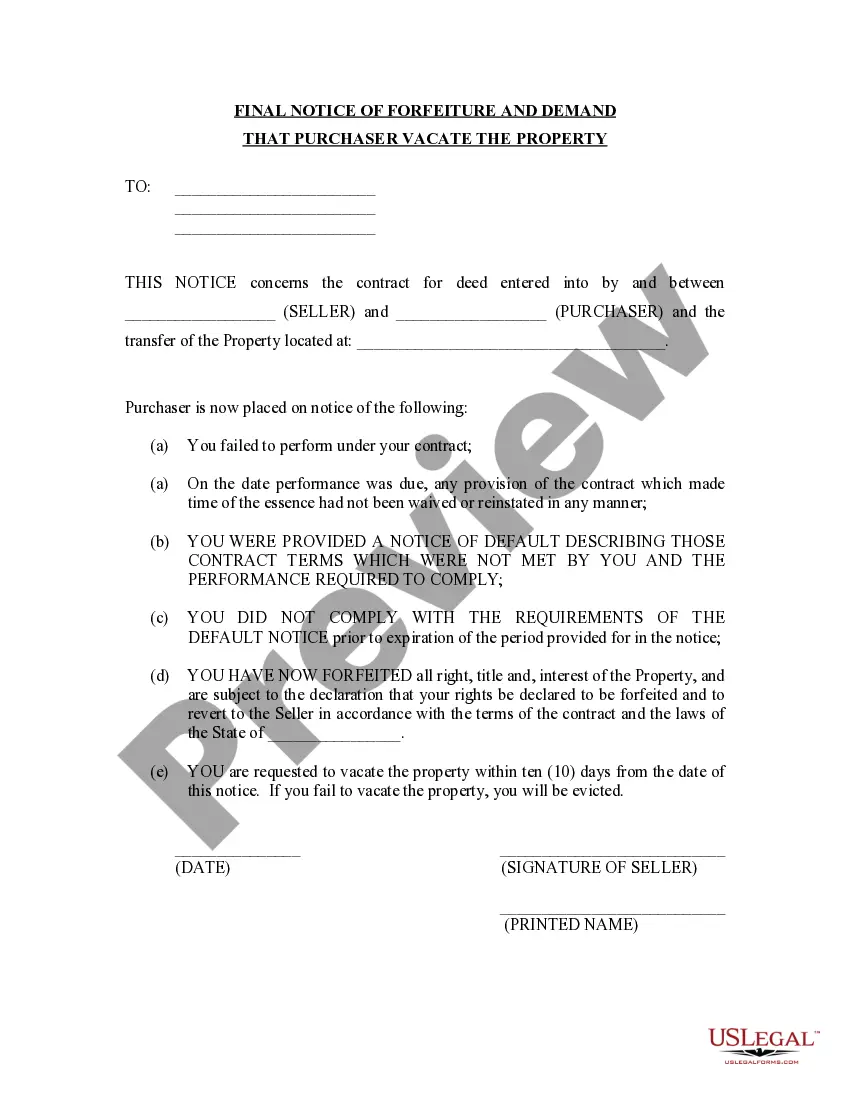
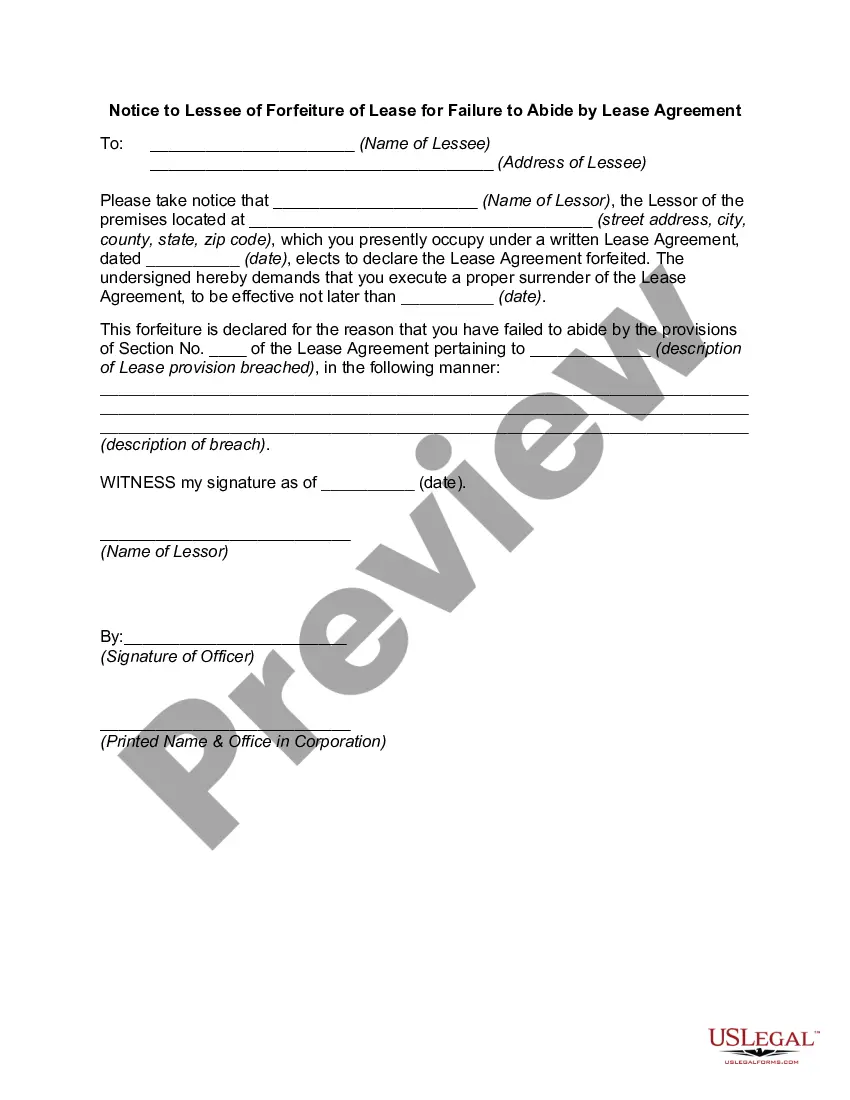
The Final Notice of Forfeiture and Request to Vacate Property under Contract for Deed is a legal form used by sellers to formally notify buyers that a contract for deed has been canceled. This notice is issued after previous warnings about contract breaches have lapsed, indicating that the seller has decided to forfeit any payments made and requests the buyer to vacate the property. It serves to terminate the buyer's occupancy rights, distinguishing it from other notices that may address earlier stages of breach or default.
What’s included in this form
- Identification of the parties involved in the contract.
- Details about the property subject to the contract for deed.
- Reference to the prior notice of default and its outcomes.
- Statement of forfeiture of all previous payments made by the buyer.
- A demand for the buyer to vacate the property.
Common use cases
This form is necessary when a buyer has failed to comply with the terms of a contract for deed, and the seller has previously issued notices of default. By sending this final notice, the seller officially informs the buyer that their rights to the property are terminated and that any remaining occupancy will lead to legal action. The form is typically used when all communication about the breach has been exhausted and serves as a precursor to court proceedings for eviction or forfeiture.
Who should use this form
- Sellers of properties under a contract for deed who need to enforce contract terms.
- Buyers who have received prior notices of default regarding their performance obligations.
- Real estate professionals assisting sellers with enforcing contract provisions.
Steps to complete this form
- Identify the parties by entering the names of the seller and buyer.
- Specify the property address included in the contract for deed.
- Reference the prior notice of default and include relevant dates.
- Clearly state the forfeiture of payments made by the buyer.
- Sign and date the form to validate the notice.
Is notarization required?
This form does not typically require notarization unless specified by local law. However, it is always good practice to check state regulations for any additional requirements.
Get your form ready online
Our built-in tools help you complete, sign, share, and store your documents in one place.
Make edits, fill in missing information, and update formatting in US Legal Forms—just like you would in MS Word.
Download a copy, print it, send it by email, or mail it via USPS—whatever works best for your next step.
Sign and collect signatures with our SignNow integration. Send to multiple recipients, set reminders, and more. Go Premium to unlock E-Sign.
If this form requires notarization, complete it online through a secure video call—no need to meet a notary in person or wait for an appointment.
We protect your documents and personal data by following strict security and privacy standards.

Make edits, fill in missing information, and update formatting in US Legal Forms—just like you would in MS Word.

Download a copy, print it, send it by email, or mail it via USPS—whatever works best for your next step.

Sign and collect signatures with our SignNow integration. Send to multiple recipients, set reminders, and more. Go Premium to unlock E-Sign.

If this form requires notarization, complete it online through a secure video call—no need to meet a notary in person or wait for an appointment.

We protect your documents and personal data by following strict security and privacy standards.
Common mistakes
- Failing to provide proper identification of the parties involved.
- Not referencing prior notices accurately.
- Leaving out key dates that affect the notice's validity.
- Neglecting to maintain copies of all communications regarding the breach.
Advantages of online completion
- Convenience of accessing a legally compliant form quickly.
- Editability allows users to customize the notice based on their situation.
- Formatted to meet state-specific legal standards, reducing the risk of errors.
- Secure download ensures privacy and protection of user information.
- This form serves as a formal notification of forfeiture, which can be critical in legal proceedings.
- It is important to ensure compliance with local laws to avoid potential disputes or liability.
What to keep in mind
- The Final Notice of Forfeiture notifies the purchaser of the cancellation of their contract for deed.
- Immediate action is required from the purchaser to vacate the property to avoid legal consequences.
- Completing the form accurately is crucial to ensure enforceability.
Looking for another form?
Form popularity
FAQ
If a seller decides to back out of a real estate contract in Michigan, they may face legal consequences, including potential lawsuits or financial penalties. It is essential to understand that a buyer could invoke their rights if the seller fails to fulfill their obligations. Additionally, the Michigan Final Notice of Forfeiture and Request to Vacate Property under Contract for Deed could become relevant in such scenarios. Utilizing platforms like USLegalForms can provide clarity and guidance in these situations.
Backing out of a land contract in Michigan is possible, but it depends on specific terms outlined in the contract. Generally, you must provide a valid reason for withdrawal and follow any stipulated notice requirements. If you have received a Michigan Final Notice of Forfeiture and Request to Vacate Property under Contract for Deed, it is crucial to understand the implications. Consulting legal resources or a professional can help you navigate this process effectively.
Forfeiture is the loss of any property without compensation as a result of defaulting on contractual obligations, or as a penalty for illegal conduct.
Forfeiture refers to a loss of any property, money, or assets without consideration or compensation in return. A forfeiture generally occurs due to default in complying with repayment obligations under a contract. It can also be used as a penalty for an illegal way of conducting business.
Criminal forfeiture is an action brought as a part of the criminal prosecution of a defendant.Civil judicial forfeiture is an in rem (against the property) action brought in court against the property. The property is the defendant and no criminal charge against the owner is necessary.
Yes, recording is not required to make the land contract valid. It just makes third parties aware of its existence.
A land contract is not legally required to be recorded in Michigan. However, both the buyer and the seller may wish to record the contract to protect their interests in the property. Make sure the contract has been properly executed before recording it.
A land contract is a contract between a buyer and private seller for real property that has a home on it.The buyer will not get legal title until the total purchase price is paid. Land contracts can make property easier to sell because the seller decides the credit requirements and down payment amount.
401(k) plan forfeitures occur when a participant terminates employment (voluntarily or involuntarily) prior to satisfying the required service years to become fully vested in his/her account.Participants are generally always 100% vested in the contributions made by the participant.
It is possible for the interest rate to change over time, but the average interest rate has to be 11% or less. In general, the buyer is in charge of making all repairs and paying property taxes in most land contracts.