Maryland Quitclaim Deed from Individual to Two Individuals in Joint Tenancy
What is this form?
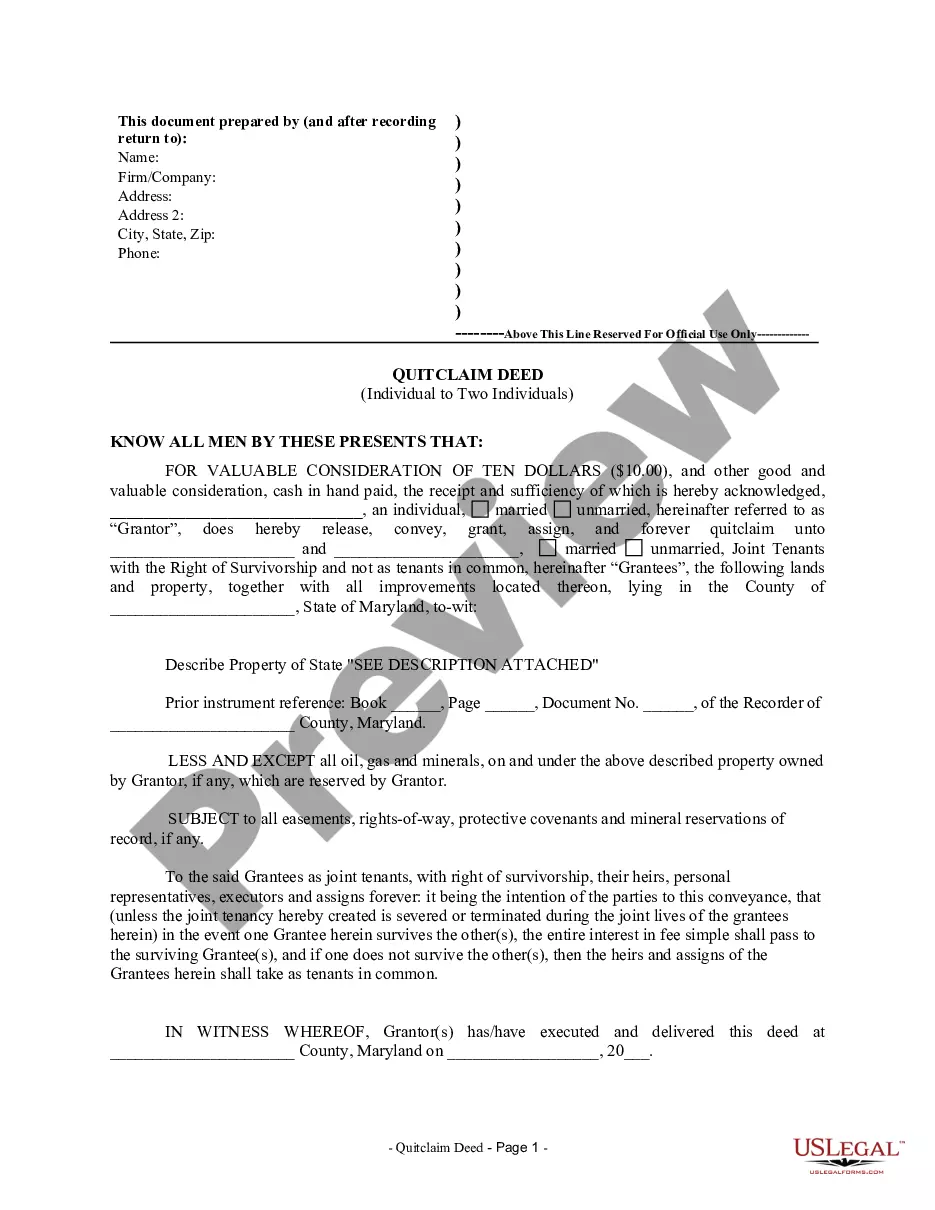
The Quitclaim Deed from Individual to Two Individuals in Joint Tenancy is a legal document used to transfer ownership of real property from one individual (the Grantor) to two individuals (the Grantees) who will hold the property as joint tenants. This means that both Grantees have equal ownership rights and, in the event of the death of one tenant, the surviving Grantee automatically inherits the deceased tenant's interest in the property. Unlike a warranty deed, a quitclaim deed offers no guarantee regarding the title, making it important to understand when and how to use it.
Key parts of this document
- Description of the property being transferred.
- Identification of the Grantor and Grantees.
- Explanation of rights, including the right of survivorship.
- Reservation of minerals, gas, and oil rights by the Grantor.
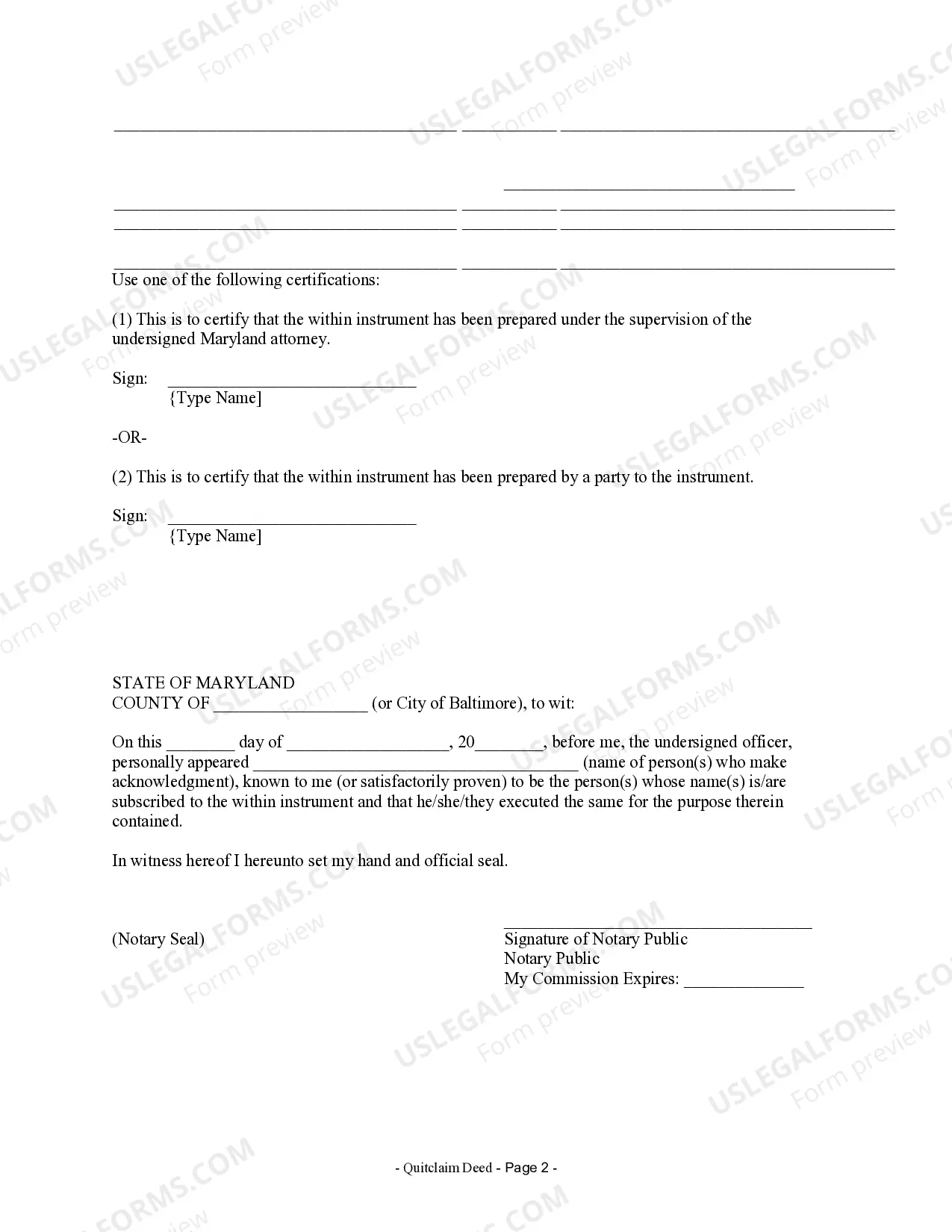
- Notary acknowledgment section for legal validation.





When to use this document
This form is used in scenarios where an individual wants to transfer property ownership to two other individuals, ensuring they hold the property as joint tenants. Common situations include gifting property to family members, transferring shared property between partners or friends, or consolidating property ownership among co-owners.
Who needs this form
This form is suitable for:
- Individuals looking to transfer property ownership to two other individuals.
- Co-owners of a property who wish to formalize their ownership structure.
- Anyone who wants to create joint tenancy rights with survivorship between Grantees.
Completing this form step by step
- Identify and describe the property being transferred in the designated section.
- Fill in the names of the Grantor and the two Grantees.
- Specify any exceptions, such as the reservation of mineral rights.
- Enter the date and signature of the Grantor.
- Complete the notary acknowledgment section by having it notarized.
Is notarization required?
Notarization is required for this form to take effect. Our online notarization service, powered by Notarize, lets you verify and sign documents remotely through an encrypted video session, available 24/7.
Get your form ready online
Our built-in tools help you complete, sign, share, and store your documents in one place.
Make edits, fill in missing information, and update formatting in US Legal Forms—just like you would in MS Word.
Download a copy, print it, send it by email, or mail it via USPS—whatever works best for your next step.
Sign and collect signatures with our SignNow integration. Send to multiple recipients, set reminders, and more. Go Premium to unlock E-Sign.
If this form requires notarization, complete it online through a secure video call—no need to meet a notary in person or wait for an appointment.
We protect your documents and personal data by following strict security and privacy standards.

Make edits, fill in missing information, and update formatting in US Legal Forms—just like you would in MS Word.

Download a copy, print it, send it by email, or mail it via USPS—whatever works best for your next step.

Sign and collect signatures with our SignNow integration. Send to multiple recipients, set reminders, and more. Go Premium to unlock E-Sign.

If this form requires notarization, complete it online through a secure video call—no need to meet a notary in person or wait for an appointment.

We protect your documents and personal data by following strict security and privacy standards.
Avoid these common issues
- Failing to accurately describe the property being transferred.
- Not specifying reservations clearly, which can lead to future disputes.
- Omitting notary acknowledgment, rendering the deed invalid.
Advantages of online completion
- Convenience of completing the form from anywhere with internet access.
- Editability allows users to customize the document to their needs before finalization.
- Access to reliable templates crafted by licensed attorneys ensures compliance.
Looking for another form?
Form popularity
FAQ
In most states you can file a disclaimer or deed of disclaimer that says specifically you were placed in title without your knowledge or consent and disclaim the deed.
But you might be wondering if an owner can transfer a deed to another person without a real estate lawyer. The answer is yes. Parties to a transaction are always free to prepare their own deeds.A quitclaim deed, for example, is far simpler than a warranty deed.
To change the names on a real estate deed, you will need to file a new deed with the Division of Land Records in the Circuit Court for the county where the property is located. The clerk will record the new deed.
Fill out the quit claim deed form, which can be obtained online, or write your own using the form as a guide. The person giving up the interest in the property is the grantor, and the person receiving the interest is the grantee.
The drawback, quite simply, is that quitclaim deeds offer the grantee/recipient no protection or guarantees whatsoever about the property or their ownership of it. Maybe the grantor did not own the property at all, or maybe they only had partial ownership.
Yes you can. This is called a transfer of equity but you will need the permission of your lender. If you are not married or in a civil partnership you may wish to consider creating a deed of trust and a living together agreement which we can explain to you.
Filing a quitclaim deed is a right of any property owner. You can file a quitclaim deed without refinancing your mortgage, but you are still responsible for the payments. Transferring the mortgage without refinancing is possible through an assumption of the loan, which requires lender approval.
Documents: To submit the quitclaim deed to the Clerk of the Circuit Court, you must have a Land Intake Sheet with the deed. Filing: Quitclaim deeds in Maryland are filed with the Clerk of the Circuit Court in the county where the property is located. Each county has its own filing fee.
A Quitclaim Deed must be notarized by a notary public or attorney in order to be valid.Consideration in a Quitclaim Deed is what the Grantee will pay to the Grantor for the interest in the property.