Maryland Quitclaim Deed from Corporation to Two Individuals
What this document covers
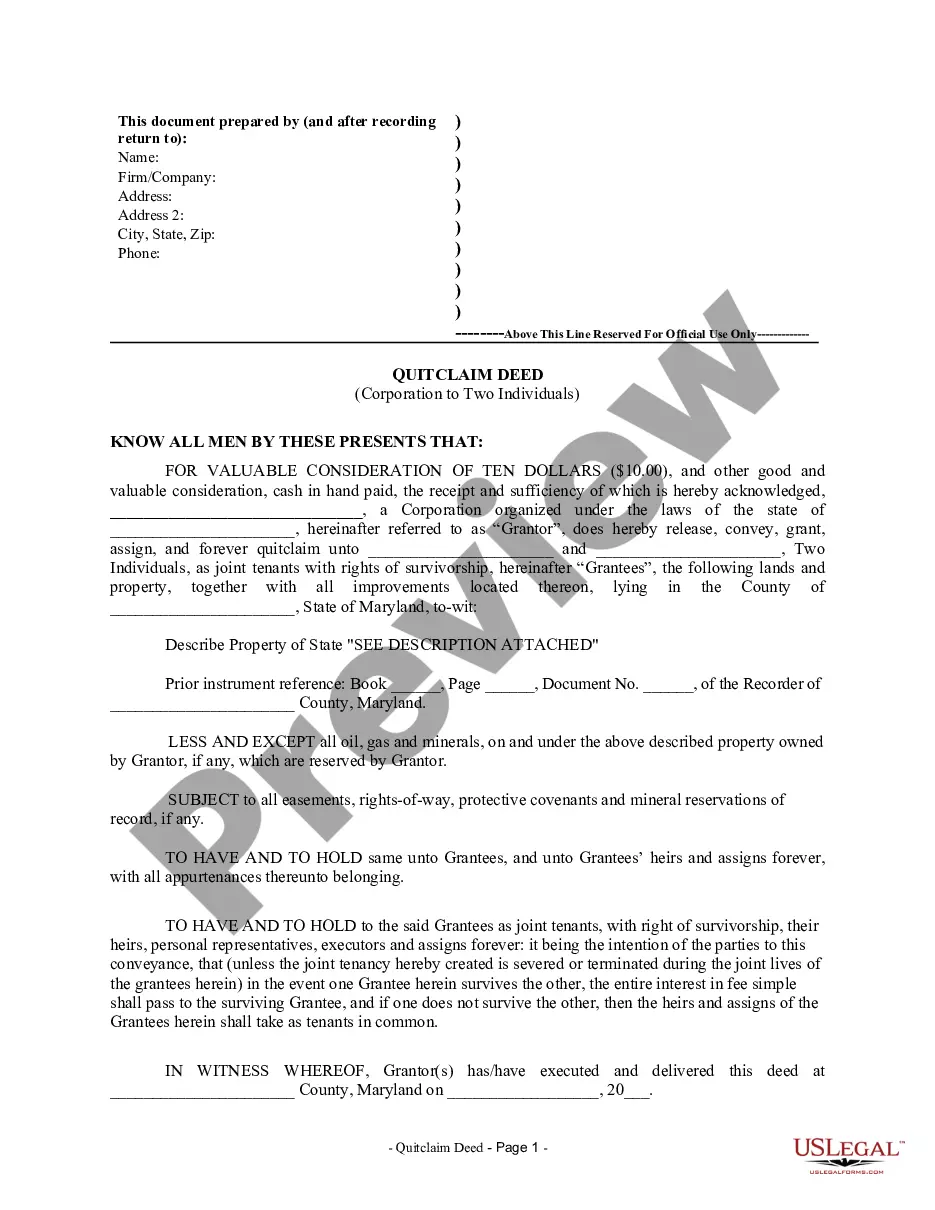
The Quitclaim Deed from Corporation to Two Individuals is a legal document used when a corporation (the Grantor) transfers property ownership to two individuals (the Grantees). Unlike a warranty deed, which guarantees clear title, this quitclaim deed conveys whatever interest the corporation may have in the property without warranties. This form is particularly important when the Grantor might be uncertain about the title to the property or wishes to transfer property rights quickly without the formalities of other deed types.
What’s included in this form
- Description of the property being conveyed.
- Reference to prior instruments that validate the current ownership.
- Clear declaration of the rights being transferred and any reservations (e.g., oil, gas, and minerals).
- Provision for joint tenancy among Grantees, with right of survivorship.
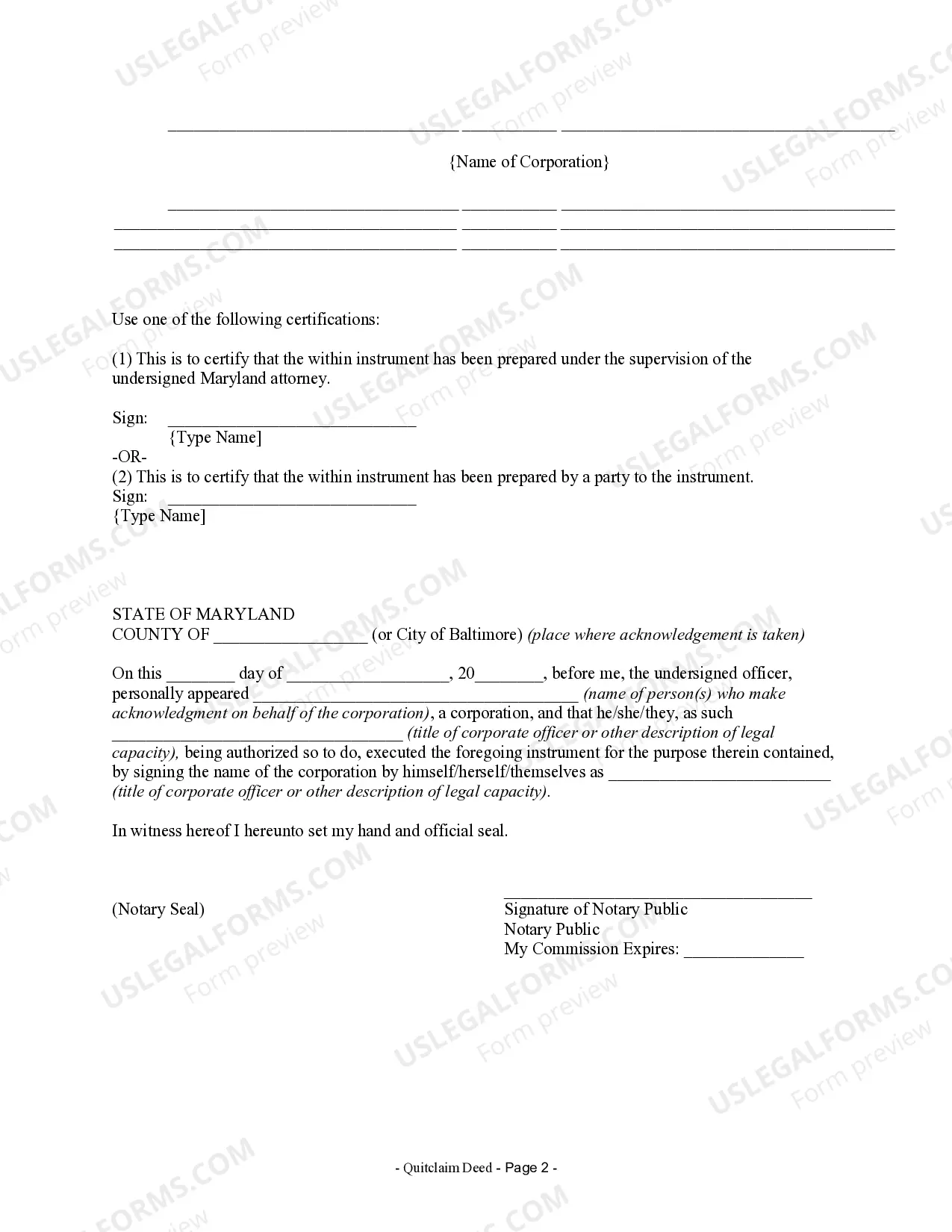
- Signature lines for the Grantor (corporation representative) and notary acknowledgment.




When this form is needed
This Quitclaim Deed is suitable for various real estate transactions. You should use this form when a corporation is transferring property to two individuals, such as when a company dissolves and its assets are distributed, or when the corporation is transferring property related to certain business decisions. It can also be used in cases where the individual parties want to establish joint ownership with survivorship rights.
Who needs this form
- Corporations looking to transfer real estate assets to individuals.
- Individuals receiving property from a corporate entity.
- Legal representatives acting on behalf of a corporation in property transactions.
- Parties interested in establishing joint ownership of property.
How to complete this form
- Identify the parties: Clearly state the names of the corporation (Grantor) and the two individuals (Grantees).
- Specify the property: Provide a detailed description of the property being conveyed, as referenced in the prior instrument.
- Include reservations: Note any exceptions such as reserved mineral rights that are not included in the conveyance.
- Sign the form: Ensure the form is signed by an authorized representative of the corporation.
- Obtain notarization: Have the executed document notarized to enhance its legal validity.
Notarization guidance
Notarization is required for this form to take effect. Our online notarization service, powered by Notarize, lets you verify and sign documents remotely through an encrypted video session, available 24/7.
Get your form ready online
Our built-in tools help you complete, sign, share, and store your documents in one place.
Make edits, fill in missing information, and update formatting in US Legal Forms—just like you would in MS Word.
Download a copy, print it, send it by email, or mail it via USPS—whatever works best for your next step.
Sign and collect signatures with our SignNow integration. Send to multiple recipients, set reminders, and more. Go Premium to unlock E-Sign.
If this form requires notarization, complete it online through a secure video call—no need to meet a notary in person or wait for an appointment.
We protect your documents and personal data by following strict security and privacy standards.

Make edits, fill in missing information, and update formatting in US Legal Forms—just like you would in MS Word.

Download a copy, print it, send it by email, or mail it via USPS—whatever works best for your next step.

Sign and collect signatures with our SignNow integration. Send to multiple recipients, set reminders, and more. Go Premium to unlock E-Sign.

If this form requires notarization, complete it online through a secure video call—no need to meet a notary in person or wait for an appointment.

We protect your documents and personal data by following strict security and privacy standards.
Avoid these common issues
- Incomplete property description leading to confusion about the property being transferred.
- Failing to specify any reservations, which can affect ownership rights later.
- Not having the document notarized, which may be a requirement in some jurisdictions.
- Incorrectly identifying the Grantor or Grantees, potentially invalidating the deed.
Why complete this form online
- Easy access to editable templates that comply with legal standards.
- Convenient download options, allowing for instant use.
- Forms prepared under the guidance of licensed attorneys to ensure accuracy.
- Time-saving process with clear instructions for completion.
Looking for another form?

Form popularity
FAQ
To change the names on a real estate deed, you will need to file a new deed with the Division of Land Records in the Circuit Court for the county where the property is located. The clerk will record the new deed.
To use a Quitclaim Deed to add someone to a property deed or title, you would need to create a Quitclaim Deed and list all of the current owners in the grantor section. In the grantee section, you would list all of the current owners as well as the person you would like to add.
A quitclaim deed transfers title but makes no promises at all about the owner's title.A person who signs a quitclaim deed to transfer property they do not own results in no title at all being transferred since there is no actual ownership interest. The quitclaim deed only transfers the type of title you own.
It is possible to be named on the title deed of a home without being on the mortgage. However, doing so assumes risks of ownership because the title is not free and clear of liens and possible other encumbrances.If a mortgage exists, it's best to work with the lender to make sure everyone on the title is protected.
Today's question is is it possible to deed real estate to someone without them knowing it? Strictly speaking, the answer is no. Because it does not meet the acceptance element of a valid deed transfer. Us lawyers must learn to speak in elements because it governs everything that we do.
Documents: To submit the quitclaim deed to the Clerk of the Circuit Court, you must have a Land Intake Sheet with the deed. Filing: Quitclaim deeds in Maryland are filed with the Clerk of the Circuit Court in the county where the property is located. Each county has its own filing fee.
Yes you can. This is called a transfer of equity but you will need the permission of your lender. If you are not married or in a civil partnership you may wish to consider creating a deed of trust and a living together agreement which we can explain to you.
If you own your own home, you are free to gift or sell an interest in the real property to someone else.You'll need to transfer an interest by writing up another deed with the person's name on it. In California, you can use either a grant deed, a quitclaim deed or an interspousal deed, depending on your circumstances.